
America’s Federal Law Firm
America’s Federal Law Firm
Built for the way the federal government actually makes decisions.

Over 250 4.9 Star Reviews on Google
– See Them Here –
– See Them Here –
Nationwide Security Clearance, Military Defense, and Federal Employment Lawyers
When a federal agency or the military is deciding your future, you need more than a lawyer who knows the rules. You need a team that understands how the government investigates allegations, evaluates credibility, measures risk, and builds the record on which decisions are made.
National Security Law Firm brings together former judges, prosecutors, security-clearance adjudicators, agency counsel, military attorneys, government litigators, and national-security professionals to protect clients when their careers, clearances, military service, liberty, businesses, federal contracts, benefits, credentials, or reputations are at risk.
Representing individuals, service members, federal employees, government contractors, and cleared companies nationwide.
Free · Confidential · No Obligation · Speak Directly With an Attorney
Former Judges · Former Prosecutors · Former Adjudicators · Former Agency Counsel · Veteran-Founded
★★★★★ 4.9 Stars From 300+ Google Reviews

Experience from Inside the System
Our attorneys have served as judges, prosecutors, adjudicators, agency counsel, military lawyers, and government litigators. We understand how the government evaluates evidence, credibility, mitigation, and risk because members of our team have made or advised those decisions.

Focused Lawyers for Specialized Federal Matters
Security clearances, military proceedings, federal employment actions, government contracts, and other federal matters follow different rules. Your case is assigned to attorneys who understand the particular system, officials, and standards controlling the decision.

One Coordinated Federal Strategy
One event can threaten a career, clearance, military status, federal contract, credential, or future eligibility. When matters overlap, our attorneys coordinate strategy to avoid unnecessary inconsistencies and protect what comes next.
Find the Right NSLF Team for What You Are Facing
We defend your career, your benefits, and your future across the full spectrum of federal and military law:
Government Contracts & Corporate Security
Travel, Transportation & Reputation
The Government Brings a System to Your Case. We Built a Law Firm to Meet It.
A consequential federal or military matter rarely passes through only one set of hands. An investigator may develop the facts. A supervisor or commander may recommend action. Agency counsel or a prosecutor may build the government’s position. A judge, adjudicator, or board may decide the result. Another official may revisit the same record months or years later.
Each role may examine the same event differently. Each may identify a different weakness. And a statement intended to help in one proceeding may create risk in another.
National Security Law Firm was built around that reality.
1. Experience From Inside the Government’s Decision-Making Systems
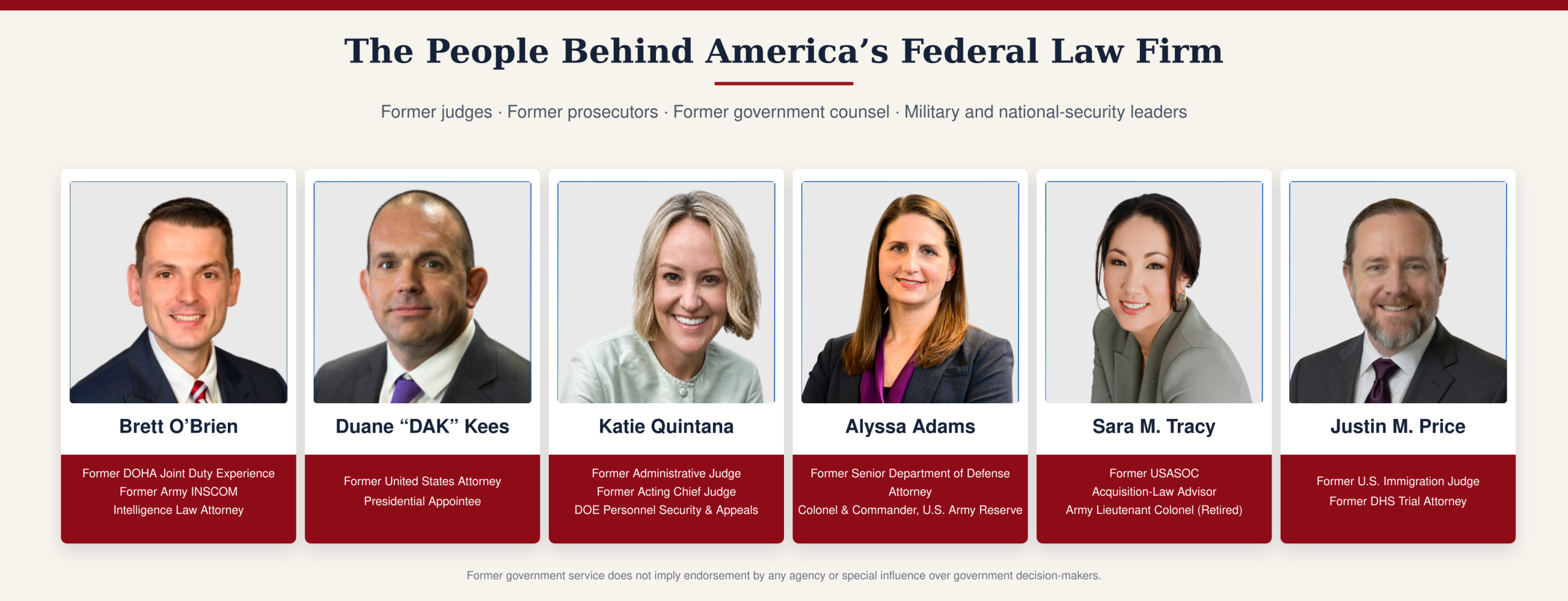
Our team includes former federal administrative and military judges, a presidentially appointed former United States Attorney, former federal and military prosecutors, former defense counsel, former agency attorneys, Judge Advocates, security-clearance adjudicators, intelligence and national-security attorneys, and advisers to senior federal and military leadership.
Those titles do not create influence or guarantee an outcome. Their value is perspective: understanding how government professionals test evidence, assess credibility, evaluate risk, and decide whether the record supports the requested result.
2. Focused Lawyers for Specialized Federal Forums
Federal law is not one practice area. A security-clearance adjudication, court-martial, MSPB appeal, contractor debarment, immigration proceeding, facility-clearance matter, and government-credential denial operate under different laws, procedures, evidentiary rules, and decision-makers.
NSLF organizes attorneys into focused practice teams so individuals and businesses receive advice grounded in the system they are actually facing—not a generic strategy borrowed from another type of case.
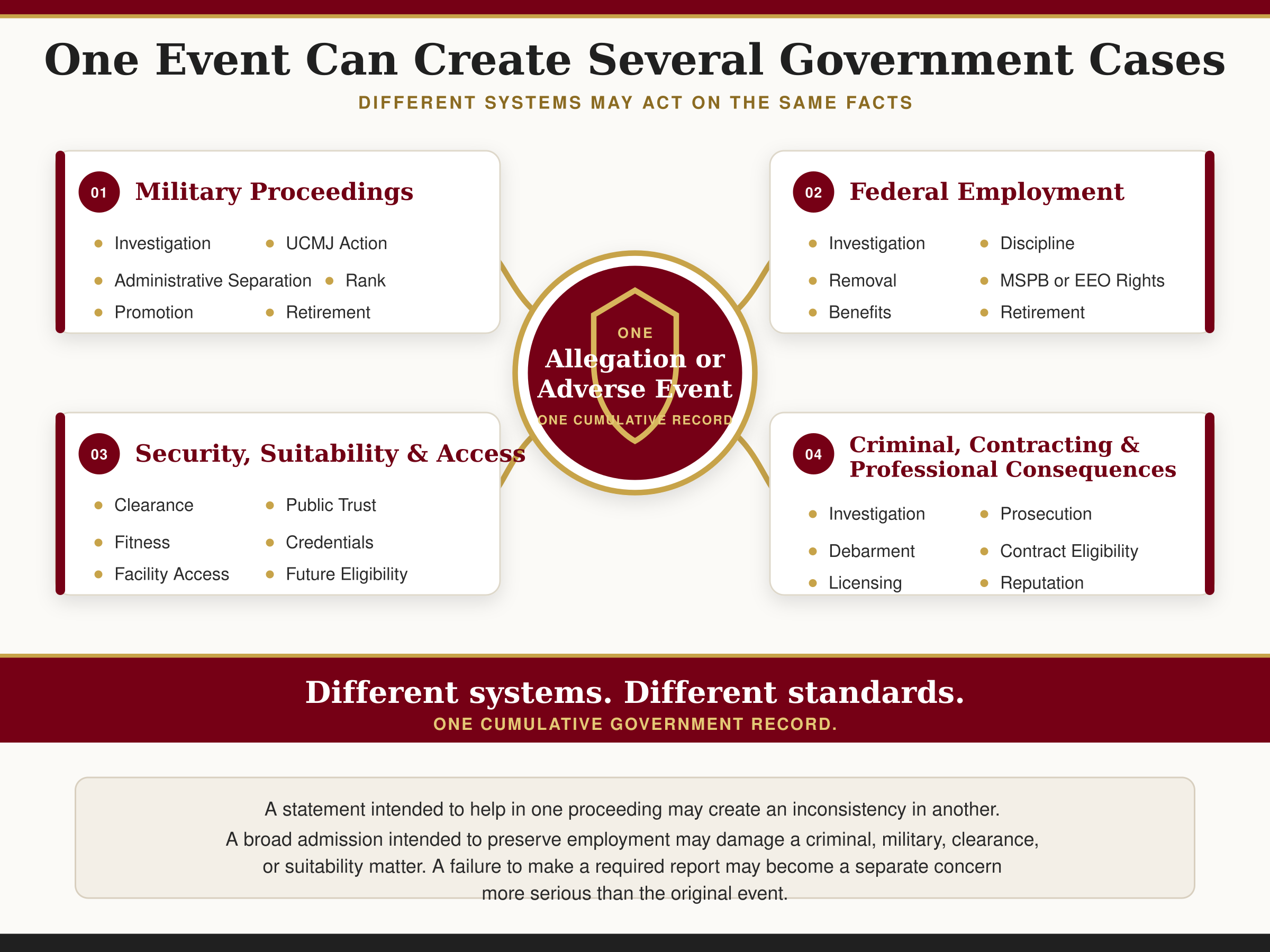
3. A Coordinated Strategy When One Event Creates Several Cases
A military investigation may also threaten a security clearance and promotion. A federal employee’s response to discipline may later be examined in a suitability or clearance review. A criminal allegation may affect immigration status, government credentials, firearm rights, or federal employment. A corporate transaction, disclosure, investigation, performance dispute, or ownership change may create contracting, suspension-and-debarment, facility-clearance, FOCI, and investigative consequences.
Our practices can work together when matters overlap, helping the client avoid disconnected strategies and unnecessary contradictions.
4. The NSLF Attorney Review Board
Complex cases should not depend on one lawyer seeing everything. Through NSLF’s Attorney Review Board, attorneys in relevant practice groups can challenge assumptions, identify weaknesses, and evaluate important strategy from different professional perspectives.
The assigned legal team remains responsible for the matter. The Review Board provides an additional structure for pressure-testing difficult decisions before they become part of the government’s record.
SEE HOW THE ATTORNEY REVIEW BOARD WORKS
The Record Controls the Case
Government systems preserve forms, interviews, investigative reports, written responses, testimony, findings, and official records. Those materials may be compared, challenged, and reused in later proceedings.
That is why NSLF does not prepare arguments merely to sound persuasive in the moment. Depending on the matter, we work to develop a record that is:
- accurate and complete;
- supported by documents and credible evidence;
- responsive to the government’s actual concern;
- consistent with prior disclosures and statements;
- strategically coordinated across related proceedings; and
- capable of withstanding later review.
In federal and military practice, the record does not merely describe the case.
The record becomes the case.
Trusted by Clients Nationwide
★★★★★
“Their Teamwork and Complementary Skills Gave Me Complete Confidence”
“They assigned three different paralegals to ensure coverage, and I worked directly with two attorneys and indirectly with a third. Their teamwork and complementary skills gave me complete confidence.
I am writing this now—deliberately before receiving any decision—because I know they did everything possible to ensure I had the strongest representation and the best chance to prove I have mitigated any concerns.”
— C.L., Security Clearance Client · Google Review
★★★★★
“I Felt Like I Was Her Most Important Case”
“The reply to my agency was extensive and methodically thought out; it was impressive. Nothing was missing. When my agency made its decision in my favor, Danielle called to deliver the good news.
There was so much care and compassion in every interaction. I do not know her workload; I just know I felt like I was her most important case every time she talked to me.”
— C.M., Federal Employment Client · Google Review
★★★★★
“Receiving an Honorable Discharge Has a Tremendous Impact on My Life”
“They helped me successfully upgrade my Army discharge from an Other Than Honorable discharge to an Honorable discharge. From start to finish, the staff was professional, knowledgeable, responsive, and genuinely supportive. They took the time to understand my situation, explained the process clearly, and worked diligently on my behalf.”
— G.G., Military Discharge-Upgrade Client · Google Review

NPR · Reuters · Law360 · No Spin News with Bill O’Reilly
Clear Scope, Predictable Fees, and Nationwide Access
Free Initial Consultation
Your consultation is free, confidential, and carries no obligation to retain the firm. You will speak directly with an attorney who can identify the type and stage of your matter, discuss what may happen next, and explain whether NSLF may be able to assist.
Flat Fees for Many Services
NSLF publishes pricing for many defined services and uses flat fees for many matters. If representation is offered, the written agreement will explain the covered work and legal fee before you decide whether to proceed.
Payment Options
Eligible clients may apply for third-party financing through Pay Later by Affirm. Approval, interest rates, and available terms are determined by the provider.
REVIEW PRICING AND PAYMENT OPTIONS
Nationwide Representation
Many federal, military, administrative, and agency matters can be handled remotely by attorneys authorized to practice in the relevant forum. NSLF represents clients throughout the United States and overseas where permitted.
What Happens When You Contact NSLF?
1. Choose the Closest Type of Matter
Select the booking category that most closely matches your situation. If you are uncertain, choose the closest option and our team will help route the matter.
2. Select a Convenient Time
Available appointments appear in your local time zone. Online booking is generally the fastest way to reserve a consultation.
3. Speak Directly With an Attorney
Tell us what happened, what government action you are facing, whether a deadline applies, and what is at risk. Do not send classified information through the website, email, or booking system.
4. Understand the Proposed Next Step
If NSLF may be able to assist, the attorney will discuss the proposed service, scope, and fee. You decide whether to move forward. There is no obligation arising from the consultation.
Frequently Asked Questions
What kinds of matters does National Security Law Firm handle?
NSLF focuses on federal, military, national-security, administrative, and government-facing matters for individuals and businesses. Core practices include security clearances, military defense, federal employment, suitability and credentialing, government contracts, contractor suspension and debarment, facility clearances and FOCI, federal investigations, immigration, veterans’ matters, federal firearms, customs seizures, transportation credentials, and related federal relief.
Does NSLF represent government contractors and cleared companies?
Yes. NSLF represents government contractors, federal vendors, cleared companies, owners, principals, and other businesses in matters involving federal procurement, contract performance, suspension and debarment, SAM.gov exclusions, facility clearances, DCSA scrutiny, and Foreign Ownership, Control, or Influence. Whether NSLF can accept a specific matter depends on the legal issue, forum, deadlines, and potential conflicts.
Do I need a lawyer located in my state?
Not necessarily. Many NSLF matters arise under federal, military, or agency-specific procedures and can be handled remotely by counsel authorized to practice in the relevant forum. During the consultation, the firm can determine whether it may represent you in your particular matter.
Is the consultation really free?
Yes. The initial consultation is free and carries no obligation to retain the firm. It is designed to identify the nature and stage of the issue, determine whether NSLF may be able to assist, and explain the next appropriate step. It is not a substitute for representation and does not itself create an attorney-client relationship.
Will more than one attorney work on my case?
The engagement agreement identifies the covered service, and an assigned attorney remains responsible for the matter. Depending on the case, other attorneys or professionals may contribute research, drafting, preparation, or strategic review. Significant issues may also be discussed through the Attorney Review Board when additional perspectives would be useful.
Does former government experience guarantee a better result?
No. Former government service does not create special access, influence, or a guaranteed result. Its value is professional judgment: understanding how government cases are developed, challenged, evaluated, and decided.
Does NSLF guarantee results?
No ethical lawyer can guarantee the outcome of a legal or administrative matter. Results depend on the facts, evidence, applicable law, forum, and decision-maker. NSLF’s role is to identify the governing process and risks, develop the strongest accurate record the circumstances permit, and advocate for the best available outcome.
How much does representation cost?
Fees depend on the practice area, stage, complexity, and scope. NSLF publishes pricing for many defined services and offers flat fees for many matters. When representation is offered, the proposed scope and fee are explained before the client decides whether to retain the firm.
Do Not Let the Government Define the Record Before You Understand the Risk
The earliest interview, disclosure, written response, proposal decision, or missed deadline may shape everything that follows. If you have received a government notice, learned of an investigation, been asked to respond, or believe your career, clearance, military service, liberty, federal contract, business, benefits, credential, or reputation may be at risk, make the next decision an informed one.
Schedule a free consultation with National Security Law Firm. We will help identify the process you are facing, discuss what may happen next, and explain whether our team may be able to assist.
Free · Confidential · No Obligation · Nationwide Representation
National Security Law Firm — America’s Federal Law Firm.