
Your Federal Case Should Not Depend on One Perspective
The government may examine your case through the eyes of investigators, agency counsel, prosecutors, commanders, security personnel, adjudicators, judges, and reviewing authorities.
Each may see something different in the same facts. Each may apply a different standard. And each may rely on the record created before the case ever reaches them.
National Security Law Firm was built to do what the government does: evaluate important federal matters from multiple informed perspectives.
Through the NSLF Attorney Review Board, significant cases may be reviewed by attorneys whose experience includes service as government decision-makers, judges, adjudicators, federal and military prosecutors, defense counsel, agency attorneys, intelligence-law attorneys, commanders, Staff Judge Advocates, and senior military leaders.
The purpose is simple: identify weaknesses, unanswered concerns, missing evidence, and potential consequences before a critical response becomes part of the federal record.
★★★★★ 4.9 Stars From 300+ Google Reviews
Former Judges, Prosecutors, Agency Counsel, and Military Leaders · Nationwide Representation · Veteran Founded
Most Clients See One Problem. The Government May See Several.
A client may see a security-clearance omission. An adjudicator may see a candor concern.
A client may see an employment dispute. Agency counsel may see a conduct charge, a credibility issue, and a potential efficiency-of-the-service argument.
A client may see a military allegation. An investigator, prosecutor, commander, administrative board, and clearance authority may each evaluate that allegation differently.
A client may see one immediate deadline. The government may be creating a record that will be reviewed again during a future reinvestigation, appeal, promotion decision, suitability determination, credentialing matter, or employment action.
This is one of the defining challenges of federal practice: the immediate issue may be only one part of the case.
An effective strategy must address the governing law and the known facts. It should also anticipate:
- who may review the matter next;
- what each reviewer may be looking for;
- how current statements compare with the existing record;
- what evidence supports or undermines credibility;
- whether mitigation addresses the government’s actual concern; and
- what consequences may arise outside the immediate proceeding.
One capable attorney can do excellent work. But one attorney still brings one professional history, one primary practice perspective, and one way of reading a record.
NSLF created the Attorney Review Board to give significant federal matters the benefit of structured challenge and informed review from more than one angle.
What Is the NSLF Attorney Review Board?
The Attorney Review Board is NSLF’s structured internal process for reviewing strategy in appropriate significant federal matters.
The Attorney Review Board is designed to stress-test the case.
Depending on the matter and scope of representation, reviewing attorneys may examine:
- the factual theory of the case;
- the applicable legal and procedural standards;
- the client’s prior statements and existing record;
- credibility and consistency risks;
- weaknesses in the government’s position;
- missing documents, witnesses, or other supporting evidence;
- the strength and relevance of proposed mitigation;
- alternative interpretations a decision-maker may adopt;
- consequences in related federal, military, employment, clearance, or credentialing systems; and
- how the submission may be read if it is reviewed or reused later.
The goal is not to make a submission longer or more aggressive. The goal is to make the strategy more accurate, complete, disciplined, and resilient.
How the Attorney Review Board Works
1. The Legal Team Develops the Case
The attorneys responsible for the matter analyze the facts, identify the governing standards, review the available record, determine what the government appears to be concerned about, and develop the proposed strategy.
2. The Case Is Presented for Review
In appropriate matters, the central issues, known risks, proposed arguments, evidentiary support, and mitigation strategy are presented to attorneys whose backgrounds are relevant to the questions involved.
3. The Board Stress-Tests the Strategy
Reviewing attorneys challenge assumptions and examine the case from different professional perspectives. They may identify an inconsistency an investigator would notice, an evidentiary weakness a prosecutor would exploit, a mission concern a commander would consider, or a mitigation gap an adjudicator would expect to be addressed.
4. Weaknesses Are Addressed Before Submission
The legal team considers the Board’s analysis, obtains additional evidence when appropriate, resolves avoidable inconsistencies, strengthens mitigation, refines arguments, and evaluates potential downstream consequences.
5. The Responsible Attorneys Finalize the Work
Collaborative review supplements—not replaces—the judgment and accountability of the attorneys responsible for the case. The final strategy and submission remain tailored to the client, the governing standard, and the authorized scope of representation.
Develop. Review. Challenge. Refine. Submit.
The time to find a weakness is before the government does.
Different Government Experience Reveals Different Risks
The value of multiple perspectives depends on the experience behind them.
NSLF’s attorneys have served in roles that required them to investigate facts, develop government positions, defend accused individuals, advise commanders and agencies, evaluate credibility, apply legal standards, and make or recommend consequential decisions.
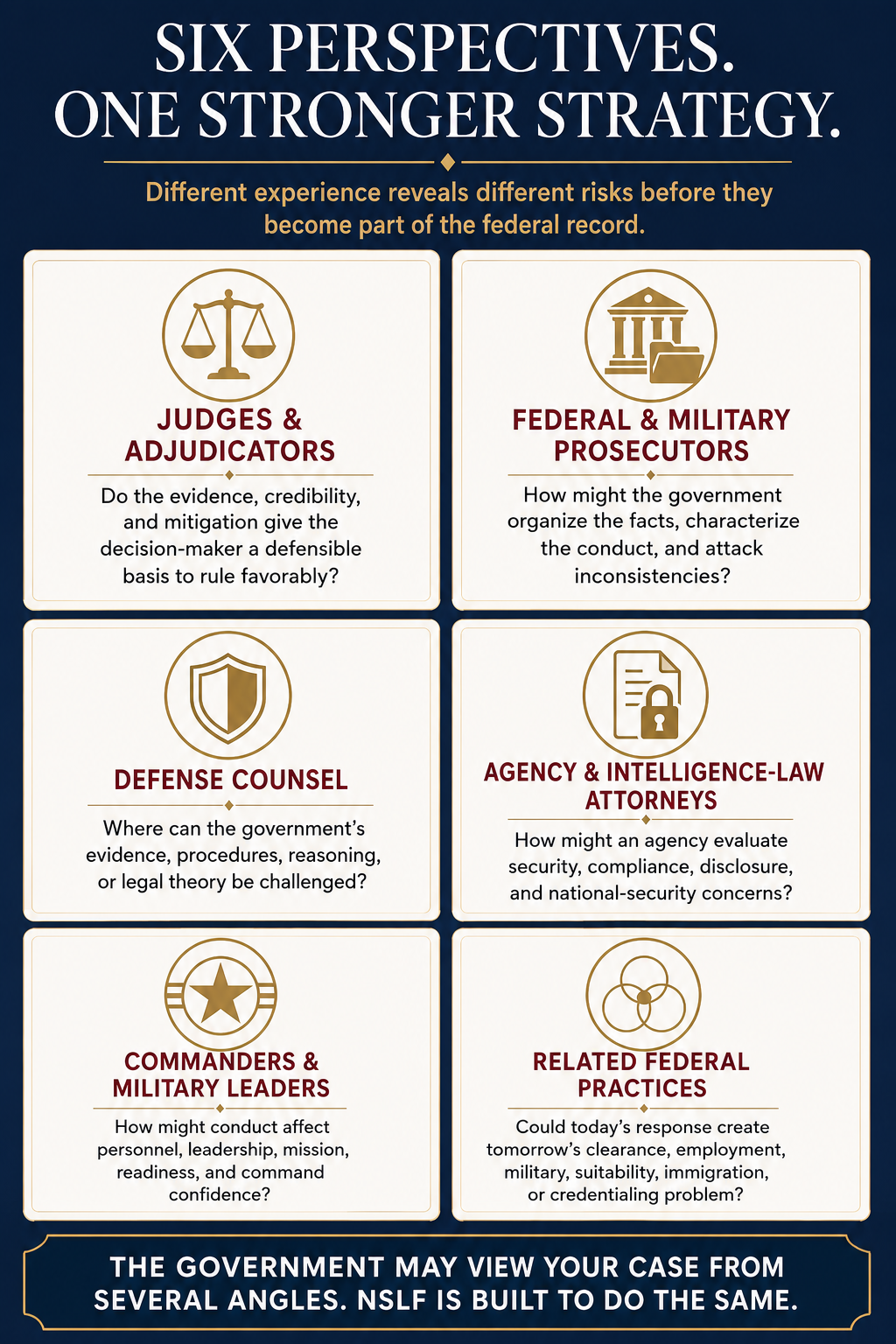
No former government title guarantees a result. Government officials do not all think alike, and every case turns on its own facts, record, forum, and legal standard.
The advantage is the ability to ask more of the questions that may matter—before the government supplies the answers.
A Simple Example: One Omission, Several Perspectives
Consider a client accused of failing to disclose information on a federal form.
The client may reasonably believe the case turns on whether the question was confusing or the omission was accidental.
But different government reviewers may approach the same record differently:
- An investigator may compare the omission with earlier forms, interviews, emails, or databases.
- Agency counsel may analyze whether the inconsistency supports a separate lack-of-candor or false-statement theory.
- A security adjudicator may focus on whether the current explanation is credible, complete, and consistent with the whole-person record.
- An employment attorney may recognize language that could affect a disciplinary or suitability action.
- A reviewing authority may be limited by what was preserved and supported in the original response.
The strongest strategy may require more than saying, “It was an honest mistake.” It may require reconstructing what the client understood, reconciling the prior record, documenting the circumstances, addressing the government’s credibility concern, and avoiding language that unnecessarily creates a separate problem.
That is the practical value of multi-perspective review.
Flat Fees Remove a Common Barrier to Collaboration
Traditional hourly billing can make collaboration expensive and uncertain.
When every internal conference, second-attorney review, strategy discussion, revision, email, and additional perspective may generate another charge, clients can understandably hesitate to authorize more attorney time. Attorneys may also feel pressure to limit consultation to control the bill—even when another perspective could add value.
The problem is not that hourly billing is improper. In some matters, it is the most appropriate arrangement. The problem is that it can introduce friction precisely when collaboration is needed.
NSLF uses flat fees for many defined federal matters. When collaborative review is included within the agreed scope of representation, the client does not receive a separate hourly charge each time another attorney contributes to that review.
That structure allows strategy to be driven more directly by what the authorized representation requires—not by whether the client is willing to incur another fraction of an hour for an internal discussion.
It also supports a broader firm model:
- focused federal practice areas that can coordinate when systems overlap;
- attorneys with experience in different government roles;
- structured internal review rather than informal last-minute consultation;
- predictable pricing for the services identified in the engagement; and
- the ability to improve significant work before it reaches the government.
Flat fees do not mean unlimited services, and not every matter or task is covered. The engagement agreement controls the scope, staffing, review process, and fee for each representation. But within that defined scope, the model can remove much of the billing anxiety that discourages meaningful collaboration.
Four Ways Collaborative Review Can Strengthen a Federal Case
Identify Blind Spots
A second or third informed perspective may detect contradictions, missing evidence, unsupported assumptions, or unanswered government concerns before they damage credibility.
Anticipate the Government’s Response
Attorneys who have served in different government and defense roles can test how investigators, counsel, commanders, adjudicators, or reviewing authorities may interpret the same facts.
Protect the Broader Record
A response can be legally effective in one proceeding and damaging in another. Cross-practice review may identify clearance, employment, military, suitability, credentialing, immigration, or appellate consequences that are easy to miss when the case is viewed in isolation.
Strengthen the Final Submission
The purpose of review is not merely to criticize. It is to convert identified weaknesses into a clearer theory, stronger evidence, better-supported mitigation, preserved objections, and a record the decision-maker can rely upon.
Built for the Case You Have—and the Record You May Need Later
Federal records can outlive the immediate dispute.
A statement made during an investigation may later be compared with a security-clearance form. A response to a proposed employment action may appear in a later suitability review. A military finding may affect a clearance, promotion, separation, correction-board application, or civilian opportunity. A contractor disclosure may be examined during a future present-responsibility determination.
That does not mean every case will trigger every possible consequence. It means important submissions should be prepared with an understanding that future reviewers may inherit the record without inheriting the context.
The Attorney Review Board is designed to help the legal team ask:
- Is this accurate?
- Is it complete?
- Is it consistent with the existing record?
- Is it supported?
- Does it address the governing standard?
- Does it resolve the government’s real concern?
- Could it create an avoidable problem somewhere else?
- Will it remain defensible if another official reads it later?
Those questions are not extras. In the right federal matter, they are part of effective defense.
Which Cases Receive Attorney Review Board Consideration?
The appropriate level of collaboration depends on the type of matter, its complexity, the procedural stage, the applicable deadline, and the scope of services the client has retained NSLF to provide.
Significant cases may be selected for formal Attorney Review Board consideration. Other matters may receive collaborative review through the firm’s practice teams or ordinary supervisory processes.
The Attorney Review Board may be particularly valuable when a matter involves:
- substantial credibility or candor concerns;
- conflicting statements or a complicated prior record;
- multiple allegations or adjudicative issues;
- serious career, clearance, military, or government-contracting consequences;
- an important written response, hearing, appeal, or other consequential stage;
- overlapping federal systems or collateral consequences; or
- unusual facts requiring experience from more than one practice area.
Not every client matter is reviewed by the full Board, and Board participation does not guarantee a particular result. The client’s legal team and engagement agreement determine the services included in the representation.
Frequently Asked Questions
Will I have multiple attorneys working on my case?
Your matter will have attorneys responsible for the representation and client communication. In appropriate cases, additional attorneys may contribute through the Attorney Review Board, practice-team consultation, supervision, or another collaborative process. The staffing and services included depend on the engagement.
Will I be charged every time another attorney reviews my case?
When collaborative review is included within a flat-fee scope of representation, NSLF does not separately bill the client in hourly increments each time another attorney contributes to that included review. The engagement agreement identifies the applicable fee and services. Work outside the agreed scope may require a separate agreement or fee.
Does the Board make the final decision about my case?
The Board provides internal analysis and recommendations. The attorneys responsible for the representation use that review to refine the strategy and finalize the work in consultation with the client where appropriate.
Does Attorney Review Board consideration guarantee success?
No. No ethical attorney can guarantee the outcome of a federal, military, administrative, or security-clearance matter. The Board is designed to improve issue identification, strategic analysis, and quality control—not to promise a result.
Why is the Board especially relevant in federal cases?
Federal matters may pass through multiple decision-makers, remain in government records, affect related proceedings, and be reviewed again later. A structured, multi-perspective process can help identify how the same facts may be interpreted at different stages and in different systems.
Does NSLF represent clients nationwide?
Yes. National Security Law Firm represents clients throughout the United States and, where permitted, clients located overseas. Many federal matters can be handled remotely, allowing clients to work with attorneys experienced in the relevant system regardless of location.
Give Your Case the Benefit of More Than One Perspective
When the government is evaluating your career, clearance, military future, reputation, eligibility, or livelihood, the smallest inconsistency or overlooked consequence can become the center of the case.
NSLF built the Attorney Review Board because important federal matters deserve more than an isolated reaction to the government’s latest letter.
They deserve a strategy informed by different sides of federal decision-making. They deserve a record examined for credibility, legal sufficiency, mitigation, and downstream risk. And they deserve a billing structure that supports appropriate collaboration within the agreed representation instead of making every internal perspective a new financial decision.
That is how National Security Law Firm was built—from our attorneys’ prior roles, to our focused practice areas, to our internal review process, to the way we price many defined matters.
The government may evaluate your case from several perspectives. We built a law firm capable of doing the same.
Nationwide Representation · Free Consultation · Online Scheduling Available
Attorney Review Board consideration and collaborative review depend on the matter and the scope of representation. No particular staffing arrangement or outcome is guaranteed. Prior results do not guarantee a similar result.