
Ten Questions to Ask Before Trusting a Law Firm With Your Clearance, Career, Military Future, Eligibility, or Reputation
Choosing a lawyer for a federal matter can be difficult.
Websites are filled with awards, credentials, promises, and claims of experience. But the qualities that are easiest to advertise are not always the qualities that will matter most once the government begins examining your record.
Federal matters can involve specialized rules, short deadlines, agency-specific procedures, multiple levels of review, and consequences that extend far beyond the immediate dispute. The lawyer you choose may help shape the statements, evidence, and strategy that become part of a lasting federal record.
The right choice is therefore not necessarily the lawyer with the closest office, the most aggressive slogan, or the longest list of practice areas.
It is the lawyer or legal team with the relevant experience, structure, judgment, and communication necessary for your particular matter, at its current stage.
This guide provides ten practical questions to help you evaluate federal legal representation—and compare law firms based on what the representation is actually likely to involve.
★★★★★ 4.9 Stars From 300+ Google Reviews
Former Judges, Prosecutors, Agency Counsel, and Military Leaders · Nationwide Representation · Veteran Founded
1. Does the Lawyer Regularly Handle This Exact Type of Federal Matter?
“Federal law” is not a single practice area.
A security-clearance adjudication is different from a Merit Systems Protection Board appeal. A court-martial is different from a military records-correction case. A suitability determination, Global Entry revocation, contractor debarment, federal investigation, and immigration proceeding each involve different legal standards, procedures, records, and decision-makers.
General legal experience may be valuable, but it is not a substitute for experience with the particular federal system involved in your case.
Ask:
- How often does the lawyer handle this type of matter?
- Has the lawyer handled cases at the stage I am facing now?
- Which agency, forum, regulation, or adjudicative standard applies?
- What are the most important risks at this stage?
- What usually happens next?
What to watch for: Descriptions of broad federal experience without a clear explanation of the specific process, deadline, decision-maker, or legal standard involved in your matter.
2. Who Will Actually Handle the Case?
The person conducting the consultation, the most prominent attorney on the website, and the lawyer performing the day-to-day work may not be the same person.
That is not necessarily a problem. Team-based representation can be a major advantage when roles are clearly defined and work is appropriately supervised. The important question is whether you understand who is responsible for your matter and how the team will operate.
Ask:
- Who will be primarily responsible for my case?
- Who will communicate with me?
- Who will draft and approve major submissions?
- Will a partner, supervising attorney, or other experienced lawyer review the work?
- What role will paralegals or nonlawyer staff perform?
What to watch for: Unclear staffing, assurances that “the firm” will handle the case without identifying responsible attorneys, or credentials belonging to lawyers who may have no meaningful role in the representation.
3. Does the Lawyer Understand How the Government Will Evaluate the Record?
Knowing the governing law is essential. Understanding how the relevant government system applies that law can also matter.
Federal decision-makers may evaluate more than the triggering event. Depending on the proceeding, they may also examine credibility, candor, consistency, rehabilitation, mitigation, judgment, reliability, vulnerability, efficiency of the service, present responsibility, or future risk.
A strong lawyer should be able to explain:
- what the government has alleged or is likely to investigate;
- what legal standard controls;
- what concern may be driving the decision;
- what facts help or hurt;
- what evidence is still needed; and
- what the government would need to justify the requested outcome.
What to watch for: A strategy based entirely on telling your side of the story without connecting the explanation to the applicable standard, evidence, or government concern.
Learn How the Government Evaluates Trust, Risk, and Credibility →
4. Has the Lawyer Handled the Case at the Stage You Are Facing?
Experience in the general subject is not always enough. Different stages require different skills.
Preparing a client for an interview is different from drafting a formal response. Developing the evidentiary record is different from conducting a hearing. Preserving issues for appeal is different from asking an appellate authority to reverse a decision based on an existing record.
Ask whether the lawyer has experience with the particular stage involved, such as:
- an initial application or disclosure;
- an investigative interview;
- a formal agency inquiry or proposed action;
- an administrative response;
- discovery and evidence development;
- a hearing, board, or personal appearance;
- an appeal or request for reconsideration; or
- a related federal-court proceeding.
What to watch for: A lawyer who describes subject-matter knowledge but cannot explain the procedural stage, available options, evidentiary needs, or consequences of the next submission.
5. Does the Firm Recognize Consequences Outside the Immediate Case?
Federal problems do not always remain in one lane.
A military investigation can create administrative, clearance, promotion, discharge, and civilian-employment consequences. A federal employment response may later be considered in a suitability or clearance proceeding. A criminal allegation can affect a professional credential, immigration status, Trusted Traveler Program eligibility, federal firearms rights, or government-contracting opportunities.
A strategy that solves one problem narrowly can create another if the systems are not considered together.
Ask:
- Could this response affect my clearance, employment, military status, license, immigration status, or eligibility for another government program?
- Could statements from this matter be reused elsewhere?
- Does the firm have experience across the related practice areas?
- If another legal issue emerges, how will the strategy be coordinated?
What to watch for: Advice that addresses only the current letter, interview, or proceeding without asking about the broader federal record or reasonably foreseeable collateral consequences.
6. How Are Strategy and Important Submissions Reviewed?
One experienced attorney can provide excellent representation. But in a significant federal matter, a second informed perspective may identify something the first reviewer did not.
Different attorneys may notice different risks. A former prosecutor may recognize how the government could organize the evidence. A former adjudicator may identify missing mitigation. A military attorney may see command or career consequences. A federal-employment attorney may identify language that could create a separate personnel issue.
Ask:
- Does another attorney review consequential submissions?
- Is collaboration informal, or is there a defined review process?
- Who evaluates credibility, mitigation, evidentiary, and collateral-risk issues?
- Is additional attorney review included in the quoted fee?
What to watch for: A firm that emphasizes the collective credentials of its lawyers but cannot explain whether or how those lawyers contribute to individual cases.
At National Security Law Firm, appropriate significant matters may receive structured multi-attorney review through the NSLF Attorney Review Board. The purpose is to identify blind spots, challenge assumptions, and strengthen important work before it becomes part of the federal record.
7. Can the Lawyer Explain the Strengths, Risks, and Strategy Clearly?
The initial consultation is not only an opportunity for the lawyer to evaluate the case. It is an opportunity for you to evaluate the lawyer.
You may not receive a complete legal opinion before the attorney reviews all relevant records. But you should leave with a clearer understanding of the process, significant uncertainties, immediate priorities, and proposed next step.
Ask yourself:
- Did the lawyer listen carefully and ask relevant questions?
- Did the lawyer distinguish known facts from assumptions?
- Were risks explained along with potential opportunities?
- Did the lawyer identify information or documents still needed?
- Was the proposed approach understandable?
- Did the lawyer avoid guaranteeing an outcome?
What to watch for: Pressure, certainty unsupported by the available record, vague promises to “fight aggressively,” or a consultation that leaves you unable to explain what the lawyer proposes to do.
Good communication does not require oversimplifying the case. It requires making a complicated case understandable.
8. What Exactly Is Included in the Fee?
Price matters, but the quoted number is only meaningful if you understand the scope behind it.
Two firms may quote different fees because they are offering different services. One fee may include document review, client preparation, evidence development, drafting, attorney collaboration, revisions, filing, and post-submission guidance. Another may cover only a limited consultation or initial document.
Ask:
- Is the fee flat, hourly, contingent, or a combination?
- What specific work is included?
- What events would require an additional fee?
- Are internal strategy conferences and additional-attorney review included?
- Does the fee include filing, hearing preparation, travel, or appeal?
- What happens if the matter becomes more complicated than expected?
How Billing Can Affect the Representation
Hourly billing may be appropriate for open-ended or unpredictable matters. It can also create uncertainty when each telephone call, email, revision, internal conference, or additional attorney’s review increases the bill.
That uncertainty may cause clients to limit communication or hesitate before authorizing collaboration. It may also make a firm more cautious about involving additional attorneys when doing so generates additional billable time.
Flat fees can reduce that friction when the required work can be reasonably defined. NSLF uses flat fees for many defined services. When collaborative review is included within the agreed scope, the client is not separately charged in hourly increments every time another attorney contributes to that included review.
Flat fees do not mean unlimited services. The engagement agreement should clearly identify the work covered, exclusions, and circumstances requiring a new agreement or fee.
9. What Do Reviews and Professional Credentials Actually Establish?
Reviews, awards, prior titles, publications, and professional recognition can all provide useful information. None should decide the hiring decision alone.
Evaluating Client Reviews
Read reviews across available sources and look for patterns rather than relying on one dramatic result.
Consider:
- Are there enough reviews to reveal consistent themes?
- Do reviews describe communication, preparation, responsiveness, and professionalism?
- Are the reviews detailed enough to sound connected to real experiences?
- Do similar strengths or problems appear repeatedly over time?
- Does the firm respond professionally when criticism appears?
Reviews describe individual experiences and cannot guarantee what will happen in another case.
Evaluating Awards and Recognition
Awards may reflect peer recognition, professional achievement, experience, visibility, or other selection criteria. Consider who issued the recognition, what it measures, when it was received, and whether it relates to the attorney or practice involved in your matter.
Evaluating Former Government Experience
A former government position can provide valuable perspective, but the title should be accurate, relevant, and connected to the work the lawyer now performs. No former position means that an attorney can predict or control what a current government official will decide.
The most useful question is not merely, “What title did this lawyer hold?” It is:
How will that experience improve the analysis, preparation, or strategy in my case?
What to watch for: Awards without verifiable details, impressive firm-wide credentials unrelated to the lawyers handling the matter, reviews treated as outcome guarantees, or former titles used without explaining their relevance.
10. Do You Understand the Next Step—and Feel Comfortable Taking It?
The hiring decision should not be based on credentials alone. You must also be able to work effectively with the legal team.
Before retaining a firm, you should generally understand:
- the immediate objective;
- the known deadline;
- the principal risks and uncertainties;
- the proposed scope of representation;
- who will handle the work;
- what the service will cost;
- what the lawyer needs from you; and
- what will happen after you sign and pay.
Federal matters are often stressful and unfamiliar. A law firm cannot remove every uncertainty, but it should provide structure, realistic expectations, and a clear path forward.
What to watch for: Pressure to retain immediately without understanding the agreement, material questions left unanswered, or uncertainty about who will contact you after payment.
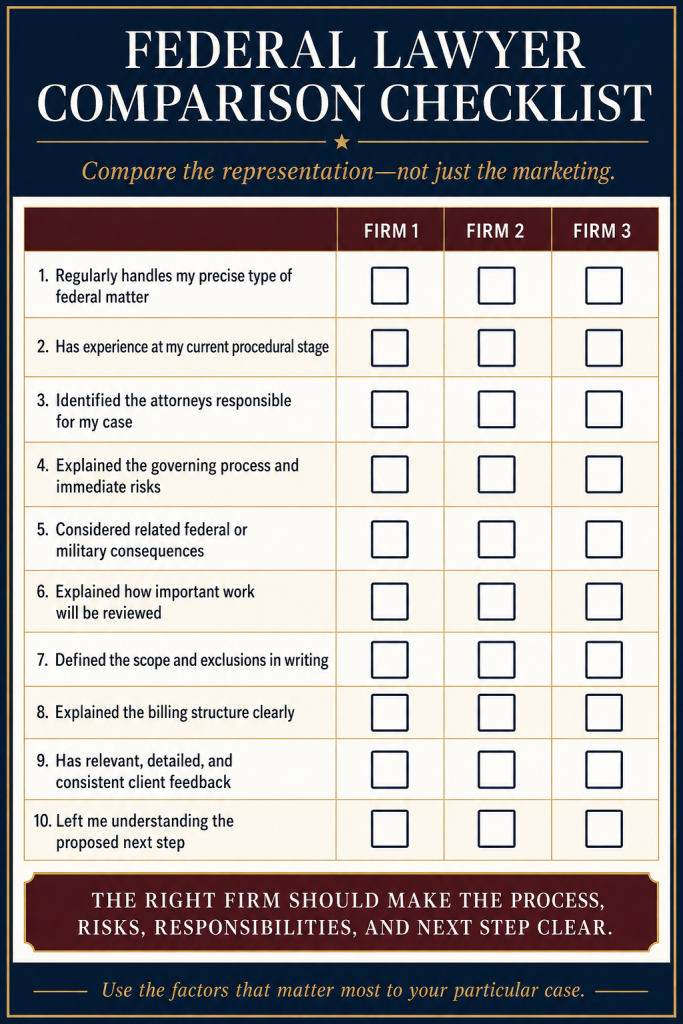
Federal Lawyer Comparison Checklist
Use this checklist when comparing firms. Do not simply count checkmarks; consider the importance of each factor to your particular matter.
How National Security Law Firm Is Structured
National Security Law Firm was built specifically for federal, military, national-security, and related government matters.
Our structure combines:
- A focused federal and military practice. Our attorneys work within the government systems our clients must navigate—not a broad collection of unrelated state-law practice areas.
- Experience from different sides of government decision-making. Our team includes former judges, adjudicators, a former United States Attorney, federal and military prosecutors, defense counsel, agency attorneys, intelligence-law attorneys, commanders, Staff Judge Advocates, and senior military leaders.
- Structured multi-attorney review. Appropriate significant matters may receive collaborative review through the NSLF Attorney Review Board or other team-based processes.
- Cross-practice coordination. Our practice structure helps attorneys identify when a matter may affect a clearance, federal position, military career, record, credential, immigration status, eligibility determination, or related proceeding.
- Flat fees for many defined matters. Predictable pricing can support communication and included collaboration without requiring the client to evaluate another hourly charge each time the legal team confers.
- Nationwide representation. Because federal law and administrative practice are not confined to one local courthouse, NSLF represents clients throughout the United States and, where permitted, overseas.
- Free, substantive consultations. Prospective clients can discuss the nature of the matter, ask questions, and evaluate the proposed fit before deciding whether to retain the firm.
No structure, credential, review, or former government position guarantees success. Its value lies in giving the client’s legal team more relevant perspectives, better opportunities to identify problems, and a disciplined framework for preparing the case.
Frequently Asked Questions
Should I hire a local lawyer for a federal matter?
Location may matter when in-person appearances, local admission, or a particular court requires it. In many administrative, military, clearance, suitability, and agency matters, however, relevant federal experience may be more important than physical proximity. Ask where appearances occur, whether remote representation is permitted, and what admissions or qualifications the matter requires.
Should I choose a former prosecutor or a defense attorney?
Prior government experience can help an attorney understand how cases are investigated and developed, while meaningful defense experience is essential to protecting clients and challenging the government. The most relevant question is how the lawyer’s complete experience applies to your type and stage of matter.
Is a larger legal team always better?
No. More attorneys do not automatically create better representation. The value comes from relevant experience, clear responsibility, disciplined collaboration, and an efficient review process—not the number of names associated with a firm.
Are flat fees always better than hourly fees?
No. The appropriate model depends on the predictability, duration, and scope of the matter. Flat fees provide certainty for defined services; hourly billing may be appropriate for work that cannot reasonably be scoped in advance. The critical issue is whether the agreement clearly explains what is included and how additional work will be handled.
Can a lawyer guarantee a favorable result?
No ethical lawyer should guarantee the outcome of a federal, military, administrative, or security-clearance matter. A lawyer can explain the process, assess the record, identify risks, recommend a strategy, and work to improve the case—but the final decision remains with the government authority or tribunal.
Choose the Firm—Not Just the Marketing
The lawyer you select may help shape the federal record that decision-makers use to evaluate your career, clearance, military future, eligibility, livelihood, or reputation.
Look beyond slogans. Ask who will perform the work. Test whether the lawyer understands the exact system and stage involved. Examine how strategy will be reviewed, how related consequences will be identified, how communication will work, and what the fee actually includes.
The right firm should not merely tell you that it is experienced. It should help you understand why its experience and structure matter to your case.
If you are considering National Security Law Firm, schedule a free consultation to discuss your situation, learn how the relevant government process works, and evaluate whether our team is the right fit.
Nationwide Representation · Free Consultation · Online Scheduling Available
Contacting National Security Law Firm does not create an attorney-client relationship. Do not submit classified, confidential, or time-sensitive information through an unsecured website form. Prior results and client reviews do not guarantee a similar outcome.