
The Biggest Misunderstanding in Clearance Cases Isn’t Legal—It’s Psychological
Most applicants believe their security clearance case will be judged on:
-
what they did
-
how serious it was
-
how well they explain it
They assume that if the facts are reasonable, the outcome will be too.
That assumption is wrong.
Security clearance decisions are not driven primarily by facts.
They are driven by:
👉 how those facts are interpreted inside a federal system designed to manage risk, not assign blame
At National Security Law Firm, our attorneys include former adjudicators, administrative judges, and attorneys who have worked inside the Defense Office of Hearings and Appeals. We have evaluated clearance cases from inside the system.
From that perspective, one reality becomes clear very quickly:
👉 Adjudicators are not deciding whether you are a good person.
They are deciding whether your record is safe to approve.
To understand the framework they are operating within, see the
→ Security Clearance Adjudicative Guidelines Explained
Quick Answer: How Adjudicators Actually Think
Adjudicators evaluate whether a clearance can be granted without creating future risk.
They focus on:
-
consistency across your entire record
-
whether issues are fully resolved—not explained
-
whether your behavior appears stable over time
-
whether approval can be defended later
This is why:
👉 people with serious past issues can be approved
👉 and people with “minor” issues can be denied
The Shift Most Applicants Never Realize
Applicants think in terms of events:
-
“This happened”
-
“Here’s why”
-
“It’s not that bad”
Adjudicators think in terms of patterns:
-
what does this suggest about judgment
-
how did the person respond under pressure
-
is the behavior predictable
-
does the record create doubt
That shift—from events to patterns—is where most cases are lost.
What Is Actually Happening When Your Case Is Reviewed
By the time an adjudicator sees your case, something important has already happened:
👉 your record has been built
That record includes:
-
your SF-86 disclosures
-
investigator summaries
-
follow-up explanations
-
timing of your responses
-
how your story evolved
Adjudicators are not reconstructing your life.
They are reading a file that already reflects:
👉 how you behave when asked difficult questions
The Way Adjudicators Actually Read Your File
Adjudicators do not read your file like an advocate.
They read it like someone who must justify a decision to others.
That means they are asking:
-
Does this file read cleanly?
-
Does it contain contradictions?
-
Does it require explanation to defend?
-
Would another adjudicator see this the same way?
If the answer requires interpretation:
👉 the case becomes harder to approve
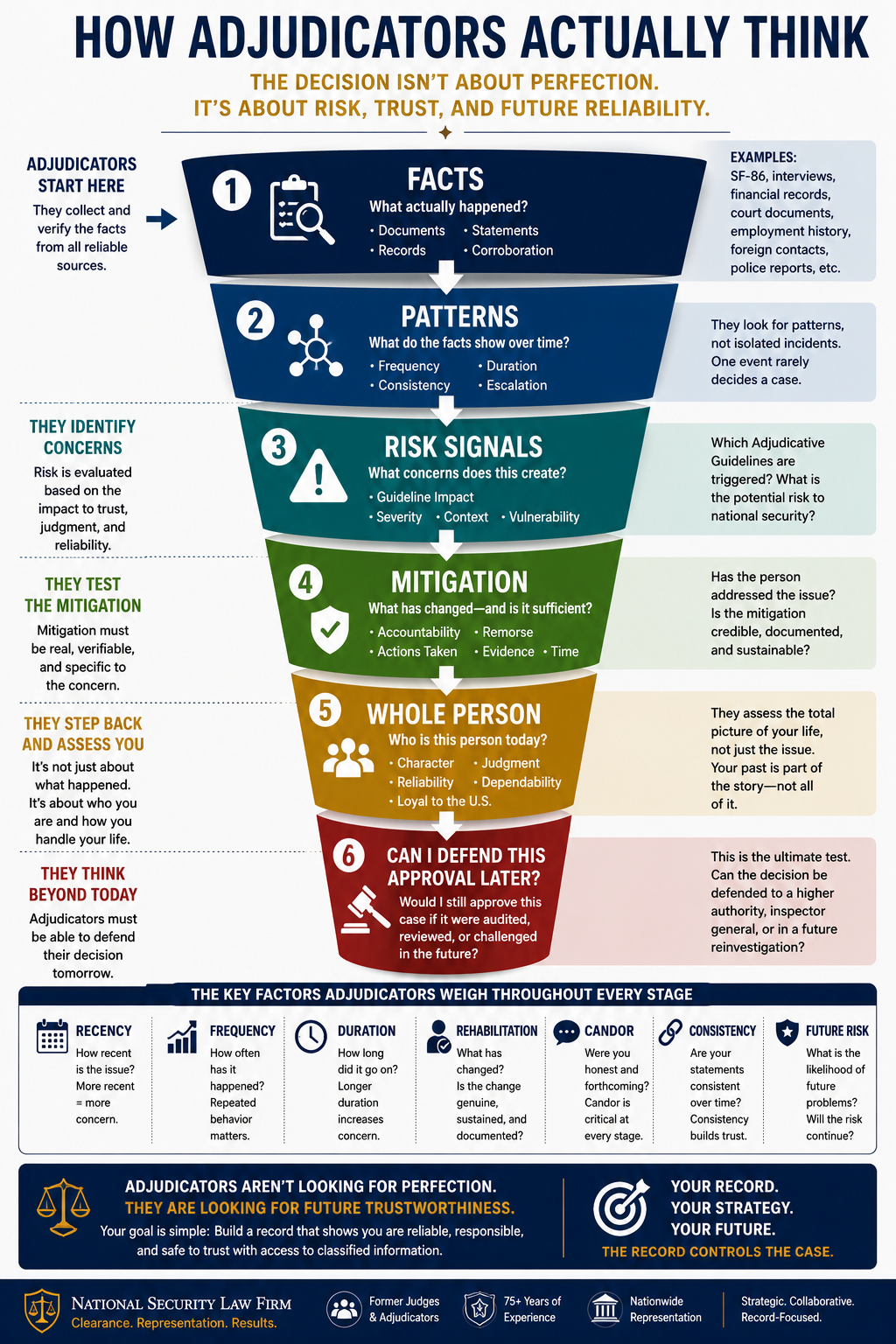
How a Decision Is Actually Made (From the Inside)
If you were sitting behind the adjudicator’s desk, this is what you would see.
Step 1: Identify All Potential Risk Signals
The adjudicator reviews the file under the
They are not just identifying issues.
They are identifying:
👉 signals about judgment and reliability
Step 2: Look for Patterns, Not Isolated Facts
This is critical.
They ask:
-
Is this behavior repeated?
-
Does it appear under stress?
-
Does it show a consistent response pattern?
One event rarely determines a case.
👉 patterns do
Step 3: Test Credibility Across Time
Adjudicators compare:
-
your initial disclosures
-
your later explanations
-
investigator notes
-
written responses
They are not asking:
👉 “Is this believable?”
They are asking:
👉 “Is this consistent?”
Even small inconsistencies create doubt.
Step 4: Evaluate Whether Issues Are Actually Resolved
This is where most applicants lose their case.
They think:
👉 “I explained it”
Adjudicators ask:
👉 “Is it finished?”
They distinguish between:
-
explanation
-
improvement
-
resolution
Only resolution satisfies the system.
Step 5: Apply the Whole-Person Concept
The
is where everything comes together.
This is not a fairness review.
It is a system-level check:
👉 “When I read this entire file, do I feel confident—or uncertain?”
Step 6: Make a Forward-Looking Judgment
The final question is always:
👉 “What happens next?”
Adjudicators evaluate:
-
future risk
-
stability of behavior
-
whether approval will hold up over time
If the answer is uncertain:
👉 denial is the safer decision
Why Good People Still Lose
This is where most applicants struggle.
They assume:
-
their character matters most
-
their intentions matter
-
their explanation will carry weight
But the system does not reward intention.
It rewards:
👉 predictability
Good people lose when:
-
their record is inconsistent
-
mitigation appears reactive
-
issues interact in unexpected ways
-
the file requires explanation to approve
None of that reflects who they are as a person.
It reflects how their record reads.
This Is Where Many Applicants Lose Their Case
Applicants often:
-
over-explain
-
add unnecessary detail
-
try to justify their actions
-
respond emotionally
Those actions:
-
introduce inconsistencies
-
expand the scope of review
-
weaken credibility
This is one of the most common mistakes we see.
The Point Where Most Cases Are Already Decided
There is a stage where the outcome becomes predictable.
It happens when:
-
the record contains inconsistencies
-
explanations evolve
-
mitigation begins too late
-
patterns become visible
At that point:
👉 the adjudicator is not deciding from scratch
They are evaluating whether the record can still be approved.
Often, it cannot.
Why Waiting Makes This Worse
Every new statement becomes part of the record.
Over time:
-
inconsistencies accumulate
-
mitigation appears reactive
-
credibility weakens
This is how small issues become larger risks.
Most people don’t realize this is happening until it’s too late.
What This Means for Your Strategy
You are not presenting your case.
You are building a record.
That record must:
-
remain consistent across time
-
demonstrate stable behavior
-
eliminate—not explain—risk
-
read clearly without interpretation
The goal is not to sound reasonable.
👉 It is to be approvable.
Why National Security Law Firm Is Different
Most firms approach clearance cases as a set of issues to respond to.
National Security Law Firm approaches them as a record that must withstand institutional scrutiny.
That difference matters.
Because adjudicators do not evaluate arguments.
They evaluate files.
Our approach is built around how those files are actually read.
Attorney Review Board
Significant cases are evaluated through our
This mirrors how the government evaluates cases—through layered review.
Record Control Strategy
Clearance decisions are not based on one moment.
They are based on how the record reads over time.
→ The Record Controls the Case
Security Clearance Resource Hub
To understand how adjudicators evaluate cases across the entire system, see the
→ Security Clearance Insiders Resource Hub
Frequently Asked Questions
Do adjudicators care if I’m a good person?
They care whether your record shows predictable, reliable behavior—not general character.
What matters most in a clearance decision?
Consistency, credibility, and whether risk is resolved.
Can small issues cause denial?
Yes, especially when they create patterns or credibility concerns.
Why do similar cases have different outcomes?
Because adjudicators evaluate how the record is structured—not just the facts.
Can explanation fix a problem?
No. Only resolution can.
Speak With a Security Clearance Lawyer Before Your Record Is Interpreted
The most important question is not:
👉 “Will they understand my situation?”
It is:
👉 “How will they interpret my record?”
By the time most applicants ask that question:
-
the record is already shaping the outcome
-
credibility impressions are already formed
-
options are limited
We offer free consultations to help you:
-
understand how your case will be evaluated
-
identify hidden risks in your record
-
determine what can still be controlled
→ schedule a free consultation