
The government has denied or revoked your security-clearance eligibility—or issued a decision requiring an immediate choice about how to challenge it. Your next filing may determine whether you preserve your clearance, cleared career, military assignment, federal position, or future eligibility.
A security-clearance appeal is not simply another opportunity to tell your story. The correct strategy depends on who issued the decision, what stage your case has reached, what the reviewing authority may consider, and whether the existing record can still be supplemented.
National Security Law Firm represents federal employees, service members, government contractors, intelligence professionals, and clearance applicants in security-clearance appeals nationwide. Our team includes a former federal Administrative Judge and Acting Chief Judge who decided clearance cases, former government adjudicators, attorneys with experience inside the Defense Office of Hearings and Appeals, former senior Army intelligence and national-security counsel, and a hearing lawyer with 16 years of Army litigation experience.
Former Federal Clearance Judge · Former Government Adjudicators · Direct DOHA Experience · Former GS-15 Intelligence Counsel · Experienced Hearing Counsel · Attorney Review Board
Your notice controls your rights and deadline. Send us the complete decision, Statement of Reasons, hearing or appeal notice, prior response, and every stated deadline. Contacting or retaining counsel does not automatically extend a deadline, postpone a proceeding, or preserve an appeal.
★★★★★ 4.9 Stars From 300+ Google Reviews
Investigation · Personnel Security · Adjudication · DOHA · Hearings · Appeals
The Government Evaluates Your Case From Every Side. So Do We.
A clearance decision may reflect the work of investigators, counterintelligence personnel, security managers, adjudicators, agency counsel, administrative judges, and appellate officials. Each may examine a different part of the same record—and each may ask a different question about your judgment, reliability, candor, vulnerability, or risk.
An effective appeal must account for all of those perspectives. It must identify how the concern was developed, how the adjudicative standards were applied, what the decision-maker found persuasive, what the reviewing authority is allowed to do, and how the government is likely to answer the arguments being made.
NSLF built its security-clearance practice to provide that range of experience on the client’s side. Covered appeal matters receive coordinated review through our Attorney Review Board, drawing on the relevant investigative, adjudicative, DOHA, judicial, national-security, and litigation perspectives for the issues presented.
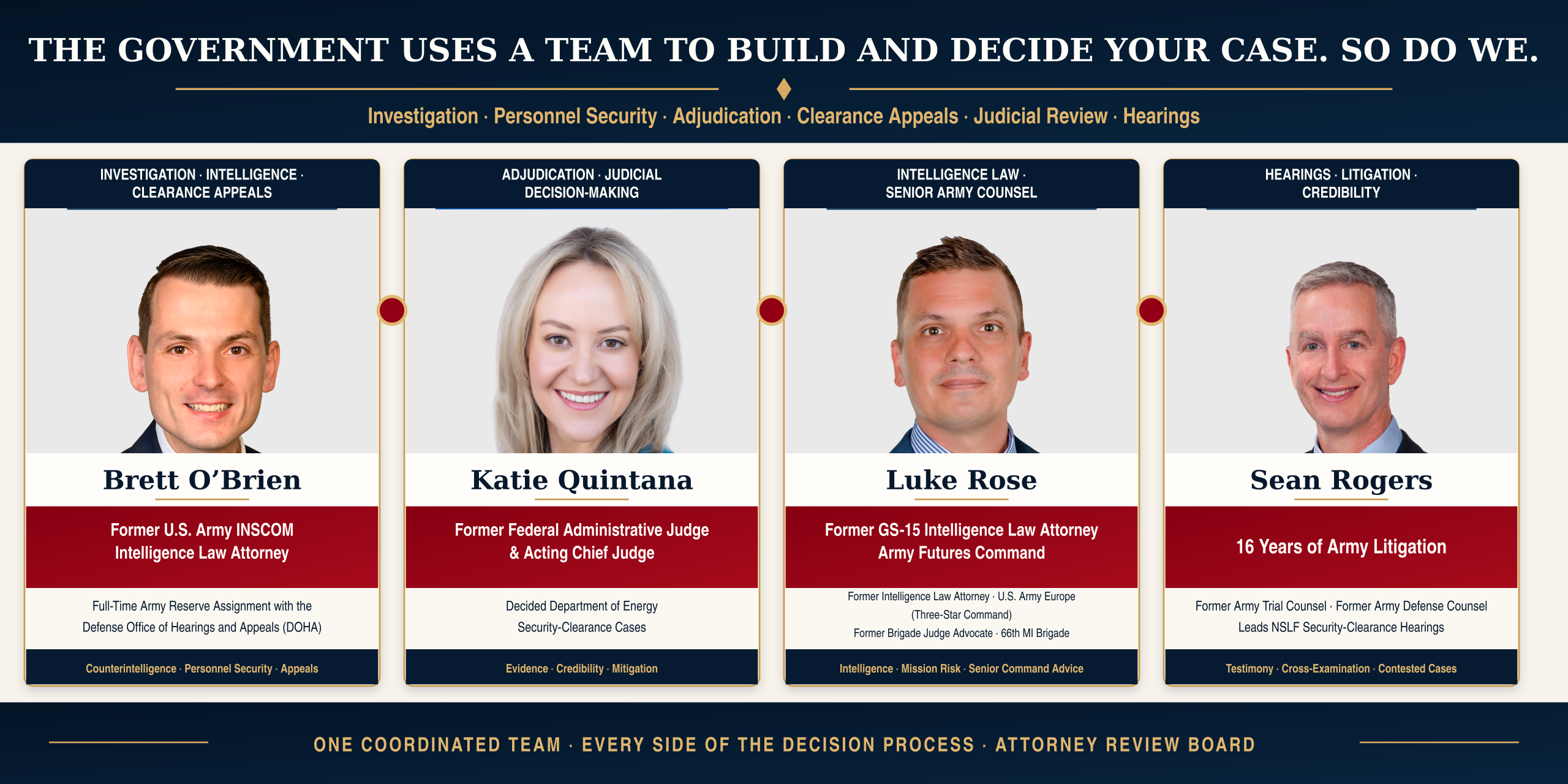
The purpose is not to make the appeal longer or more aggressive. It is to test the case from the same directions the government may evaluate it—and to submit one clear, accurate, supportable strategy.
A Security Clearance “Appeal” Can Mean Several Different Proceedings
People commonly use the word appeal for every attempt to challenge a clearance concern. Legally and strategically, those proceedings are not interchangeable.
Depending on your employer, sponsoring agency, status, and the document you received, you may be facing:
- a response to a Statement of Reasons before a final decision;
- a choice between a Defense Office of Hearings and Appeals hearing and a decision on the written record;
- an appeal to the DOHA Appeal Board after an Administrative Judge’s decision;
- a written appeal to a military department or component Personnel Security Appeals Board;
- a personal appearance followed by a PSAB determination;
- an intelligence-community or other agency-specific appeal;
- reconsideration or reapplication after the administrative appeal process has ended; or
- a related employment, military, suitability, access, or credentialing action.
The first task is not drafting an argument. It is identifying the decision that was made, the official or board authorized to review it, the material that reviewer may consider, the available remedy, and the deadline for preserving your rights.
That classification can determine whether you may submit new evidence, testify, call witnesses, challenge factual findings, or only argue that a decision already issued contains material error.
Have an Attorney Review Your Notice
Which Security Clearance Appeal Do You Have?
You Received a Statement of Reasons but No Final Decision
You may still be at the initial response stage rather than a true appeal. This is ordinarily the time to answer every allegation, develop documentary mitigation, reconcile earlier statements, and make any election required by the notice.
The written response may shape every later stage. Treating it as a preliminary explanation can leave admissions, factual gaps, or unsupported mitigation in the record.
Learn About Statement of Reasons Representation
You Are a Government Contractor Offered a DOHA Hearing or Written-Record Decision
In many industrial-security cases, the applicant may request a hearing before a DOHA Administrative Judge or allow the case to be decided on the written record. Those choices are not strategically equivalent.
A hearing may allow testimony, witnesses, and live credibility assessment. A written-record case depends on the documents and written submissions admitted into the record. The proper election depends on the allegations, prior statements, credibility issues, available witnesses, documentary proof, and weaknesses in the existing file.
Learn About DOHA Hearing Representation
A DOHA Administrative Judge Issued an Unfavorable Decision
The Defense Office of Hearings and Appeals (DOHA) is the Department of Defense office that conducts administrative hearings and appellate review in significant security-clearance matters. An appeal to the DOHA Appeal Board is not a new hearing. The Board reviews the Administrative Judge’s decision and the existing record for error; it does not accept evidence that was not before the Hearing Office judge.
The appeal must therefore identify a reviewable factual, procedural, or legal error, show where the problem appears in the decision or record, and explain why it materially affected the outcome. Disagreement with the judge’s conclusion—or stronger evidence developed too late—is not enough.
DOHA currently states that the Notice of Appeal must be received within 15 days of the date appearing on the judge’s decision. The Board then notifies the appealing party when the appeal brief is due. Follow the instructions and deadline in your own decision and correspondence.
You Are a DoD Civilian or Service Member Appealing to a PSAB
The process for DoD civilian and military personnel differs from the contractor process. Depending on the notice and procedural posture, an individual may appeal in writing to the appropriate component Personnel Security Appeals Board or elect a personal-appearance hearing before a DOHA Administrative Judge. In that setting, the Administrative Judge makes a recommendation that is forwarded to the PSAB, and the PSAB makes the final appeal determination.
The representation must be built around the reviewing body’s role, the permitted record, and the procedure stated in the decision package.
You Work for an Intelligence-Community or Other Federal Agency
Agencies may use different notices, appellate officials, boards, filing requirements, evidentiary rules, and deadlines. A procedure described for DOHA or a DoD component may not apply to an intelligence-community or agency-specific matter.
We begin with the actual notice, governing authority, and existing record before recommending an appeal strategy.
The Administrative Appeal Process Has Ended
Reconsideration, reapplication, employment litigation, military administrative relief, or another remedy may sometimes be evaluated after an appeal ends. Those are separate matters and are not automatically included in an appeal engagement.
Ask an Attorney to Identify Your Appeal Stage
What Is at Stake Beyond the Clearance Decision?
An unfavorable eligibility decision can affect far more than access to classified information. Depending on your status and agency, it may affect:
- current employment or a conditional offer;
- military duties, assignment, promotion, retention, separation, or retirement;
- access to secure facilities, systems, programs, intelligence, or credentials;
- eligibility for future cleared positions;
- professional reputation and mobility within the federal sector;
- related suitability, fitness, public-trust, or credentialing determinations; and
- the way later decision-makers interpret earlier disclosures and explanations.
Clearance eligibility and employment consequences are legally distinct. A clearance appeal does not automatically challenge a removal, suspension, reassignment, rescinded offer, or military action. Those proceedings may involve different officials, rules, deadlines, and remedies.
When several systems are involved, a statement intended to help in one can damage another. A broad admission may affect a military, criminal, employment, suitability, or credentialing matter. A failure to make a required report may become a separate concern. Strategy should account for the cumulative government record, not only the document immediately in front of you.
The Existing Record Sets the Boundaries of the Appeal
By the time an appeal begins, the government may already possess years of information, including:
- an SF-86, eApp, e-QIP, or another security questionnaire;
- investigator interview summaries;
- self-reports and security-office communications;
- Letters of Interrogatory and written responses;
- Statements of Reasons and answers;
- financial, court, employment, medical, military, travel, or foreign-contact records;
- testimony, witness statements, exhibits, or transcripts; and
- the findings and conclusions being challenged.
An appeal cannot be developed safely from the final decision alone. Counsel must determine what you said earlier, what evidence the government relied on, what the decision-maker found credible, whether objections or issues were preserved, and what the current forum is permitted to consider.
Credibility Findings Must Be Confronted
If the appeal presents a new explanation, the reviewer may ask why it did not appear in the questionnaire, interview, Letter of Interrogatory response, SOR answer, or hearing testimony. A truthful clarification may still fail if the inconsistency is ignored rather than explained through the permitted record.
Mitigation Must Answer the Actual Security Concern
General character letters and evidence of strong work performance can contribute to a whole-person analysis, but they do not automatically resolve financial irresponsibility, foreign influence, substance misuse, criminal conduct, security violations, or personal-conduct concerns. Evidence should be tied to a disputed fact, an identified risk, or an applicable mitigating condition.
Some Appeals Are Confined to the Prior Record
This is particularly important before the DOHA Appeal Board. The Board reviews the decision for error and does not receive new evidence. Material that might have changed the outcome may be unusable if it was not properly developed before the Administrative Judge.
The objective is not to submit the longest possible appeal. It is to make the permitted record support the precise relief the reviewing authority can grant.
The exact service depends on the notice, forum, procedural stage, deadline, and written engagement agreement. A covered appeal may include the following attorney-led work.
1. Immediate Notice, Forum, and Deadline Review
We review the complete adverse decision, appeal instructions, service information, election forms, and deadlines. We identify the reviewing authority, available procedural options, filing method, and immediate preservation requirements.
When appropriate and within the agreed scope, counsel may evaluate an extension or other preliminary request. No extension is guaranteed. The existing deadline controls unless the appropriate authority grants additional time.
2. Complete Prior-Record Review
We review the materials reasonably necessary for the covered appeal. Depending on the proceeding, that may include the SOR, answer, Letter of Interrogatory, investigative materials made available to you, hearing exhibits, transcript, prior submissions, procedural correspondence, and the decision being challenged.
This review identifies admissions, disputed findings, credibility determinations, evidentiary gaps, preserved issues, and earlier statements that may limit or shape the available strategy.
3. Appeal Route, Standard, and Remedy Analysis
We determine what the reviewing authority may do and what type of submission the governing procedure permits. The analysis may address:
- written appeal versus personal appearance;
- hearing versus written-record adjudication;
- whether additional evidence is permitted;
- the applicable standard and scope of review;
- the relief the authority can grant;
- potential reconsideration or reapplication routes; and
- interaction with separate employment or military consequences.
4. Finding-by-Finding Record Analysis
We map the challenged findings to the record, applicable adjudicative guidelines, mitigating conditions, and whole-person considerations. In a record-review appeal, we identify potential factual, procedural, or legal errors. When new evidence is allowed, we determine what proof may rebut, explain, extenuate, or mitigate the concerns.
5. Timeline and Consistency Audit
We reconstruct the relevant chronology and compare the proposed appeal position against earlier disclosures, documents, and testimony. Dates, amounts, treatment history, foreign relationships, security reports, court events, and changed circumstances can determine whether the explanation is internally consistent and supported.
When a fact cannot be verified, the submission should not disguise uncertainty as certainty. We distinguish what the record establishes, what can be explained, and what requires careful qualification.
6. Targeted Evidence Plan When New Evidence Is Permitted
If the procedure permits additional evidence, we identify the records and statements most likely to matter. Depending on the issues, this may include:
- tax documents, payment records, repayment evidence, budgets, credit reports, or financial counseling;
- court dispositions, police records, or proof of completed obligations;
- treatment, evaluation, testing, counseling, rehabilitation, or aftercare documentation;
- employment, military, travel, residence, or citizenship records;
- foreign-contact, property, travel, and financial-interest documentation;
- evidence of changed circumstances, compliance, rehabilitation, or passage of time; and
- carefully selected declarations or witness evidence.
We do not recommend material merely to increase the size of the submission. Each item should help establish a relevant fact, answer an identified concern, or demonstrate meaningful mitigation.
7. Attorney-Drafted Appeal Submission
Counsel prepares the filing required for the covered matter. Depending on the proceeding, the submission may include:
- a response to disputed findings or allegations;
- a concise procedural history and statement of the review standard;
- citations to the record;
- legal, factual, or procedural assignments of error;
- guideline-specific rebuttal and mitigation;
- reconciliation of earlier statements;
- an organized evidentiary submission when permitted; and
- a precise request for relief the reviewing authority may grant.
8. Personal-Appearance or Hearing Preparation When Included
If the engagement expressly includes a personal appearance or hearing, we prepare the client for the issues likely to be tested, organize the permitted evidence, evaluate potential witnesses, and develop the presentation strategy. Hearing or personal-appearance representation is not included in a written-appeal engagement unless the agreement says so.
9. Attorney Review Board
Covered appeal matters receive collaborative review through NSLF’s Attorney Review Board. One attorney remains responsible for leading the representation and communicating with the client, but the strategy is not limited to that attorney’s experience alone.
Depending on the case, the review may draw on attorneys with experience in counterintelligence investigations, personnel-security adjudication, DOHA proceedings and appeals, federal clearance judging, senior national-security advising, and contested hearings.
The reviewing attorneys test for:
- an allegation or finding that has not been answered;
- an assertion unsupported by the permitted record;
- conflict with an earlier disclosure or statement;
- evidence that does not establish the claimed mitigation;
- a credibility problem likely to concern the reviewer;
- an argument the deciding authority cannot consider;
- a weakness opposing counsel may exploit; and
- language that could create consequences in another proceeding.
The result is one coordinated appeal—not several competing theories.
10. Client Review, Finalization, and Filing Guidance
You review the draft for factual accuracy and completeness. We address reasonable revisions needed to finalize the covered submission based on timely feedback and materials provided during the representation.
You remain responsible for confirming that every factual statement submitted on your behalf is truthful and accurate. We then provide the submission-ready package and filing guidance under the procedure stated in your notice. If the engagement assigns filing responsibility differently, the written agreement controls.
11. Guidance Through the Covered Appeal Stage
We remain available for reasonable questions arising during preparation and finalization of the covered appeal. The engagement concludes as defined in the written agreement. A later hearing, board appeal, remand, reconsideration request, reapplication, employment case, or court proceeding is not automatically included.
What Is Not Automatically Included
Unless expressly included in the engagement agreement, appeal representation does not include:
- representation at a later or different administrative stage;
- a hearing or personal appearance under a written-submission engagement;
- a DOHA Appeal Board brief following a separate hearing engagement;
- representation following a remand or reopening;
- judicial review or litigation in federal court;
- an MSPB, EEO, OSC, union, grievance, military, or other employment proceeding;
- suitability, fitness, public-trust, CAC, credentialing, or facility-access representation;
- criminal, court-martial, administrative-separation, debarment, or professional-licensing defense;
- an independent investigation or compulsory process for records or witnesses;
- a FOIA or Privacy Act request or lawsuit;
- expert, evaluator, investigator, records, transcript, travel, or witness expenses;
- reconsideration or reapplication after the appeal process; or
- any guarantee of continued employment, restored access, or a favorable eligibility decision.
If another proceeding is affecting the same government record, we can identify the overlap and discuss whether separate coordinated representation is available.
Security Clearance Appeal Fees
The fee depends on the procedural stage because an SOR response, evidentiary hearing, record-review appeal, and agency-board submission require different work.
| Service | Standard Fee or Pricing Method |
|---|---|
| Statement of Reasons response | $5,000 flat fee |
| Credit following prior LOI representation | $3,000 credit toward the SOR fee when applicable under the engagement terms |
| DOHA hearing representation | $7,500 flat fee for the covered hearing stage |
| DOHA Appeal Board brief | Quoted after review of the decision, record, transcript, and deadline |
| PSAB appeal or personal appearance | Quoted after review of the decision package and permitted procedure |
| Intelligence-community or agency-specific appeal | Quoted after review of the notice, record, and governing process |
| Reconsideration or reapplication | Separately evaluated and quoted |
The written engagement agreement controls the exact scope, fee, credits, expenses, filing responsibilities, and conclusion of representation.
View Security Clearance Lawyer Costs · Learn About Financing
The Attorneys Behind the Coordinated Appeal Strategy
The team’s value is not that several résumés appear on one page. It is that NSLF brings together experience from the institutions and roles that can shape a security-clearance case—and uses those perspectives to test one coordinated strategy.
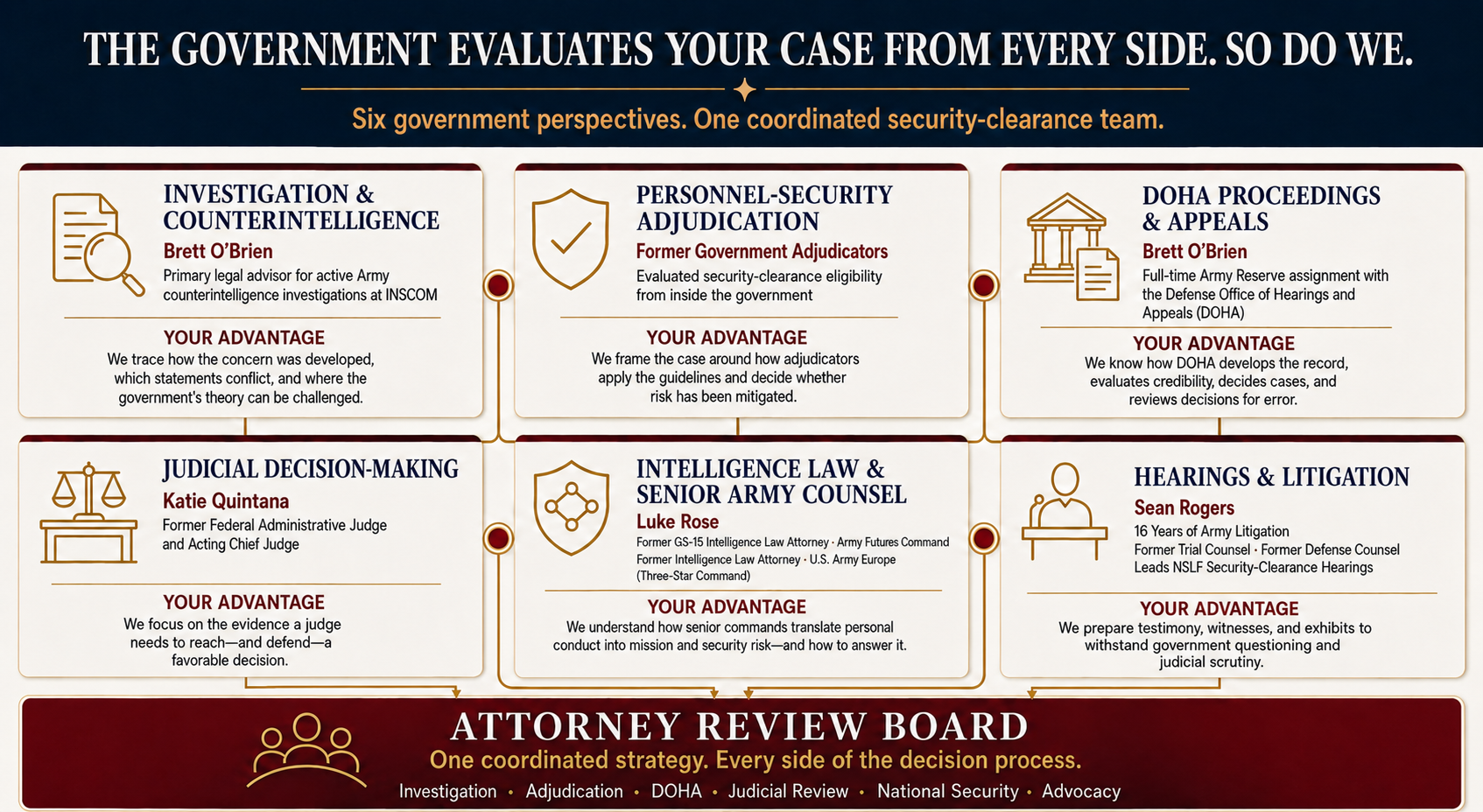
Brett O’Brien: Investigation, Counterintelligence, and DOHA
Brett O’Brien served as an Intelligence Law Attorney for U.S. Army Intelligence and Security Command (INSCOM) and as the primary legal advisor for active Army counterintelligence investigations. He worked with military leaders, intelligence professionals, the FBI, NSA, DIA, Department of the Treasury, and other members of the Intelligence Community.
While serving as an Army Reserve Judge Advocate, Brett also completed a full-time assignment with the Defense Office of Hearings and Appeals. This was experience inside the office—not occasional contact with DOHA from the outside.
Why that matters: The team can examine how an underlying concern was developed, what investigators may have been testing, where statements or evidence diverge, and how facts move from an investigative file into a DOHA decision and appellate record.
Katie Quintana: Adjudication and Judicial Decision-Making
Katie Quintana served as a federal Administrative Judge and Acting Chief Judge responsible for deciding Department of Energy security-clearance cases. She evaluated evidence, testimony, credibility, mitigation, and national-security risk from the decision-maker’s side of the process.
Why that matters: The team does not stop at asking whether an explanation sounds reasonable. It asks whether the permitted record gives the judge, adjudicator, or appellate official a defensible basis to resolve every material concern favorably.
Luke Rose: Intelligence Law, Senior Commands, and Mission Risk
Luke Rose served as a GS-15 Intelligence Law Attorney for Army Futures Command. He also served as an Intelligence Law Attorney for U.S. Army Europe, a three-star command, and as Brigade Judge Advocate for the 66th Military Intelligence Brigade.
Why that matters: The team understands how senior commands and intelligence organizations can translate conduct that appears personal or isolated into questions about mission risk, access, judgment, and national-security reliability—and how an appeal must answer that institutional concern rather than relying on general assurances.
Sean Rogers: Hearings, Litigation, and Credibility
Sean Rogers brings 16 years of Army litigation experience, including service as both trial counsel and defense counsel. He leads NSLF’s security-clearance hearing work and focuses on contested presentation, testimony, cross-examination, and credibility.
Why that matters: Even a written appeal should be tested as though a skilled government advocate will challenge it. The team can anticipate opposing arguments, expose weak explanations, prepare testimony and witnesses when the procedure permits, and identify credibility problems before they become the government’s strongest point.
One Lead Attorney. A Broader Institutional Perspective.
Not every attorney personally performs every task in every case. The attorney assigned to the matter leads the representation. Through the Attorney Review Board, covered appeals can draw on the perspectives relevant to the specific record and forum.
The government uses a coordinated system to investigate, adjudicate, defend, and decide security-clearance cases. NSLF has built a coordinated team to evaluate the client’s case across those same dimensions before the government reviews the appeal.
Meet the Security Clearance Team
What Appeal Clients Say About Working With NSLF
★★★★★ “I found Brett O’Brien when I had my security clearance revoked. After working together on my issue, we fought the revocation during an appeal and won. I highly recommend him.”
P.S. · Security Clearance Appeal Client · Google Review
★★★★★ “They created a plan forward based on my unique circumstances and helped me through the entire process. I received a favorable response from DOHA and can’t thank them enough.”
R.R. · DOHA Client · Google Review
★★★★★ “The team did an outstanding job drafting a thorough and compelling appeal that accurately reflected both the facts and my professional record. As a result, my clearance was reinstated.”
J.B. · Security Clearance Appeal Client · Google Review
These excerpts have been shortened for length, and names are abbreviated on this service page for privacy. Results depend on the facts and circumstances of each matter. Prior results and client reviews do not guarantee a similar outcome.
How the Appeal Process Works With NSLF
Step 1: Send the Complete Decision and Deadline
Provide the adverse decision, SOR, appeal instructions, prior responses, hearing decision, transcript if available, exhibits, and every communication stating a deadline. Tell intake immediately if the deadline is near.
Step 2: We Identify the Forum and Procedural Stage
We determine whether the matter involves an initial SOR response, a written-record case, a hearing, the DOHA Appeal Board, a PSAB, an agency-specific process, or a possible post-appeal remedy.
Step 3: We Confirm the Scope and Immediate Responsibilities
If NSLF accepts the matter and you retain the firm, the engagement agreement defines the covered service, fee, filing responsibility, and stage. Retaining counsel does not itself stay a decision or extend a deadline.
Step 4: We Reconstruct and Analyze the Record
We compare the decision against the complete prior file, isolate the findings and concerns that control the outcome, and determine what arguments and evidence the reviewing authority is permitted to consider.
Step 5: We Develop and Test the Appeal
Counsel drafts the submission and, when permitted and included, develops additional evidence, witnesses, or an appearance strategy. Covered matters undergo collaborative review before finalization.
Step 6: You Review and the Submission Is Finalized
You confirm factual accuracy and completeness. Counsel finalizes the package, and it is filed according to the procedure and responsibilities stated in the notice and engagement agreement.
Step 7: We Address the Next Event Within the Covered Scope
If the reviewing authority requests information, schedules an appearance, issues a decision, or creates another appeal right, we explain what falls within the existing engagement and what would require separate representation.
Common Security Clearance Appeal Mistakes
Missing the Deadline While Preparing the “Perfect” Filing
An untimely submission may eliminate rights regardless of its quality. Confirm the deadline, method of filing, and receipt requirements immediately.
Using the Wrong Forum, Standard, or Remedy
A DOHA Appeal Board brief, PSAB submission, SOR answer, personal appearance, and reconsideration request serve different purposes. A persuasive filing must ask the proper authority for relief that authority may grant.
Treating the Appeal as a New Opportunity to Retell Everything
An unstructured narrative can introduce new inconsistencies without addressing the findings that control the decision.
Submitting New Evidence Where It Cannot Be Considered
The DOHA Appeal Board does not accept new evidence. A Board appeal must be built from the record that was before the Administrative Judge.
Ignoring an Adverse Credibility Finding
Repeating the same explanation does not answer a finding that it was inconsistent, unsupported, or not credible. The appeal must confront the finding under the applicable review standard.
Relying Only on Good Character or Strong Performance
Evidence that you are valued at work may be helpful, but it may not mitigate the specific conduct, vulnerability, or risk identified by the government.
Assuming the Clearance Appeal Protects the Job
An agency, command, or employer may pursue a separate personnel or military action. Those deadlines may continue while the clearance appeal is pending.
Providing Only the Final Decision to Counsel
The decision may depend on statements made months or years earlier. Counsel needs the complete available record, not only the last letter.
Frequently Asked Questions About Security Clearance Appeals
Can I appeal a security clearance denial or revocation?
Many unfavorable clearance determinations provide administrative review or appeal rights, but the available procedure depends on your status, agency, and stage. The decision package should identify the forum, deadline, and permitted submission. Have the actual notice reviewed rather than relying only on a general online description.
Is responding to a Statement of Reasons the same as filing an appeal?
Not necessarily. An SOR response often occurs before a final denial or revocation. Because people frequently search for an appeal lawyer at the SOR stage, the first step is determining the exact procedural posture and matching the representation to it.
What is the difference between a DOHA hearing and a DOHA Appeal Board appeal?
At a DOHA hearing, the evidentiary record may be developed through documents and testimony under the governing procedure. The Appeal Board later reviews the Administrative Judge’s decision and existing record for error. It does not conduct a new hearing or accept new evidence.
How long do I have to appeal a DOHA decision?
DOHA currently states that a Notice of Appeal must be received within 15 days of the date on the Administrative Judge’s decision. The Board then provides the deadline for the appeal brief. Follow the instructions in your own decision and contact counsel promptly.
Can I submit new evidence to the DOHA Appeal Board?
No. DOHA states that the Appeal Board is not permitted to receive or consider evidence that was not before the Hearing Office judge.
What is a PSAB appeal?
A Personnel Security Appeals Board reviews certain unfavorable clearance determinations involving DoD civilian or military personnel. Depending on the governing process, the individual may appeal in writing or elect a personal-appearance hearing before a DOHA Administrative Judge who makes a recommendation to the PSAB. The PSAB makes the final appeal determination.
Should I choose a hearing or a written-record decision?
There is no universally correct choice. A hearing may allow testimony and live credibility assessment. A written-record case avoids live questioning but depends entirely on the admitted documentary record. The allegations, prior statements, witnesses, documentary evidence, and credibility risks should be evaluated before the election is made.
What does a security clearance appeal lawyer do?
Counsel identifies the correct forum and standard, reviews the complete prior record, isolates the findings controlling the outcome, develops permitted mitigation, drafts the submission, and—when expressly included—prepares and represents the client at a hearing or personal appearance.
Does hiring NSLF guarantee that my clearance will be restored?
No. No lawyer can guarantee a security-clearance decision. The government retains authority over eligibility, and the outcome depends on the facts, record, governing standards, credibility assessments, and available procedure.
Does a clearance appeal automatically protect my employment?
No. Clearance eligibility and a resulting employment or military action may involve separate officials, rules, and deadlines. A clearance engagement does not include an employment or military proceeding unless the written agreement expressly says so.
What happens if the appeal is unsuccessful?
The possible next step depends on the forum and decision. Reconsideration, reapplication after a waiting period, a separate employment remedy, or limited judicial review may require evaluation. None is automatic, and each is outside the appeal engagement unless expressly included.
Can NSLF represent me anywhere in the country or overseas?
NSLF represents clearance applicants, employees, service members, and contractors nationwide and, when permitted, clients stationed or working overseas. Representation remains subject to conflicts, timing, forum requirements, and case acceptance.
What should I send before the consultation?
Send the complete decision or notice, SOR and answer, any Letter of Interrogatory and response, appeal instructions, hearing decision, transcript and exhibits if available, related security-office communications, and every stated deadline.
Related Security Clearance Resources
For narrower explanations of the process:
- Security Clearance Appeals Guide
- Can You Appeal a Security Clearance Denial?
- How to Respond to a Statement of Reasons
- What Happens at a DOHA Hearing?
- Security Clearance Reinstatement After Revocation
For representation at a specific stage:
Official Government Resources
- DCSA: Appeal an Investigation Decision
- DCSA: Security Review Proceedings FAQ
- DOHA: Overview of the Industrial Security Clearance Program
- DOHA: Industrial Security Clearance Decisions
- Security Executive Agent Directive 4: National Security Adjudicative Guidelines
- 32 C.F.R. Part 156: Department of Defense Personnel Security Program
Government procedures and links can change. The decision package and instructions issued in your individual matter control.
Put a Complete Security Clearance Team on Your Side
A denial or revocation does not reveal, by itself, what remedy remains. The notice, forum, deadline, prior record, and governing procedure determine what can still be done.
National Security Law Firm brings together attorneys with experience across the security-clearance system—from counterintelligence investigation and personnel-security adjudication to DOHA proceedings, administrative judging, senior intelligence advising, contested hearings, and appeals.
We can review where your case stands, identify the correct appeal route, and explain what representation at that stage would include.
Send us the complete decision, prior submissions, and every deadline before the consultation whenever possible.
Former Federal Clearance Judge · Former Adjudicators · Direct DOHA Experience · Former National-Security Counsel · Experienced Litigators · Attorney Review Board
All case results and client reviews depend on the facts and circumstances of the individual matter. Past results do not guarantee a similar outcome. This page provides general information and is not legal advice. Viewing this page or contacting the firm does not create an attorney-client relationship. Representation begins only after the firm accepts the matter and a written engagement agreement is executed.
Attorney reviewer: Katherine O’Brien
Last reviewed: September 4, 2026