
In this guide, we’ll explain what a dual strategy is, when it makes sense, when it probably doesn’t, why National Security Law Firm generally recommends starting with removal first, and how our refund-based business model allows clients to pursue both strategies without unnecessarily increasing their financial risk.
What Is a Dual Strategy?
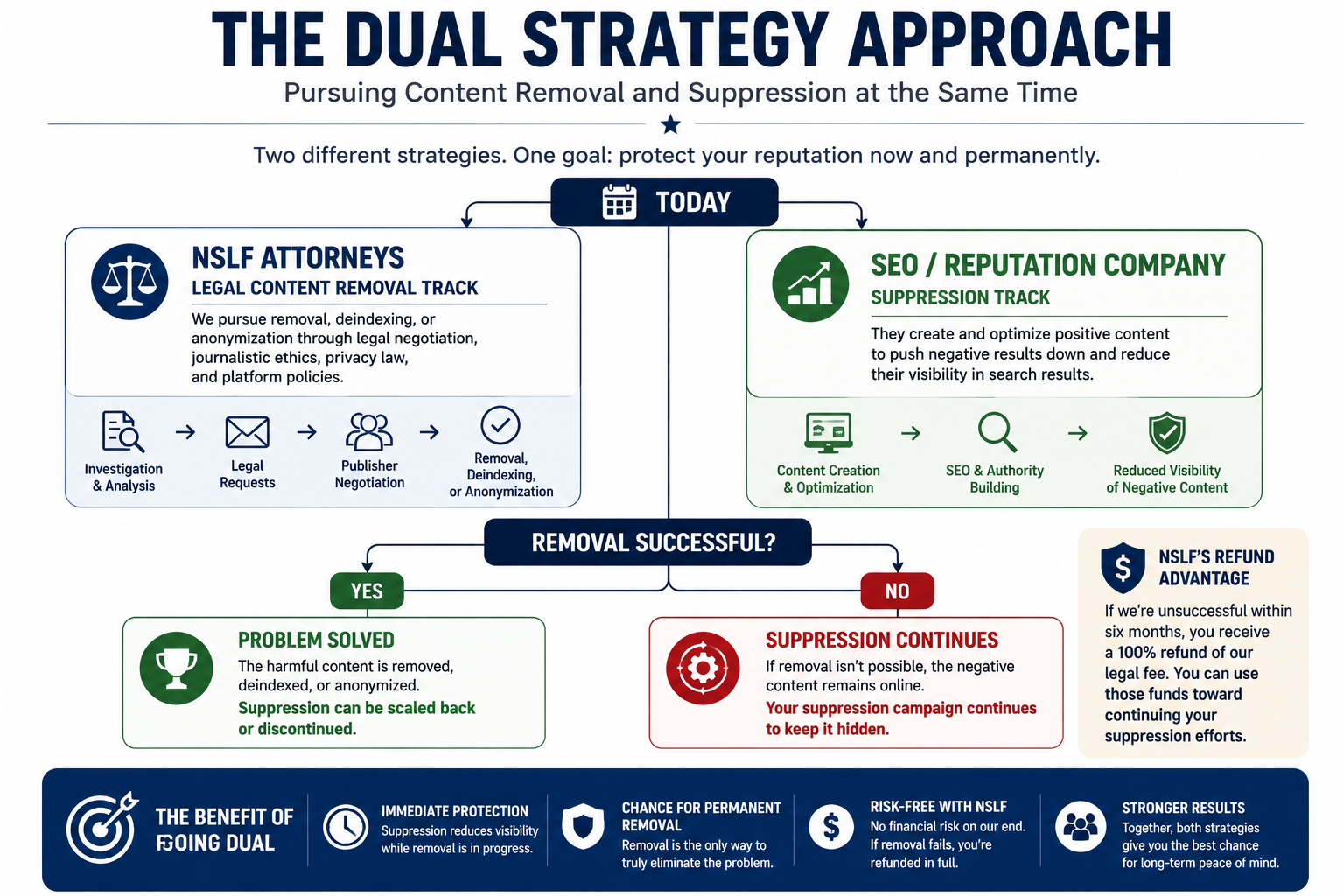
A dual strategy simply means pursuing legal content removal and SEO suppression at the same time. Each strategy serves a different purpose.
Our attorneys focus on removal, deindexing, anonymization, publisher negotiations, and legal and policy advocacy.
SEO and reputation management companies focus on creating positive online content, improving search visibility, building websites and profiles, and reducing the visibility of negative search results.
One strategy attempts to permanently solve the problem. The other attempts to reduce its visibility while that process is taking place. For certain clients, combining both approaches can make sense.
When Does a Dual Strategy Make Sense?
For many people, we believe pursuing removal first is the smartest and most cost-effective approach. However, there are situations where time matters.
An Important Employment Opportunity — A background investigation or job interview is approaching. You need immediate reputation management while removal efforts continue.
Professional Licensing — You’re applying for a professional license, security clearance, or government position. Every day matters.
A Business Launch — You’re launching a business, running for public office, announcing a new venture, or expecting significant publicity. You don’t want damaging content dominating search results while removal efforts are underway.
Multiple High-Visibility Articles — Several publishers are involved. Some may respond quickly. Others may not. Suppression can help reduce the visibility of remaining articles while removal efforts continue.
Why We Usually Recommend Removal First
Even when clients ultimately pursue both strategies, we generally recommend beginning with removal whenever there’s a legitimate opportunity. Here’s why.
If removal is successful, you’ve permanently eliminated the problem. If removal isn’t successful, suppression remains available. The reverse isn’t true. If you begin with suppression alone, you’ll never know whether permanent removal was possible. That’s one of the reasons we’ve structured our practice differently.
Why Our Business Model Supports a Dual Strategy
One of the concerns clients often have is paying twice. They worry they’ll spend money pursuing removal, then spend even more on suppression if removal isn’t successful. We understand that concern. That’s why our business model is different. If we’re unsuccessful under the terms of our representation agreement, we refund our legal fee in full. That gives clients flexibility. If removal succeeds, they’ve achieved what we believe is the strongest possible outcome. If removal isn’t successful, they receive their legal fee back and can use those funds toward suppression or another solution if they choose. We believe that allows clients to pursue the strongest opportunity first without permanently risking the money they invested in trying.
Who Handles Suppression?
This is an important distinction. National Security Law Firm does not provide suppression services. We’re attorneys. Our practice focuses exclusively on removal, deindexing, anonymization, publisher negotiations, and legal advocacy. Suppression is generally performed by SEO and online reputation management professionals. When appropriate, clients may choose to hire a separate suppression provider while we continue pursuing removal. Because the two services involve different skill sets, they’re often handled by different professionals.
A Real-World Example
Imagine a physician preparing for a credentialing review in six weeks. An old news article still appears near the top of Google. Waiting several months for suppression alone may not be fast enough. Instead, the physician hires National Security Law Firm to pursue removal while simultaneously hiring an SEO company to begin suppression efforts. If our attorneys successfully negotiate removal or deindexing, the article disappears from search results. If that doesn’t happen, the suppression campaign is already underway. The physician benefits from both immediate reputation management and the opportunity for a permanent solution.
Is a Dual Strategy Right for Everyone?
No. In many situations, we believe pursuing removal first is the simplest and most cost-effective approach. A dual strategy generally makes the most sense when timing is critical, multiple publishers are involved, the potential consequences of waiting are significant, or immediate reputation management is needed while legal removal efforts continue. Every situation is different. That’s why we discuss these options during your consultation rather than recommending the same strategy for every client.
Key Takeaway
Removal and suppression aren’t competing strategies. They’re different tools designed to accomplish different goals. Whenever there’s a legitimate opportunity, we generally recommend pursuing removal first. In situations where timing is critical, pursuing removal and suppression simultaneously may provide both immediate reputation management and the opportunity for a permanent solution.
Continue Exploring
👉 Content Removal Lawyers
📖 Complete Guide to Content Removal
📚 Content Removal Resource Center
❓ Frequently Asked Questions
📅 Schedule a Free Consultation