
If you’ve been researching content removal, you’ve probably come across the word deindexing. It’s one of the most misunderstood terms in online reputation management. Many people hear the word and immediately assume it means: “The article couldn’t be removed.” In reality, that’s often not the case. For many clients, deindexing accomplishes exactly what they care about most: when someone searches their name on Google, the article is no longer there.
In This Guide
You’ll learn: what deindexing actually means; how search engines decide what appears in search results; the difference between removal and deindexing; why deindexing is often just as valuable as complete removal; when Google can remove search results; when websites can remove search results; and why National Security Law Firm often pursues deindexing when complete removal isn’t possible.
What Is Deindexing?
Deindexing means a webpage no longer appears in search engine results, even though it may still exist on the original website.
In other words, the page is removed from the searchable indexes used by major search engines such as Google, Bing, Yahoo, and others.
Think of a search engine’s index like the index at the back of a textbook.
The index doesn’t contain the information itself.
It simply tells you where to find it.
Search engines work much the same way.
They constantly scan billions of webpages across the internet, store information about those pages in searchable indexes, and display the pages they believe are most relevant when someone performs a search.
When a page is deindexed, search engines are instructed to remove that page from their searchable indexes.
The webpage itself may still exist on the original website.
But it no longer appears in search results when someone searches your name or other relevant terms.
For most people, that’s exactly how online content is found in the first place.
That’s why deindexing is often one of the most valuable outcomes in content removal.
Why That’s Such a Big Deal
Most people don’t visit a newspaper’s website and manually search years of archived articles. They use Google. Employers use Google. Neighbors use Google. Business partners use Google. Professional licensing boards use Google. Friends use Google. If an article no longer appears when someone searches your name, you’ve often accomplished the practical goal that mattered most in the first place. That’s why we often tell clients: for many people, deindexing is functionally “as good as gone.”
How Does Deindexing Actually Work?
There are generally two ways a page becomes deindexed.
Option 1: Website-Initiated Deindexing (The Most Common)
This is the type of deindexing our attorneys pursue most often. The publisher adds a small piece of code to the webpage called a “noindex” meta tag. That instruction tells search engines: “Do not include this page in search results.” Google’s search crawlers periodically revisit the page. When they discover the noindex instruction, they remove the page from Google’s searchable index. The article remains on the publisher’s website. But it no longer appears in Google, Bing, Yahoo, or most other major search engines. For many clients, this is an outstanding outcome.
Option 2: Google-Initiated Removal
Sometimes Google itself will remove a search result under its published content removal policies. Examples include certain privacy violations, non-consensual intimate imagery, doxxing, certain exploitative websites, copyright claims, and other limited legal circumstances. These situations are much less common than publisher-based deindexing. In the overwhelming majority of U.S. content removal matters, the publisher—not Google—is the decision-maker.
Does Deindexing Remove the Article?
No. The article usually remains on the publisher’s website. That’s one of the biggest misconceptions about deindexing. The article still exists. What’s changed is how people find it. Instead of appearing in Google when someone searches your name, the page simply isn’t returned as a search result.
Can Someone Still Find a Deindexed Article?
Technically, yes—but only under limited circumstances. Generally speaking, someone would need to already know the exact web address (URL), or visit the publisher’s website directly and manually search its archives. For the overwhelming majority of people, neither of those things ever happens. That’s why deindexing is often so effective.
Deindexing vs. Removal
Many people assume complete removal is the only successful outcome. We don’t. Whenever there’s a legitimate opportunity, complete removal is always our first objective. But when complete removal isn’t possible, deindexing is often the next best outcome.
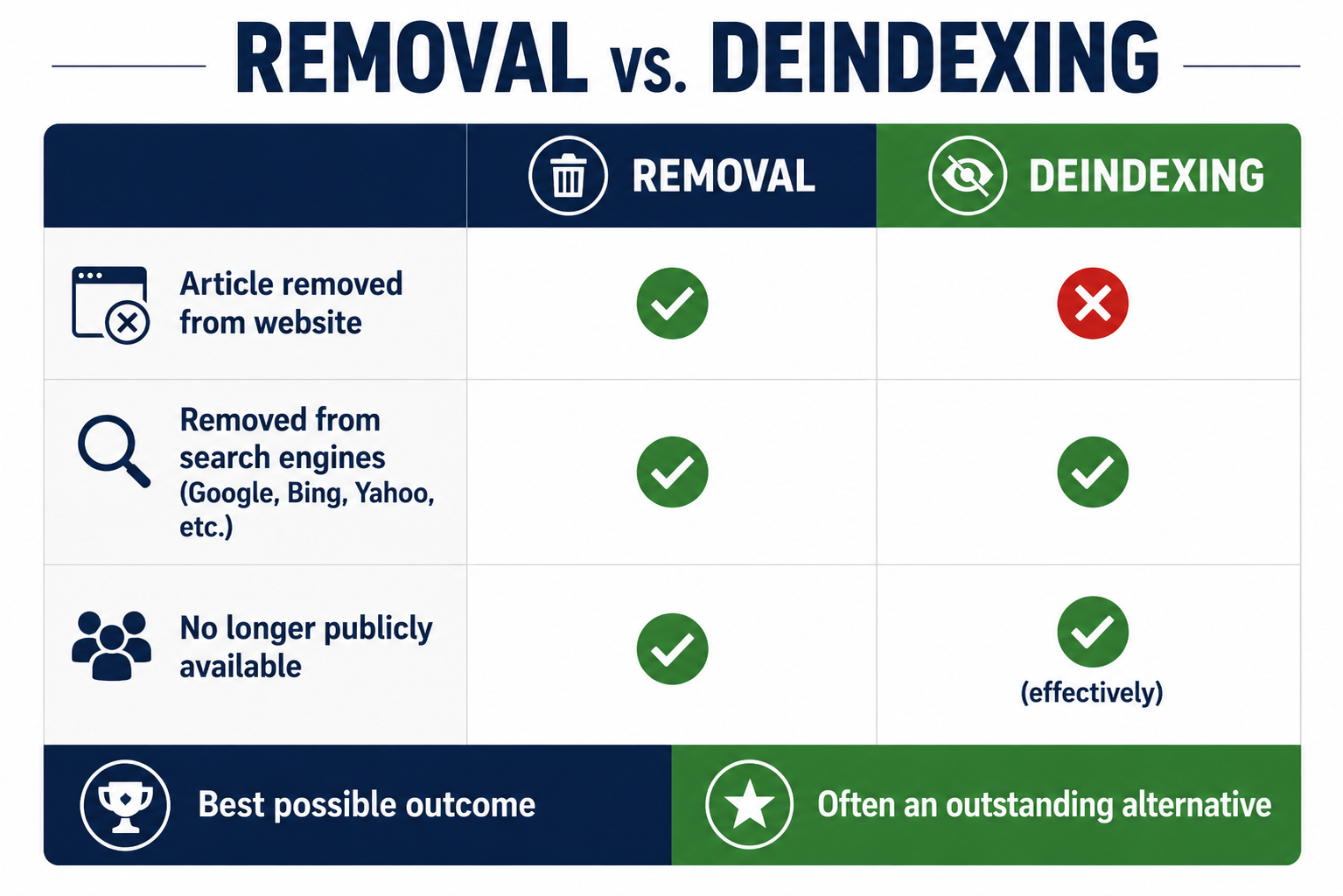
For many clients, both outcomes accomplish the same practical goal: people searching their name no longer find the article.
Why We Often Pursue Deindexing
One of the biggest misconceptions about content removal is that every case ends with either complete removal or failure. In reality, there are often excellent middle-ground solutions. Some publishers will never delete an article. But they may be willing to remove your name, add a noindex tag, or anonymize the article. Those outcomes can dramatically reduce the ongoing harm while preserving the publisher’s editorial interests. That’s why our attorneys evaluate every legitimate opportunity—not just complete removal. Our goal is always to achieve the strongest outcome available for each client and each publisher.
Key Takeaway
Complete removal is always our first choice. When that isn’t possible, deindexing often accomplishes what matters most: the article no longer appears when someone searches your name online.
What Should You Do Next?
If you’re wondering whether your article could be removed or deindexed, the first step is determining who controls the content and what strategies may be available. During a consultation, one of our attorneys can evaluate the publisher, the type of content, whether deindexing may be possible, whether complete removal should be pursued instead, and which strategy gives you the strongest opportunity for success. If we don’t believe we can meaningfully help, we’ll tell you. If we do, we’ll explain why.
Continue Exploring
👉 Content Removal Lawyers
📖 Complete Guide to Content Removal
📚 Content Removal Resource Center
❓ Frequently Asked Questions
📅 Schedule a Free Consultation