
Security clearance subject interviews are one of the most misunderstood parts of the clearance process.
Most applicants believe the interview is simply an opportunity to answer questions and clarify information. In reality, it is something far more significant.
It is where your credibility is assessed.
Inside the federal clearance system, decisions are not made based on how persuasive someone sounds after the fact. They are made based on a documented record created during the investigation. That record is later evaluated by adjudicators applying the Adjudicative Guidelines and the whole-person concept.
Subject interviews play a central role in building that record.
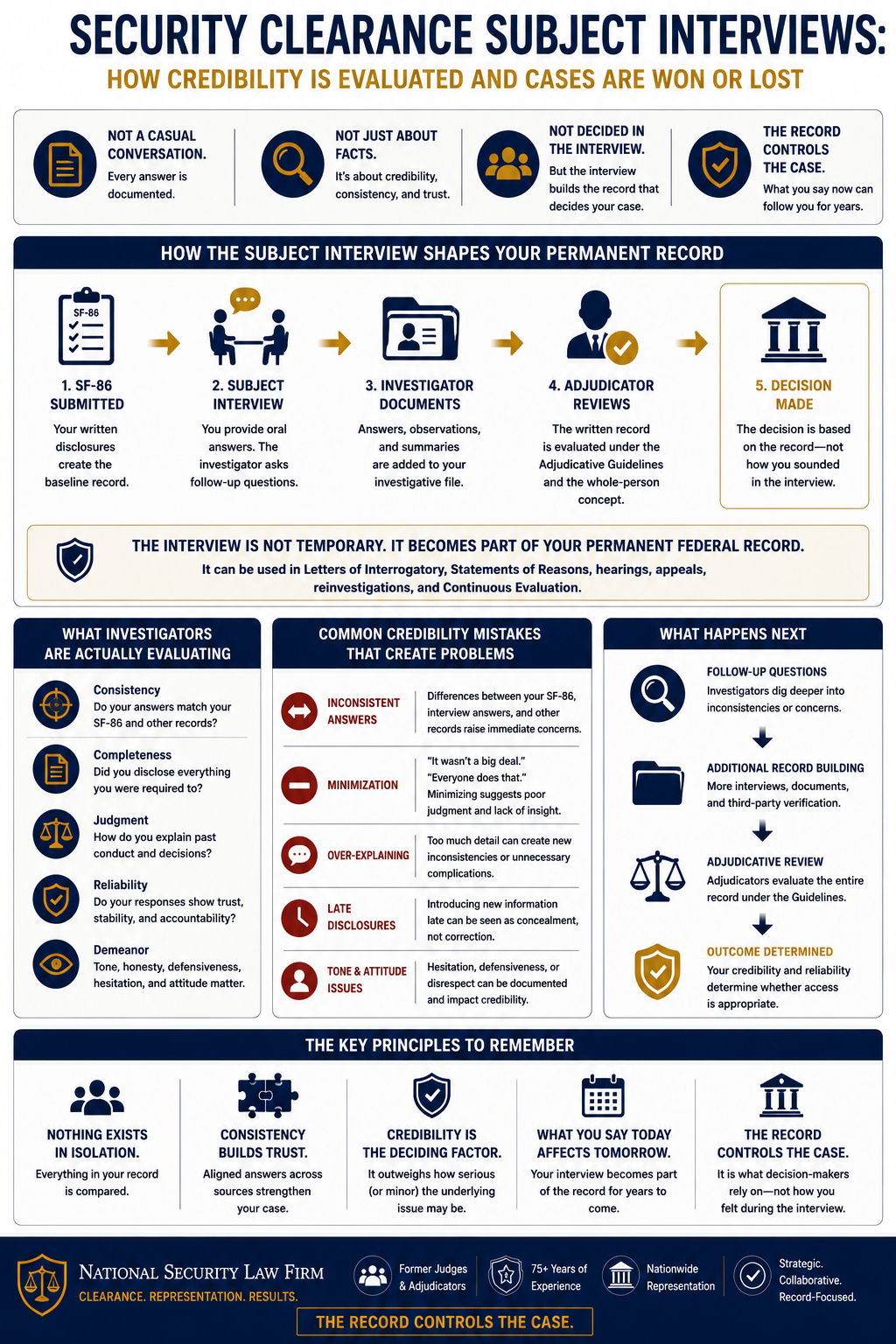
At National Security Law Firm, our attorneys include former clearance adjudicators, administrative judges, and Department of Defense attorneys who have reviewed these records from inside the system. From that perspective, one pattern is clear:
Many clearance cases are effectively decided during the investigation—before adjudication ever begins.
This guide explains how subject interviews actually work, what investigators are evaluating, and how small mistakes can become long-term clearance problems.
Where Subject Interviews Fit in the Security Clearance Process
Subject interviews occur during the background investigation phase, after submission of the SF-86.
You can see how this stage fits into the broader lifecycle in the
Security Clearance Process.
At this stage, investigators are tasked with:
- verifying disclosures
- resolving inconsistencies
- identifying risk indicators
- documenting relevant facts
The investigator does not make the clearance decision.
However, they control something just as important:
They create the written record that decision-makers rely on.
What a Security Clearance Subject Interview Actually Is
A subject interview is a structured, recorded conversation between you and a federal investigator.
It is typically conducted:
- in person, by phone, or via secure video
- after initial background checks
- once investigators identify areas requiring clarification
The interview may last:
- one to three hours
- longer in more complex cases
Topics commonly covered include:
- financial issues
- foreign contacts and travel
- criminal history
- drug or alcohol use
- employment history
- discrepancies in your SF-86
Although it may feel conversational, it is not informal.
Every relevant statement may be summarized and included in your investigative file.
What Investigators Are Actually Evaluating
Applicants often prepare for interviews by focusing on facts.
Investigators are focused on something else:
credibility and consistency.
They are evaluating:
- whether your statements match your SF-86
- whether your answers align with other sources
- whether you disclose information voluntarily
- how you explain past conduct
- whether your responses suggest reliability
They are also observing:
- hesitation
- tone
- defensiveness
- attempts to minimize
These observations are not written as “opinions.”
They are embedded into how your answers are documented.
That documentation is what adjudicators later review.
The Most Important Reality: The Interview Creates the Record
The subject interview is not temporary.
It becomes part of a permanent investigative file.
As explained in
The Record Controls the Case,
information from your interview may later appear in:
- Letters of Interrogatory
- Statements of Reasons
- clearance hearings
- appeals
- reinvestigations
- Continuous Evaluation
You can learn how ongoing monitoring works in
Continuous Evaluation
This is why subject interviews are not just “part of the process.”
They are one of the most important record-building stages in the entire clearance system.
How Subject Interviews Influence Clearance Decisions
Adjudicators do not attend your interview.
They rely entirely on the written record.
That means your statements are filtered through:
- investigator summaries
- report language
- context provided in the file
When adjudicators evaluate your case, they are asking:
- Is this person credible?
- Are their statements consistent?
- Do their explanations make sense over time?
- Does the record support trust going forward?
Even when the underlying issue is minor, credibility concerns can escalate the case.
This is why two applicants with similar histories can have very different outcomes.
The Most Common Credibility Failures in Subject Interviews
Across clearance cases, certain patterns appear repeatedly.
Inconsistent Answers
Differences between:
- SF-86 disclosures
- interview responses
- third-party interviews
These inconsistencies are often interpreted under
Guideline E — Personal Conduct
Minimization
Statements such as:
- “it wasn’t a big deal”
- “everyone does that”
- “I didn’t think it mattered”
From an adjudicator’s perspective, minimization suggests poor judgment—not rehabilitation.
Over-Explaining
Attempting to “talk through” an issue often introduces:
- new inconsistencies
- unnecessary details
- confusion in the record
Late Disclosures
Introducing new information during or after the interview can be interpreted as:
- correction
or - concealment
The difference depends on how the record reads.
Tone and Demeanor Issues
Investigators document more than content.
They capture:
- cooperation
- responsiveness
- attitude
These factors influence how answers are interpreted later.
How Small Interview Mistakes Become Major Clearance Problems
Most applicants assume that if something goes wrong during the interview, they can fix it later.
In practice, the opposite is usually true.
By the time a clearance case escalates:
- the interview has already been completed
- the investigator has already documented the answers
- the narrative has already been formed
What felt like a minor issue at the time—an unclear answer, a small inconsistency, a delayed disclosure—may later appear in the record as:
- lack of candor
- inconsistent reporting
- credibility concerns
These issues are not introduced during adjudication.
They are carried forward from the investigation.
This is why many clearance cases become difficult before adjudicators ever review them.
When This Becomes a Real Problem in Your Case
Most applicants do not realize there is a problem until they receive a Statement of Reasons.
By that point:
- the interview has already shaped the record
- inconsistencies have already been documented
- credibility concerns are already embedded
What could have been addressed early becomes significantly harder to correct.
This is the point where many cases shift from manageable to defensive.
Why Waiting Makes This Worse
Security clearance cases are not decided in a single moment.
They are built over time.
The statements you make during your subject interview may later be:
- compared against new information
- reinterpreted during adjudication
- reviewed during Continuous Evaluation
- reused in future investigations
This is why early-stage issues—especially those involving credibility—tend to expand rather than resolve on their own.
Waiting does not make the issue disappear.
It allows the record to become more fixed.
Real-World Examples: How Subject Interviews Shape Clearance Outcomes
Understanding how subject interviews affect real cases is critical.
Below are simplified examples that reflect how adjudicators actually evaluate credibility inside the system.
Example 1: The “Minor Inconsistency” That Became a Guideline E Issue
An applicant disclosed past drug use on the SF-86.
During the subject interview, the applicant:
- described the frequency differently
- gave slightly different dates
- minimized the significance
From the applicant’s perspective, nothing major had changed.
From the investigator’s perspective:
- the story was inconsistent
- the applicant appeared to be adjusting details
- credibility became the issue—not the drug use
The issue was later framed under
Guideline E — Personal Conduct
Outcome: The case became significantly harder to mitigate—not because of the conduct, but because of how it was explained.
Example 2: The “Helpful Explanation” That Created New Problems
An applicant was asked about financial issues.
Instead of answering directly, they:
- provided a long explanation
- introduced additional details not previously disclosed
- speculated about events they were unsure about
This created:
- new inconsistencies
- confusion in the record
- additional follow-up questions
The original issue was manageable.
The expanded narrative created multiple new concerns.
Outcome: The case escalated into further investigation and delayed adjudication.
Example 3: The “Late Disclosure” That Looked Like Concealment
During the interview, an applicant remembered an issue not included on the SF-86.
They disclosed it mid-interview.
From the applicant’s perspective:
- they were being honest
From the investigator’s perspective:
- the information was omitted initially
- the timing raised questions
- intent became unclear
Outcome: The issue shifted from the underlying conduct to a potential credibility concern.
Example 4: The “Calm and Consistent” Case That Was Approved
Another applicant had:
- financial issues
- a past arrest
During the interview, they:
- provided consistent answers
- acknowledged the issues directly
- avoided minimizing
- aligned with their SF-86
The record showed:
- consistency
- accountability
- reliability
Outcome: Despite the underlying issues, the case was approved.
What These Examples Show
Across cases, one pattern is consistent:
👉 The issue itself is not always decisive
👉 How it is documented and explained often is
This is why subject interviews matter.
Preparing for a Subject Interview (What Actually Matters)
Preparation is not about scripting answers.
It is about alignment.
Review Your SF-86
Your SF-86 is the baseline document investigators use.
Review it carefully before the interview.
For deeper guidance, see
SF-86 Strategy
Identify Risk Areas
Focus on areas that commonly raise questions:
- finances
- foreign contacts
- past conduct
- inconsistencies
Understand Your Timeline
Be clear on:
- dates
- sequences of events
- prior disclosures
Uncertainty leads to inconsistency.
Avoid Minimization and Overcorrection
Neither extreme helps.
Clarity and accuracy matter more than persuasion.
Think in Terms of the Record
Ask yourself:
👉 “How will this sound when written down and read later?”
When Subject Interviews Lead to Escalation
If concerns arise during the interview, the case may escalate into:
- Letters of Interrogatory
- Statements of Reasons
- administrative hearings
- appeals
At that point, the interview becomes the foundation of the issue.
Cascading Federal Consequences
Interview statements do not only affect clearance eligibility.
They can also impact:
- federal employment
- contractor eligibility
- internal agency decisions
- future clearance opportunities
This is why subject interviews must be approached as part of a broader federal system.
Why National Security Law Firm Is Different
Security clearance cases are not typical legal disputes.
They are risk determinations made inside a federal system.
National Security Law Firm is built specifically for that system.
Our team includes:
- former clearance adjudicators
- former administrative judges
- former DOHA attorneys
We analyze cases the same way decision-makers do:
- evaluating credibility
- identifying record risk
- structuring defensible explanations
Complex matters are reviewed through our
Attorney Review Board
This collaborative model mirrors how agencies evaluate cases internally.
Security Clearance Interview Strategy & Risk Library
Understanding subject interviews requires more than knowing what questions are asked.
It requires understanding how answers are evaluated, how credibility is formed, and how small issues become formal clearance problems.
The resources below break down the most critical aspects of subject interviews and how they affect clearance outcomes.
What Investigators Actually Evaluate
These articles explain how investigators interpret your answers and what they are looking for beyond the surface level:
- Security Clearance Subject Interviews: What Investigators Ask and How Your Answers Are Evaluated
- What Investigators Flag Before Adjudicators Ever See Your Case
Interview Mistakes That Create Clearance Problems
These are the most common ways applicants unintentionally damage their case during the interview:
- Top Security Clearance Interview Mistakes That Trigger Credibility Problems
- What Not to Say in a Subject Interview
- Why “Just Answer the Question” Is Bad Advice in Clearance Interviews
- How Innocent Interview Answers Turn Into Guideline E Problems
- Inconsistent Answers Between the SF-86 and the Interview
What Happens During and After the Interview
These explain how the interview actually unfolds and what happens next:
- What to Expect During a Security Clearance Interview
- How to Prepare for a Security Clearance Interview
- Why Silence After a Security Clearance Interview Is a Red Flag
High-Risk Situations That Require Careful Handling
These situations can significantly affect how your case is evaluated:
- Can You Have a Lawyer Present at a Clearance Interview?
- What Happens If You Refuse to Answer Questions at a Security Clearance Subject Interview?
Frequently Asked Questions (FAQs)
What questions do investigators ask during a security clearance interview?
Investigators focus on areas that may affect national security risk, including finances, foreign contacts, criminal history, substance use, and inconsistencies in your SF-86.
However, the specific questions are less important than how your answers are evaluated. Investigators are looking for consistency, completeness, and credibility across all sources of information.
What happens if my interview answers do not match my SF-86?
Inconsistencies between your SF-86 and your interview are one of the most common triggers for additional scrutiny.
Even small differences can lead to concerns under
Guideline E — Personal Conduct
These inconsistencies may later appear in:
- Letters of Interrogatory
- Statements of Reasons
- hearing records
Can I clarify or correct something after the interview?
Yes—but corrections can be risky.
If handled properly, they can strengthen credibility.
If handled poorly, they can be interpreted as:
- concealment
- changing stories
- lack of candor
The context and timing matter.
Do investigators record subject interviews?
Interviews are typically not recorded verbatim, but investigators take detailed notes and prepare summaries that become part of the official record.
Those summaries are what adjudicators rely on—not your memory of what was said.
Can I refuse to answer certain questions?
Refusing to answer questions can raise concerns about:
- cooperation
- transparency
- reliability
In some cases, refusal may negatively impact clearance eligibility.
Can I bring a lawyer to a security clearance interview?
Generally, no.
However, preparation with experienced counsel before the interview can significantly affect how issues are handled and documented.
What matters more: what I say or what others say about me?
Both matter—but inconsistencies between them are often what create problems.
Investigators compare:
- your statements
- reference interviews
- employer responses
- database records
The alignment between these sources is critical.
How long does a subject interview last?
Most interviews last between one and three hours, but complex cases may take longer.
Can a good interview fix problems in my record?
Sometimes—but only if the explanation is:
- consistent
- credible
- aligned with other evidence
A good interview can help.
A poor interview can make the case significantly worse.
What is the biggest mistake people make in subject interviews?
The most common mistake is not understanding that the interview is building a permanent record.
Applicants often focus on “getting through the conversation” instead of ensuring their statements are:
- consistent
- accurate
- defensible later
Security Clearance Lawyer Pricing
NSLF offers transparent flat-fee pricing for:
- SF-86 review
- LOI responses
- SOR responses
- hearings
Learn more:
Speak With a Security Clearance Lawyer Before the Record Is Locked In
Most people seek help after receiving a Statement of Reasons.
At that point, the record is already written.
The subject interview is one of the last stages where your case is still being shaped—not just evaluated.
If your situation involves:
- inconsistencies in your SF-86
- uncertainty about how your answers were documented
- follow-up questions from investigators
- concerns about how your interview may be interpreted
this is the stage where strategy has the greatest impact.
National Security Law Firm is built specifically for the federal clearance system. Our attorneys—including former adjudicators, administrative judges, and DOHA attorneys—evaluate cases the same way decision-makers do.
You can
👉 Schedule a Free Consultation
The Record Controls the Case.