
Federal cases are not always decided by the underlying allegation alone. Decision-makers may also evaluate what the record suggests about your future judgment, reliability, credibility, vulnerability, and risk.
National Security Law Firm was built to analyze all of it.
★★★★★ 4.9 Stars From 300+ Google Reviews
Former Judges, Prosecutors, Agency Counsel, and Military Leaders · Nationwide Representation · Veteran Founded
The Government May Be Asking a Different Question Than You Think
When people face a federal investigation, adverse action, clearance concern, or eligibility decision, they naturally focus on one question:
What happened?
The government may be asking additional questions:
- What do these facts suggest about the person’s judgment?
- Was the person candid, complete, and consistent?
- Does the conduct reveal a continuing vulnerability or reliability concern?
- Has the underlying problem been corrected?
- Is the issue likely to happen again?
- Can a favorable decision be justified if it is later reviewed?
The facts and the law matter. In some cases, allegations should be directly challenged, evidence should be disputed, and procedural or legal errors should be exposed.
But in many federal proceedings, that is only part of the work.
The government may also be deciding whether it can responsibly continue to trust, employ, clear, credential, promote, retain, or do business with a person or organization.
That distinction can change the entire strategy.
An explanation that addresses only the triggering event may leave the government’s real concern unresolved. Effective representation requires identifying both the stated allegation and what that allegation may mean to the people making the decision.
We call that identifying the concern behind the concern.
Your Case May Be Evaluated From Several Government Perspectives
Federal decisions are rarely made in a vacuum. A matter may pass through several people, offices, and levels of review. Each may evaluate the same record for a different purpose.
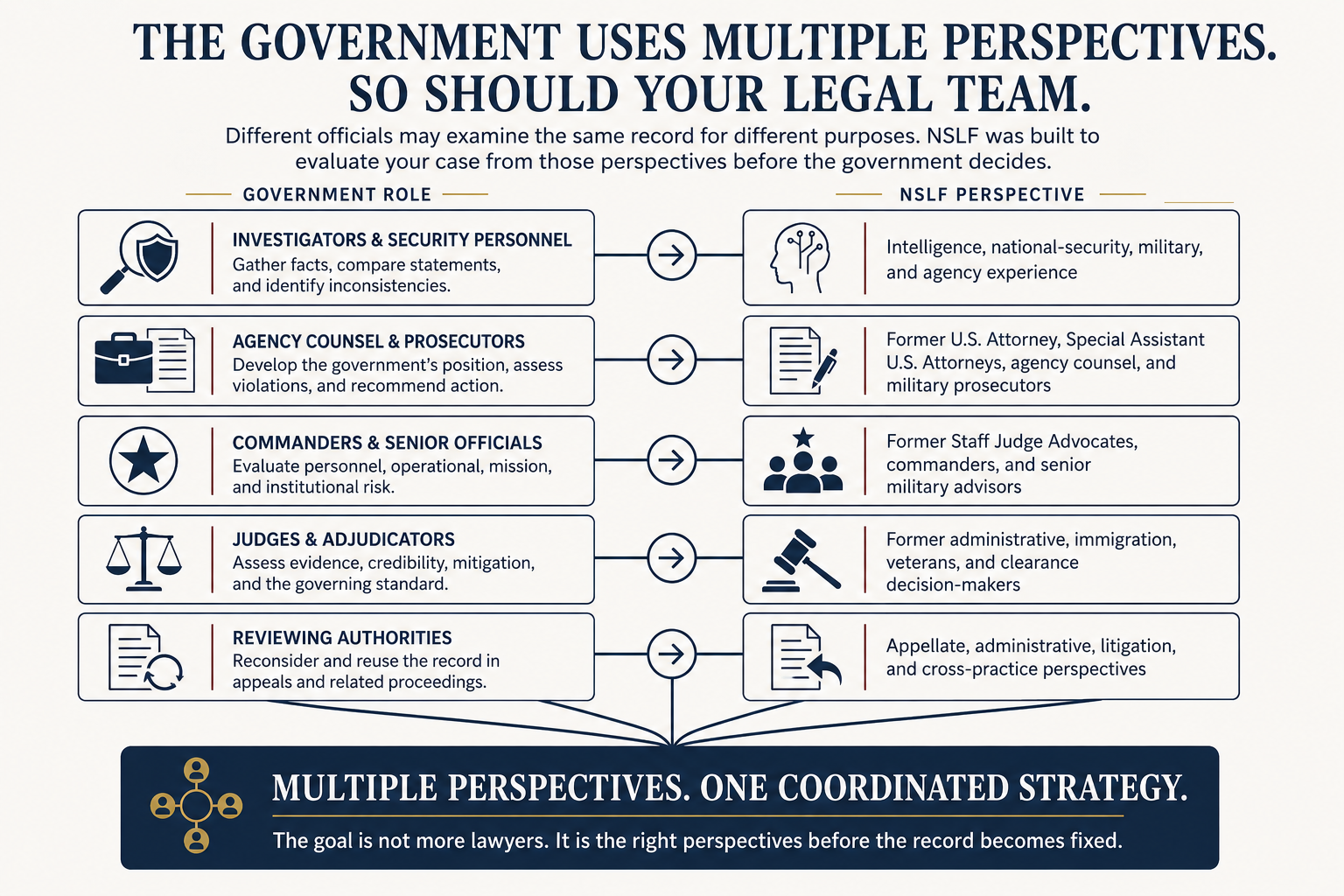
Your case may pass through several of these perspectives. NSLF was deliberately built to evaluate it from more than one.
That matters because a statement that appears helpful at one stage may create a credibility problem at another. A narrow response to an employment allegation may unintentionally create a security-clearance issue. A military administrative action may affect a future promotion, discharge characterization, clearance, federal position, or professional credential.
The earlier those connections are identified, the more options may remain available.
Federal Decisions Can Be Both Backward-Looking and Forward-Looking
Every federal system has its own statutes, regulations, procedures, and legal standards. A security-clearance adjudication is not the same as a federal employment action, military proceeding, contractor-responsibility review, or Trusted Traveler Program determination.
But many discretionary government decisions include a forward-looking component.
Decision-makers may examine past events to determine what they suggest about the future:
- A financial problem may raise questions about judgment, stability, or vulnerability.
- An omission or inconsistent statement may become a concern about candor or reliability.
- An isolated incident may prompt questions about recurrence, accountability, or rehabilitation.
- A foreign relationship or outside interest may be examined for possible conflict, influence, or divided obligation.
- A workplace or military incident may raise broader concerns about leadership, professionalism, or continued confidence.
- A contractor violation may cause an agency to question present responsibility and the effectiveness of corrective measures.
This does not mean the government’s interpretation is always correct. It does not mean every allegation should be accepted or every case should be approached as a mitigation case.
It means the strategy must account for the decision the government is actually making.
Five Questions Government Decision-Makers May Ask
Although the exact legal standard varies, many government trust and eligibility decisions turn on five practical questions.
1. What concern does the record establish?
The starting point is not always the allegation as summarized in a notice or interview question. The complete record may reveal that the factual premise is incomplete, disputed, exaggerated, outdated, or unsupported.
The first task is to determine what the evidence actually shows—and what it does not.
2. What does the concern suggest?
The same event can be interpreted in several ways. Decision-makers may view it as evidence of poor judgment, dishonesty, unreliability, vulnerability, divided loyalty, lack of rehabilitation, or another institutional concern.
Unless that underlying inference is identified, a response may answer the facts without answering the case.
3. Is the person’s account credible and consistent?
Federal records are compared and reused. Forms, interviews, emails, investigative statements, disciplinary responses, applications, hearing testimony, and earlier submissions may later be read together.
Credibility therefore depends on more than sounding persuasive in one document. It depends on whether the account is accurate, complete, supported, and consistent across the life of the matter.
4. What has changed?
When a legitimate concern exists, assurances alone may not resolve it. Decision-makers may look for objective evidence of correction, rehabilitation, treatment, repayment, changed circumstances, training, compliance measures, accountability, or sustained stability.
Strong mitigation does not simply describe the past. It demonstrates why the future should be evaluated differently.
5. Can the favorable decision be justified?
Government officials operate within institutions. Their decisions may be reviewed by supervisors, agency counsel, inspectors, appellate authorities, auditors, or later adjudicators.
A strong record gives the decision-maker a defensible basis for ruling in the client’s favor under the applicable standard.
Effective Representation Addresses the Concern Behind the Concern
Clients understandably want the government to know that they are good people, that an event was out of character, or that a situation felt unfair.
Those points may be true and important. But they may not be enough.
The decision-maker may need evidence that answers a more specific institutional concern:
| What the client may want to say | What the government may need answered |
|---|---|
| “I am a good person.” | “Why does the current record support future trust and reliability?” |
| “This was a misunderstanding.” | “What evidence establishes what actually occurred?” |
| “It will never happen again.” | “What changed, and what objective evidence makes recurrence less likely?” |
| “The allegation is unfair.” | “Which facts, standards, or procedures undermine the proposed conclusion?” |
| “I already explained this.” | “Is the explanation consistent with every prior statement and document?” |
This is why effective federal representation may require several forms of work at once:
- challenging unsupported or inaccurate allegations;
- identifying the legal and procedural standards that control the decision;
- protecting credibility across interviews, forms, and written submissions;
- developing evidence that addresses the government’s actual concern;
- documenting corrective action and changed circumstances;
- anticipating collateral consequences in related federal systems; and
- building a record that remains defensible during later review.
The objective is not to make the client appear perfect. It is to present the most accurate, complete, credible, and legally relevant record possible.
Why the Record Matters
What is said early in a federal matter may shape what happens later.
An investigator may record a statement. Agency counsel may compare it with documents or earlier disclosures. An adjudicator may rely on it when assessing credibility. A reviewing authority may later be limited to the record that already exists.
That is why waiting to “explain everything later” can be dangerous.
Later explanations may be interpreted as inconsistent, incomplete, or recently constructed—even when the person has an innocent reason for the difference. Important evidence may become harder to locate. Opportunities to preserve objections or correct assumptions may be lost. A response written for one proceeding may produce unintended consequences in another.
Before submitting a form, answering an investigative question, responding to an agency, or creating a written record, it is important to understand:
- who will read it;
- what legal standard that person will apply;
- what concern the response must resolve;
- how the response compares with the existing record; and
- where the same information may appear again.
The record does not merely describe the case. In many federal matters, the record becomes the case.
NSLF Was Built Around How the Federal Government Makes Decisions
Many law firms rely on one attorney to identify the issues, develop the theory, test the explanation, and approve the final work.
National Security Law Firm was structured differently.
Federal agencies frequently evaluate important matters through multiple roles and levels of review. Investigators gather facts. Agency counsel examines violations and legal exposure. Commanders and senior officials assess mission and personnel consequences. Judges and adjudicators evaluate evidence, credibility, and mitigation. Reviewing authorities consider the record already created.
We built a team capable of examining cases through those different perspectives.
Our attorneys include former government decision-makers, judges, adjudicators, federal and military prosecutors, defense counsel, agency attorneys, intelligence-law attorneys, commanders, Staff Judge Advocates, and senior military leaders.
Those backgrounds are not displayed merely as biographies. They can help our team ask better questions:
- What will an investigator notice?
- Where might agency counsel identify an inconsistency or legal violation?
- What personnel or mission concern may matter to a commander?
- What evidence will an adjudicator expect?
- What will a reviewing authority be permitted to consider later?
No prior position guarantees a result, and no two government officials will evaluate a case identically. The value lies in being able to test a case from several informed perspectives before a submission becomes part of the record.
The NSLF Attorney Review Board
The NSLF Attorney Review Board is a structured internal review process designed for significant federal matters.
Depending on the case and scope of representation, multiple attorneys may help:
- identify factual and legal weaknesses;
- challenge assumptions;
- test the credibility and consistency of an explanation;
- assess mitigation from different decision-maker perspectives;
- identify consequences outside the immediate proceeding; and
- refine the strategy before the response is submitted.
The purpose is not to add opinions for their own sake. It is to reduce blind spots.
One attorney may focus on defeating the immediate allegation. Another may recognize that the proposed response could create a security-clearance, military, employment, licensing, immigration, or future suitability problem. A former adjudicator may identify evidence that the ultimate decision-maker will expect but that has not yet been developed.
The government may review your case from more than one angle. We believe important federal matters can benefit from the same discipline.
One Federal Problem Can Affect More Than One Part of Your Life
Federal systems frequently intersect.
A security-clearance issue may threaten federal employment or contractor access. A military investigation may lead to administrative action, adverse records, clearance consequences, or separation. A federal employment response may later be reviewed during a suitability or credentialing determination. A criminal allegation may affect Global Entry, TWIC, immigration status, firearms rights, or professional opportunities.
A strategy that succeeds narrowly in one forum can still create broader damage if those consequences are overlooked.
NSLF’s focused federal practice allows our attorneys to identify potential intersections early and coordinate strategy across related systems when appropriate.
That does not mean every possible consequence will apply to every client. It means the case should be evaluated broadly enough to avoid solving today’s problem by creating tomorrow’s.
Where This Approach Matters
Security Clearances
Clearance adjudicators evaluate whether access to classified information is clearly consistent with national-security interests. The record may require careful attention to candor, consistency, mitigation, vulnerability, judgment, and recurrence.
Federal Employment
Adverse actions, investigations, suitability concerns, and disciplinary matters may involve both contested facts and broader questions about credibility, continued confidence, and the efficiency of the service.
Federal and Administrative Investigations
Investigative interviews and early written statements can shape the government’s narrative before formal charges or proposed actions exist. Early guidance may help protect the record and preserve available options.
Military Administrative and Career Matters
Commanders, boards, and reviewing authorities may assess conduct alongside leadership, mission, retention, promotion, and future-service considerations. Military matters can also produce clearance and post-service consequences.
Suitability and Credentialing
Suitability, fitness, credentialing, and other trust determinations may turn on the nature of the concern, the surrounding circumstances, candor, rehabilitation, and the relationship between the conduct and the position or credential.
Global Entry and Trusted Traveler Programs
Trusted Traveler Program decisions involve an assessment of whether an applicant satisfies the government’s low-risk eligibility requirements. An effective response must address the specific basis for the denial or revocation.
Contractor Responsibility and Debarment
Contractor matters may focus on present responsibility, compliance, cooperation, corrective measures, and whether the government can continue to rely on an individual or organization performing federal work.
What a Strong Federal Case Record Looks Like
A strong case does not require perfect facts. It requires a record that gives the decision-maker a legally and factually defensible basis for the requested outcome.
Depending on the proceeding, that may include:
- a clear and accurate account of the relevant facts;
- consistency across forms, interviews, documents, and testimony;
- direct treatment of unfavorable evidence;
- meaningful supporting documentation;
- mitigation connected to the government’s actual concern;
- proof of rehabilitation, correction, or changed circumstances where relevant;
- preserved legal and procedural objections;
- recognition of related or downstream consequences; and
- a presentation organized around the standard the decision-maker must apply.
Persuasion matters. But in federal practice, credibility and institutional defensibility often make persuasion possible.
Frequently Asked Questions
Does every federal matter involve a trust or risk determination?
No. Each federal proceeding has its own purpose and legal standard. Some cases turn primarily on disputed facts, statutory requirements, constitutional protections, procedural errors, or burdens of proof. However, many discretionary clearance, employment, military, suitability, credentialing, trusted-traveler, and contractor decisions also include a forward-looking evaluation of reliability, judgment, credibility, or risk.
Can one federal issue affect another?
Yes. Information created in one proceeding may be reported, compared, or considered in another. For example, an investigation may affect a clearance or federal position; a military action may affect future employment or records; and a criminal allegation may affect credentialing or Trusted Traveler Program eligibility. The possible consequences depend on the facts and governing system.
Should I speak with a lawyer before receiving a formal charge or denial?
It can be valuable to seek guidance early. Forms, interviews, investigative statements, responses to agency inquiries, and informal explanations can influence the record before a formal adverse decision is issued. Earlier advice may provide options that no longer exist after statements have been documented or deadlines have passed.
Will every NSLF matter be reviewed by multiple attorneys?
The appropriate staffing and review process depends on the nature of the matter and the scope of representation. Significant cases may receive collaborative review through the Attorney Review Board or other team-based processes. Your engagement agreement and legal team will explain the services included in your representation.
Does National Security Law Firm represent clients nationwide?
Yes. NSLF represents clients throughout the United States and, where permitted, clients located overseas. Because many federal matters can be handled remotely, clients can work with attorneys experienced in the relevant federal system regardless of geography.
What should I do before responding to the government?
Preserve the notice, correspondence, and relevant records. Identify every stated deadline. Avoid guessing, minimizing, or submitting an incomplete response simply to answer quickly. If possible, obtain advice before making statements or producing a written submission that may later be compared with other records.
Before You Respond, Understand What the Government Is Really Evaluating
The government may be evaluating more than the immediate allegation. It may be evaluating whether your explanation is credible, whether the concern has been resolved, whether future problems are likely, and whether a favorable decision can be defended.
National Security Law Firm helps clients identify those questions, protect the record, address the governing legal standard, and present the evidence that matters.
If you are facing a security-clearance concern, federal employment action, military matter, investigation, suitability or credentialing decision, Trusted Traveler Program issue, contractor-responsibility concern, or another high-stakes federal proceeding, speak with our team before an avoidable mistake becomes part of the record.
Nationwide Representation · Free Consultation · Online Scheduling Available
Contacting National Security Law Firm does not create an attorney-client relationship. Do not submit classified, confidential, or time-sensitive information through an unsecured website form. Prior results do not guarantee a similar outcome.