Most People Think Federal Legal Problems Exist in Isolation
They do not.
A security clearance issue is rarely just a security clearance issue. A proposed removal is rarely just an employment dispute. A contractor investigation rarely remains confined to procurement concerns alone. Statements made during one federal interview may later reappear years later in a completely different proceeding reviewed by entirely different decision-makers inside entirely different agencies.
Federal systems are interconnected.
That reality changes how these matters must be understood, approached, and defended.
At National Security Law Firm, we focus on understanding how federal systems actually function: how agencies evaluate trust, how credibility evolves, how records are built and reused over time, how institutional risk is assessed, and how decisions made in one process quietly shape outcomes in another.
Most people understandably enter these systems believing their case will revolve primarily around proving they are a good person, explaining a misunderstanding, correcting inaccurate information, or persuading an agency that they deserve another chance.
But federal systems are not primarily designed to determine whether someone is “good” or “bad.”
They are designed to determine whether the government can responsibly assume risk.
That distinction is one of the most important concepts in federal-system representation.
Across the federal government, agencies constantly make institutional decisions involving trustworthiness, reliability, judgment, discretion, vulnerability, consistency, candor, and future predictability. Security clearance adjudicators evaluate whether granting access to classified information can be justified and defended under the Whole-Person Concept. Federal agencies evaluate whether employees can continue serving in sensitive positions. Investigators document concerns that may later be reviewed by entirely different offices or agencies. Contractor oversight systems evaluate whether an individual or company demonstrates sufficient present responsibility to continue receiving government trust.
These systems often overlap in ways most people do not initially recognize.
A statement made during a security clearance subject interview may later appear in a federal employment matter. A disciplinary issue may affect future suitability determinations. A military administrative action may later influence civilian opportunities. Information disclosed on an SF-86 may later be compared against testimony, investigative summaries, contractor disclosures, or future agency submissions years later during continuous vetting, reinvestigations, or administrative reviews.
Federal systems remember.
And because they remember, the way a matter becomes documented is often just as important as the underlying allegation itself.
This is one of the most misunderstood realities in federal representation.
Many individuals focus almost entirely on the triggering event:
- the suspension,
- the interview,
- the accusation,
- the proposed removal,
- the Statement of Reasons,
- the contractor inquiry,
- or the administrative investigation.
But experienced federal decision-makers are often evaluating something much larger than the event itself. They are evaluating the evolving record surrounding that event. They are evaluating whether explanations remain consistent over time. They are evaluating whether the individual appears candid, reliable, cooperative, stable, and institutionally trustworthy. They are evaluating whether future reviewers, investigators, auditors, supervisors, or adjudicators could later defend continued trust in that individual if the matter is revisited years later.
That is why federal cases are frequently won or lost long before a hearing ever occurs.
The trajectory of many federal matters is shaped early:
- during interviews,
- inside written responses,
- through investigative summaries,
- within internal agency memoranda,
- during security clearance subject interviews,
- through contractor disclosures,
- and through the subtle ways credibility impressions begin to harden across the record.
Once concerns become embedded inside federal systems, they often do not remain confined to a single proceeding. They become part of an institutional history that may continue influencing future decisions across multiple federal environments.
Understanding how federal systems actually work changes how these matters should be approached.
It changes how records should be built.
It changes how disclosures should be handled.
It changes how investigations should be navigated.
It changes how mitigation should be framed.
And it changes how long-term federal risk should be evaluated.
That institutional understanding sits at the center of how National Security Law Firm approaches federal-system representation.
Federal Systems Are Institutional, Not Emotional
One of the biggest mistakes people make when entering federal systems is assuming these matters function like ordinary disputes between two opposing sides.
In reality, most federal systems are not primarily designed around emotion, sympathy, outrage, or even punishment alone.
They are designed around institutional risk management.
That distinction explains why federal outcomes often feel confusing, frustrating, or impersonal to the individuals experiencing them.
A security clearance adjudicator is not simply asking whether someone is patriotic. A federal agency is not merely deciding whether an employee made a mistake. A suspension and debarment official is not focused solely on whether a contractor violated a rule. An investigator is not always attempting to determine whether someone is morally good or bad.
Instead, federal systems are typically asking a different set of questions entirely:
- Can this individual be trusted moving forward?
- Does the record demonstrate reliability?
- Can continued access, employment, eligibility, or institutional trust be defended if later scrutinized?
- Would future reviewers view this person, contractor, or employee as predictable, stable, candid, and sufficiently low-risk?
- Can the agency responsibly justify continued trust?
Those are fundamentally institutional questions.
And once someone understands that, federal systems begin to make far more sense.
This is especially important because many people unintentionally damage their own cases by responding emotionally to systems that are operating institutionally. Individuals often assume the primary objective is to prove they are a good person, explain why something feels unfair, or persuade agencies that they deserve compassion.
While those considerations may matter at times, federal systems often place far greater weight on:
- consistency,
- judgment,
- mitigation,
- candor,
- future reliability,
- and whether concerns appear likely to recur.
That is why two people with similar underlying conduct can receive dramatically different outcomes.
Often, the difference is not the allegation itself.
The difference is how institutional risk appears across the record.
For example, federal systems frequently place enormous weight on:
- honesty during interviews,
- voluntary disclosures,
- consistency between statements,
- acceptance of responsibility,
- evidence of rehabilitation,
- responsiveness to concerns,
- willingness to cooperate,
- and whether future conduct appears predictable and manageable.
A person with significant past issues may still receive favorable outcomes if federal decision-makers believe the overall record demonstrates candor, stability, and credible mitigation. Conversely, relatively minor issues can become far more serious when agencies begin questioning credibility, judgment, reliability, or trustworthiness.
This is why many federal matters become less about the triggering event itself and more about how the event was handled afterward.
In security clearance matters, for example, adjudicators often evaluate whether concerns have been sufficiently mitigated under the Adjudicative Guidelines and the Whole-Person Concept. In federal employment matters, agencies may evaluate whether an employee’s conduct affects the efficiency of the service, institutional trust, or the agency’s confidence moving forward. In suspension and debarment proceedings, officials frequently focus on present responsibility rather than punishment for past conduct alone.
Across these systems, the common thread is institutional confidence.
Federal agencies must be able to justify their decisions internally. Supervisors, adjudicators, investigators, review boards, inspectors, auditors, and future decision-makers may all later revisit the same file. That reality naturally pushes federal systems toward cautious, documentation-driven decision-making structures.
As a result, federal systems frequently reward:
- credibility,
- consistency,
- preparation,
- mitigation,
- institutional awareness,
- and long-term thinking.
They frequently punish:
- contradictions,
- omissions,
- impulsive responses,
- defensive minimization,
- credibility erosion,
- and poorly coordinated explanations across different proceedings.
Understanding this changes the way effective federal representation must be approached.
It changes how interviews should be prepared for. It changes how disclosures should be framed. It changes how mitigation should be documented. It changes how records should be developed over time. And it changes how long-term institutional trust should be rebuilt.
At National Security Law Firm, we believe many federal cases become clearer once individuals understand that these systems are not primarily emotional systems.
They are institutional systems designed to evaluate future risk, defensibility, and trust.
The Record Often Matters More Than the Argument
One of the most important realities in federal systems is that agencies do not simply evaluate isolated moments.
They evaluate records.
Those records often evolve over years, move between offices and agencies, and become part of larger institutional histories that future decision-makers may revisit long after the original issue appears resolved.
This is one of the biggest differences between federal systems and many traditional legal disputes.
In ordinary litigation, people often focus primarily on the hearing, the trial, the lawsuit, or the final argument presented to a judge or jury.
Federal systems frequently function differently.
In many federal matters, the record itself gradually becomes the case.
Investigators prepare summaries. Agencies generate memoranda. Supervisors document concerns. Interview notes become part of official files. Security clearance disclosures are retained and compared over time. Prior statements are revisited during future investigations, reinvestigations, suitability reviews, contractor evaluations, Inspector General inquiries, credentialing processes, and administrative proceedings.
That process creates a cumulative institutional record that often carries enormous weight.
This is particularly important because federal systems are heavily dependent on consistency. Agencies frequently compare:
- present statements against prior disclosures,
- interviews against written submissions,
- testimony against investigative records,
- contractor certifications against agency findings,
- and explanations given years apart.
Inconsistencies are often viewed not simply as factual discrepancies, but as potential indicators of larger concerns involving candor, judgment, reliability, or credibility.
That is why relatively small omissions sometimes create disproportionately serious consequences inside federal systems.
The underlying issue itself is not always what causes the greatest damage.
The greater concern may become what the omission appears to say about trustworthiness.
For example, a federal agency may view:
- an omission,
- an inconsistent explanation,
- a changing narrative,
- or a contradiction between records
as evidence that future disclosures may also be unreliable.
Once credibility concerns begin to harden across a federal record, they can become extraordinarily difficult to reverse.
This is especially true because federal systems are often designed around future defensibility. Decision-makers are not simply asking whether they personally believe an explanation today. They are often asking whether future reviewers, investigators, auditors, supervisors, adjudicators, or oversight officials could later defend continued trust in that individual if the file is scrutinized again years later.
That institutional mindset changes how records are interpreted.
A written response drafted quickly under stress may later become part of a permanent federal file. Statements made casually during an interview may later be compared against future disclosures. An overly narrow answer intended to “avoid raising issues” may later appear misleading when viewed alongside newly discovered information. Even well-intentioned attempts to minimize embarrassment can unintentionally create credibility concerns that become far more serious than the underlying conduct itself.
This is one reason Guideline E / Personal Conduct issues and lack of candor allegations are often viewed so seriously inside federal systems. In many cases, agencies become less concerned about the original conduct itself and more concerned about what the evolving record appears to say about judgment, honesty, reliability, and future trustworthiness.
This is why experienced federal representation often involves far more than simply “arguing the facts.”
It requires understanding how records evolve over time inside federal systems.
It requires understanding:
- what agencies document,
- what investigators flag,
- how credibility impressions develop,
- how future reviewers interpret inconsistencies,
- and how institutional trust is either strengthened or weakened across the life of a case.
In many federal matters, the most important strategic decisions occur long before any hearing takes place.
They occur:
- during disclosures,
- during interviews,
- inside written responses,
- through mitigation submissions,
- within contractor communications,
- during agency interactions,
- and through the careful development of a record that can withstand future scrutiny.
This is especially true during security clearance subject interviews, responses to a Statement of Reasons, proposed removal responses, and matters involving continuous vetting or future reinvestigations.
That is one of the central ideas underlying National Security Law Firm’s approach to federal-system representation.
Because in federal systems, the immediate problem is often only one part of the larger institutional equation.
The long-term record may ultimately matter even more.
Why Federal Cases Are Frequently Lost Before a Hearing Ever Occurs
Many people assume the most important moment in a federal case is the hearing.
In reality, many federal matters are substantially shaped long before any hearing, appeal, or formal adjudication ever takes place.
By the time a case reaches a hearing stage, investigators may already have formed credibility impressions. Agencies may already have developed internal narratives about the individual or contractor involved. Decision-makers may already be evaluating whether the record appears stable, reliable, and institutionally defensible moving forward.
That process often begins quietly and much earlier than most people realize.
It begins during:
- initial disclosures,
- subject interviews,
- contractor responses,
- written explanations,
- investigative summaries,
- internal agency memoranda,
- supervisor reports,
- security clearance questionnaires,
- administrative inquiries,
- and early communications with investigators or agency personnel.
Federal systems are heavily documentation-driven. As concerns begin moving through those systems, impressions gradually harden across the record. Investigators flag inconsistencies. Agencies document perceived credibility concerns. Written explanations become reference points for future comparisons. Internal notes begin shaping how future reviewers interpret the matter.
Over time, those accumulated impressions can become far more important than any single allegation standing alone.
This is one of the reasons federal cases sometimes appear confusing to outsiders. Individuals may focus almost entirely on disproving the triggering event itself, while agencies are simultaneously evaluating something much broader:
- whether explanations evolved over time,
- whether disclosures were candid,
- whether responses appeared defensive or incomplete,
- whether future risk appears manageable,
- and whether institutional trust can still be justified moving forward.
In many cases, credibility becomes the central issue long before anyone formally labels it as such.
A person may believe they are protecting themselves by minimizing details during an interview, narrowing disclosures, delaying admissions, or trying to avoid drawing attention to embarrassing information. But federal systems often interpret those decisions very differently. What feels protective in the moment can later appear evasive, incomplete, or unreliable when viewed across a larger institutional record.
That is how relatively manageable issues sometimes evolve into major federal problems.
The concern is often no longer simply:
“What happened?”
The concern becomes:
“Can this individual’s explanations be trusted moving forward?”
Once federal systems begin questioning credibility, cases frequently become much harder to stabilize.
This is especially true because federal agencies often evaluate not just current explanations, but whether future reviewers could later defend continued trust in the individual if the matter resurfaces years later. Agencies understand that federal records are repeatedly revisited through:
- reinvestigations,
- continuous vetting,
- audits,
- promotions,
- credential renewals,
- Inspector General reviews,
- suitability determinations,
- contractor oversight,
- and future administrative proceedings.
As a result, federal systems frequently reward early candor, consistency, preparation, and thoughtful record development far more than reactive damage control later in the process.
This does not mean people should panic or over-disclose impulsively. In fact, poorly planned disclosures can create their own long-term problems. But it does mean that federal matters should be approached strategically from the very beginning, with a clear understanding of how agencies document concerns and how institutional records evolve over time.
This is especially true in matters involving:
- security clearance investigations,
- responses to a Statement of Reasons,
- proposed removals,
- lack of candor allegations,
- and matters involving future reinvestigation or institutional review.
At National Security Law Firm, we often tell clients that federal systems do not merely evaluate isolated events.
They evaluate trajectories.
They evaluate whether the overall direction of the record increases or decreases institutional confidence over time. They evaluate whether concerns appear contained and mitigated, or whether the evolving documentation suggests expanding reliability, judgment, or credibility problems.
That is why many federal cases are effectively shaped long before a hearing ever occurs.
By the time formal proceedings begin, the institutional record may already be telling a story.
Effective federal representation requires understanding how that story is being built while there is still time to influence its direction.
Why General Legal Advice Often Fails in Federal Systems
One of the most dangerous assumptions people make in federal matters is believing that all legal experience translates equally across federal systems.
It does not.
Many lawyers are highly skilled litigators, negotiators, or trial attorneys. But federal systems often operate according to institutional rules, documentation structures, adjudicative frameworks, investigative cultures, and long-term risk models that differ substantially from ordinary litigation environments.
That distinction matters far more than most people initially realize.
Traditional legal disputes are often focused on resolving a specific conflict:
- winning a lawsuit,
- negotiating a settlement,
- excluding evidence,
- attacking witness credibility,
- or prevailing at a hearing or trial.
Federal systems frequently operate on a much longer institutional timeline.
Agencies may revisit the same record repeatedly over many years. Statements made in one context may later be reviewed in another. Different offices may evaluate the same conduct through entirely different frameworks. Security concerns, suitability issues, contractor responsibility questions, disciplinary matters, investigative findings, and administrative records may quietly intersect across multiple federal environments over time.
As a result, strategies that appear effective in ordinary litigation can sometimes create serious downstream consequences inside federal systems.
For example, a narrowly crafted employment response designed solely to avoid discipline may later create problems during a security clearance review. An aggressive litigation position may unintentionally undermine future mitigation arguments. Statements made to investigators without careful coordination may later conflict with security clearance disclosures, contractor certifications, sworn testimony, or future agency submissions. Attempts to minimize conduct in one proceeding may later appear inconsistent when compared against records developed elsewhere.
Federal systems frequently compare information across time, agencies, and proceedings.
That reality requires a different type of strategic thinking.
It requires understanding not simply how to respond to the immediate issue, but how the response itself may later be interpreted inside interconnected federal systems.
This is one reason many federal matters become unexpectedly complicated for individuals who initially received otherwise competent legal advice from lawyers unfamiliar with the broader institutional landscape. The advice may not have been “wrong” in the traditional sense. It simply may not have accounted for the unique ways federal systems preserve, compare, reuse, and reinterpret records over time.
Federal systems also tend to place unusually high importance on concepts that are sometimes secondary in ordinary litigation:
- candor,
- consistency,
- mitigation,
- judgment,
- cooperation,
- institutional reliability,
- present responsibility,
- and future predictability.
In many federal environments, agencies are not simply evaluating whether someone can technically defend a position today. They are evaluating whether continued trust can be justified tomorrow, next year, and years into the future if the record is later revisited.
That institutional mindset changes everything.
It changes how disclosures should be approached.
It changes how interviews should be prepared for.
It changes how mitigation should be framed.
It changes how investigative risks should be evaluated.
And it changes how long-term credibility should be protected across multiple overlapping systems.
This is also why National Security Law Firm intentionally built a practice structure centered around interconnected federal systems rather than isolated legal categories alone.
Security clearance issues often overlap with federal employment concerns. Federal investigations frequently create downstream clearance or suitability implications. Contractor matters may involve administrative, investigative, reputational, and institutional-risk considerations simultaneously. Military administrative actions may later affect civilian federal opportunities. FOIA, privacy, and reputational concerns can intersect with ongoing agency matters in ways many traditional firms never fully evaluate.
These are not separate worlds.
They are overlapping federal systems that often influence one another in ways invisible to individuals unfamiliar with how the government actually evaluates institutional risk.
Understanding those overlaps is not a secondary advantage in federal representation.
In many cases, it is the difference between solving an immediate problem and unintentionally creating a much larger long-term one.
How National Security Law Firm Approaches Federal Risk
The structure of National Security Law Firm reflects the structure of the federal systems our clients face.
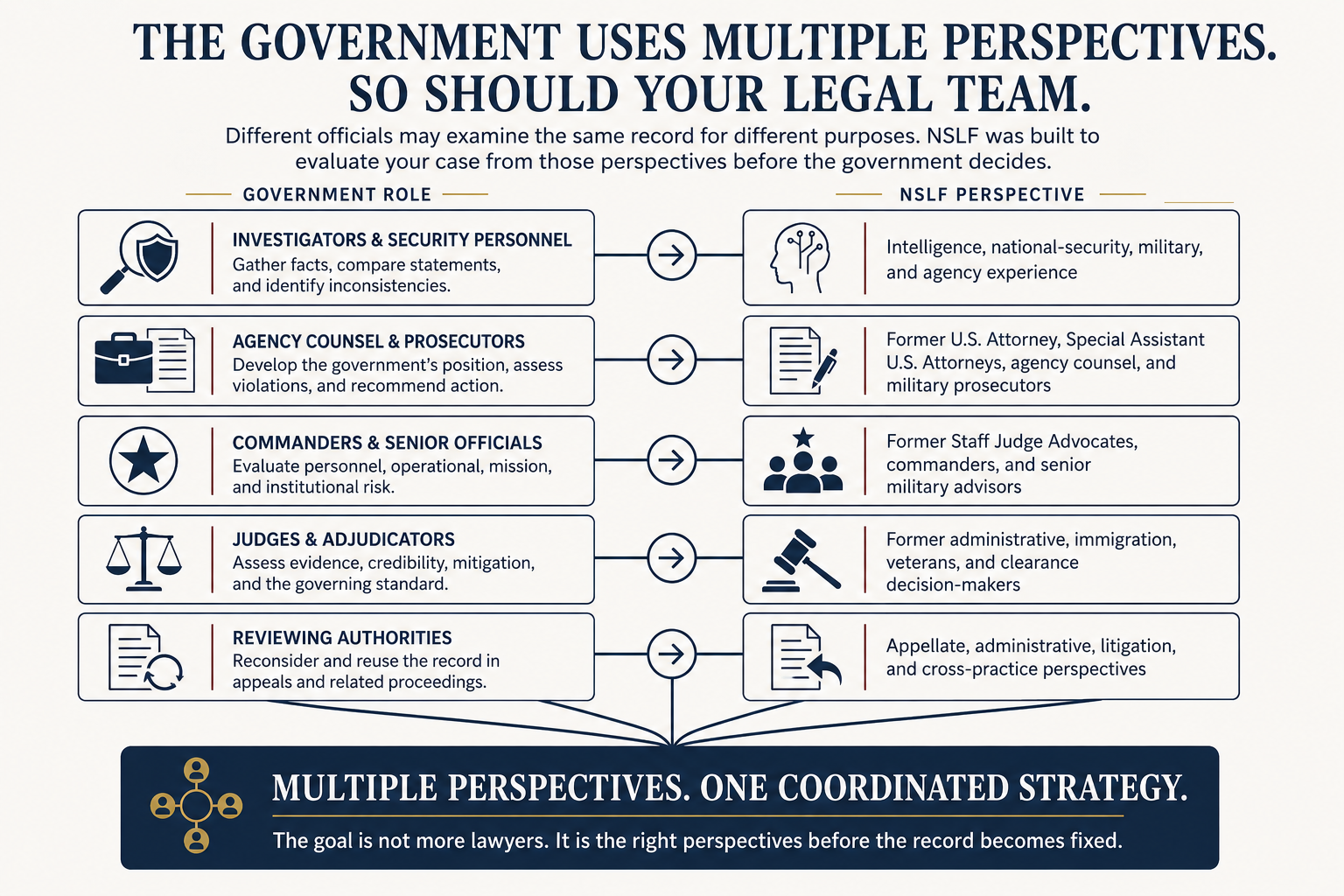
Federal systems are rarely evaluated by a single person operating in isolation. Investigators, supervisors, adjudicators, reviewing officials, agency counsel, administrative judges, contractor oversight personnel, security officials, and future reviewers may all interact with the same record over time. Different offices may analyze the same issue through entirely different institutional frameworks. Concerns that appear resolved in one setting may later reappear in another.
That reality is one of the reasons National Security Law Firm intentionally developed a highly specialized, collaborative federal-systems practice model rather than operating as a traditional general-practice law firm.
Our practice areas are connected because the federal systems themselves are connected.
Security clearance issues often overlap with federal employment concerns. Administrative investigations can create future clearance implications. Contractor scrutiny may involve employment, investigative, reputational, and institutional-risk considerations simultaneously. Military administrative records can affect future civilian opportunities. Public disclosures, online allegations, or reputational issues may influence agency perceptions long after the original matter appears closed.
Approaching these matters effectively requires more than isolated legal analysis.
It requires understanding how federal systems interact with one another over time.
That institutional perspective influences how National Security Law Firm approaches federal representation from the very beginning of a matter. Rather than focusing only on the immediate dispute in front of a client, we often evaluate broader questions involving:
- long-term record development,
- future reinvestigation risk,
- downstream suitability implications,
- institutional credibility,
- overlapping agency concerns,
- investigative exposure,
- contractor eligibility,
- and the long-term defensibility of the overall record.
This is also why National Security Law Firm places significant emphasis on collaborative review and institutional analysis.
Many law firms operate through highly individualized models where one attorney independently manages nearly every aspect of a case. Federal systems themselves rarely function that way. Important federal decisions often involve multiple reviewers, layered oversight structures, internal consultation, and institutional scrutiny from different perspectives over time.
Our Attorney Review Board model was designed to reflect that reality.
In significant matters, attorneys may collaborate internally to evaluate strategic risks, identify downstream concerns, test mitigation approaches, analyze credibility issues, and assess how future decision-makers may interpret different aspects of the record. The goal is not simply to react to the immediate issue, but to build coordinated strategies designed to withstand broader federal-system scrutiny over time.
National Security Law Firm also intentionally focuses on niche federal systems rather than attempting to operate as a broad general-practice firm. Our attorneys include former military attorneys, former federal insiders, former agency counsel, former security clearance decision-makers, and attorneys with extensive experience navigating sensitive federal administrative systems. That background provides insight not only into legal procedure, but into how agencies often evaluate institutional trust, reliability, mitigation, and future risk internally.
In many federal matters, understanding how the system thinks is just as important as understanding the law itself.
That does not mean federal outcomes are predetermined. Nor does it mean agencies always act fairly or correctly. Federal systems are still operated by people, and flawed investigations, poor judgment, incomplete information, bureaucratic incentives, and institutional errors can all significantly affect outcomes.
But effective representation requires understanding the system that produced the problem in the first place.
It requires understanding:
- how records evolve,
- how credibility is evaluated,
- how agencies document concerns,
- how institutional risk is assessed,
- how mitigation is measured,
- and how future reviewers may later interpret today’s decisions.
Our goal is not simply to help clients respond to isolated allegations or immediate agency actions. Our goal is to help clients navigate complex federal systems strategically, thoughtfully, and with a clear understanding of how those systems evaluate trust, credibility, reliability, and institutional risk over time.
Because in many federal matters, the immediate issue is only one part of the larger institutional equation.
The long-term trajectory of the record may ultimately matter even more.
The Federal Systems We Help Clients Navigate
Although federal systems often overlap, each operates through its own procedures, investigative structures, documentation practices, and decision-making frameworks. Understanding how those systems function individually — and how they interact collectively — is critical to effective federal representation.
National Security Law Firm focuses on helping clients navigate high-risk federal systems where trust, credibility, institutional reliability, and long-term record development often determine outcomes.
Security Clearance Systems
Security clearance matters are rarely limited to a single event or disclosure. Federal investigators, adjudicators, and security officials often evaluate years of financial history, foreign contacts, personal conduct, employment history, criminal allegations, substance use, mental health considerations, online activity, and prior disclosures through the broader lens of future reliability and institutional risk.
These systems frequently involve:
- security clearance investigations,
- subject interviews,
- Statements of Reasons (SORs),
- Letters of Intent (LOIs),
- hearings and appeals,
- continuous vetting,
- polygraph examinations,
- reinvestigations,
- and long-term record comparison across multiple review cycles.
Because security clearance systems repeatedly revisit historical records, the way concerns are documented, mitigated, and explained often becomes just as important as the underlying conduct itself.
Federal Employment Systems
Federal employment systems involve far more than ordinary workplace disputes. Agencies often evaluate employee conduct through institutional frameworks focused on efficiency of the service, public trust, reliability, judgment, professionalism, and future organizational risk.
These systems may involve:
- proposed removals,
- suspensions,
- disciplinary investigations,
- misconduct allegations,
- lack of candor charges,
- suitability determinations,
- Inspector General investigations,
- retaliation claims,
- MSPB proceedings,
- security violations,
- and adverse action appeals.
Federal employment matters also frequently overlap with security clearance concerns, investigative records, contractor eligibility, military administrative history, and future credentialing opportunities.
Federal Investigations
Federal investigations often begin long before individuals fully appreciate the seriousness of the institutional concerns involved. Interviews, requests for information, administrative inquiries, and internal investigations can quickly create records that later influence employment actions, security clearance decisions, contractor eligibility, credentialing reviews, and future agency trust assessments.
These matters may involve:
- administrative investigations,
- Inspector General investigations,
- contractor investigations,
- compelled interviews,
- security-related inquiries,
- false statement allegations,
- witness interviews,
- investigative subpoenas,
- and agency fact-finding processes.
In many cases, the trajectory of a federal matter is shaped during the investigative stage itself.
Contractor & Institutional Risk Systems
Federal contractors operate inside complex institutional-risk environments where agencies continuously evaluate present responsibility, organizational reliability, compliance history, disclosure obligations, and future government trust.
These systems may involve:
- suspension and debarment,
- procurement-related investigations,
- present responsibility reviews,
- contractor disclosures,
- SAM exclusion,
- internal investigations,
- agency oversight inquiries,
- and reputational concerns affecting government eligibility.
Because federal contractor systems are heavily relationship- and trust-driven, strategic responses often require balancing legal defense, institutional credibility, disclosure obligations, and long-term government confidence simultaneously.
Military Administrative Systems
Military administrative systems involve unique procedural and institutional frameworks that can continue affecting service members long after active service concludes. Administrative records generated during military proceedings may later influence civilian federal employment, security clearance eligibility, contractor opportunities, credentialing, and future agency trust evaluations.
These systems may involve:
- administrative separations,
- boards of inquiry,
- GOMORs,
- security clearance issues,
- military investigations,
- adverse fitness reports,
- discharge matters,
- and military credentialing concerns.
Because military records frequently migrate into later civilian federal systems, strategic coordination across both environments is often critical.
Privacy, FOIA & Reputation Risk
Federal systems increasingly intersect with public disclosures, reputational concerns, online allegations, media exposure, privacy issues, and Freedom of Information Act requests. Information released publicly or circulated online can sometimes influence agency perceptions, investigative scrutiny, contractor relationships, employment opportunities, and long-term institutional trust.
These matters may involve:
- FOIA requests,
- privacy disputes,
- reputational defense,
- online content removal,
- media-related concerns,
- prepublication review,
- disclosure-risk analysis,
- and sensitive information management.
As federal systems become increasingly interconnected and documentation-driven, reputational and informational risks often carry far broader consequences than individuals initially realize.
While each of these federal systems operates differently, they frequently intersect around the same core institutional questions:
Can the government continue trusting this individual, employee, contractor, or organization moving forward?
Understanding how those systems ask — and answer — that question sits at the center of National Security Law Firm’s approach to federal-system representation.
Why Understanding the System Changes Outcomes
Many people enter federal systems believing the most important question is whether they can explain what happened.
In reality, federal systems are often evaluating something much larger:
- whether the explanation appears credible,
- whether the record appears stable,
- whether future risk appears manageable,
- and whether continued institutional trust can still be justified moving forward.
That distinction changes how effective federal representation must be approached.
In many federal matters, the issue is not simply the allegation itself. The issue is how the allegation evolves across the record over time. Agencies frequently evaluate whether concerns appear isolated and mitigated, or whether the surrounding documentation suggests expanding reliability, judgment, candor, or trust concerns that may continue affecting future decision-making.
That is why federal systems often reward:
- consistency,
- preparation,
- thoughtful disclosures,
- credible mitigation,
- institutional awareness,
- and long-term strategic thinking.
And it is why they frequently react negatively to:
- contradictions,
- incomplete explanations,
- reactive responses,
- poorly coordinated disclosures,
- shifting narratives,
- and credibility erosion across multiple proceedings.
Understanding that institutional framework changes the way cases are navigated from the very beginning.
It changes how interviews should be approached. It changes how records should be developed. It changes how mitigation should be documented. It changes how agencies’ concerns should be interpreted. And it changes how immediate decisions may later affect future opportunities, investigations, reinvestigations, or reviews years into the future.
This is particularly important because federal systems rarely evaluate people at a single moment in time.
They evaluate trajectories.
Agencies often ask whether the overall direction of the record increases or decreases institutional confidence moving forward. They evaluate whether concerns appear likely to recur, whether explanations remain stable across time, and whether future reviewers could later defend continued trust if the matter resurfaces under additional scrutiny.
In many cases, federal systems are not searching for perfection.
They are searching for predictability, credibility, mitigation, and evidence that future risk can be responsibly managed.
That is one reason institutional understanding matters so much in federal-system representation. Without understanding how agencies evaluate risk internally, individuals often focus on the wrong strategic priorities. They may spend enormous energy disputing minor facts while unintentionally creating larger credibility concerns. They may respond emotionally to systems that are operating institutionally. They may underestimate how records are preserved, compared, and revisited over time. And they may fail to appreciate how quickly small inconsistencies can evolve into larger trust concerns inside federal environments.
This is especially true in matters involving:
- security clearances,
- federal employment actions,
- suspension and debarment proceedings,
- continuous vetting reviews,
- suitability determinations,
- and matters involving credibility or personal conduct concerns.
Understanding how federal systems actually work changes that analysis.
It allows representation to focus not only on the immediate dispute, but on the broader institutional dynamics shaping how the matter will likely be viewed across time, agencies, investigations, and future reviews.
At National Security Law Firm, we believe effective federal representation requires more than isolated legal arguments. It requires understanding how federal systems evaluate trust, credibility, reliability, mitigation, and institutional risk over time — and developing strategies that account for those realities from the very beginning.
Because in federal systems, outcomes are often shaped not simply by what happened, but by how the evolving record affects institutional confidence moving forward.
Speak With a Federal Systems Defense Team
Federal systems are complex, interconnected, and often far more institutional than most people initially realize.
A security clearance issue may affect federal employment. An administrative investigation may later influence suitability determinations. Contractor scrutiny may create future reputational, credentialing, or agency-trust concerns. Statements made during one proceeding may later be reviewed years later in entirely different contexts by entirely different decision-makers.
That is why effective federal representation often requires more than responding to a single immediate issue in isolation.
It requires understanding how federal systems:
- build records,
- evaluate credibility,
- assess mitigation,
- measure future risk,
- preserve institutional memory,
- and justify continued trust over time.
At National Security Law Firm, our practice is built around helping clients navigate those systems strategically and with a long-term institutional perspective. Our attorneys include former military attorneys, former federal insiders, former agency counsel, former security clearance decision-makers, and attorneys with extensive experience handling complex federal administrative matters involving trust, credibility, investigations, security concerns, and institutional risk.
We represent clients nationwide in matters involving:
- security clearances,
- federal employment,
- Inspector General investigations,
- contractor risk,
- suspension and debarment,
- military administrative law,
- FOIA and privacy issues,
- reputational defense,
- and other high-risk federal matters.
Our approach is intentionally collaborative, systems-focused, and designed around the realities of how federal agencies actually evaluate institutional trust.
Because in many federal matters, the immediate allegation is only one part of the larger picture.
The long-term trajectory of the record may ultimately matter even more.
Explore Our Federal Practice Areas
Learn More About the NSLF Attorney Review Board
Schedule a Free Consultation
National Security Law Firm: It’s Our Turn to Fight for You.