
Most applicants misunderstand what is actually happening inside a security clearance case.
They believe the government is evaluating:
- fairness,
- intent,
- personal character,
- or whether they “deserve” another chance.
That is rarely how adjudicators actually think.
Security clearance adjudication is not:
- traditional litigation,
- emotional persuasion,
- or ordinary administrative review.
It is a specialized federal national security system built around:
- future risk evaluation,
- credibility analysis,
- mitigation,
- institutional defensibility,
- and long-term trustworthiness.
That distinction changes how every fact inside the file gets interpreted.
Because adjudicators are not simply asking:
👉 “What happened?”
They are asking:
👉 “What does this record suggest about future reliability and future risk?”
This is one reason why:
- relatively small inconsistencies sometimes become extremely dangerous,
while: - applicants with serious past conduct sometimes still retain or recover clearance eligibility.
The difference is often not the underlying issue itself.
It is:
👉 how the record is interpreted institutionally.
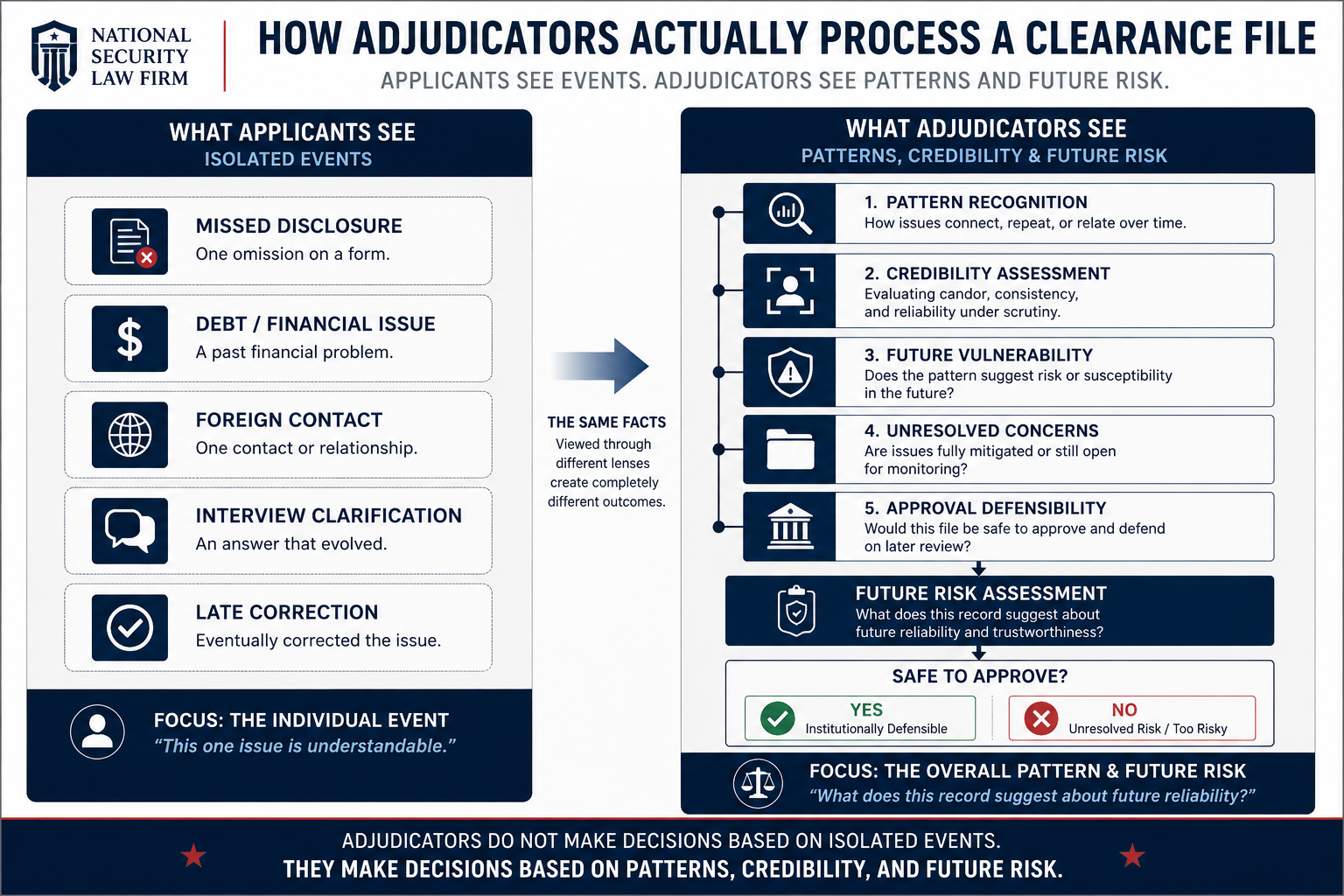
Most Applicants See the Case Emotionally. Adjudicators Evaluate It Structurally.
Applicants naturally focus on:
- fairness,
- context,
- stress,
- personal explanation,
- and whether the conduct feels understandable.
Adjudicators often evaluate something much narrower:
- disclosure stability,
- credibility under scrutiny,
- future vulnerability,
- unresolved concern,
- and whether the file feels safe to approve.
This is one reason why:
👉 applicants and adjudicators frequently perceive the same case completely differently.
For example:
an applicant may think:
- “I already explained this.”
- “This issue was years ago.”
- “I was honest eventually.”
- “This was not intentional.”
An adjudicator may instead evaluate:
- whether the disclosure evolved,
- whether the explanation shifted,
- whether the conduct appears fully resolved,
- and whether future disclosures can still be trusted.
This is why:
👉 many applicants do not realize the case is becoming dangerous until the record has already started hardening.
Why Insider Perspective Matters
At National Security Law Firm, our security clearance lawyers include:
- former adjudicators,
- former administrative judges,
- former Defense Office of Hearings and Appeals (DOHA) attorneys,
- and lawyers who have worked inside military and national security systems themselves.
These are the professionals responsible for:
- reviewing investigative records,
- evaluating mitigation,
- assessing credibility,
- applying the Adjudicative Guidelines,
- and determining whether security clearance eligibility can safely continue.
That experience matters because:
👉 security clearance cases are not usually won through emotional advocacy or generic legal argument.
They are won by understanding:
- how federal decision-makers interpret risk,
- how files become institutionally defensible,
- how credibility destabilizes,
- and how records quietly evolve over time.
This guide exists to explain:
👉 how adjudicators actually think behind the scenes.
Because once applicants understand:
- how files are interpreted,
- how risk is evaluated,
- and how credibility shapes outcomes,
their strategy changes completely.
What This Guide Will Teach You
This guide explains:
- how adjudicators interpret patterns instead of isolated events,
- why disclosures become more dangerous when they evolve,
- how “paper risk” quietly affects approvals,
- why credibility often matters more than the underlying conduct,
- why explanation alone frequently fails,
- and why similar facts can produce dramatically different outcomes depending on how the record develops.
It also explains:
- why some files feel institutionally “safe” to approve,
while: - others quietly create unresolved concern even when the underlying conduct appears manageable.
Because security clearance cases are not decided only by:
- the allegation,
- the guideline,
- or the triggering event.
They are decided through:
👉 how the record is interpreted over time by federal decision-makers evaluating future national security risk.
And that is what most applicants never fully see happening until much later in the process.
Adjudicators Think in Patterns, Not Events
One of the biggest mistakes applicants make is assuming adjudicators evaluate:
👉 isolated incidents.
They usually do not.
Applicants naturally focus on:
- one missed disclosure,
- one debt,
- one foreign contact,
- one interview answer,
- or one past mistake.
Adjudicators often evaluate:
👉 patterns.
This is one of the most important psychological realities in the entire security clearance system.
Because adjudicators are not simply trying to determine:
👉 “Did something bad happen?”
They are trying to determine:
👉 “What does this pattern suggest about future reliability, judgment, and vulnerability?”
That distinction changes how every fact inside the file gets interpreted.
Adjudicators Rarely View Conduct in Isolation
Most applicants think:
👉 each issue stands alone.
Adjudicators frequently evaluate:
- how the issues connect,
- whether the disclosures remained stable,
- whether similar behavior repeated over time,
- and whether the overall pattern suggests unresolved concern.
For example:
- one omitted foreign contact may initially appear manageable,
while: - multiple evolving disclosures over time may suggest disclosure instability.
Similarly:
- one financial problem may appear explainable,
while: - repeated financial instability combined with minimization may suggest broader judgment concerns.
This is why:
👉 multiple “small” issues often become much more dangerous together than applicants expect.
Because adjudicators are evaluating:
- consistency,
- reliability,
- behavioral patterns,
- and whether the conduct suggests future vulnerability.
This dynamic is explored further in:
How Adjudicators Think in Patterns, Not Events.
The System Is Constantly Evaluating Whether the Issue Is Truly Isolated
One of the central questions adjudicators quietly ask is:
👉 “Is this an isolated event—or evidence of something larger?”
That question shapes almost every major clearance decision.
For example:
adjudicators may evaluate:
- whether the conduct appears recurring,
- whether the disclosure behavior changed over time,
- whether the issue reflects a broader judgment pattern,
- and whether the applicant appears stable under scrutiny.
This is one reason why:
👉 evolving explanations frequently become much more dangerous than applicants expect.
Because instability itself may begin suggesting:
- minimization,
- unreliable disclosure behavior,
- or unresolved future risk.
Applicants often think:
👉 “I’m clarifying.”
Adjudicators may instead see:
👉 expanding narrative structure.
That difference matters enormously.
Adjudicators Infer Meaning From Behavioral Patterns
Many applicants assume adjudicators evaluate:
👉 objective facts only.
In reality:
adjudicators frequently infer meaning from:
- how disclosures evolved,
- how the applicant reacted under scrutiny,
- whether explanations shifted,
- and whether the behavior appears stable over time.
This is one reason why:
👉 the same underlying issue can produce completely different outcomes depending on how the surrounding record develops.
For example:
- old debt combined with stable repayment and disciplined disclosure may feel manageable,
while: - relatively ordinary conduct combined with evolving explanations may create much broader institutional concern.
Because adjudicators are often evaluating:
👉 what the conduct implies about future trustworthiness.
Not just what happened historically.
Small Inconsistencies Quietly Become Larger Credibility Signals
One of the most misunderstood realities in security clearance law is this:
👉 adjudicators frequently evaluate inconsistency as a pattern problem—not just a factual problem.
For example:
- changing timelines,
- partial disclosure,
- expanding explanations,
- or repeated “clarification”
may begin suggesting: - instability,
- minimization,
- or disclosure unreliability.
This is one reason why:
👉 multiple small inconsistencies often create disproportionate concern.
Especially under:
Guideline E – Personal Conduct.
Because once adjudicators begin evaluating:
👉 the reliability of the record itself,
the entire case often becomes more difficult to approve.
Read:
- Credibility, Candor, and Consistency: The Signals That Decide Most Cases
- Why Adjudicators Rarely Reverse Themselves Once Credibility Is Lost
Time and Pattern Change Matter More Than Many Applicants Realize
Applicants often assume:
👉 older issues automatically become irrelevant.
That is not always true.
Adjudicators frequently evaluate:
- whether the pattern genuinely changed,
- whether mitigation remained stable,
- whether disclosures became more reliable over time,
- and whether the underlying concern appears truly resolved.
This is why:
👉 the passage of time alone does not always mitigate concern.
What matters more is:
👉 whether the pattern itself changed convincingly.
For example:
- old conduct followed by long-term stability may strongly support mitigation,
while: - older conduct followed by disclosure instability or recurring judgment concerns may still create institutional hesitation.
Relevant resources:
- Why Time and Pattern Change Matter So Much
- The Whole-Person Concept Explained: Why “Good People” Still Lose Clearance Cases
Adjudicators Frequently Detect Risk Long Before Applicants Realize It
Another major misunderstanding in clearance law is this:
👉 applicants often believe they can control how serious the issue appears.
In reality:
adjudicators are often evaluating:
- disclosure behavior,
- consistency,
- escalation patterns,
- and credibility signals
long before formal concern becomes visible.
This is one reason why:
👉 many applicants are shocked when:
- an LOI appears,
- a subject interview becomes aggressive,
- or an SOR suddenly alleges broader concerns than expected.
Because the system may already have been identifying:
👉 emerging risk patterns inside the record.
Relevant resource:
How Adjudicators Detect Risk Even When Applicants Think They Hid It
Once You Understand Pattern Thinking, Strategy Changes Completely
Once applicants understand that adjudicators evaluate:
👉 patterns instead of isolated incidents,
the strategy changes dramatically.
The focus shifts away from:
- defending single events,
- emotional justification,
- or minimizing isolated conduct.
And toward:
- stabilizing disclosures,
- reducing ambiguity,
- strengthening mitigation consistency,
- controlling escalation,
- and demonstrating reliable long-term behavioral change.
This is one reason why:
strong security clearance strategy focuses so heavily on:
👉 the overall structure of the file.
Because adjudicators are rarely evaluating:
👉 one event alone.
They are evaluating:
👉 what the pattern suggests about future national security risk.
Adjudicators Frequently Read the Record Backwards
Most applicants think chronologically.
Adjudicators often do not.
Applicants usually experience a clearance case as:
- one event,
then: - another event,
then: - an interview,
then: - an LOI,
then: - possibly an SOR.
Adjudicators frequently evaluate the file in reverse.
They often begin with:
- the current inconsistency,
- the current omission,
- the current credibility concern,
- or the current unresolved issue,
and then work backward through the record asking:
- Was this disclosed earlier?
- Did the explanation change?
- Does the timeline remain stable?
- Does the earlier record support the current explanation?
- Has the narrative evolved under pressure?
This is one reason why:
👉 later disclosure instability can suddenly make older conduct appear much more serious.
The Current Concern Often Reframes the Entire Historical Record
One of the most important realities in security clearance adjudication is this:
👉 current credibility concerns frequently reshape how earlier conduct gets interpreted.
For example:
an older omission may initially appear manageable.
But if:
- disclosures evolve later,
- timelines shift,
- or explanations expand under scrutiny,
the adjudicator may begin reevaluating:
👉 the entire disclosure history differently.
This is one reason why:
👉 reactive clarification often creates more danger than applicants expect.
Applicants frequently think:
👉 “I’m helping by providing more explanation.”
Adjudicators may instead see:
- evolving narrative structure,
- reactive disclosure,
- or instability under pressure.
That difference quietly changes how the entire file gets interpreted.
This dynamic is explored further in:
Why Adjudicators Read Your History Backwards.
Later Instability Often Makes Earlier Conduct Look Intentional
Many applicants assume:
👉 if the original issue was understandable, the case should remain manageable.
That is not always how adjudicators evaluate it.
Once:
- explanations begin evolving,
- disclosures expand,
- or inconsistencies emerge,
adjudicators often begin asking:
👉 “Was the earlier disclosure actually reliable in the first place?”
This is especially dangerous because:
👉 later instability frequently changes how earlier intent gets interpreted.
For example:
- an omission initially viewed as accidental
may later begin looking:- strategic,
- selective,
- or intentionally incomplete.
Especially when:
- additional disclosures only appear after pressure increases,
- timelines change repeatedly,
- or mitigation appears reactive.
This is one reason why:
👉 small disclosure problems sometimes quietly evolve into major Guideline E concerns.
The System Frequently Reinterprets Earlier Statements Through New Information
Another major misconception applicants have is this:
👉 “I already explained that earlier.”
That does not necessarily stabilize the issue.
As new information appears:
- investigators,
- adjudicators,
- and future reviewers
often reinterpret earlier disclosures through the lens of the newer concern.
This means:
- earlier wording may suddenly appear incomplete,
- old explanations may look less reliable,
- and prior mitigation may lose credibility once the broader pattern changes.
This is one reason why:
👉 consistency over time matters so much.
Because once:
- disclosures evolve,
- explanations drift,
- or clarification repeatedly expands,
the adjudicator often begins reevaluating:
👉 the reliability of the entire narrative structure.
Investigators and Adjudicators Frequently Compare Earlier and Later Versions of the Story
Applicants often underestimate how heavily the system compares:
- SF-86 disclosures,
- interview statements,
- LOI responses,
- SOR rebuttals,
- hearing testimony,
- and later clarification.
This comparison process is constant.
Investigators and adjudicators routinely evaluate:
- whether wording changed,
- whether explanations expanded,
- whether timelines shifted,
- and whether the overall narrative remained stable under scrutiny.
This is one reason why:
👉 repeated clarification attempts frequently become dangerous.
Because every new explanation creates:
👉 another version of the story to compare against the existing record.
Especially involving:
- foreign contacts,
- employment history,
- financial disclosures,
- prior criminal conduct,
- and omission corrections.
Applicants Often Think They Are Fixing the Problem While Quietly Expanding It
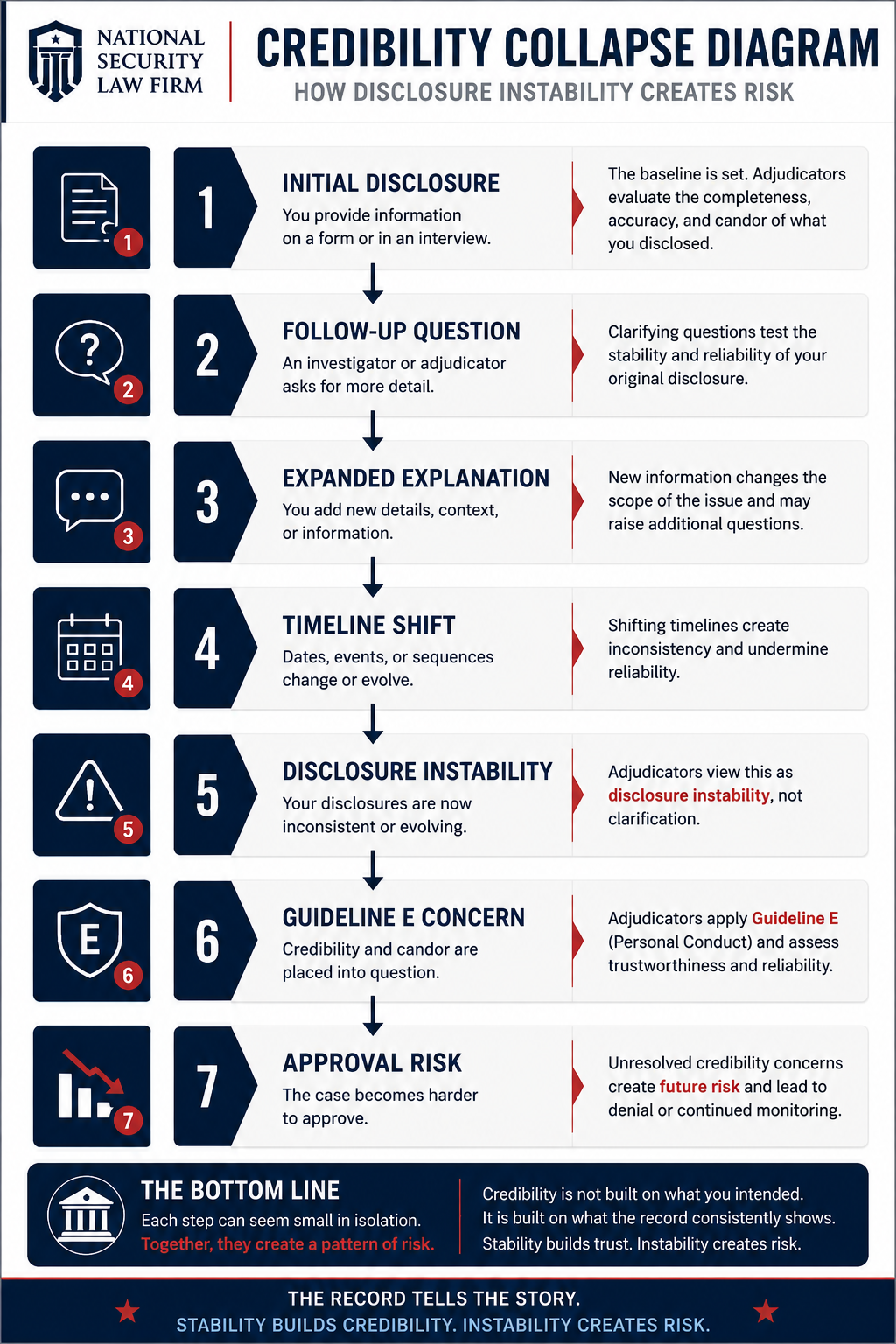
One of the most common escalation patterns in clearance law looks like this:
Initial disclosure
↓
Follow-up question
↓
Expanded explanation
↓
Additional clarification
↓
Timeline shift
↓
Disclosure instability
↓
Credibility concern
↓
Guideline E expansion
Many applicants do not recognize:
👉 the case is becoming more dangerous while they are attempting to “fix” it.
Because from the applicant’s perspective:
- they are helping,
- clarifying,
- or trying to cooperate fully.
From the adjudicator’s perspective:
the issue may now appear:
- unstable,
- reactive,
- incomplete,
- or strategically evolving.
This is one reason why:
👉 disciplined disclosure strategy matters so much.
Especially once:
- investigators begin focusing on credibility,
- clarification becomes repetitive,
- or the record starts hardening.
Strong Cases Usually Maintain Narrative Stability Across Every Stage
One of the most important strategic realities in the clearance system is this:
👉 strong files usually remain stable over time.
That does not mean:
- perfect memory,
- flawless detail,
- or zero clarification.
It means:
- the disclosures remain coherent,
- the explanations remain structurally consistent,
- and the mitigation remains believable as scrutiny increases.
Weak files often begin:
- expanding,
- shifting,
- fragmenting,
- or evolving
as pressure increases.
Adjudicators notice that quickly.
Because from the institutional perspective:
👉 stable disclosures suggest future reliability.
Unstable disclosures suggest:
👉 future uncertainty.
And uncertainty creates:
👉 approval risk.
Understanding Backward Review Changes How Strong Strategy Works
Once applicants understand:
👉 adjudicators frequently read the record backwards,
the strategy changes dramatically.
The focus shifts away from:
- trying to “improve” explanations repeatedly,
- reactive clarification,
- or emotional narrative expansion.
And toward:
- disclosure stability,
- disciplined wording,
- consistency across stages,
- and preventing the file from evolving unnecessarily over time.
Because once:
- the narrative begins shifting,
- disclosures repeatedly expand,
- or earlier statements stop aligning cleanly with later explanations,
👉 adjudicators often begin reevaluating the entire file differently.
That is one reason why:
👉 strategic consistency matters so much in security clearance law.
Adjudicators Evaluate Whether a File Feels Safe to Approve
One of the most important insider concepts in security clearance law is this:
👉 adjudicators are not only evaluating the applicant.
They are also evaluating:
👉 the risk of approving the file itself.
This is one of the least understood dynamics in the entire clearance system.
Many applicants assume adjudicators simply decide:
- whether they believe the applicant,
- whether the conduct seems understandable,
- or whether the issue feels serious enough to justify denial.
In reality:
many adjudicators are also quietly evaluating:
- whether another reviewer later could question the approval,
- whether unresolved ambiguity still exists,
- and whether the approval itself would create institutional risk later.
This is sometimes referred to as:
👉 paper risk.
And it quietly shapes a tremendous number of security clearance outcomes.
Approval Defensibility Quietly Drives Many Clearance Decisions
Most applicants think:
👉 the issue is:
- whether the conduct was bad enough.
Adjudicators often evaluate something narrower:
👉 “Can this approval be defended later if another reviewer examines the file?”
That question changes everything.
Because security clearance adjudication is institutional.
Approvals:
- get reviewed,
- get revisited,
- get reexamined,
- and sometimes get second-guessed years later.
This means adjudicators frequently evaluate:
- whether the mitigation feels durable,
- whether the disclosures remained stable,
- whether unresolved concern still exists,
- and whether future reviewers may later see the file differently.
This is one reason why:
👉 emotionally sympathetic cases sometimes still struggle to get approved.
Not because the adjudicator necessarily believes the applicant is dangerous.
But because:
👉 the approval itself may not feel institutionally safe.
Unresolved Ambiguity Creates Approval Risk
One of the biggest hidden dangers in security clearance law is:
👉 unresolved ambiguity.
Applicants often believe:
- partial explanation,
- vague mitigation,
- or emotional context
reduces concern.
Adjudicators frequently evaluate:
👉 whether the ambiguity itself creates future risk.
For example:
- unclear timelines,
- evolving disclosures,
- incomplete financial explanation,
- unstable foreign contact reporting,
- or vague mitigation claims
may leave the adjudicator asking: - “Do I fully understand this issue?”
- “Could another reviewer later interpret this differently?”
- “Would I feel comfortable defending this approval later?”
This is one reason why:
👉 strong cases usually feel:
- coherent,
- documented,
- stable,
- and internally complete.
Weak cases often feel:
- uncertain,
- reactive,
- fragmented,
- or institutionally uncomfortable.
And discomfort creates:
👉 paper risk.
Relevant resource:
Paper Risk: Why Adjudicators Avoid Approvals They’d Have to Defend Later
Adjudicators Often Distrust Files That Require Too Much Interpretation
Applicants frequently believe:
👉 more explanation improves the case.
That is not always true.
In practice:
files that require:
- excessive interpretation,
- emotional contextualization,
- repeated clarification,
- or complicated narrative reconstruction
often create institutional discomfort.
This is because adjudicators generally prefer files that:
- make sense quickly,
- remain internally stable,
- and reduce future uncertainty.
This is one reason why:
👉 strong mitigation usually simplifies the file rather than expanding it endlessly.
Especially involving:
- omissions,
- financial instability,
- foreign influence concerns,
- and evolving disclosure timelines.
Because:
👉 files that feel difficult to explain internally often become difficult to approve institutionally.
“Reluctant Approvals” Reveal How Institutional Risk Actually Works
One of the clearest examples of paper risk is:
👉 the reluctant approval.
These are cases where:
- mitigation technically exists,
- the applicant may appear credible,
- and the conduct may no longer feel highly dangerous,
but:
👉 the file still creates institutional hesitation.
In these cases adjudicators may quietly think:
- “This may be manageable…”
while also thinking: - “I am not fully comfortable defending this approval later.”
This is one reason why:
👉 two applicants with similar facts may receive very different outcomes.
Because:
one file may feel:
- controlled,
- stable,
- and institutionally defensible.
While another may still feel:
- ambiguous,
- reactive,
- or difficult to defend confidently later.
Relevant resources:
- Reluctant Approvals: Why Some “Yes” Decisions Come With Conditions
- The Approval Memo Test: Would This Clearance File Survive Audit?
Emotional Persuasion Often Underperforms Because Adjudicators Are Evaluating Institutional Safety
Applicants naturally want adjudicators to:
- empathize,
- understand,
- or emotionally relate to the situation.
That instinct is understandable.
But adjudicators are generally operating inside:
👉 institutional risk logic.
This means:
they are often evaluating:
- whether the mitigation feels durable,
- whether the disclosures remained stable,
- whether future scrutiny may create problems later,
- and whether the approval itself introduces institutional vulnerability.
This is one reason why:
👉 emotional explanation frequently underperforms compared to:
- structured mitigation,
- disciplined disclosures,
- stable documentation,
- and ambiguity reduction.
Because adjudicators are not simply evaluating:
👉 “Do I feel bad for this person?”
They are evaluating:
👉 “Would another reviewer later question this approval?”
That distinction quietly shapes many clearance outcomes.
Strong Security Clearance Strategy Reduces Approval Anxiety
One of the most important goals of strong security clearance strategy is:
👉 reducing institutional hesitation.
This means:
- reducing ambiguity,
- stabilizing disclosures,
- strengthening mitigation,
- controlling escalation,
- and building a file that feels safe to rely on long-term.
Strong strategy often focuses less on:
- “winning the argument,”
and more on: - making the file feel institutionally comfortable to approve.
This is one reason why:
National Security Law Firm focuses heavily on:
- record control,
- mitigation architecture,
- credibility stabilization,
- and approval defensibility strategy.
Because in many cases:
👉 adjudicators are not deciding whether the applicant is perfect.
They are deciding:
👉 whether the file feels safe enough to carry forward inside the federal system.
Adjudicators Care More About Resolution Than Explanation
One of the biggest mistakes applicants make is believing:
👉 strong explanations win security clearance cases.
That is rarely how adjudicators actually evaluate files.
Applicants naturally focus on:
- why something happened,
- what circumstances existed,
- what pressures they were under,
- or why the conduct should be viewed sympathetically.
Adjudicators are usually evaluating something much narrower:
👉 whether the concern appears resolved.
That distinction quietly shapes many clearance outcomes.
Because security clearance adjudication is not fundamentally about:
- punishment,
- fairness,
- or emotional blame.
It is about:
👉 future national security risk.
This means adjudicators often care far more about:
- stability,
- mitigation,
- future reliability,
- and whether the conduct appears unlikely to recur
than the emotional explanation surrounding the issue itself.
Read:
Why Adjudicators Don’t Care About Explanations—Only Resolution
What Adjudicators Really Look for in a Security Clearance Case
Worried About Your Security Clearance? How the System Actually Decides Risk
Explanation and Mitigation Are Not the Same Thing
Many applicants unintentionally confuse:
👉 explanation
with
👉 mitigation.
They are not the same thing.
Explanation focuses on:
- why the issue happened,
- what circumstances existed,
- or why the applicant believes the conduct was understandable.
Mitigation focuses on:
- whether the concern is now resolved,
- whether future risk appears reduced,
- and whether the file supports safe long-term approval.
This is one reason why:
👉 explanation alone frequently fails.
Especially when:
- the conduct remains unresolved,
- the mitigation appears weak,
- or the explanation becomes emotionally defensive instead of structurally reassuring.
For example:
an applicant may explain:
- stress,
- financial pressure,
- relationship problems,
- emotional hardship,
- or workplace instability.
Adjudicators may still ask:
- “Has the underlying risk actually changed?”
- “Would this behavior recur under pressure?”
- “Does the mitigation feel stable over time?”
- “Does the file now support institutional trust?”
That is the actual strategic battleground.
Relevant resource:
Mitigation vs. Justification: Why Framing Your Response Wins or Loses Cases
Emotional Context Often Matters Less Than Applicants Expect
Applicants frequently assume:
👉 if adjudicators understand the emotional circumstances, the issue will feel less serious.
That is not always how institutional review operates.
Adjudicators are generally evaluating:
- whether the issue appears controlled,
- whether the applicant now appears reliable,
- and whether future national security risk remains unresolved.
This is one reason why:
👉 emotionally persuasive narratives often underperform compared to:
- disciplined mitigation,
- stable documentation,
- behavioral consistency,
- and strong long-term resolution evidence.
Applicants often think:
- “If I fully explain this, they’ll understand.”
Adjudicators may instead evaluate:
- whether the explanation feels stable,
- whether the issue still creates future concern,
- and whether the approval would remain defensible later.
This is one reason why:
👉 emotionally exhaustive responses frequently create:
- unnecessary ambiguity,
- unstable narrative structure,
- or expanded credibility risk.
Adjudicators Frequently Evaluate Whether the Behavior Appears Likely to Recur
This is one of the central concepts in clearance adjudication.
Adjudicators are often evaluating:
👉 future predictability.
That means:
they care heavily about:
- whether the issue appears controlled,
- whether mitigation appears durable,
- whether the conduct reflects stable judgment,
- and whether future disclosure behavior appears trustworthy.
This is one reason why:
👉 two applicants with very similar conduct can receive dramatically different outcomes.
For example:
- old financial instability combined with strong repayment and stable mitigation may appear manageable,
while: - smaller underlying conduct combined with unstable disclosures may still feel institutionally risky.
Because:
👉 adjudicators are not just evaluating the conduct itself.
They are evaluating:
👉 what the conduct suggests about future reliability.
Weak Mitigation Often Sounds Defensive or Reactive
Many applicants unintentionally create weak mitigation by:
- over-explaining,
- minimizing,
- blaming external circumstances,
- or reacting emotionally under pressure.
Weak mitigation frequently sounds:
- defensive,
- unstable,
- emotionally driven,
- or overly focused on justification.
Strong mitigation usually feels:
- structured,
- documented,
- stable,
- accountable,
- and future-focused.
This is one reason why:
👉 calm mitigation often performs much better than emotionally persuasive explanation.
Especially under:
- financial,
- personal conduct,
- foreign influence,
- and substance-related guidelines.
Because adjudicators are often evaluating:
👉 whether the mitigation itself feels institutionally reliable.
Adjudicators Often Distrust Files That Continue Expanding Under Scrutiny
One of the reasons explanation frequently fails is this:
👉 explanation often expands the file.
Applicants attempting to explain conduct sometimes:
- introduce new details,
- create timeline inconsistencies,
- add unsupported context,
- or evolve earlier disclosures unintentionally.
This is one reason why:
👉 “helping explain things” sometimes quietly destabilizes the record further.
Especially during:
- interviews,
- LOI responses,
- SOR rebuttals,
- and hearing preparation.
At that point:
the adjudicator may begin evaluating:
- narrative instability,
- reactive disclosure behavior,
- or unresolved credibility concern.
This is one reason why:
👉 disciplined disclosure strategy matters so much.
Resolution Creates Institutional Comfort
One of the most important realities in security clearance law is this:
👉 adjudicators are generally trying to determine whether they feel comfortable approving the file institutionally.
Strong resolution usually creates:
- stability,
- predictability,
- documentation,
- behavioral consistency,
- and reduced ambiguity.
Weak explanation often creates:
- uncertainty,
- instability,
- narrative complexity,
- and unresolved concern.
This is why:
👉 strong clearance strategy focuses heavily on:
- mitigation architecture,
- ambiguity reduction,
- and building a file that feels safe to approve over time.
Not simply:
👉 explaining why the issue happened.
Because in many cases:
👉 the explanation itself is not the strategic problem.
The unresolved future risk is.
Why Two People With Similar Facts Get Completely Different Outcomes
One of the most frustrating things about the security clearance system is this:
👉 two applicants with seemingly similar facts can receive completely different outcomes.
Applicants often assume:
- the rules operate mechanically,
- similar conduct should produce similar decisions,
- or the guidelines automatically dictate the result.
That is not how security clearance adjudication actually works.
Security clearance decisions are highly:
- contextual,
- discretionary,
- credibility-dependent,
- and influenced heavily by how the record evolved over time.
This is one reason why:
👉 applicants with serious underlying conduct sometimes retain or recover clearance eligibility,
while:
👉 applicants with much more manageable facts sometimes lose.
The difference is often not:
👉 the allegation itself.
It is:
👉 how the file developed around it.
The Same Conduct Can Feel Very Different Depending on the Record
Applicants naturally focus on:
👉 the issue itself.
Adjudicators often focus on:
👉 how the issue fits into the broader record.
For example:
two applicants may both have:
- debt,
- prior drug use,
- foreign relationships,
- or criminal conduct.
But adjudicators may evaluate the cases very differently depending on:
- disclosure stability,
- mitigation quality,
- timing,
- credibility,
- pattern behavior,
- and whether the file feels institutionally defensible.
This is why:
👉 the surrounding record frequently matters more than the conduct itself.
For example:
- old debt with stable repayment and disciplined disclosure may feel manageable,
while: - smaller financial issues combined with minimization and evolving explanation may feel much riskier.
Because:
👉 adjudicators are evaluating future reliability—not simply categorizing conduct.
Relevant resource:
Same Facts, Different Outcome: Why Two Clearance Cases Don’t Resolve the Same Way
Disclosure Behavior Frequently Changes the Outcome More Than the Underlying Issue
One of the biggest reasons similar cases produce different outcomes is:
👉 disclosure behavior.
For example:
- one applicant may disclose conduct early, consistently, and transparently,
while: - another applicant may partially disclose, clarify repeatedly, or reactively expand explanations later.
Even if the underlying conduct is similar:
👉 adjudicators may interpret the files completely differently.
Because once:
- credibility destabilizes,
- disclosures evolve,
- or the narrative begins shifting,
the concern often expands beyond:
👉 the original issue itself.
At that point:
the adjudicator may begin evaluating:
- trustworthiness,
- disclosure reliability,
- and whether future reporting can still be trusted.
This is one reason why:
👉 many manageable cases quietly become dangerous after disclosure instability begins.
Timing Quietly Shapes Many Outcomes
Another major reason similar facts produce different outcomes is:
👉 timing.
Adjudicators frequently evaluate:
- how long ago the conduct occurred,
- whether behavioral patterns changed,
- whether mitigation remained stable,
- and whether the issue appears truly resolved over time.
This is why:
- older conduct combined with long-term stability may strongly support mitigation,
while: - newer conduct,
- ongoing instability,
- or repeated recurrence
may still create institutional concern.
Importantly:
👉 time alone does not always mitigate concern.
What matters more is:
👉 whether the overall pattern changed convincingly.
This is one reason why:
- some applicants benefit enormously from stable long-term mitigation,
while: - others remain vulnerable despite the passage of time.
Discretion Quietly Exists Throughout the Entire System
Many applicants search for:
👉 certainty.
They want to know:
- “Will this automatically disqualify me?”
- “What are my chances?”
- “Does this issue always cause denial?”
That is not usually how the system operates.
Security clearance adjudication involves:
👉 significant institutional discretion.
This is one reason why:
👉 clearance law is not fully predictable in the way applicants often expect.
Adjudicators evaluate:
- credibility,
- mitigation,
- disclosure behavior,
- future risk,
- and institutional defensibility through:
👉 the whole-person concept.
This means:
- the same guideline,
- the same conduct,
- or the same allegation
may still produce very different outcomes depending on: - how the record developed,
- how mitigation was presented,
- and whether the file feels safe to approve institutionally.
Relevant resources:
- Discretion Is the Rule, Not the Exception: Why Security Clearance Law Is Not Predictable
- The Whole-Person Concept Explained: Why “Good People” Still Lose Clearance Cases
- SEAD-4 Explained: How Adjudicators Apply the 13 Security Clearance Guidelines
Strong Files Usually Feel Predictable and Institutionally Comfortable
Another major reason similar facts produce different outcomes is:
👉 institutional comfort.
Strong files often feel:
- coherent,
- stable,
- documented,
- predictable,
- and internally consistent.
Weak files often feel:
- reactive,
- fragmented,
- emotionally unstable,
- difficult to interpret,
- or institutionally risky.
This distinction matters enormously.
Because adjudicators frequently evaluate:
👉 whether another reviewer later could confidently rely on the file.
This is one reason why:
👉 ambiguity creates so much danger.
Especially when:
- explanations evolve,
- timelines drift,
- or mitigation appears reactive rather than stable.
At that point:
the adjudicator may begin viewing the file as:
👉 difficult to defend institutionally.
Security Clearance Outcomes Are Often Determined by the Structure of the Record
One of the most important realities in clearance law is this:
👉 adjudicators are not only evaluating what happened.
They are evaluating:
👉 how the issue evolved inside the record.
This includes:
- disclosure timing,
- consistency,
- mitigation quality,
- credibility stability,
- escalation behavior,
- and whether the concern appears resolved convincingly over time.
This is why:
👉 two applicants with similar underlying conduct may still receive radically different outcomes.
Because:
👉 the difference is often not the allegation.
It is:
👉 the structure and stability of the file built around it.
And that is why:
strong security clearance strategy focuses so heavily on:
- disclosure discipline,
- mitigation architecture,
- credibility stabilization,
- and long-term record defensibility.
Because in the federal clearance system:
👉 the file itself often becomes the real case.
Understanding Adjudicator Psychology Changes Strategy Completely
Once applicants understand how adjudicators actually think, the strategy changes completely.
The focus shifts away from:
- emotional persuasion,
- volume of explanation,
- “telling your side,”
- or trying to win a moral argument.
And toward:
- reducing ambiguity,
- stabilizing disclosures,
- strengthening mitigation,
- controlling escalation,
- and building a file that feels institutionally defensible over time.
That shift is often the difference between:
👉 reacting emotionally,
and
👉 strategically navigating the federal security clearance system.
Because once applicants understand:
- how files are interpreted,
- how credibility quietly shapes outcomes,
- how adjudicators infer meaning from patterns,
- and how records evolve under scrutiny,
they begin approaching the case differently.
And that difference matters enormously.
Most Applicants Focus on the Allegation. Strong Strategy Focuses on the File.
Applicants naturally focus on:
👉 the triggering issue.
For example:
- the debt,
- the foreign contact,
- the drug use,
- the arrest,
- or the omission.
Strong clearance strategy focuses much more heavily on:
👉 how the issue now exists inside the record.
That includes:
- how disclosures align,
- whether explanations remained stable,
- how mitigation appears institutionally,
- and whether future reviewers are likely to trust the file later.
This is one reason why:
👉 strategic mitigation frequently matters more than the original conduct itself.
Especially once:
- interviews occur,
- investigative summaries are written,
- or formal adjudicative review begins.
Because at that point:
👉 the record itself often becomes the real strategic battleground.
Strong Strategy Focuses on Preventing Escalation
One of the biggest strategic shifts applicants make after understanding adjudicator psychology is this:
👉 the goal is not simply responding to allegations.
The goal is:
👉 preventing unnecessary escalation.
This means:
- avoiding disclosure instability,
- reducing ambiguity early,
- strengthening mitigation before adjudication,
- and preventing credibility problems from spreading across the file.
This is especially important because:
👉 many dangerous clearance cases do not initially look dangerous.
They often begin with:
- manageable disclosure problems,
- ordinary financial issues,
- partial reporting,
- or seemingly minor inconsistencies.
The danger frequently comes later through:
- evolving explanations,
- reactive mitigation,
- expanding narrative structure,
- and institutional discomfort with the file.
This is one reason why:
👉 early-stage strategy changes outcomes so dramatically.
Strong Security Clearance Strategy Is Institutional—Not Emotional
Applicants naturally want adjudicators to:
- understand,
- empathize,
- or emotionally relate to the situation.
Strong strategy operates differently.
It asks:
- How will this mitigation look institutionally?
- Does the file feel stable?
- Would another reviewer later question the approval?
- Does the disclosure behavior inspire confidence?
- Has ambiguity been reduced—or expanded?
This is why:
👉 strong mitigation often feels calm, controlled, and strategically restrained.
While weak mitigation frequently feels:
- reactive,
- emotionally driven,
- defensive,
- or unstable.
This is one reason why:
👉 applicants who fully understand adjudicator psychology often stop:
- over-explaining,
- emotionally justifying,
- or trying to “convince” the government emotionally.
And instead begin focusing on:
👉 institutional credibility and long-term defensibility.
Once the Record Hardens, Strategic Flexibility Narrows
Another major realization applicants often have after understanding adjudicator psychology is this:
👉 later stages rarely fully undo early-stage damage.
Because:
- investigative summaries persist,
- interview wording gets reused,
- mitigation framing hardens,
- and credibility impressions often remain embedded throughout the file.
This is why:
👉 waiting frequently makes cases much harder to stabilize.
Especially involving:
- omissions,
- foreign contact disclosures,
- evolving timelines,
- and reactive clarification attempts.
By the time many applicants seek strategic guidance:
- the record may already be working against them,
- and adjudicators may already have:
- credibility concerns,
- institutional hesitation,
- or unresolved ambiguity embedded into the file.
This is one reason why:
National Security Law Firm focuses heavily on:
- early-stage strategy,
- mitigation architecture,
- disclosure discipline,
- and long-term record control.
Because:
👉 the earlier the strategy begins,
the more control applicants usually still have over the file.
Understanding the System Changes Everything
Most security clearance resources explain:
- procedures,
- timelines,
- statutes,
- or guidelines.
Very few explain:
👉 how federal decision-makers actually interpret the record behind the scenes.
That is the purpose of this guide.
Because once applicants understand:
- how adjudicators evaluate future risk,
- how credibility quietly shapes interpretation,
- how approval defensibility influences decisions,
- and how instability spreads through the file,
their strategy changes fundamentally.
At that point:
the focus shifts away from:
- reacting emotionally,
- or simply explaining conduct.
And toward:
- disciplined mitigation,
- disclosure stability,
- institutional defensibility,
- and long-term strategic record control.
That is also why:
strong security clearance strategy requires much more than:
👉 understanding the rules.
It requires understanding:
👉 how the system actually thinks.
For deeper strategic guidance, continue exploring:
- the Security Clearance Strategy & Mitigation Hub
- Record Control Strategy
- How to Win a Security Clearance Case
- and our Stage-Based Strategy Playbooks
Because in security clearance law:
👉 understanding how the system interprets the file is often the beginning of building a stronger one.
Before the Record Hardens
Most applicants do not realize:
👉 the system often begins shaping the outcome long before formal denial becomes visible.
By the time many people:
- receive a Statement of Reasons,
- prepare for a hearing,
- or begin thinking strategically,
the government may already have: - credibility impressions,
- unresolved concerns,
- and institutional hesitation embedded into the file.
This is one reason why:
👉 timing matters so much in security clearance law.
Because:
- disclosures harden,
- explanations get reused,
- mitigation gets reevaluated,
- and credibility patterns become increasingly difficult to reverse over time.
Most Security Clearance Problems Become Harder to Fix the Longer They Evolve
Many applicants initially believe:
👉 “I’ll deal with this later if it becomes serious.”
That often becomes dangerous.
Especially because:
- investigators may already be documenting concerns,
- interview summaries may already be shaping credibility impressions,
- and adjudicators may already be interpreting unresolved risk long before formal escalation appears.
This is especially true involving:
- omissions,
- foreign contact disclosures,
- financial instability,
- reactive clarification,
- and evolving timelines.
This is one reason why:
👉 many cases become significantly harder once:
- the narrative starts shifting,
- credibility destabilizes,
- or the record begins hardening institutionally.
The Earlier the Strategy Begins, the More Control Usually Still Exists
One of the most important realities in the federal clearance system is this:
👉 strategic flexibility narrows over time.
Early in the process:
- disclosures can still be stabilized,
- mitigation can still be structured carefully,
- escalation may still be preventable,
- and the record may still remain controllable.
Later in the process:
- investigative language becomes embedded,
- credibility impressions harden,
- and adjudicators may already be evaluating the file through a framework of institutional concern.
This is one reason why:
National Security Law Firm focuses heavily on:
- early-stage strategy,
- mitigation architecture,
- disclosure discipline,
- and long-term record control.
Because once:
- ambiguity spreads,
- explanations evolve,
- or reactive mitigation takes over,
👉 changing how the government interprets the file becomes dramatically more difficult.
Speak With a Security Clearance Lawyer Before the Record Becomes Harder to Control
If your clearance, career, or future eligibility may be at risk, the best time to act is usually:
👉 before the record becomes significantly harder to stabilize.
National Security Law Firm offers:
- free confidential consultations,
- nationwide representation,
- and strategic evaluation of security clearance matters at every stage of the process.
Our security clearance lawyers include:
- former adjudicators,
- former administrative judges,
- former Defense Office of Hearings and Appeals (DOHA) attorneys,
- and lawyers who understand how federal decision-makers actually evaluate these cases from the inside.
We help clients:
- identify escalation risk,
- stabilize credibility concerns,
- strengthen mitigation,
- and build records designed for long-term institutional defensibility.
You can:
- schedule a free consultation
- explore the Security Clearance Insiders Resource Hub
- review our Attorney Review Board strategy system
- or learn more about security clearance lawyer pricing and legal financing through Pay Later by Affirm
before the case progresses further.
Because in security clearance law:
👉 the earlier the strategy begins,
the more control applicants usually still have over the record.