
Many airport cash seizure cases become significantly more difficult not because the money itself was illegal, but because of what happens after the seizure.
Most travelers have never experienced:
- federal questioning,
- airport currency seizures,
- administrative forfeiture proceedings,
- or financial scrutiny by multiple federal agencies.
As a result, many people react emotionally, speak too quickly, or begin trying to “fix” the situation before they fully understand:
- what the government is evaluating,
- how the administrative process works,
- or how their statements and documentation may later be interpreted.
That reaction is understandable.
The problem is that airport cash seizure cases frequently become heavily:
- credibility-driven,
- documentation-driven,
- and mitigation-driven
almost immediately.
Federal agencies often begin evaluating:
- source-of-funds explanations,
- banking activity,
- procedural behavior,
- narrative consistency,
- and financial plausibility
from the very beginning of the encounter.
That means relatively small mistakes made during the first few days may later become:
- credibility concerns,
- mitigation problems,
- procedural complications,
- or expanded scrutiny.
Many people unintentionally damage their own leverage while trying to help themselves.
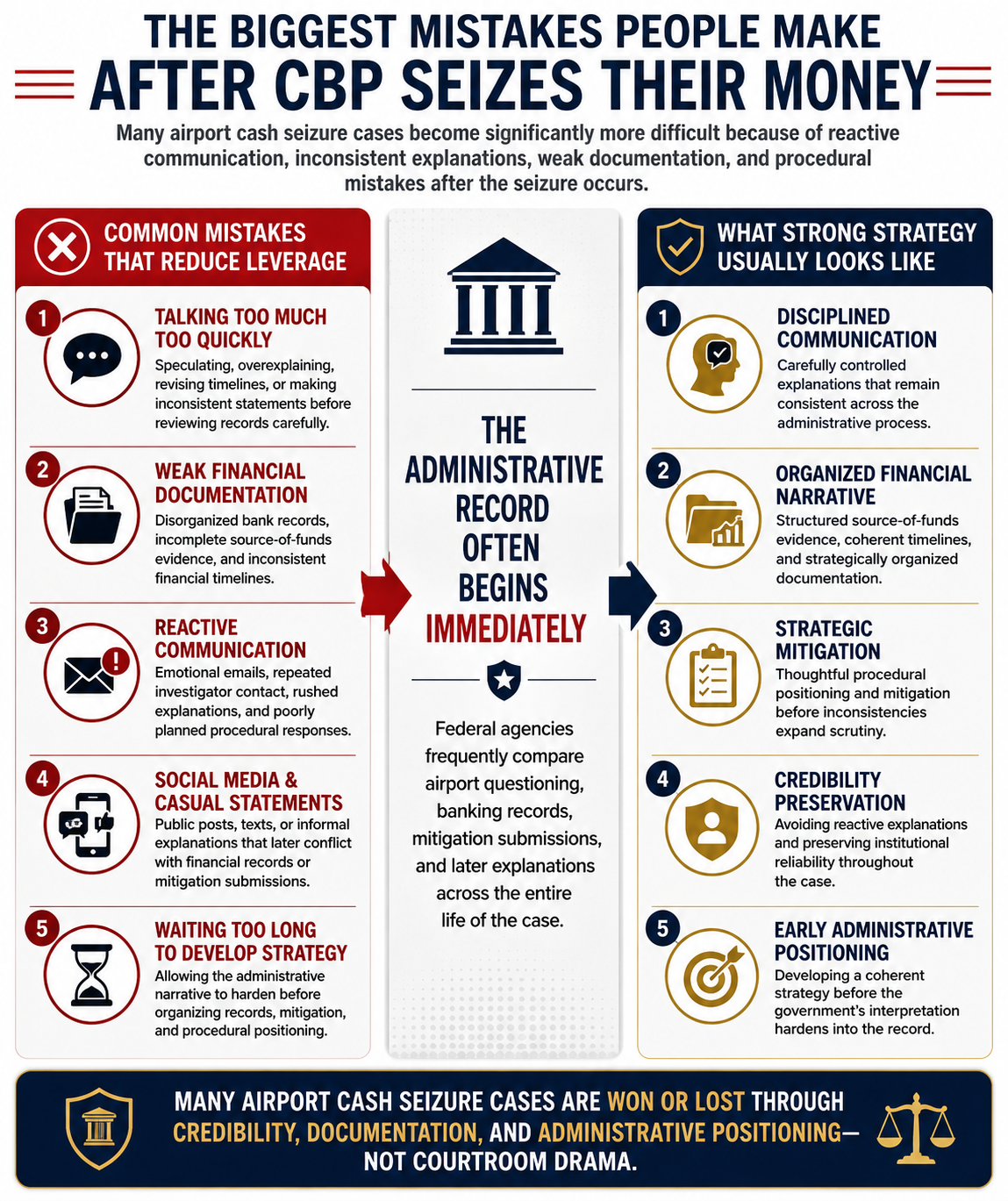
National Security Law Firm frequently emphasizes that the administrative record often begins forming immediately after the seizure occurs. Additional discussion appears in What Happens When CBP Seizes Your Cash at the Airport?, How to Win a CBP Currency Seizure Case, and the broader Customs Seizure Lawyer Hub.
Talking Too Much Too Quickly
One of the most common mistakes after an airport cash seizure is continuing to talk before understanding:
- what records exist,
- how the banking history appears,
- what prior statements were made,
- and how the government is likely interpreting the situation.
Many travelers feel an overwhelming urge to:
- explain everything immediately,
- clarify inconsistencies,
- defend themselves emotionally,
- or “clear up misunderstandings.”
That instinct often creates additional problems.
Federal agencies frequently compare:
- airport questioning,
- customs declarations,
- banking records,
- mitigation submissions,
- and later explanations
across the entire life of the case.
That means:
- rushed explanations,
- speculative answers,
- timeline confusion,
- or changing narratives
may later become significant credibility concerns.
Many people unintentionally weaken their own position by:
- guessing about financial timelines,
- reconstructing banking activity from memory,
- overexplaining,
- or revising explanations later after reviewing records.
Once inconsistencies enter the administrative record, they frequently become much harder to unwind later.
Sophisticated customs seizure strategy often focuses first on:
- slowing the situation down,
- organizing documentation carefully,
- reviewing financial records thoroughly,
- and preserving credibility before additional procedural damage occurs.
In many airport cash seizure cases, disciplined communication frequently becomes one of the most important strategic advantages available.
We discuss these issues in much greater detail in our pages on Why Early Statements to CBP Can Destroy Your Case and Why Consistency Matters in Federal Seizure Cases.
Failing To Organize Financial Records Immediately
Another major mistake is waiting too long to organize:
- bank statements,
- withdrawal history,
- tax records,
- contracts,
- invoices,
- business records,
- and source-of-funds documentation.
Many people incorrectly assume:
“We can gather the paperwork later.”
In reality, strong documentation frequently shapes leverage from the beginning.
Federal agencies often evaluate whether:
- the records support the explanation,
- the financial story appears coherent,
- the timelines remain consistent,
- and the source of funds appears credible.
Weak or disorganized documentation frequently creates:
- administrative skepticism,
- expanded scrutiny,
- mitigation problems,
- and procedural complications.
Many strong airport cash seizure cases involve:
- organized banking timelines,
- clearly documented withdrawals,
- coherent source-of-funds narratives,
- and consistent financial records early in the process.
This is one reason sophisticated customs seizure strategy often begins by reconstructing the financial narrative carefully before major procedural submissions are made.
Documentation organization is not merely administrative busywork. In many situations, it is one of the central strategic components of the entire case.
These issues frequently overlap with the financial pattern analysis discussed in our page on CBP Seized My Cash for “Structuring”: What Does That Mean? as well as our discussion of what agencies often evaluate in remission petitions.
Assuming “The Money Was Legal” Ends the Analysis
One of the most common misunderstandings in airport cash seizure matters is the belief that proving the money was legally earned automatically resolves the case.
In many situations, federal agencies evaluate something much broader than:
- whether the money existed legally.
Investigators frequently examine:
- banking behavior,
- reporting issues,
- travel patterns,
- source-of-funds explanations,
- financial timelines,
- and narrative consistency
collectively.
That means a traveler may still face significant scrutiny even where:
- the money was legitimate,
- no drugs were involved,
- and no criminal charges are filed.
For example, federal agencies may continue evaluating:
- whether banking activity appears structured,
- whether reporting obligations were avoided,
- whether explanations remain consistent,
- whether the transportation method appears suspicious,
- or whether the overall financial narrative appears administratively credible.
Many travelers become frustrated because they continue repeating:
“The money was legal.”
From the government’s perspective, that statement alone often does not resolve:
- credibility concerns,
- reporting issues,
- concealment allegations,
- or financial pattern analysis.
This is one reason airport cash seizure matters frequently become much more sophisticated than people initially realize. Federal agencies often focus less on:
“Was the money real?”
and more on:
“Does the overall financial story make institutional sense?”
Strong customs seizure strategy frequently involves:
- understanding how the government is analyzing the case,
- identifying areas creating suspicion,
- narrowing inconsistencies,
- and strengthening the overall financial narrative before additional procedural problems develop.
These issues frequently overlap with the structuring and reporting concerns discussed in our pages on Why CBP Thinks Carrying Large Amounts of Cash Is Suspicious and Bulk Cash Smuggling Explained: What CBP Must Prove.
Posting Online or Talking Casually About the Seizure
Another mistake many travelers make is assuming casual conversations about the seizure cannot affect the case later.
After an airport seizure, people often:
- text friends,
- post online,
- email explanations,
- discuss the matter publicly,
- or describe the situation casually on social media.
The problem is that airport cash seizure cases frequently become heavily dependent on:
- consistency,
- credibility,
- and narrative coherence.
Federal agencies may later compare:
- airport questioning,
- procedural filings,
- mitigation submissions,
- banking records,
- and public statements
across the entire administrative process.
Even relatively informal comments made online or in text messages may later create:
- inconsistencies,
- credibility concerns,
- or expanded scrutiny
if those statements conflict with:
- financial records,
- customs declarations,
- or later procedural explanations.
Many travelers underestimate how long administrative records and investigative materials may follow them across multiple federal systems. Statements made casually during stressful moments may later resurface during:
- Global Entry reviews,
- security clearance investigations,
- contractor vetting,
- immigration proceedings,
- or future border encounters.
This is one reason sophisticated customs seizure strategy often focuses heavily on:
- narrative discipline,
- consistency,
- and careful procedural communication from the very beginning.
We discuss these overlap issues in much greater detail in our page on Can Social Media or Prior Statements Hurt Your CBP Case? as well as our broader discussion regarding how federal agencies frequently share and reuse information across systems.
Waiting Too Long To Develop a Strategic Plan
Many airport cash seizure cases become substantially harder because people spend the first several weeks reacting emotionally instead of developing a coherent strategy.
After the seizure, travelers are often overwhelmed by:
- uncertainty,
- embarrassment,
- financial pressure,
- fear of criminal exposure,
- and confusion about the administrative process.
As a result, many people:
- delay organizing records,
- ignore procedural deadlines,
- continue making inconsistent statements,
- or wait too long before evaluating how the government is likely viewing the case.
That delay frequently reduces leverage.
Federal agencies often continue building the administrative narrative while the traveler is still trying to understand what happened. During that time, investigators may continue reviewing:
- banking activity,
- source-of-funds documentation,
- travel records,
- customs declarations,
- and procedural behavior.
The longer a case develops without a clear strategy, the more likely it becomes that:
- inconsistencies harden into the record,
- mitigation opportunities narrow,
- procedural problems expand,
- and institutional suspicion deepens.
This is one reason sophisticated customs seizure strategy frequently focuses heavily on:
- early documentation review,
- credibility preservation,
- procedural positioning,
- and administrative leverage
before the government’s interpretation of the case becomes deeply entrenched.
Many travelers underestimate how quickly the administrative narrative can solidify. Once federal agencies begin viewing the matter through a lens of:
- structuring,
- concealment,
- reporting avoidance,
- or financial inconsistency,
reactive explanations later often become significantly less persuasive.
Strong strategy frequently involves understanding:
- what the government is likely evaluating,
- which facts create institutional concern,
- how to strengthen mitigation,
- and how to preserve long-term credibility across overlapping federal systems.
This is one reason early strategic analysis often changes the trajectory of airport cash seizure matters substantially.
We discuss these issues further in our pages on Why Hiring a Customs Seizure Lawyer Early Matters and The Record Controls the Case: Why Your First Submission Matters.
Treating the Seizure Like an Isolated Event
Another major mistake is viewing the seizure as nothing more than:
- a temporary dispute about money.
In reality, airport cash seizure matters often create much broader federal consequences than people initially realize.
Depending on the allegations involved, the administrative record developed during the seizure may later affect:
- immigration matters,
- Global Entry eligibility,
- future border screening,
- security clearances,
- contractor eligibility,
- federal employment,
- banking scrutiny,
- and broader federal investigations.
Federal agencies frequently share information and evaluate these systems collectively rather than in isolation.
That means:
- airport statements,
- mitigation submissions,
- procedural filings,
- and credibility findings
may later appear in entirely separate federal contexts months or even years later.
Many travelers unintentionally create broader long-term problems because they focus only on:
“getting the money back”
without considering how the administrative narrative may affect:
- future travel,
- professional licensing,
- federal credentials,
- or long-term institutional credibility.
This broader overlap is one reason sophisticated customs seizure strategy often requires evaluating not only:
“How do we respond to the seizure?”
but also:
“How does this record affect the client’s broader federal position moving forward?”
We discuss these overlapping federal consequences in much greater detail in our page on Customs Seizure Cases Often Involve More Than Customs Law as well as our broader discussion regarding how federal agencies frequently share and reuse information across systems.
What Strong Airport Cash Seizure Strategy Usually Looks Like
Strong airport cash seizure strategy is usually much more disciplined and methodical than people initially expect.
Many travelers assume the strongest response is:
- aggressive confrontation,
- emotional explanations,
- or immediately threatening litigation.
In reality, sophisticated customs seizure strategy often focuses first on:
- understanding how the government is interpreting the case,
- identifying where institutional suspicion exists,
- organizing the financial narrative carefully,
- and preserving credibility before inconsistencies expand further.
Strong cases frequently involve:
- organized source-of-funds documentation,
- coherent financial timelines,
- disciplined communication,
- strategic mitigation,
- and careful procedural positioning.
Federal agencies often evaluate whether:
- the records support the explanation,
- the banking activity appears plausible,
- the traveler appears administratively reliable,
- and the overall narrative remains consistent over time.
That broader institutional analysis frequently shapes:
- mitigation opportunities,
- settlement posture,
- procedural leverage,
- and recovery potential.
This is one reason strong customs seizure strategy frequently involves:
- reconstructing banking timelines carefully,
- identifying inconsistencies early,
- reviewing reporting issues thoroughly,
- and developing a coherent mitigation narrative before major procedural submissions are made.
In many situations, the strongest airport cash seizure cases are not necessarily the most aggressive cases. They are the cases where:
- the documentation is organized,
- the financial story remains coherent,
- the explanations stay consistent,
- and the administrative narrative appears credible.
Sophisticated strategy often looks calm, disciplined, and highly organized rather than reactive or emotional.
We discuss many of these concepts further in our pages on How to Win a CBP Currency Seizure Case and How To Choose the Best Customs Seizure Lawyer.
Why National Security Law Firm Is Different
Many law firms approach airport cash seizure matters as isolated forfeiture disputes. The focus often becomes reacting procedurally after the government has already shaped the administrative narrative.
We approach these matters differently.
Our customs seizure practice is built around understanding how overlapping federal systems actually operate. That means evaluating not only:
“How do we recover the money?”
but also:
“How does this administrative record affect the client long-term?”
We regularly handle:
- airport cash seizure matters,
- Global Entry appeals,
- TSA credential matters,
- security clearance cases,
- federal investigations,
- federal employment matters,
- export-control issues,
- and overlapping national security-related administrative proceedings.
That combination is extremely uncommon.
Most customs seizure lawyers do not regularly practice in these adjacent federal systems. As a result, they may not fully evaluate how:
- credibility findings,
- banking explanations,
- mitigation submissions,
- or procedural inconsistencies
could later affect:
- security clearances,
- Global Entry,
- immigration,
- contractor eligibility,
- federal employment,
- or future border screening.
We evaluate airport cash seizure matters through that broader federal-systems lens from the beginning.
That often means analyzing:
- how the financial narrative will appear institutionally,
- whether explanations remain consistent across systems,
- how mitigation may affect future scrutiny,
- and how to preserve long-term administrative credibility before procedural problems harden the government’s position.
In many situations, the strongest strategic advantage is not simply proving:
“The money was legal.”
It is building a financial and procedural narrative that appears:
- coherent,
- documented,
- internally consistent,
- and administratively credible
across the entire federal record.
For broader discussion of airport cash seizure strategy generally, visit CBP Money Seizure Lawyers: How to Get Seized Cash Back From Customs and the broader Customs Seizure Lawyer Hub.
Frequently Asked Questions
What mistakes hurt airport cash seizure cases most?
Many cases become substantially more difficult because of:
- inconsistent explanations,
- weak documentation,
- reactive communication,
- emotional decision-making,
- delayed strategy,
- and procedural mistakes after the seizure occurs.
Why do early statements matter so much?
Federal agencies frequently compare:
- airport questioning,
- customs declarations,
- financial records,
- mitigation submissions,
- and later explanations
across the entire administrative process.
Even relatively small inconsistencies may later create:
- credibility concerns,
- procedural complications,
- mitigation problems,
- or expanded scrutiny.
What records should I organize first?
Strong cases frequently involve:
- bank statements,
- withdrawal records,
- tax returns,
- contracts,
- invoices,
- business records,
- and source-of-funds documentation.
Well-organized financial timelines often shape leverage significantly.
Can social media hurt my case?
Potentially, yes.
Public statements, texts, emails, or online posts that conflict with:
- financial records,
- customs declarations,
- or later procedural explanations
may later create credibility concerns or expanded scrutiny.
Why does credibility matter so much?
Many airport cash seizure matters become heavily:
- credibility-driven,
- documentation-driven,
- and mitigation-driven.
Federal agencies frequently evaluate:
- consistency,
- financial plausibility,
- procedural behavior,
- and administrative reliability
across the entire record.
What happens if my explanations change later?
Changing narratives frequently create:
- administrative skepticism,
- mitigation problems,
- reduced leverage,
- or expanded scrutiny.
This is one reason disciplined communication early in the process often matters enormously.
Can airport cash seizures affect Global Entry or security clearances?
Potentially, yes.
Depending on the allegations involved, airport cash seizure matters may later affect:
- Global Entry,
- security clearances,
- immigration,
- contractor eligibility,
- federal employment,
- and future border screening.
Why does early strategy matter so much?
Federal agencies frequently begin evaluating:
- credibility,
- banking activity,
- mitigation,
- and documentation
almost immediately after the seizure occurs.
Strong early strategy often helps preserve leverage before the administrative narrative hardens.
What does strong airport cash seizure strategy usually look like?
Strong cases frequently involve:
- organized documentation,
- coherent financial timelines,
- disciplined communication,
- strategic mitigation,
- and careful procedural positioning.
Sophisticated strategy is often much calmer and more methodical than people initially expect.
Why are these cases more complicated than people expect?
Because airport cash seizure matters frequently involve much more than:
- the money itself.
Federal agencies often evaluate:
- banking activity,
- reporting behavior,
- credibility,
- financial patterns,
- and broader institutional concerns
collectively across multiple overlapping federal systems.
Speak With a Nationwide Airport Cash Seizure Lawyer
If CBP seized your cash at the airport or border, the strategic decisions made during the first few days may significantly affect:
- mitigation opportunities,
- procedural leverage,
- credibility assessments,
- litigation exposure,
- and broader federal consequences.
Airport cash seizure matters are often heavily influenced by:
- source-of-funds documentation,
- banking analysis,
- consistency of explanations,
- procedural timing,
- mitigation strategy,
- and administrative positioning.
We offer nationwide representation and free consultations for airport cash seizure matters.
The fastest and easiest way to get started is through our online booking system.
In many situations, same-day consultations are available, and the process typically takes less than a minute to schedule online.
Once booked, one of our attorneys will personally call you at the scheduled time to discuss:
- the seizure,
- procedural deadlines,
- banking activity,
- source-of-funds documentation,
- mitigation strategy,
- credibility concerns,
- and broader federal implications.
To schedule a consultation online, visit:
Book a Free Consultation Online
You may also contact us directly at:
Phone: (202) 600-4996
Additional related resources: