
One of the biggest misconceptions in customs seizure cases is the belief that:
- litigation is automatically stronger,
or - administrative petitions are automatically weaker.
In reality, neither option is inherently:
- “better,”
- “safer,”
- or “more aggressive.”
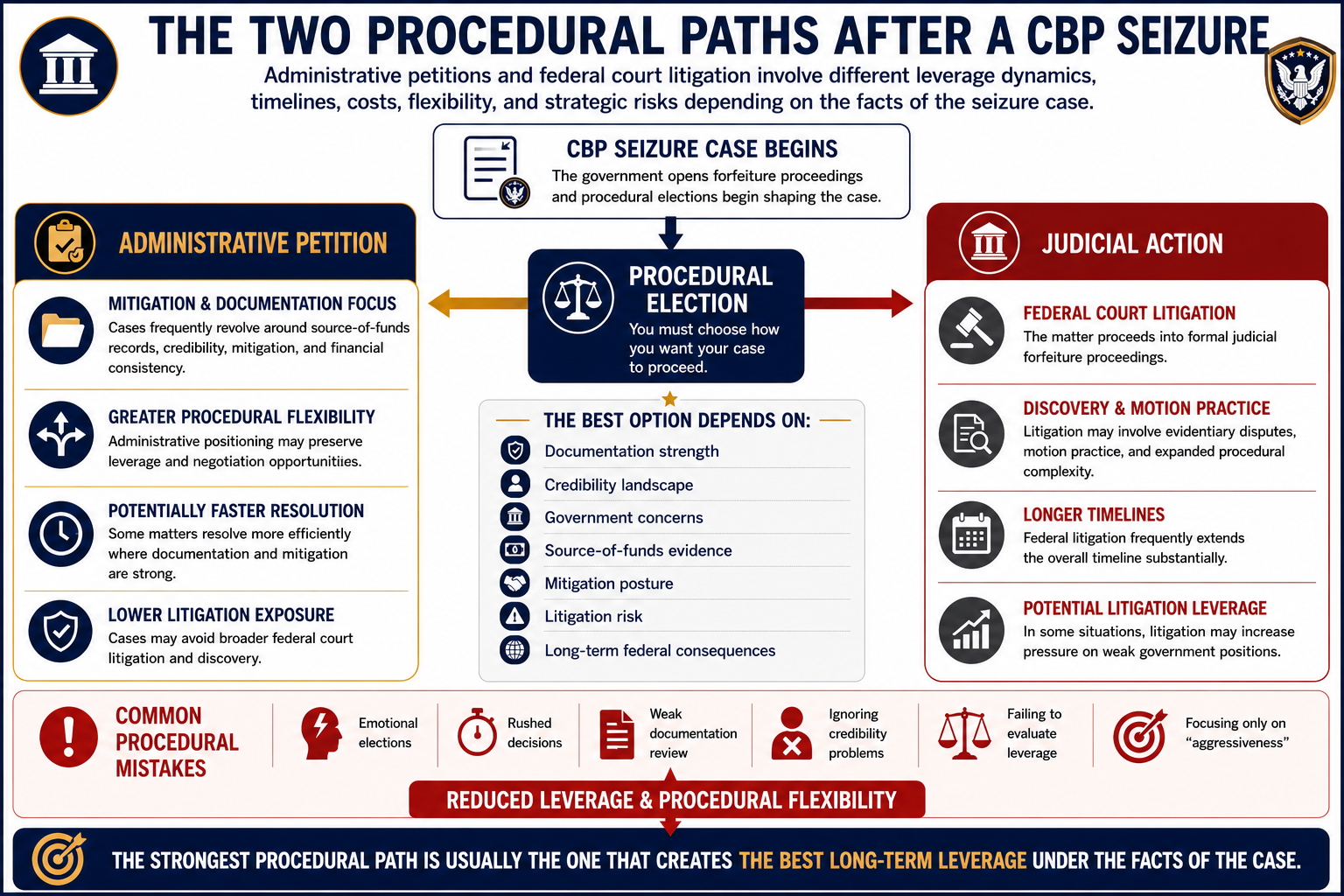
The strongest procedural path often depends heavily on:
- the documentation,
- the source-of-funds evidence,
- the credibility landscape,
- the government’s apparent concerns,
- the procedural posture,
- and the broader federal risks surrounding the case.
Many travelers do not realize this decision may significantly affect:
- leverage,
- timing,
- costs,
- procedural flexibility,
- mitigation opportunities,
- and long-term strategy.
That is one reason the Election of Proceedings decision frequently becomes one of the most important strategic moments in the entire case.
Many people make this choice while:
- overwhelmed,
- financially stressed,
- embarrassed,
- or trying to regain control quickly after the seizure.
As a result, travelers often approach the decision emotionally rather than strategically.
Federal agencies are frequently already evaluating:
- banking activity,
- reporting behavior,
- source-of-funds explanations,
- credibility,
- and mitigation posture
before the election is even made.
This is one reason customs seizure matters often become much more strategic and procedurally sophisticated than people initially expect.
We discuss many of these broader procedural issues throughout our Election of Proceedings Form Explained guide as well as the broader CBP Notice of Seizure Letter Explained: What To Do Next hub.
What Is an Administrative Petition?
An administrative petition generally asks CBP to:
- remit,
- mitigate,
- or return the seized property
through the agency’s administrative forfeiture process.
Many travelers mistakenly assume administrative petitions are simply:
- emotional pleas,
- requests for mercy,
- or informal settlement letters.
In reality, strong administrative petitions are often highly strategic and documentation-driven.
Federal agencies frequently evaluate:
- source-of-funds documentation,
- banking records,
- financial timelines,
- reporting behavior,
- mitigation,
- and credibility
throughout the administrative review process.
This is one reason sophisticated administrative strategy often focuses heavily on:
- organizing the financial narrative,
- narrowing institutional suspicion,
- preserving credibility,
- and strengthening mitigation before inconsistencies expand scrutiny further.
Strong administrative petitions frequently involve:
- coherent financial timelines,
- organized documentation,
- disciplined procedural communication,
- and carefully structured mitigation narratives.
In many situations, administrative proceedings also preserve greater procedural flexibility than immediate litigation.
That does not mean administrative resolution is always the strongest option. However, many travelers underestimate how much leverage strong administrative positioning may create before federal court litigation becomes necessary.
We discuss these broader mitigation and administrative review issues further in our pages on What Is a Petition for Remission or Mitigation? and What CBP Looks for in a Petition for Remission.
What Is Judicial Action?
Judicial action generally moves the forfeiture dispute into:
- federal court litigation.
This often changes the entire procedural landscape of the case.
Judicial forfeiture litigation may involve:
- formal pleadings,
- motion practice,
- discovery,
- evidentiary disputes,
- witness issues,
- and substantially more procedural complexity.
Many travelers initially assume litigation automatically creates stronger leverage.
Sometimes it does.
In certain situations, litigation may significantly improve leverage where:
- the government’s evidence appears weak,
- major factual disputes exist,
- procedural problems occurred,
- or aggressive agency positions become difficult to justify under closer judicial scrutiny.
At the same time, litigation frequently:
- extends timelines,
- increases costs,
- expands procedural exposure,
- and creates substantially more complexity.
This is one reason sophisticated customs seizure strategy often requires evaluating:
- the quality of the documentation,
- the credibility landscape,
- the government’s apparent concerns,
- and the broader litigation risks
before electing judicial action.
Many strong cases resolve administratively without full litigation. Other matters legitimately require federal court proceedings because:
- the administrative process stalls,
- the government hardens its position,
- or broader disputes remain unresolved.
The important point is that judicial action is not automatically:
- stronger,
- faster,
- or strategically superior.
The strongest path often depends heavily on:
- leverage,
- timing,
- documentation,
- and the broader institutional posture of the case.
We discuss these procedural distinctions further in our pages on Administrative Petition vs Federal Court Litigation.
Why Neither Option Is Automatically Better
One of the biggest strategic mistakes travelers make is trying to reduce the decision to:
- “administrative vs aggressive”
or - “easy vs hard.”
In reality, the strongest procedural strategy depends heavily on:
- how strong the documentation is,
- how much institutional suspicion exists,
- how the government appears to be evaluating the case,
- how consistent the financial narrative appears,
- and how much litigation exposure may exist.
For example, some cases may benefit from:
- strong administrative mitigation,
- procedural flexibility,
- and carefully organized documentation.
Other matters may require litigation because:
- factual disputes remain unresolved,
- the government’s theory appears weak,
- or administrative review is unlikely to narrow the dispute effectively.
Sophisticated customs seizure strategy frequently involves evaluating:
- leverage,
- timing,
- credibility,
- mitigation posture,
- and long-term federal consequences
before deciding which path creates the strongest position moving forward.
Many travelers initially approach the election emotionally because they feel:
- angry,
- embarrassed,
- overwhelmed,
- or pressured to “fight back.”
Strong strategy often looks much calmer and more disciplined than people initially expect.
Federal agencies frequently continue evaluating:
- financial consistency,
- source-of-funds evidence,
- reporting behavior,
- and procedural reliability
throughout both administrative and judicial proceedings.
This is one reason strong customs seizure strategy often focuses less on:
“What sounds toughest?”
and more on:
“What creates the strongest leverage under these facts?”
We discuss many of these broader leverage concepts throughout our How to Win a CBP Currency Seizure Case guide as well as our broader discussion of How CBP Actually Decides Seizure Cases.
When Administrative Resolution May Create Stronger Leverage
Many travelers initially assume administrative proceedings are:
- weaker,
- less serious,
- or merely “asking CBP nicely” for the money back.
In reality, strong administrative positioning is often far more strategic than people initially realize.
Administrative proceedings frequently allow travelers to:
- organize documentation carefully,
- strengthen source-of-funds explanations,
- develop mitigation,
- narrow institutional suspicion,
- and preserve procedural flexibility before broader litigation escalates the case further.
In many airport cash seizure matters, strong administrative strategy focuses heavily on:
- credibility,
- financial consistency,
- documentation quality,
- and mitigation posture.
Federal agencies often evaluate whether:
- the records support the explanation,
- the timelines remain coherent,
- the traveler appears administratively reliable,
- and the financial narrative remains internally consistent over time.
Where those issues are addressed effectively, administrative proceedings may sometimes create:
- stronger settlement leverage,
- faster procedural movement,
- reduced litigation exposure,
- and more flexibility than immediate federal court escalation.
Many travelers underestimate how important:
- organized source-of-funds records,
- disciplined communication,
- and coherent mitigation narratives
become during administrative review.
Strong administrative positioning often helps:
- narrow unresolved questions,
- reduce institutional skepticism,
- and stabilize the credibility landscape before procedural conflict intensifies further.
This is one reason sophisticated customs seizure strategy frequently focuses heavily on:
- building leverage early,
- preserving credibility,
- and understanding how the government is already evaluating the financial narrative before major procedural escalation occurs.
Administrative proceedings are not necessarily:
- passive,
- weak,
- or informal.
In many situations, they become the central strategic battleground of the entire case.
We discuss many of these broader administrative leverage issues throughout our pages on How Long Does It Take To Get Seized Cash Back From CBP? and The Biggest Mistakes People Make After CBP Seizes Their Money.
When Judicial Litigation May Become Necessary
At the same time, some customs seizure matters legitimately require judicial litigation.
In certain situations, federal court proceedings may become strategically necessary where:
- the government’s position appears overly aggressive,
- major factual disputes remain unresolved,
- the administrative process stalls,
- or broader constitutional and evidentiary issues exist.
Judicial litigation may sometimes improve leverage because it creates:
- formal procedural scrutiny,
- discovery opportunities,
- motion practice,
- and broader judicial review of the government’s position.
However, litigation also frequently changes the entire structure of the case.
Federal court proceedings often involve:
- significantly longer timelines,
- broader procedural complexity,
- higher litigation costs,
- expanded evidentiary disputes,
- and greater procedural exposure overall.
This is one reason sophisticated customs seizure strategy often requires carefully evaluating:
- the strength of the government’s evidence,
- the quality of the documentation,
- the credibility landscape,
- the litigation risks,
- and the broader long-term federal implications
before escalating the matter into federal court.
Many travelers initially view litigation emotionally because it feels:
- more aggressive,
- more powerful,
- or more confrontational.
Strong strategy often looks more disciplined than emotional.
In some situations, litigation genuinely creates stronger leverage. In others, it may unnecessarily:
- prolong the case,
- increase costs,
- harden positions,
- and expand scrutiny.
The strongest procedural path frequently depends on:
- leverage,
- timing,
- documentation,
- credibility,
- and how federal agencies are already evaluating the overall financial narrative.
We discuss many of these broader procedural considerations further in our pages on Can CBP Keep Your Money Even If You Were Never Charged With a Crime? and Bulk Cash Smuggling Explained: What CBP Must Prove.
Why Procedural Decisions Often Affect More Than the Seizure Itself
Many travelers initially view the decision between:
- administrative petition
and - judicial action
as nothing more than a procedural choice about:
- getting the money back.
In reality, these decisions frequently affect much broader federal interests than people initially realize.
Depending on the allegations involved, the administrative record created during:
- airport questioning,
- procedural filings,
- mitigation submissions,
- litigation positions,
- and source-of-funds explanations
may later affect:
- Global Entry eligibility,
- security clearances,
- contractor eligibility,
- immigration matters,
- federal employment,
- future border screening,
- banking scrutiny,
- and broader federal investigations.
Federal agencies frequently share information and evaluate these systems collectively rather than in isolation.
That means procedural decisions made early in the forfeiture process may later follow travelers into entirely separate:
- federal vetting systems,
- credentialing reviews,
- investigative files,
- or administrative proceedings.
This broader overlap is one reason sophisticated customs seizure strategy often requires evaluating not only:
“How do we challenge the forfeiture?”
but also:
“How will this procedural path affect the client’s broader federal position long-term?”
This is also where we are uniquely positioned compared to most customs seizure lawyers.
We are one of the only federal law firms in the country that simultaneously handles:
- customs seizure matters,
- Global Entry appeals,
- TSA credential matters,
- security clearance cases,
- federal investigations,
- federal employment matters,
- export-control issues,
- and overlapping national security-related administrative proceedings.
These are highly specialized federal systems that many traditional customs seizure lawyers do not regularly handle or fully understand.
That distinction matters enormously because procedural decisions in customs seizure matters often affect substantially more than the seized property itself.
Why National Security Law Firm Is Different
Many law firms approach customs seizure cases primarily as:
- forfeiture disputes,
- litigation matters,
- or isolated administrative proceedings.
We approach these matters through a much broader federal-systems lens.
Our customs seizure practice is built around understanding how overlapping federal agencies evaluate:
- credibility,
- mitigation,
- financial consistency,
- procedural behavior,
- reporting issues,
- and administrative reliability over time.
We regularly handle:
- airport cash seizure matters,
- Global Entry appeals,
- TSA credential matters,
- security clearance cases,
- federal investigations,
- federal employment matters,
- export-control issues,
- and overlapping national security-related administrative proceedings.
That combination is extremely uncommon.
Most customs seizure lawyers do not regularly practice in these adjacent federal systems. As a result, many do not fully evaluate how:
- procedural elections,
- litigation positions,
- mitigation submissions,
- credibility findings,
- or financial explanations
could later affect:
- security clearances,
- Global Entry,
- immigration,
- contractor eligibility,
- federal employment,
- or future border screening.
We evaluate petition-versus-litigation decisions through that broader institutional framework from the beginning.
That often means analyzing:
- how the government is already viewing the case,
- how the procedural path may affect leverage,
- how the financial narrative appears institutionally,
- and how to preserve long-term administrative credibility before positions harden further.
In many situations, the strongest strategic advantage is not simply choosing:
- “the aggressive option”
or - “the fast option.”
It is selecting the procedural path that best aligns with:
- the documentation,
- the credibility landscape,
- the government’s apparent concerns,
- the mitigation posture,
- and the client’s broader long-term federal interests.
For broader discussion of customs seizure strategy generally, visit CBP Notice of Seizure Letter Explained: What To Do Next and the broader Customs Seizure Lawyer Hub.
Frequently Asked Questions
What is the difference between a petition and judicial action?
An administrative petition generally keeps the matter within the administrative forfeiture system and often focuses heavily on:
- mitigation,
- documentation,
- financial consistency,
- and credibility.
Judicial action generally moves the matter into federal court litigation involving:
- formal procedural litigation,
- discovery,
- motion practice,
- and broader judicial review.
Is litigation always stronger?
No.
In some situations litigation may improve leverage significantly. In others, strong administrative positioning may create:
- faster resolution,
- stronger flexibility,
- reduced exposure,
- and better mitigation opportunities.
The strongest procedural path often depends heavily on:
- leverage,
- documentation,
- credibility,
- and the government’s apparent concerns.
Does judicial forfeiture usually take longer?
Often, yes.
Federal court litigation frequently involves:
- longer timelines,
- broader procedural complexity,
- discovery,
- evidentiary disputes,
- and increased litigation costs.
Can administrative petitions succeed?
Absolutely.
Many airport cash seizure matters resolve administratively where:
- documentation is strong,
- mitigation is persuasive,
- and the financial narrative appears coherent and credible.
What does CBP often evaluate before deciding how aggressively to pursue the case?
Federal agencies frequently evaluate:
- source-of-funds documentation,
- banking activity,
- reporting behavior,
- financial consistency,
- mitigation posture,
- and procedural reliability
very early in the process.
Why does documentation matter so much?
Many customs seizure matters become heavily:
- documentation-driven,
- credibility-driven,
- and mitigation-driven.
Federal agencies frequently evaluate whether:
- the records support the explanation,
- the financial narrative remains coherent,
- and the traveler appears administratively reliable over time.
What makes some cases better candidates for litigation?
Litigation may become strategically important where:
- factual disputes remain unresolved,
- the government’s position appears weak,
- procedural concerns exist,
- or broader evidentiary scrutiny is necessary.
Can this affect Global Entry or security clearances?
Potentially, yes.
Depending on the allegations involved, customs seizure proceedings may later affect:
- Global Entry,
- security clearances,
- immigration,
- contractor eligibility,
- federal employment,
- and future border screening.
What is the strongest procedural strategy?
Strong strategy frequently involves:
- understanding how the government is evaluating the case,
- organizing source-of-funds documentation carefully,
- preserving credibility,
- and selecting the procedural path that creates the strongest long-term leverage under the facts involved.
Should I talk to a lawyer before making the election?
In many situations, yes.
The Election of Proceedings decision may significantly affect:
- leverage,
- timing,
- procedural flexibility,
- litigation exposure,
- mitigation opportunities,
- and broader federal consequences later in the case.
Speak With a Nationwide Customs Seizure Lawyer
If you received a CBP Notice of Seizure and must decide between:
- administrative petition,
- or judicial action,
the procedural choices made early in the process may significantly affect:
- leverage,
- timing,
- mitigation opportunities,
- litigation exposure,
- and broader federal consequences.
Strong procedural strategy often depends heavily on:
- source-of-funds documentation,
- banking analysis,
- credibility,
- mitigation posture,
- procedural timing,
- and the government’s apparent concerns.
We offer nationwide representation and free consultations for customs seizure matters.
The fastest and easiest way to get started is through our online booking system.
In many situations, same-day consultations are available, and the process typically takes less than a minute to schedule online.
Once booked, one of our attorneys will personally call you at the scheduled time to discuss:
- the seizure,
- procedural deadlines,
- election strategy,
- source-of-funds documentation,
- mitigation considerations,
- credibility concerns,
- and broader federal implications.
To schedule a consultation online, visit:
Book a Free Consultation Online
You may also contact us directly at:
Phone: (202) 600-4996
Additional related resources: