
Most people are shocked when they learn that CBP can seize an entire vehicle.
Unlike airport cash seizure cases, where the focus is often on currency, reporting requirements, or source-of-funds issues, vehicle seizure cases frequently involve an entirely different set of federal concerns.
Many vehicle owners assume:
“If I legally own the vehicle, I should get it back.”
Unfortunately, ownership is often only one piece of the analysis.
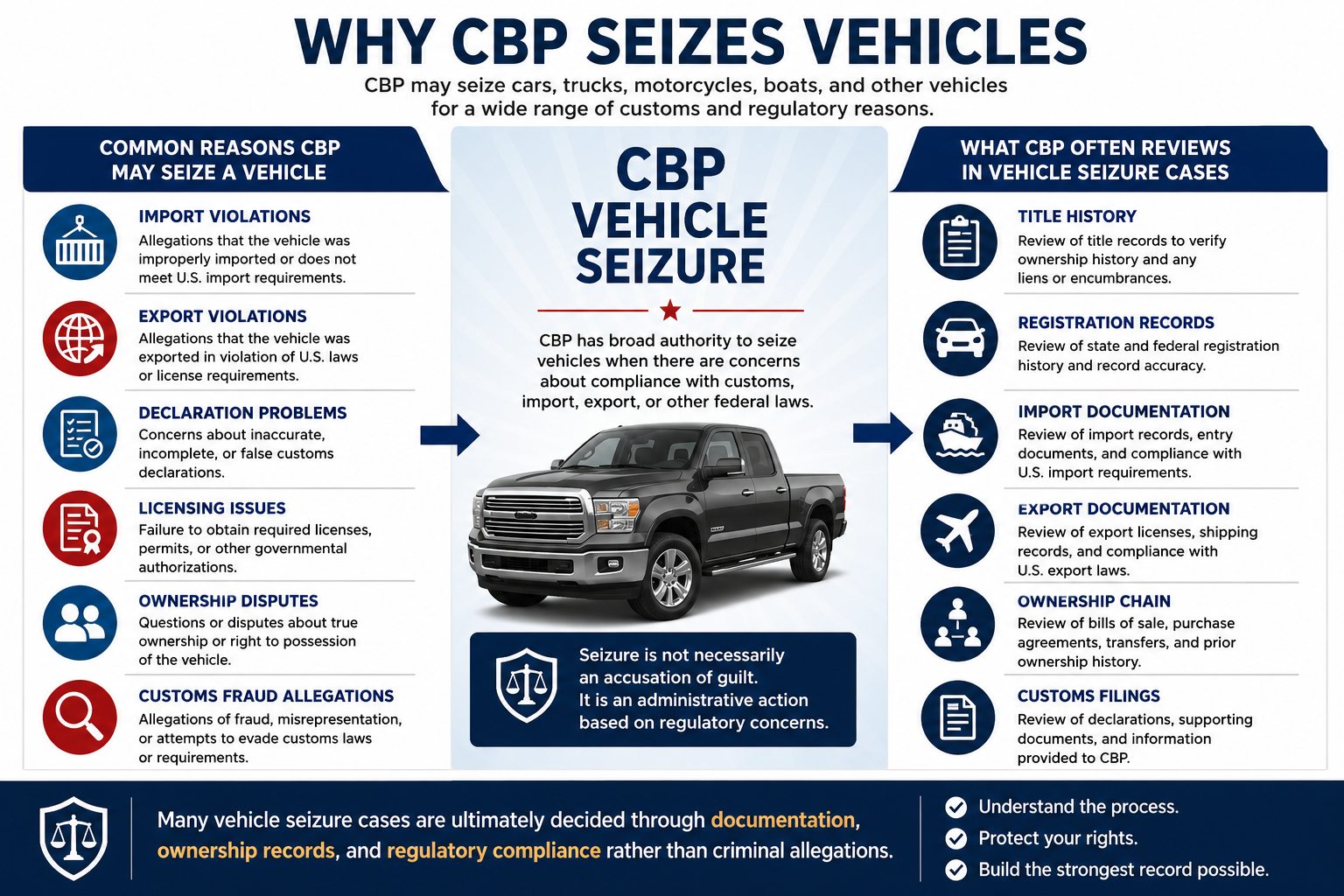
Federal agencies may seize vehicles for reasons involving:
- import violations,
- export violations,
- customs declaration issues,
- licensing concerns,
- sanctions-related allegations,
- prohibited modifications,
- documentation problems,
- ownership disputes,
- or broader customs enforcement issues.
As a result, vehicle seizure cases frequently become heavily dependent on:
- title records,
- registration history,
- customs filings,
- ownership documentation,
- import or export compliance,
- and the overall credibility of the documentary record.
This is one reason vehicle seizure matters often look very different from the cash seizure cases discussed throughout our CBP Money Seizure Lawyers: How to Get Seized Cash Back From Customs resource hub.
Vehicle seizures are often won or lost through documentation, chronology, and regulatory compliance rather than dramatic courtroom battles.
Understanding how federal agencies actually evaluate vehicle seizure cases is often the first step toward developing an effective strategy.
For a broader overview of customs seizure matters generally, visit our Customs Seizure Lawyer Hub.
Why CBP Seizes Vehicles
One of the biggest misconceptions surrounding vehicle seizures is that they only occur when a vehicle is stolen or connected to serious criminal conduct.
In reality, CBP seizes vehicles for a wide variety of reasons.
Some cases involve allegations that a vehicle was improperly imported into the United States. Others involve export-control concerns, inaccurate customs declarations, sanctions-related issues, licensing problems, or documentation irregularities.
For example, CBP may scrutinize:
- how the vehicle entered the country,
- whether proper declarations were made,
- whether import requirements were satisfied,
- whether export restrictions apply,
- whether ownership documentation is accurate,
- or whether the vehicle was involved in activity that triggered customs enforcement authority.
This is one reason vehicle seizure cases frequently become highly document-intensive.
Federal agencies often spend far more time reviewing:
- title history,
- registration records,
- customs paperwork,
- bills of sale,
- shipping records,
- and ownership chains
than many vehicle owners initially realize.
In many situations, the dispute is not about whether someone physically possesses the vehicle.
The dispute is whether the vehicle’s history, movement, ownership, and regulatory compliance can be adequately documented and supported.
That distinction becomes critically important when developing a strategy to recover the vehicle.
Vehicle Seizure Cases Are Often Very Different From Cash Seizure Cases
Many people assume all customs seizures work the same way.
They do not.
Currency seizure cases often revolve around questions such as:
- where the money came from,
- whether reporting requirements were followed,
- whether structuring concerns exist,
- and whether the financial narrative appears credible.
Vehicle seizure cases frequently involve an entirely different analysis.
Federal agencies may instead focus on:
- ownership history,
- import compliance,
- export compliance,
- customs declarations,
- title documentation,
- licensing requirements,
- and chain-of-custody issues.
As a result, the evidence needed to recover a vehicle often looks very different from the evidence used in airport cash seizure matters.
A strong vehicle seizure case frequently depends on building a coherent documentary record showing:
- lawful ownership,
- regulatory compliance,
- accurate declarations,
- and reliable supporting documentation.
In many situations, vehicle seizure cases become administrative record cases long before they become litigation cases.
That is one reason understanding how federal agencies evaluate documentation often matters far more than many vehicle owners initially expect.