
Few things are more frustrating than discovering that CBP has seized a valuable watch, piece of jewelry, designer handbag, or other luxury item.
Many people are shocked when it happens.
After all, they know the item belongs to them. They may have purchased it legally, owned it for years, inherited it from a family member, or received it as a gift.
As a result, the immediate reaction is often:
“Why would customs seize something that I legally own?”
The answer is that customs seizure cases are often about much more than ownership.
Federal agencies may evaluate:
- how the item entered the country,
- what declarations were made,
- whether duties applied,
- whether import requirements were satisfied,
- whether authenticity concerns exist,
- and whether the available documentation supports the item’s history.
This is one reason luxury goods seizures frequently become documentation cases rather than ownership disputes.
Many people assume that proving:
“It’s mine”
ends the discussion.
In reality, federal agencies often focus on broader questions involving:
- authenticity,
- valuation,
- import compliance,
- customs declarations,
- and supporting documentation.
Whether the item involves:
- a Rolex watch,
- luxury jewelry,
- designer handbags,
- high-end collectibles,
- luxury accessories,
- or other valuable property,
the government’s analysis often centers on whether the available record supports lawful importation and ownership.
Understanding how CBP evaluates luxury goods seizures is often the first step toward developing an effective strategy.
For a broader overview of customs seizure matters generally, visit our:
- CBP Property Seizures: Vehicles, Merchandise, Electronics, Jewelry, and Luxury Goods
- Customs Seizure Lawyer Hub
resources.
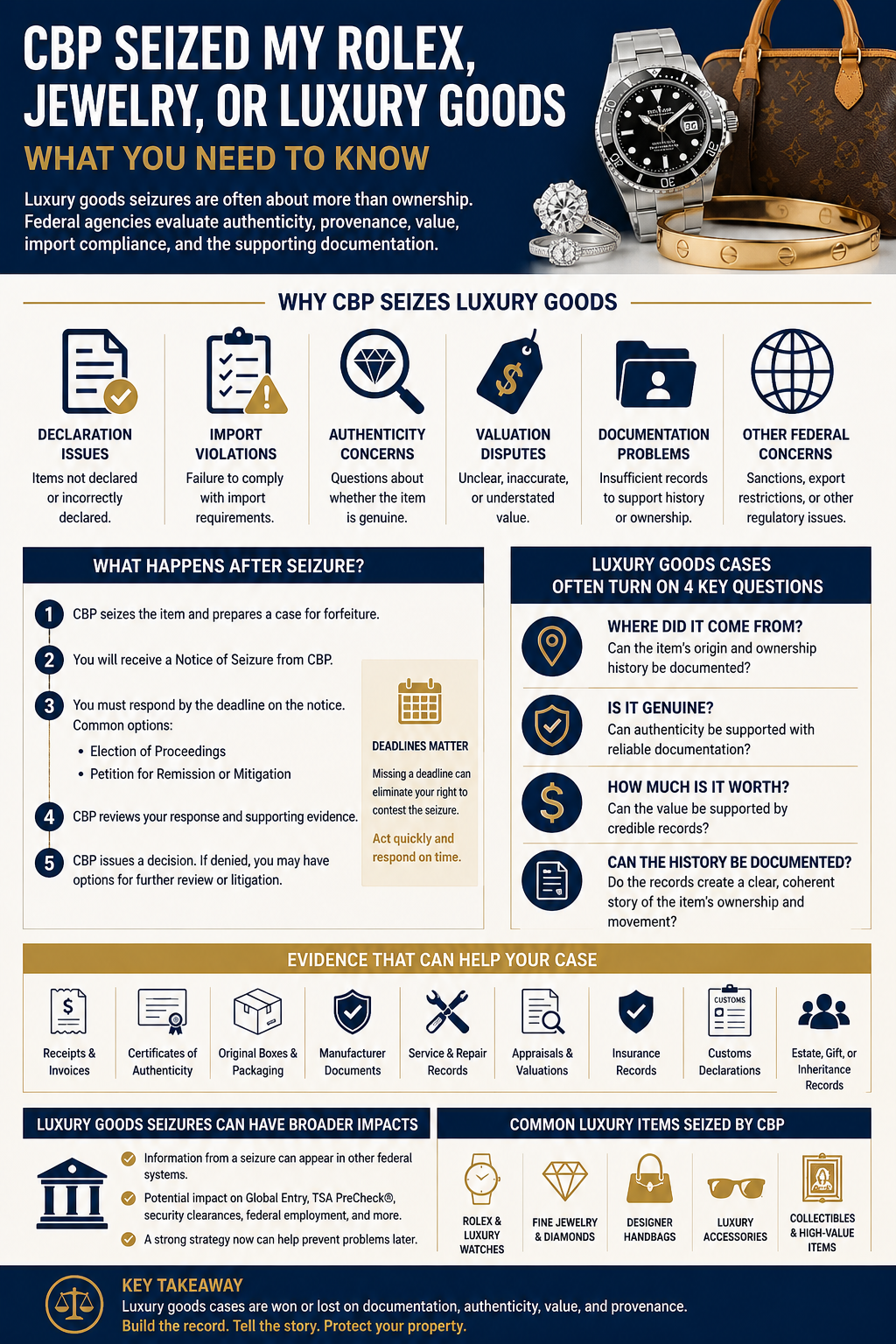
Why CBP Seizes Rolex Watches, Jewelry, and Luxury Goods
One of the biggest misconceptions surrounding luxury goods seizures is that customs only seizes counterfeit items.
Counterfeit allegations certainly account for many seizures, but they are far from the only reason valuable property may be detained or seized.
Federal agencies may scrutinize luxury goods because of:
- declaration issues,
- import violations,
- valuation disputes,
- authenticity concerns,
- customs duty questions,
- documentation problems,
- sanctions-related restrictions,
- or broader regulatory concerns.
For example, travelers may encounter problems where:
- expensive items were not properly declared,
- supporting documentation is unavailable,
- ownership records are unclear,
- authenticity cannot be established,
- or customs officials believe import requirements were not satisfied.
Many people are surprised to learn that customs scrutiny often increases as the value of an item increases.
A luxury watch, high-end jewelry collection, or designer handbag may attract substantially more attention than ordinary personal property simply because the financial stakes are higher.
This is one reason luxury goods cases frequently become highly dependent on:
- receipts,
- certificates of authenticity,
- appraisals,
- ownership records,
- customs declarations,
- and other supporting documentation.
In many situations, federal agencies are attempting to determine whether the available record creates confidence regarding:
- authenticity,
- ownership,
- value,
- and import compliance.
That evaluation often becomes the central issue in the case.
One of the Biggest Questions: Does CBP Think the Item Is Counterfeit?
In many luxury goods seizure matters, the most important question is whether federal agencies believe the item is counterfeit.
This distinction matters enormously because a counterfeit seizure case is often very different from a declaration issue, valuation issue, or documentation issue.
When authenticity concerns arise, federal agencies may evaluate:
- trademarks,
- serial numbers,
- manufacturer records,
- authenticity documentation,
- purchase history,
- and ownership records.
Luxury watches such as Rolexes, designer handbags, jewelry, and other high-end goods are frequently targeted by counterfeit enforcement efforts because counterfeit markets involving these products are substantial.
Many people become alarmed when they hear the word:
“counterfeit.”
However, an authenticity concern does not automatically mean the government is correct.
The critical issue often becomes whether sufficient evidence exists to establish:
- authenticity,
- provenance,
- lawful acquisition,
- and ownership.
This is one reason documentation frequently becomes one of the most important aspects of luxury goods seizure cases.
The stronger the documentation supporting authenticity, the stronger the position often becomes.
We discuss these issues further in our:
resource.