Having a phone, laptop, drone, camera, tablet, hard drive, or other electronic device seized by CBP can be particularly unsettling.

Unlike many other types of property, electronic devices often contain much more than their physical value.

They may hold:

  • personal photographs,
  • business records,
  • communications,
  • work product,
  • proprietary information,
  • travel records,
  • and years of personal data.

As a result, many people are concerned not only about the loss of the device itself, but also about what happens next.

Common questions include:

“Why did customs seize my laptop?”

“Can CBP keep my phone?”

“How do I get my device back?”

“What happens to the information stored on it?”

The answer depends heavily on why the device was seized in the first place.

Many people assume customs only seizes electronics when they contain prohibited material.

In reality, federal agencies may seize electronic devices for a wide variety of reasons involving:

  • import violations,
  • export restrictions,
  • customs declarations,
  • licensing requirements,
  • sanctions-related concerns,
  • documentation problems,
  • and broader regulatory issues.

This is one reason electronics seizure cases often become very different from:

  • cash seizure cases,
  • vehicle seizure cases,
  • luxury goods seizures,
  • or merchandise seizures.

The government is frequently evaluating issues that extend well beyond ownership alone.

Understanding those issues is often the first step toward determining what options may exist moving forward.

For a broader overview of property seizure matters generally, visit:

Why CBP Seizes Electronics and Devices

Many people are surprised to learn that customs seizures involving electronics are often driven by regulatory concerns rather than the devices themselves.

Federal agencies may scrutinize:

  • phones,
  • laptops,
  • tablets,
  • drones,
  • cameras,
  • communications equipment,
  • hard drives,
  • computer components,
  • and other technology products

for a variety of reasons.

In some situations, the concern involves import compliance.

In others, the focus may involve:

  • export restrictions,
  • licensing requirements,
  • sanctions programs,
  • customs declarations,
  • product classifications,
  • or other federal regulations.

The issue is not always:

“What is the device?”

The issue may be:

“How did the device enter or leave the country, and were all applicable requirements satisfied?”

This distinction becomes important because many owners focus entirely on proving ownership.

Federal agencies may instead be evaluating:

  • regulatory compliance,
  • import documentation,
  • export documentation,
  • declarations,
  • licensing,
  • and supporting records.

That broader analysis often shapes the entire direction of the case.
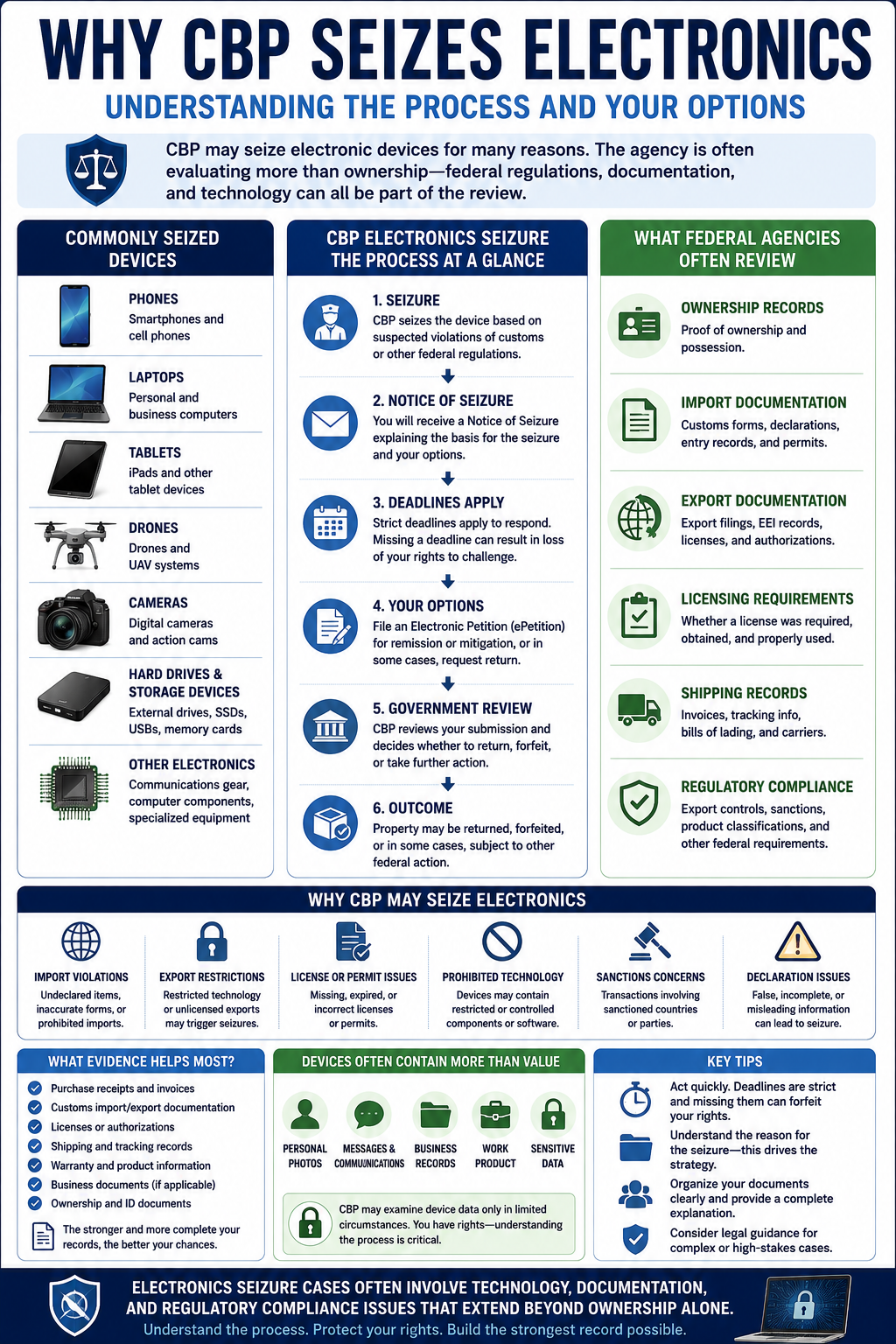
Electronics Seizures Often Raise Different Concerns Than Other Property Seizures

Electronic devices occupy a unique place within customs enforcement.

A seized watch, handbag, or piece of jewelry often raises questions involving:

  • ownership,
  • authenticity,
  • valuation,
  • and provenance.

Electronics cases frequently raise a different set of issues.

Federal agencies may evaluate:

  • technology classifications,
  • communications capabilities,
  • export-control restrictions,
  • licensing requirements,
  • commercial use,
  • and regulatory compliance.

This is particularly true with:

  • drones,
  • specialized equipment,
  • communications devices,
  • high-end technology products,
  • and devices that may have commercial or technical applications.

As a result, electronics seizure cases frequently involve broader regulatory questions than many owners initially expect.

The government’s concern may have little to do with ownership and much more to do with:

  • how the device was imported,
  • how it was exported,
  • whether licensing requirements applied,
  • and whether regulatory requirements were satisfied.

That is one reason electronics seizures often require a different strategic analysis than other property seizure matters.

What Happens After CBP Seizes a Phone, Laptop, Drone, or Other Device?

For many people, the most stressful part of an electronics seizure begins after the device has already been taken.

The immediate questions are often practical:

  • Where is the device?
  • Am I getting it back?
  • How long will this take?
  • What happens to the information stored on it?
  • What should I do next?

Unfortunately, many people do not receive clear answers immediately.

Instead, the matter typically moves into the federal administrative process.

As the case progresses, CBP may continue evaluating:

  • the reason for the seizure,
  • the applicable regulations,
  • supporting documentation,
  • import or export records,
  • ownership records,
  • licensing issues,
  • and other information relevant to the device.

Eventually, owners often receive formal notices explaining:

  • the basis for the seizure,
  • applicable deadlines,
  • available procedural options,
  • and how the government intends to proceed.

This is frequently the point where people first encounter terms such as:

  • Notice of Seizure,
  • Election of Proceedings,
  • Petition for Remission or Mitigation,
  • administrative forfeiture,
  • and other procedural mechanisms governing customs seizures.

Many owners make the mistake of treating this stage as a waiting period.

In reality, this is often the point where the administrative record begins taking shape.

Federal agencies frequently continue reviewing:

  • purchase records,
  • shipping records,
  • customs declarations,
  • licensing information,
  • ownership documentation,
  • and other supporting materials

while the procedural process moves forward.

This is one reason understanding the government’s actual concern is often critically important.

A device seized because of:

  • an import issue,
  • an export-control issue,
  • a licensing concern,
  • or a declaration problem

may require very different documentation and strategy than a device seized for an entirely different reason.

The sooner the underlying issue is identified, the easier it often becomes to determine what evidence may be most helpful moving forward.

Many of the deadlines and procedural decisions that arise in electronics seizure cases are similar to those found throughout the broader customs seizure system.

Owners who understand those deadlines early frequently preserve substantially more flexibility than those who wait until the process has already advanced.

The Government Is Often Evaluating More Than the Device Itself

One of the biggest misconceptions in electronics seizure cases is the belief that the government’s focus is limited to the physical device.

Many owners assume the central question is simply:

“Do I own this laptop, phone, drone, or other device?”

In reality, federal agencies are often evaluating a much broader set of issues.

Depending on the circumstances, the inquiry may involve questions regarding:

  • import compliance,
  • export compliance,
  • licensing requirements,
  • customs declarations,
  • product classifications,
  • shipping history,
  • and regulatory obligations.

In other words, the device itself may simply be the starting point.

Federal agencies frequently attempt to understand:

  • how the device moved across borders,
  • what declarations were made,
  • whether any restrictions applied,
  • whether required authorizations existed,
  • and whether the overall transaction complied with applicable regulations.

This is one reason electronics seizure cases often become highly document-intensive.

Investigators may review:

  • purchase records,
  • shipping records,
  • customs filings,
  • import documents,
  • export documents,
  • licensing records,
  • invoices,
  • and supporting correspondence.

Many owners are surprised by how much emphasis federal agencies place on the documentary record.

The issue often becomes less about:

“Who owns the device?”

and more about:

“Can the movement, transfer, importation, or exportation of the device be adequately documented and explained?”

That distinction is important because it affects the type of evidence that may ultimately matter most.

Strong cases frequently involve documentation that allows federal decision-makers to understand:

  • where the device came from,
  • how it crossed the border,
  • what requirements applied,
  • and why the transaction complied with applicable rules.

When those questions can be answered clearly, the government’s review often becomes much easier.

When the record contains gaps, inconsistencies, or missing documentation, scrutiny frequently increases.

That pattern appears repeatedly throughout federal administrative systems.

The stronger the documentary record becomes, the easier it often becomes for federal agencies to evaluate the owner’s position.