
Discovering that customs has seized your package can be confusing and frustrating.
For many people, the package contains something they legally purchased online and fully expected to receive.
The first questions are usually:
“Why was my package seized?”
“Can I get it back?”
“Did I do something wrong?”
“What happens now?”
In many situations, the recipient has no idea there was a problem until a notice arrives from CBP or the package simply stops moving through the shipping system.
What surprises many people is that package seizures often have very little to do with who ordered the item.
Instead, federal agencies are frequently evaluating:
- what is inside the package,
- whether it can lawfully enter the United States,
- whether import requirements were satisfied,
- and whether any federal restrictions apply.
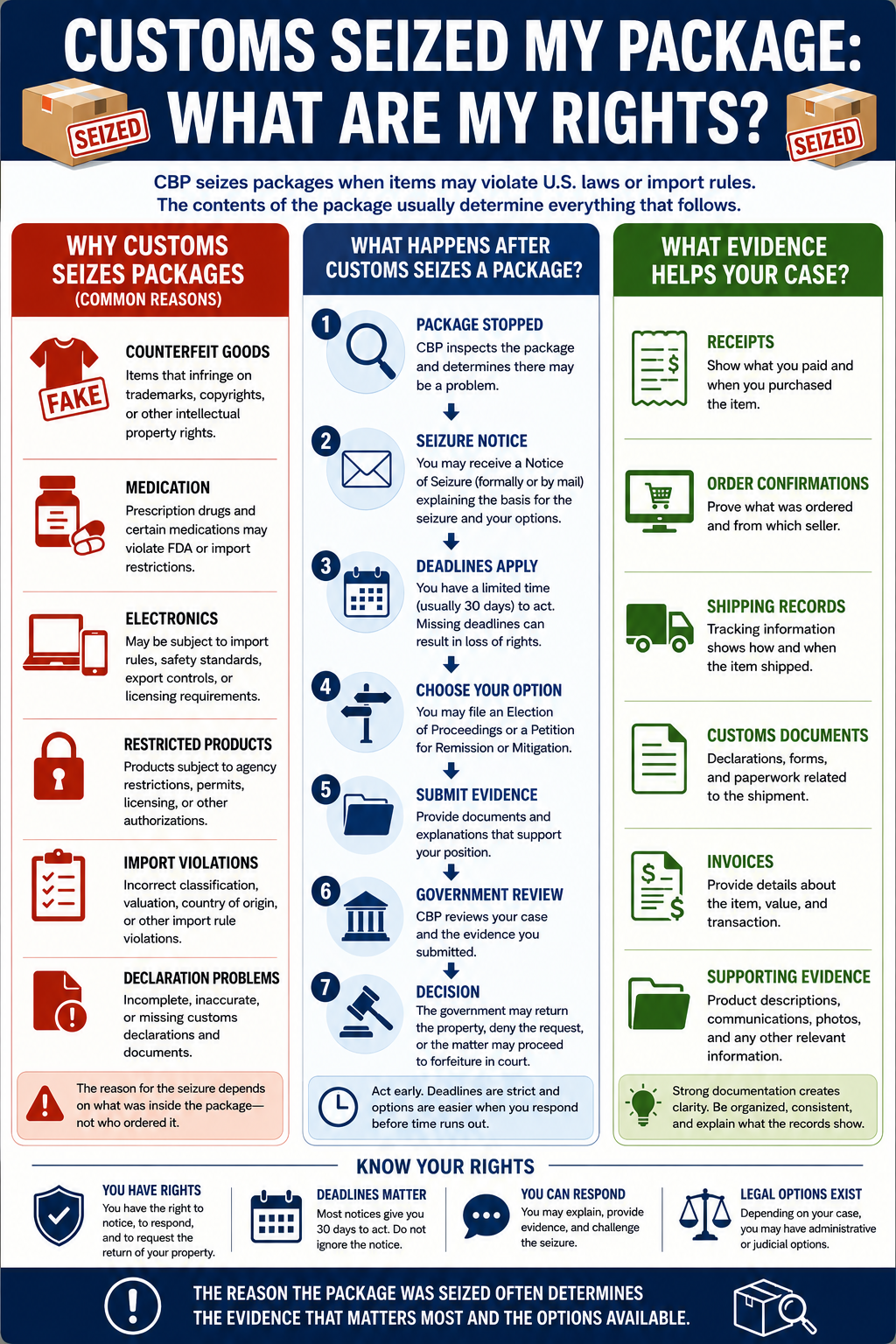
This is one reason package seizure cases can involve a wide variety of issues, including:
- counterfeit goods,
- prescription medication,
- electronics,
- restricted products,
- customs declaration problems,
- intellectual property concerns,
- and broader import compliance issues.
Understanding why the package was seized is often the most important step in understanding what options may exist moving forward.
For a broader overview of customs seizure matters generally, visit:
- CBP Property Seizures: Vehicles, Merchandise, Electronics, Jewelry, and Luxury Goods
- Customs Seizure Lawyer Hub
Why Customs Seizes Packages
Many people assume customs only seizes packages containing illegal items.
In reality, packages may be stopped or seized for a variety of reasons.
Federal agencies may scrutinize shipments because of:
- counterfeit merchandise,
- prescription medication,
- restricted products,
- intellectual property concerns,
- import violations,
- customs declaration issues,
- labeling problems,
- licensing requirements,
- or other regulatory concerns.
In many situations, the issue is not whether the recipient intended to violate any law.
The issue is whether the contents of the package comply with applicable federal requirements.
That distinction is important.
A person may legally purchase an item from an overseas seller and still encounter customs problems if the product itself triggers regulatory concerns.
This is one reason package seizure cases frequently become product-specific cases.
The government’s analysis often depends heavily on:
- what was shipped,
- where it came from,
- how it was declared,
- and what regulations apply to the item.
Understanding the nature of the item frequently becomes the key to understanding the seizure itself.
Package Detention and Package Seizure Are Not Always the Same Thing
One of the biggest sources of confusion is that people often use the terms:
- detention,
- hold,
- inspection,
- and seizure
interchangeably.
Federal agencies do not.
A detained package is not necessarily a seized package.
Packages are frequently delayed for:
- inspection,
- document review,
- customs processing,
- agency review,
- or additional examination.
In many situations, a package may ultimately be released without being formally seized.
A seizure generally represents a more significant action.
It usually means federal authorities have determined there is a basis to formally take possession of the property and begin the forfeiture process.
This distinction matters because the procedural options available often depend on whether:
- the package is merely delayed,
- under review,
- detained,
- or formally seized.
Many people assume their package has been seized when it is actually being held for inspection.
Others assume the package is merely delayed when a formal seizure has already occurred.
That is one reason understanding the procedural posture of the shipment is often one of the first issues that should be clarified.