
When most businesses think about customs enforcement, they think about imports.
They think about products entering the United States.
They think about duties, tariffs, inspections, and customs declarations.
Export seizures are different.
In an export seizure case, the government’s concern is often not:
“Should this item be allowed into the United States?”
The question frequently becomes:
“Should this item be allowed to leave the United States?”
That distinction changes the entire analysis.
Many export seizures involve issues relating to:
- export controls,
- licensing requirements,
- sanctions restrictions,
- destination countries,
- end users,
- technical products,
- controlled technology,
- and broader national security concerns.
As a result, export seizure cases often look very different from:
- import seizures,
- merchandise seizures,
- luxury goods seizures,
- package seizures,
- and other customs matters.
Federal agencies frequently evaluate not only the shipment itself but also the broader transaction, the parties involved, and the regulatory framework governing the export.
For many businesses, the first indication of a problem occurs when a shipment is suddenly stopped before leaving the country.
The shipment may have already been:
- packaged,
- scheduled,
- sold,
- contracted,
- or promised to a customer.
Then the export stops.
Understanding why that happened is often the first step toward understanding what options may exist moving forward.
For a broader overview of customs seizure matters generally, visit:
Why CBP Seizes Exports
Many businesses are surprised to learn that CBP actively enforces export regulations.
The assumption is often:
“We own the product. We should be able to ship it.”
Federal agencies frequently evaluate a different question.
They may examine:
- whether export restrictions apply,
- whether a license was required,
- whether declarations were accurate,
- whether sanctions concerns exist,
- whether restricted parties are involved,
- and whether applicable federal regulations were satisfied.
This is one reason export seizures frequently become regulatory compliance cases.
The government’s focus often extends beyond ownership.
Questions frequently arise regarding:
- who is receiving the shipment,
- where the shipment is going,
- what the shipment contains,
- and whether the transaction complies with federal requirements.
Many export seizures originate from concerns involving:
- export-control regulations,
- sanctions programs,
- licensing obligations,
- technical products,
- controlled technologies,
- and restricted destinations.
As a result, export enforcement often operates within a very different framework than ordinary commercial transactions.
The stronger a company’s understanding of that framework becomes, the easier it often is to understand why a shipment was stopped and what issues federal agencies may be evaluating.
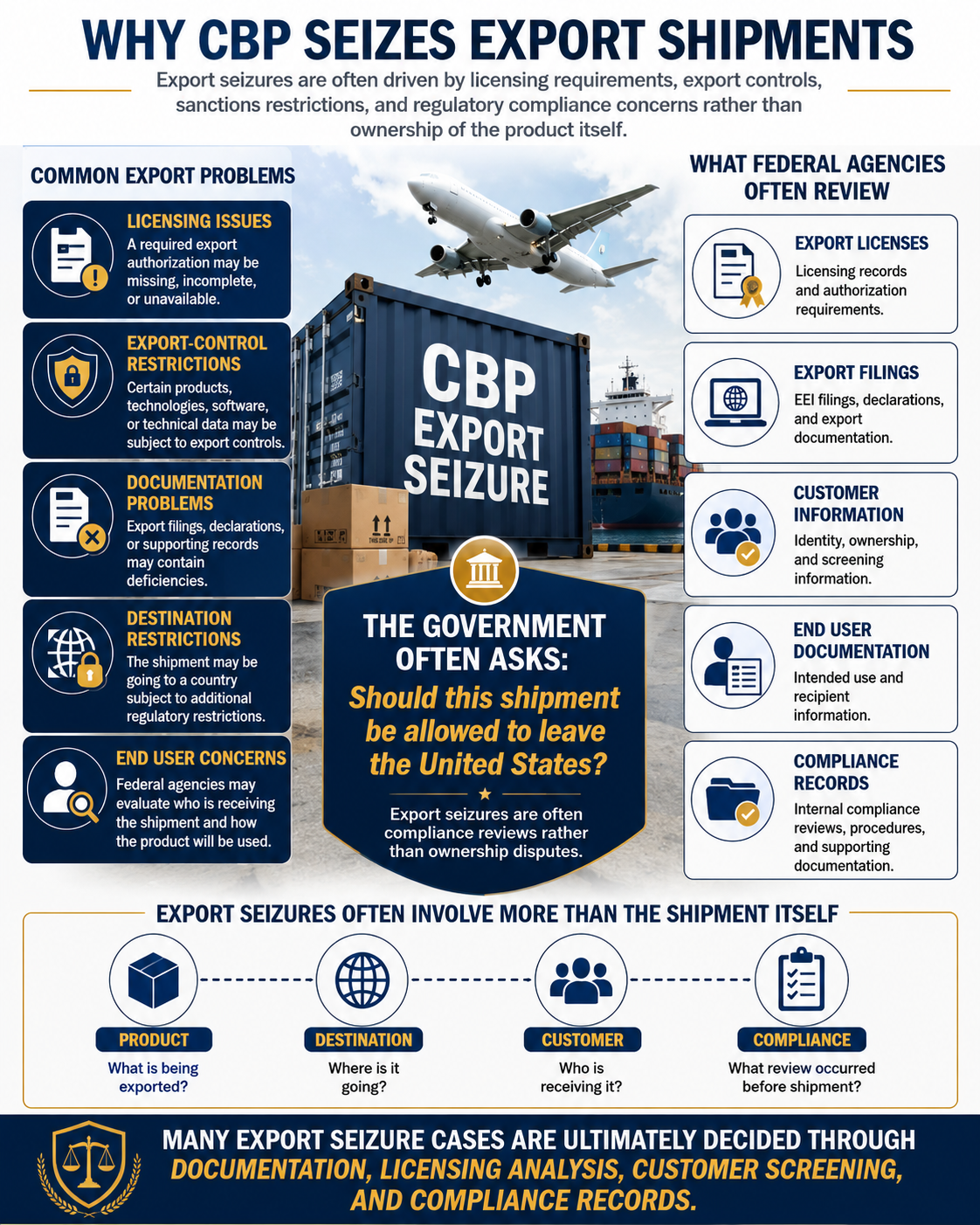
Export Seizures Are Often Different From Import Seizures
One of the biggest mistakes businesses make is assuming that export seizures operate under the same framework as import seizures.
They often do not.
Import seizures typically focus on questions such as:
- whether merchandise may enter the United States,
- whether declarations were accurate,
- whether duties were properly assessed,
- whether country-of-origin requirements were satisfied,
- and whether the product complies with applicable import regulations.
Export seizures frequently involve a very different set of concerns.
Federal agencies may instead focus on:
- who is receiving the product,
- where the shipment is going,
- whether export restrictions apply,
- whether a license was required,
- whether sanctions programs are implicated,
- and whether the transaction presents broader regulatory concerns.
This distinction is important because it changes how federal agencies evaluate risk.
In many import cases, the focus is on admissibility.
In many export cases, the focus is on control.
The government is often attempting to determine whether certain products, technologies, or information should leave the United States at all.
That is one reason export seizures frequently involve:
- licensing requirements,
- export-control regulations,
- restricted destinations,
- restricted end users,
- sanctions concerns,
- and national security considerations.
Many businesses are surprised when a shipment is stopped even though:
- the customer appears legitimate,
- the transaction appears ordinary,
- and the product itself is legal.
The issue may not be the product.
The issue may be the combination of:
- the product,
- the destination,
- the recipient,
- the licensing requirements,
- and the broader regulatory framework governing the export.
This is one reason export seizures frequently require a different strategic analysis than import seizures.
The key questions are often:
- What was being exported?
- Who was receiving it?
- Where was it going?
- What regulations applied?
- What authorizations were required?
The answers to those questions frequently shape the entire direction of the case.
What Happens After CBP Seizes an Export Shipment?
For most businesses, the first indication of a problem is that the shipment simply stops moving.
The goods may have already been:
- sold,
- packaged,
- loaded,
- scheduled for transport,
- or promised to a customer.
Then the export process suddenly comes to a halt.
At that point, many businesses understandably focus on operational concerns:
- Will the shipment be released?
- Will the customer cancel the order?
- How long will this take?
- What are we supposed to do now?
Meanwhile, the federal administrative process is already moving forward.
Once a seizure occurs, CBP will generally begin a formal review process and eventually issue notices explaining:
- the basis for the seizure,
- applicable deadlines,
- procedural options,
- and how the government intends to proceed.
As the matter develops, federal agencies may continue reviewing:
- export filings,
- shipping records,
- customer information,
- licensing records,
- product descriptions,
- technical specifications,
- and other supporting documentation.
This is one reason export seizure cases frequently become highly document-intensive.
Federal agencies are often attempting to understand:
- the transaction,
- the parties involved,
- the destination,
- the regulatory framework,
- and whether the export complied with applicable requirements.
The period immediately following the seizure is often one of the most important stages of the case.
Many businesses initially focus on recovering the shipment.
Federal agencies are often focused on understanding why the shipment was moving in the first place and whether the export complied with federal regulations.
Understanding that distinction frequently helps explain why export seizures often involve much more than the shipment itself.
The Government Is Often Evaluating More Than the Shipment Itself
One of the most important concepts in export seizure cases is understanding that the shipment itself is often only the beginning of the government’s inquiry.
Many businesses naturally focus on the shipment that was stopped.
That makes sense. The shipment may represent:
- revenue,
- inventory,
- a customer relationship,
- a contractual obligation,
- or an important international transaction.
As a result, the immediate question is usually:
“Why was this shipment seized?”
Federal agencies are often asking a broader question.
In many export matters, the shipment functions as a trigger event that causes investigators to examine a larger set of compliance issues surrounding the transaction.
For example, federal agencies may begin evaluating:
- who the customer is,
- where the shipment was going,
- how the product was classified,
- whether licensing requirements applied,
- what due diligence was performed,
- and whether similar transactions have occurred previously.
The focus frequently expands beyond the shipment itself and into the company’s overall export practices.
This is one reason export seizures often feel different from many other customs matters.
In a typical property seizure case, the primary issue may be the property itself.
In an export seizure case, the shipment often becomes a window into the company’s broader compliance program.
Federal agencies may review:
- prior exports,
- customer relationships,
- distributor relationships,
- destination countries,
- licensing decisions,
- end-user certifications,
- internal compliance procedures,
- and export documentation.
The goal is often to determine whether the shipment was an isolated issue or part of a broader compliance concern.
This does not mean every export seizure develops into a major investigation.
Most do not.
However, businesses are often surprised by how quickly federal agencies begin evaluating the larger context surrounding the transaction.
For example, investigators may ask:
- Has the company shipped similar products before?
- Have similar destinations been involved previously?
- Were the same customers involved?
- Were proper screening procedures followed?
- Does the company’s documentation consistently support its export decisions?
Those questions often become just as important as the shipment itself.
This is one reason export seizure cases frequently become heavily documentation-driven.
Federal agencies are often evaluating whether the company’s records demonstrate a thoughtful and compliant export process.
Strong documentation frequently shows:
- how decisions were made,
- why certain classifications were used,
- what due diligence occurred,
- and how the company addressed regulatory obligations before the shipment was sent.
Weak documentation often creates uncertainty.
And uncertainty tends to create additional scrutiny.
In many export seizure matters, the central issue eventually becomes larger than:
“Should this shipment have left the country?”
The broader question often becomes:
“Can federal agencies trust the compliance process that produced this shipment?”
That distinction is one of the defining characteristics of export seizure cases and helps explain why these matters frequently evolve into broader compliance reviews rather than simple disputes over a single shipment.
Export Licensing Issues Frequently Drive These Cases
One of the most common reasons export shipments are stopped is because federal agencies believe a licensing issue may exist.
This often surprises businesses.
Many companies assume that if they can legally manufacture, purchase, possess, or sell a product within the United States, they can also export it without significant restrictions.
Federal export regulations do not always work that way.
Certain products, technologies, software, components, and technical data may be subject to export controls depending on:
- what the item is,
- where it is going,
- who is receiving it,
- how it will be used,
- and what regulations govern the transaction.
As a result, a shipment that appears completely ordinary from a commercial perspective may raise significant concerns from a regulatory perspective.
This is one reason export seizures frequently occur even when businesses believe they are engaging in routine international commerce.
The issue is often not whether the product itself is unlawful.
The issue is whether the product can be exported to a particular destination, customer, or end user without additional authorization.
Federal agencies frequently evaluate:
- export classifications,
- licensing requirements,
- destination restrictions,
- end-user information,
- technical specifications,
- and the overall regulatory framework surrounding the shipment.
Many businesses do not discover a licensing issue until after the shipment has already been prepared.
The product may have been:
- sold,
- invoiced,
- packaged,
- and scheduled for export
before anyone realizes additional requirements may apply.
When that happens, the shipment itself often becomes the focal point of a broader review.
Investigators may begin examining:
- why the product was classified a certain way,
- whether licensing requirements were considered,
- what due diligence was performed,
- and whether the available documentation supports the export decision.
This is one reason export seizure cases frequently become highly document-intensive.
Federal agencies often place significant weight on records showing:
- how export decisions were made,
- what information was reviewed,
- what screening occurred,
- and why the company concluded the shipment could proceed.
The stronger that documentary record becomes, the easier it often is to evaluate the transaction.
The weaker the record becomes, the more difficult it often is to explain how compliance decisions were reached.
In many export seizure matters, the central dispute is not ownership of the product.
It is whether the company adequately navigated the regulatory requirements governing the export.
That distinction helps explain why licensing issues frequently become one of the most important aspects of the entire case.
Sanctions and Restricted Party Concerns
Many businesses assume that export compliance is primarily about the product being shipped.
In some situations, the government’s primary concern is not the product at all.
Instead, federal agencies may focus on:
- who is receiving the shipment,
- where the shipment is going,
- who ultimately controls the receiving company,
- and how the product may be used after delivery.
This is one reason sanctions and restricted-party issues frequently appear in export seizure cases.
A product that can be legally exported to one customer may raise entirely different concerns when shipped to another.
Similarly, a destination that appears routine from a business perspective may trigger additional scrutiny under federal regulations.
As a result, export enforcement often involves much more than evaluating the physical shipment.
Federal agencies frequently review:
- customer information,
- ownership information,
- destination countries,
- intermediary parties,
- end-user certifications,
- and transaction records
to understand who is involved in the transaction and whether any restrictions apply.
This is particularly important because sanctions programs and restricted-party regulations often focus on:
- people,
- entities,
- destinations,
- and relationships
rather than products alone.
Many businesses are surprised when a shipment is stopped even though the product itself appears unremarkable.
The issue may not be the shipment.
The issue may be the recipient.
Federal agencies frequently evaluate whether:
- screening procedures were performed,
- customer information was verified,
- destination restrictions were considered,
- and available documentation supports the transaction.
This is one reason export seizures often become heavily dependent on documentation.
Records relating to:
- customer screening,
- end-user verification,
- compliance reviews,
- destination analysis,
- and transaction approvals
may become critically important during the government’s review.
In many situations, the government’s concern is not:
“What is being exported?”
The concern may instead be:
“Who is receiving it and should they be receiving it?”
That distinction is one of the defining characteristics of sanctions-related export matters.
The stronger the documentation explaining:
- who the customer is,
- how the customer was vetted,
- what screening occurred,
- and why the transaction was approved,
the easier it often becomes for federal agencies to evaluate the export.
This is one reason sophisticated export compliance programs place significant emphasis on:
- customer screening,
- end-user verification,
- documentation,
- and recordkeeping.
In many export seizure matters, those records become some of the most important evidence in the entire case.
What Evidence Helps Resolve an Export Seizure?
In many export seizure cases, the outcome is heavily influenced by documentation.
That is because federal agencies are often attempting to reconstruct the transaction and understand exactly how the export decision was made.
Questions frequently include:
- What was being exported?
- Who was receiving it?
- Where was it going?
- How was it classified?
- What screening occurred?
- Were licenses required?
- What records support the company’s decisions?
As a result, export seizure cases are often highly document-driven.
The specific records that matter will vary from case to case, but federal agencies commonly review:
- commercial invoices,
- shipping records,
- export filings,
- purchase orders,
- customer information,
- end-user certifications,
- licensing records,
- compliance reviews,
- technical specifications,
- and internal communications relating to the transaction.
Many businesses assume that the government is primarily evaluating the shipment itself.
Frequently, federal agencies are evaluating the decision-making process behind the shipment.
This is one reason documentation often carries so much weight.
Strong records frequently show:
- how the customer was vetted,
- how the product was classified,
- what compliance review occurred,
- whether licensing issues were considered,
- and why the company concluded the export could proceed.
Weak records often create uncertainty.
For example, investigators may struggle to determine:
- how a classification decision was reached,
- whether restricted-party screening occurred,
- whether destination concerns were evaluated,
- or whether compliance personnel reviewed the transaction.
That uncertainty frequently leads to additional scrutiny.
This is one reason successful export-seizure matters often involve more than simply collecting documents.
The strongest submissions usually present a coherent documentary narrative explaining:
- the product,
- the customer,
- the destination,
- the compliance review,
- and the basis for the export decision.
Federal agencies often place significant weight on records that demonstrate a thoughtful and documented compliance process.
The issue frequently becomes less about whether a mistake occurred and more about whether the available records allow investigators to understand what happened and why.
In many export seizure matters, the quality of the documentary record becomes one of the most important factors affecting the outcome.
Export Seizures Can Create Significant Business Consequences
For many businesses, the immediate concern is the shipment itself.
The shipment may represent:
- revenue,
- inventory,
- a customer relationship,
- a contract,
- or an important international opportunity.
Those concerns are real.
At the same time, export seizures often create consequences that extend well beyond the shipment that was stopped.
For example, businesses may encounter:
- delayed transactions,
- customer disputes,
- contractual issues,
- increased compliance costs,
- additional government scrutiny,
- licensing complications,
- and future export delays.
The shipment may be the most visible problem.
It is not always the only problem.
Federal agencies frequently evaluate whether the seizure reveals broader compliance concerns that warrant additional review.
As a result, companies sometimes find themselves examining:
- export procedures,
- screening processes,
- documentation practices,
- recordkeeping systems,
- compliance programs,
- and internal controls
after a seizure occurs.
This is one reason export seizures often feel different from ordinary business disputes.
The issue frequently extends beyond the shipment itself and into the systems that produced the shipment.
For many companies, the larger question eventually becomes:
“How do we prevent this from happening again?”
That question often drives internal reviews long after the immediate seizure issue has been addressed.
Federal agencies frequently place significant weight on:
- compliance procedures,
- documentation,
- consistency,
- recordkeeping,
- and screening practices.
Businesses that maintain strong compliance records are often in a stronger position than businesses attempting to reconstruct decisions after the fact.
In many export seizure matters, the shipment serves as a catalyst for a broader review of how the company approaches export compliance as a whole.
Many Export Seizures Overlap With BIS, OFAC, and National Security Regulations
One of the reasons export seizure cases can become so complicated is that they often sit at the intersection of multiple federal regulatory systems.
Many businesses initially believe they are dealing with a customs issue.
In reality, CBP is frequently enforcing requirements that originate elsewhere.
Depending on the circumstances, the shipment may implicate regulations administered by:
- the Bureau of Industry and Security (BIS),
- the Office of Foreign Assets Control (OFAC),
- the Department of State,
- or other federal agencies responsible for export controls and national security programs.
This is one reason export seizures often involve a broader regulatory analysis than many import-related matters.
The government’s concern may not simply be whether a shipment was properly declared.
Instead, federal agencies may be evaluating:
- technology transfers,
- controlled products,
- restricted destinations,
- sanctioned jurisdictions,
- end-user concerns,
- licensing requirements,
- and broader national security implications.
Many businesses are surprised by how interconnected these systems can be.
A shipment that appears routine from a commercial perspective may raise concerns because of:
- who is receiving it,
- where it is being sent,
- what technology is involved,
- or how the product is classified under federal regulations.
As a result, export seizures frequently involve agencies and regulatory frameworks that extend well beyond traditional customs enforcement.
This is particularly true in industries involving:
- advanced technology,
- aerospace,
- defense,
- communications,
- software,
- manufacturing,
- and other sectors that routinely interact with export-control regulations.
In those situations, the shipment itself often becomes only one piece of a larger compliance picture.
Federal agencies frequently evaluate whether the transaction fits within broader regulatory frameworks designed to protect:
- national security interests,
- export-control objectives,
- sanctions programs,
- and technology-transfer restrictions.
This is one reason export seizure cases often require a different strategic approach than ordinary customs disputes.
The issue may not be whether the shipment was properly documented.
The issue may be whether the shipment was permissible under a broader federal regulatory regime.
Understanding which regulatory system is driving the government’s concern often becomes one of the most important parts of understanding the case itself.
How Export Seizure Cases Are Really Won
Many businesses assume export seizure cases are ultimately won through legal arguments.
While legal arguments certainly matter, the strongest cases are often built long before anyone begins arguing with the government.
In many export matters, outcomes are heavily influenced by:
- documentation,
- compliance procedures,
- recordkeeping,
- screening practices,
- licensing analysis,
- and the overall quality of the administrative record.
Federal agencies frequently make decisions based on the information available to them.
That means the record often becomes the case.
Investigators are typically reviewing:
- export filings,
- customer information,
- screening records,
- licensing documentation,
- product classifications,
- compliance reviews,
- and supporting evidence.
The stronger and more coherent that record becomes, the easier it often is for federal decision-makers to evaluate the transaction.
Conversely, weak documentation frequently creates uncertainty.
And uncertainty often creates additional scrutiny.
This is one reason successful export seizure matters frequently involve:
- organized records,
- documented decision-making,
- clear compliance procedures,
- and well-supported explanations.
The strongest cases often allow federal agencies to quickly understand:
- what was exported,
- who received it,
- why the transaction occurred,
- what compliance review took place,
- and why the company believed the export was permissible.
That type of record frequently carries far more weight than broad assurances that the company acted appropriately.
Export seizure matters are often won through preparation.
They are often won through documentation.
And they are often won through a compliance record that demonstrates thoughtful decision-making long before the shipment was ever stopped.
For many businesses, the most important work occurs not in court, but in building and presenting a record that allows federal agencies to understand exactly what happened and why.
Why National Security Law Firm Is Different
Export seizure cases frequently sit at the intersection of multiple federal regulatory systems.
A shipment may appear to involve a customs issue on the surface while simultaneously raising questions involving:
- export controls,
- licensing requirements,
- sanctions programs,
- technology transfers,
- federal investigations,
- government contracting,
- and national security regulations.
This is one reason export seizure matters often require a broader perspective than many businesses initially expect.
Federal agencies frequently evaluate:
- the shipment,
- the customer,
- the destination,
- the compliance process,
- and the documentary record surrounding the transaction.
As a result, these cases often resemble other federal administrative matters where:
- documentation,
- compliance,
- chronology,
- and institutional reliability
play a significant role in the outcome.
Businesses are often surprised to learn that the central issue may not be the shipment itself.
The issue may be how the shipment fits within a broader regulatory framework.
Questions involving:
- export classifications,
- restricted destinations,
- licensing requirements,
- customer screening,
- and compliance procedures
frequently become central to the government’s analysis.
Because we regularly handle matters involving:
- customs seizures,
- export-control issues,
- federal investigations,
- security clearances,
- federal employment matters,
- government contractors,
- Global Entry appeals,
- and other federal administrative proceedings,
we frequently evaluate export seizure matters through a broader federal-systems perspective.
That perspective can be particularly important when a shipment raises issues extending beyond traditional customs enforcement.
In many export seizure cases, the strongest position is built through:
- documentation,
- compliance records,
- screening procedures,
- licensing analysis,
- and a coherent explanation of how export decisions were made.
The stronger and more organized that record becomes, the easier it often is for federal agencies to evaluate the transaction.
Frequently Asked Questions
Why did CBP seize my export shipment?
Export shipments may be seized for a variety of reasons, including:
- licensing concerns,
- export-control issues,
- sanctions restrictions,
- destination concerns,
- restricted parties,
- declaration problems,
- or other regulatory requirements.
The specific reason depends on the facts of the transaction.
What is an export-control violation?
Generally speaking, export-control issues involve federal regulations governing whether certain products, technologies, software, or technical data may be transferred outside the United States.
Can I get the shipment released?
Potentially.
The answer often depends on:
- the reason for the seizure,
- the available documentation,
- the regulatory issues involved,
- and the procedural posture of the matter.
What if I did not know a license was required?
This is a common situation.
Many businesses do not discover potential licensing issues until a shipment is reviewed by federal authorities.
The government’s analysis often focuses on the transaction itself and the applicable regulatory requirements.
What documents are usually most important?
Commonly important records include:
- export filings,
- commercial invoices,
- shipping records,
- customer information,
- end-user certifications,
- licensing records,
- compliance documentation,
- and product classifications.
What if BIS or OFAC is involved?
When BIS, OFAC, or other regulatory agencies become involved, the matter may extend beyond traditional customs enforcement and into broader export-control or sanctions-related issues.
How long do export seizure cases take?
There is no universal timeline.
The duration often depends on:
- the complexity of the transaction,
- the regulatory issues involved,
- the documentation available,
- and the procedural path the matter follows.
Can future exports be affected?
Potentially.
Federal agencies frequently evaluate broader compliance practices and export history when reviewing transactions.
That is one reason many businesses carefully examine their export procedures after a seizure occurs.
Speak With a Nationwide Customs Seizure Lawyer
If CBP has seized an export shipment, understanding the government’s actual concern is often the first step toward evaluating available options.
Export seizure matters frequently involve questions regarding:
- export controls,
- licensing,
- sanctions,
- customer screening,
- destination restrictions,
- compliance programs,
- and regulatory requirements.
We offer nationwide representation and free consultations for customs seizure matters.
The fastest and easiest way to get started is through our online scheduling system.
During the consultation, we can discuss:
- the shipment,
- the destination,
- the customer,
- the regulatory issues involved,
- available documentation,
- and potential next steps.
To schedule a consultation online, visit:
Book a Free Consultation Online
You may also contact us directly at:
Phone: (202) 600-4996
Related resources:
- CBP Import and Export Seizure Lawyers for Businesses and Importers
- OFAC, BIS, and Export-Control Related Seizures Explained
- CBP Notice of Seizure Letter Explained: What To Do Next
- How Customs Seizure Cases Are Really Won
- Customs Seizure Lawyer Hub
Export seizure cases are frequently driven by licensing requirements, export controls, sanctions restrictions, and regulatory compliance rather than ownership of the product itself. Understanding the regulatory framework governing the shipment is often one of the most important steps toward understanding what happens next.