
Receiving a CBP Notice of Seizure is often the moment people realize their case has entered a formal federal process.
The property has already been seized.
The notice is the government’s way of informing you that the forfeiture process is now moving forward.
For many people, this creates immediate questions:
What am I supposed to do now?
How much time do I have?
Can I still get the property back?
What happens next?
The answer depends on a variety of factors, including:
- what property was seized,
- why it was seized,
- what deadlines apply,
- and what procedural options may be available.
What is important to understand is that the Notice of Seizure is usually not the end of the story.
It is often the beginning of the next phase.
Understanding that process can help explain why the period immediately after receiving the notice is frequently one of the most important stages of the entire case.
For a broader explanation of what the notice itself means, see:
- I Received a CBP Notice of Seizure: What Does It Mean?
- Customs Seizure Letter Explained: A Line-by-Line Breakdown
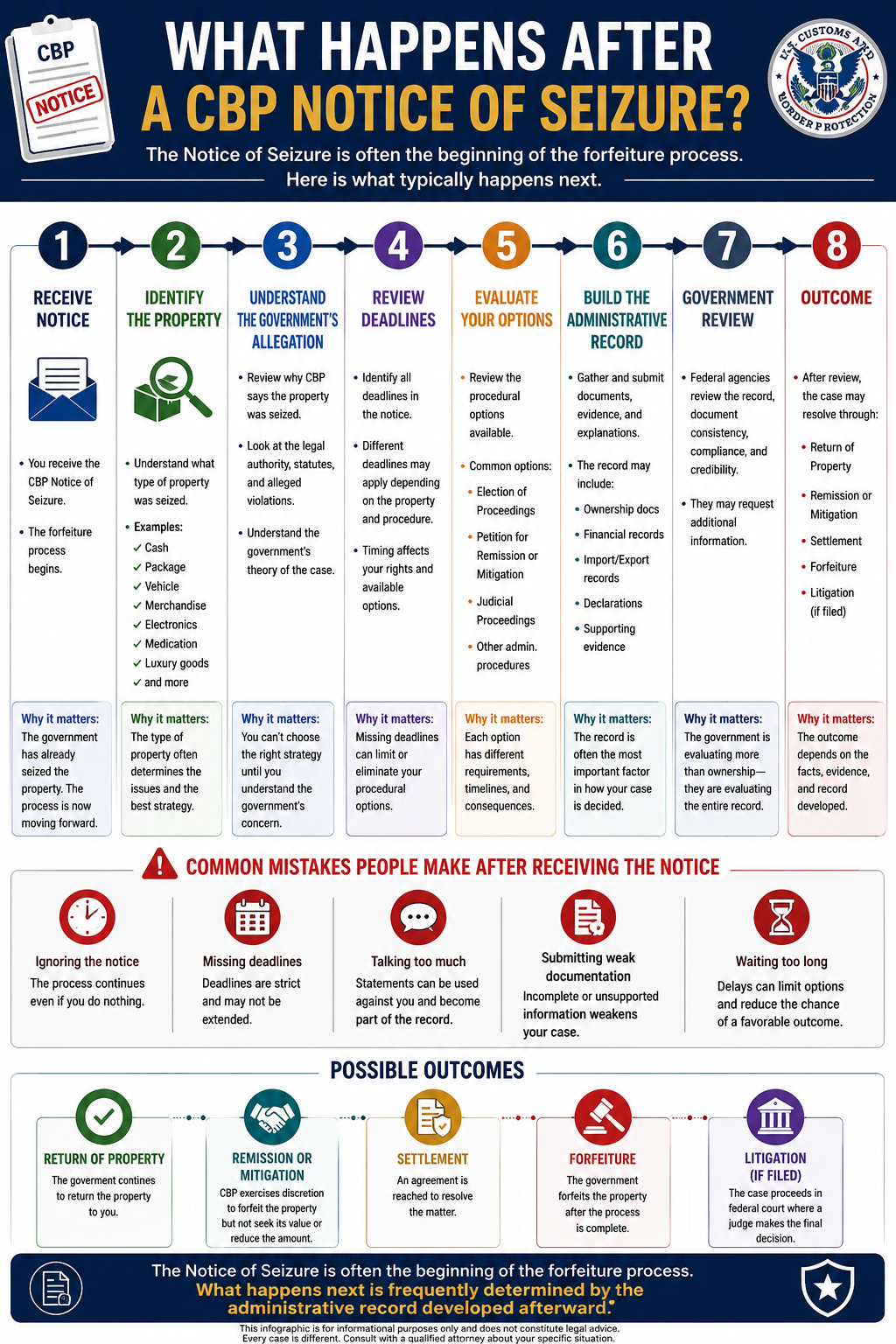
Step 1: Understand What Property Was Seized
The first step is understanding exactly what type of property is involved.
This may sound obvious.
However, the category of property often determines much of what happens next.
CBP Notices of Seizure commonly involve:
- currency,
- vehicles,
- packages,
- imported merchandise,
- electronics,
- prescription medication,
- luxury goods,
- firearms parts,
- and other property.
Although the forfeiture process may look similar on paper, the underlying issues frequently differ dramatically.
For example:
A currency seizure case may involve:
- reporting requirements,
- source-of-funds issues,
- or financial documentation.
A package seizure may involve:
- counterfeit goods,
- import restrictions,
- or prohibited merchandise.
A medication seizure may involve:
- FDA regulations,
- import restrictions,
- or prescription documentation.
This is one reason identifying the property category is often one of the most important first steps in evaluating the case.
The government’s concerns are frequently tied to the property itself.
Step 2: Identify Why CBP Says the Property Was Seized
After identifying the property, the next step is understanding why the government says the seizure occurred.
The Notice of Seizure usually contains references to:
- statutes,
- regulations,
- legal authorities,
- and alleged violations.
Many recipients immediately focus on the legal citations.
A more practical question is often:
What does CBP believe happened?
The answer frequently drives the entire case.
Depending on the circumstances, the government’s concerns may involve:
- reporting violations,
- import restrictions,
- export controls,
- licensing requirements,
- sanctions concerns,
- intellectual property issues,
- declaration problems,
- or regulatory compliance.
Understanding the government’s theory is often more important than understanding every legal citation appearing in the notice.
Before evaluating procedural options, it is generally helpful to understand what concern federal agencies are actually attempting to address.
Step 3: Determine What Deadlines Apply
Once the property and alleged basis for seizure are understood, attention usually turns to deadlines.
Most Notices of Seizure contain important timing requirements.
Many recipients underestimate how important these deadlines can become.
Federal forfeiture procedures continue moving forward regardless of whether the recipient feels prepared to respond.
This is one reason timing frequently affects:
- available options,
- procedural rights,
- flexibility,
- and overall strategy.
The purpose of this section is not to explain every possible deadline.
Instead, the key point is that deadlines often become one of the most important issues immediately after the notice arrives.
For more detailed discussions of specific timing requirements, see:
- CBP Notice of Seizure Deadlines: How Much Time Do You Have to Respond?
- The 30-Day Deadline That Can Cost You Your Property
The important takeaway is simple:
The forfeiture process generally does not pause while recipients decide what they want to do.