
John F. Kennedy International Airport is one of the busiest international airports in the world.
Every day, travelers depart for and arrive from:
- Europe,
- Asia,
- the Middle East,
- Africa,
- South America,
- and destinations across the globe.
With that level of international traffic comes significant customs enforcement activity.
Many travelers are shocked to learn that CBP can seize cash at JFK Airport even when:
- the money belongs to them,
- the funds were earned legally,
- no criminal charges are filed,
- and the traveler had no intention of violating any law.
For most people, the experience is completely unexpected.
One moment they are preparing to board an international flight.
The next, CBP officers are asking questions about:
- where the money came from,
- where it is going,
- why it is being transported,
- and whether reporting requirements were satisfied.
The first questions are usually:
Why did CBP take my money?
Am I in criminal trouble?
Can I get the money back?
What happens next?
The answer depends on the specific facts of the case.
However, understanding how JFK Airport currency seizures work is often the first step toward understanding what options may exist moving forward.
For a broader overview of customs currency seizure matters generally, visit:
Cash Seizures at JFK Airport Often Catch Travelers Completely Off Guard
Most international travelers passing through JFK have never heard of a customs currency seizure until they experience one themselves.
Many assume that carrying cash is perfectly legal as long as:
- they own the money,
- the money was lawfully earned,
- and they are not committing a crime.
Federal agencies often evaluate additional issues.
CBP may examine:
- reporting requirements,
- declarations,
- source-of-funds documentation,
- travel patterns,
- financial records,
- and explanations provided during the inspection process.
As a result, a traveler carrying lawful funds can still find themselves facing a currency seizure.
This often surprises people because they focus on ownership.
Federal agencies frequently focus on documentation, compliance, and the explanations surrounding the funds.
Why CBP Seizes Cash at JFK Airport
CBP currency seizures arise for many different reasons.
Federal agencies may evaluate:
- reporting requirements,
- declarations,
- source-of-funds questions,
- travel history,
- financial records,
- and supporting documentation.
Many people believe the issue is:
“Is the money legal?”
While legality certainly matters, federal agencies often ask additional questions:
- Can the source of the money be documented?
- Were reporting requirements satisfied?
- Are the explanations consistent?
- Does the documentation support the traveler’s position?
This is one reason many JFK Airport currency seizure matters ultimately become documentation cases.
The issue frequently extends beyond the physical cash itself.
Federal agencies often focus on the records surrounding the cash.
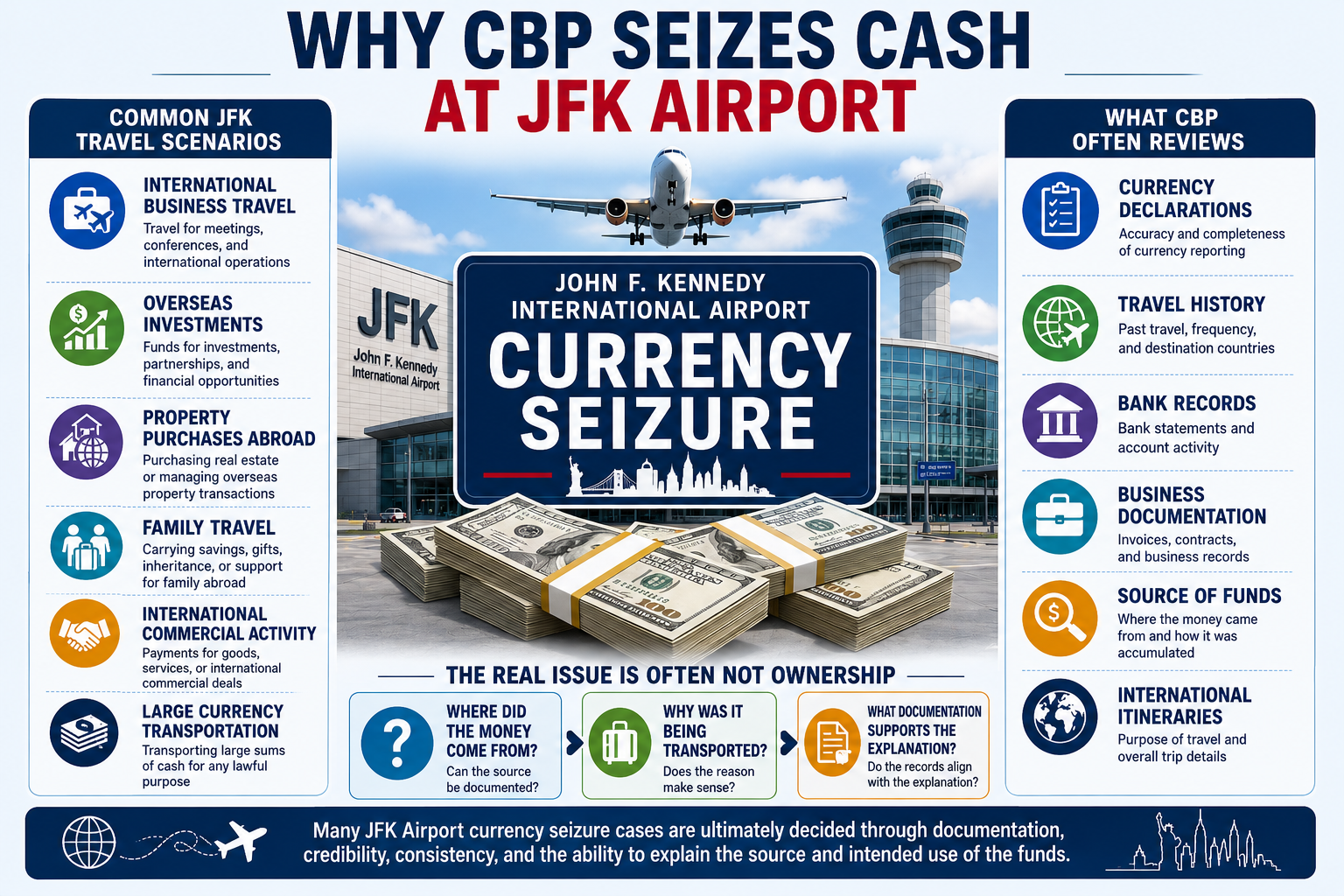
Why JFK Is One of the Most Active Airports for International Currency Enforcement
JFK occupies a unique position among U.S. airports.
Unlike airports that primarily serve domestic travelers, JFK functions as a major global transportation hub connecting the United States to virtually every region of the world.
As a result, CBP officers routinely encounter travelers carrying substantial sums of money associated with:
- international business activity,
- overseas investments,
- property purchases abroad,
- commercial transactions,
- international family travel,
- and cross-border financial activity.
JFK’s enormous volume of international departures and arrivals means CBP officers regularly evaluate:
- currency declarations,
- financial documentation,
- international itineraries,
- and source-of-funds explanations.
Many travelers moving through JFK are engaged in legitimate international commerce.
Others are transporting savings, investment funds, or money intended for lawful overseas purposes.
The issue is often not whether the funds belong to the traveler.
The issue is whether the available documentation adequately explains:
- where the money came from,
- why it is being transported,
- and whether applicable requirements were satisfied.
This combination of international travel volume and global business activity makes JFK one of the most significant locations for customs currency enforcement in the country.
What Happens After CBP Seizes Cash at JFK?
For many travelers, the airport encounter feels like the end of the process.
In reality, it is often only the beginning.
Once the money is seized, CBP generally begins the administrative forfeiture process.
Travelers may later receive:
- receipts,
- seizure paperwork,
- Notices of Seizure,
- Elections of Proceedings,
- and other administrative documents.
At that point, the focus typically shifts from the airport inspection itself to the forfeiture process that follows.
Many of the most important decisions in the case are often made after the seizure has already occurred.
Questions frequently arise regarding:
- deadlines,
- procedural options,
- supporting evidence,
- and administrative strategy.
This is one reason understanding the post-seizure process becomes critically important.
For more detailed discussions of the process, see:
- CBP Notice of Seizure Letter Explained: What To Do Next
- What Happens After You Receive a CBP Notice of Seizure?
Many JFK Cash Seizure Cases Involve Lawful Money
One of the most common misconceptions about currency seizures is that CBP only seizes money connected to criminal activity.
That is not always the case.
Many JFK Airport currency seizures involve money that was:
- legally earned,
- legally possessed,
- and owned by the traveler.
For example, travelers may be carrying:
- personal savings,
- investment funds,
- business proceeds,
- real estate funds,
- inheritance funds,
- or family money.
The existence of lawful ownership does not necessarily end the government’s inquiry.
Federal agencies often evaluate additional issues involving:
- documentation,
- declarations,
- source-of-funds evidence,
- and reporting compliance.
This is one reason many travelers are surprised when their money is seized despite having completely legitimate explanations for the funds.
The dispute often becomes less about ownership and more about documentation.
The strongest cases frequently involve records that clearly explain:
- where the money came from,
- how it was accumulated,
- and why it was being transported.