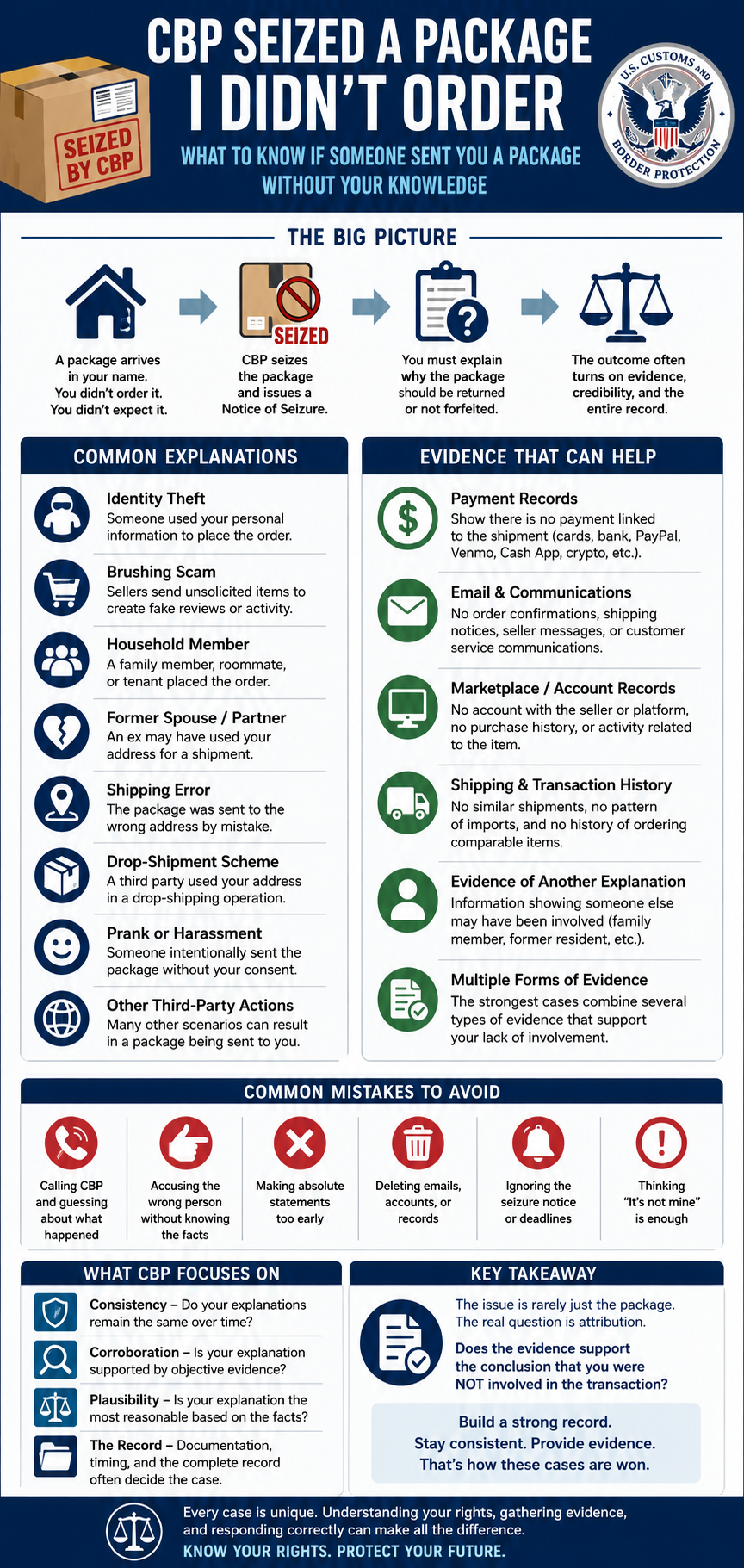
Few customs seizure situations are more confusing than receiving a CBP seizure notice for a package that you never ordered, never expected, and may not have even known existed.
Many recipients immediately assume there must be some mistake.
After all, they did not:
- place an order,
- communicate with a seller,
- make a payment,
- or expect a shipment.
Yet the package was addressed to them.
The shipment was sent to their address.
And the seizure notice now bears their name.
As a result, one of the most common questions we hear is:
“Can CBP hold me responsible for a package that someone else sent to me?”
The answer is often more complicated than people expect.
One reason is that this situation is different from identity theft.
In an identity-theft case, someone may have pretended to be you.
In this type of case, the package may have been intentionally sent to you even though nobody was pretending to be you at all.
That distinction matters.
The central issue often becomes:
“What evidence exists connecting the recipient to the transaction itself?”
Understanding that question is often the first step toward understanding what options may exist moving forward.
For a broader discussion of package seizures generally, visit:
How This Situation Is Different From Identity Theft
Many people initially assume that a package arriving in someone else’s name must involve identity theft.
Sometimes that is true.
However, many package seizures arise under a completely different fact pattern.
In an identity-theft case, someone may:
- use another person’s name,
- use another person’s financial information,
- use another person’s account,
- or otherwise pretend to be someone else.
In the situations discussed in this article, the sender may not be pretending to be the recipient at all.
Instead, the sender intentionally chooses the recipient’s address as the destination for the shipment.
The sender may know exactly who the recipient is.
The recipient simply has no involvement in the transaction.
This distinction is important because it changes the nature of the case.
The question is often not:
“Did someone steal my identity?”
The question becomes:
“Why was this package sent to me?”
Understanding that distinction often helps explain why these cases can be so confusing.
Can Someone Really Send a Package to You Without Your Knowledge?
Yes.
In fact, it happens more often than many people realize.
Every day, packages are shipped to people who:
- never placed an order,
- never communicated with the sender,
- never paid for the item,
- and never expected the shipment.
Sometimes the explanation is innocent.
Sometimes it is not.
The important point is that a package arriving at a person’s address does not automatically prove that the person requested it.
Many people naturally assume:
“If it was sent to me, I must somehow be responsible.”
Federal agencies often look for additional evidence before reaching that conclusion.
The existence of the package is one fact.
The recipient’s connection to the transaction is a separate question.
That distinction becomes critically important in many customs seizure cases.
Common Reasons Someone Might Ship a Package to Another Person
There are many reasons why a package may be intentionally sent to someone who had no involvement in the purchase.
Some explanations are relatively benign.
Others are far more concerning.
Gifts, Surprises, and Unrequested Packages From Friends or Relatives
Not every package sent without the recipient’s knowledge involves fraud, identity theft, or wrongdoing.
Sometimes a package is exactly what it appears to be:
A gift.
Friends, family members, business associates, and acquaintances sometimes send items without informing the recipient beforehand.
For example:
- a relative living overseas may mail a gift,
- a friend may send a surprise package,
- a family member may ship personal property,
- or someone may simply assume the recipient would want the item.
In these situations, the recipient may genuinely have no idea the shipment exists until:
- a delivery notice arrives,
- customs contacts them,
- or a seizure notice is issued.
The important point is that receiving a package is not necessarily the same thing as ordering a package.
A recipient may have:
- never communicated with the seller,
- never made a payment,
- never placed an order,
- and never expected the shipment,
even though the sender fully intended the package to reach them.
These situations often create a different type of evidentiary question.
The issue is frequently not:
“Who ordered this?”
Instead, the question may become:
“What did the recipient know about the shipment before it was sent?”
Documentation showing that the package originated from a known friend, family member, or acquaintance may sometimes help explain why the shipment appeared in the recipient’s name despite the recipient having no involvement in the purchase or shipment process.
Pranks and Practical Jokes
Some shipments are sent as jokes.
The sender may:
- know the recipient,
- know the address,
- and intentionally arrange the shipment without the recipient’s knowledge.
The recipient may have no idea the package is coming.
Harassment and Retaliation
Unfortunately, not every shipment is sent with good intentions.
Former spouses, former partners, former friends, neighbors, or other individuals involved in personal disputes sometimes send packages as a form of harassment or retaliation.
The goal may be:
- embarrassment,
- inconvenience,
- intimidation,
- or creating problems for the recipient.
Former Spouses and Former Partners
These situations can be particularly difficult because former partners often know:
- addresses,
- contact information,
- personal details,
- and household information.
As a result, they may be capable of arranging shipments that appear connected to the recipient despite the recipient having no involvement.
Drop Shipments and Delivery Points
Sometimes the recipient is simply being used as a delivery location.
The sender may intend to:
- retrieve the package later,
- intercept delivery,
- redirect the shipment,
- or otherwise separate themselves from the transaction.
In these situations, the recipient may simply be an unwitting intermediary.
Wrong Recipient Situations
Not every package is sent maliciously.
A sender may intentionally ship an item to an address believing that:
- the intended recipient still lives there,
- the address belongs to someone else,
- or the shipment will ultimately reach another person.
The current occupant may have no connection to the transaction whatsoever.
Being the Recipient Is Not Necessarily the Same Thing as Being the Purchaser
This is one of the most important concepts in the entire article.
Many people assume that if a package is addressed to someone, that person must have ordered it.
Federal agencies often evaluate the issue more carefully.
The fact that a package was shipped to a particular address does not automatically establish:
- who ordered it,
- who paid for it,
- who expected it,
- or who was involved in the transaction.
Those are separate questions.
For example, a package may be addressed to a person who:
- never communicated with the seller,
- never made a payment,
- never maintained an account,
- and never expected a delivery.
In those situations, the government’s focus often shifts toward determining what evidence actually connects the recipient to the transaction.
This is one reason customs seizure cases frequently become evidence cases.
The package itself is only part of the story.
The larger question often becomes:
“What evidence exists showing that the recipient actually participated in the purchase?”
That distinction frequently drives the entire analysis.