
Many veterans spend years believing they are permanently barred from VA benefits because of the type of discharge listed on their DD-214.
Others spend years pursuing a military discharge upgrade without realizing they may already have a separate path to VA benefits.
The reason for this confusion is simple: most veterans have never been told that a military discharge upgrade and a VA Character of Discharge Determination are two completely different legal processes.
Although both can affect eligibility for veterans benefits, they are administered by different agencies, apply different legal standards, serve different purposes, and can produce very different outcomes.
In fact, some veterans receive VA disability compensation without ever obtaining a discharge upgrade. Others successfully upgrade their discharge but still encounter separate issues when seeking certain VA benefits. Many veterans ultimately benefit from pursuing both processes simultaneously.
Understanding the distinction is critical because it can significantly impact your strategy, your timeline, and your ability to access the benefits you earned through your military service.
If you are new to this subject, we recommend first reviewing our Complete Guide to Upgrading Your Military Discharge, which explains the military discharge upgrade process from start to finish.
The Short Answer: They Are Two Different Systems Solving Two Different Problems
The easiest way to understand the difference is this:
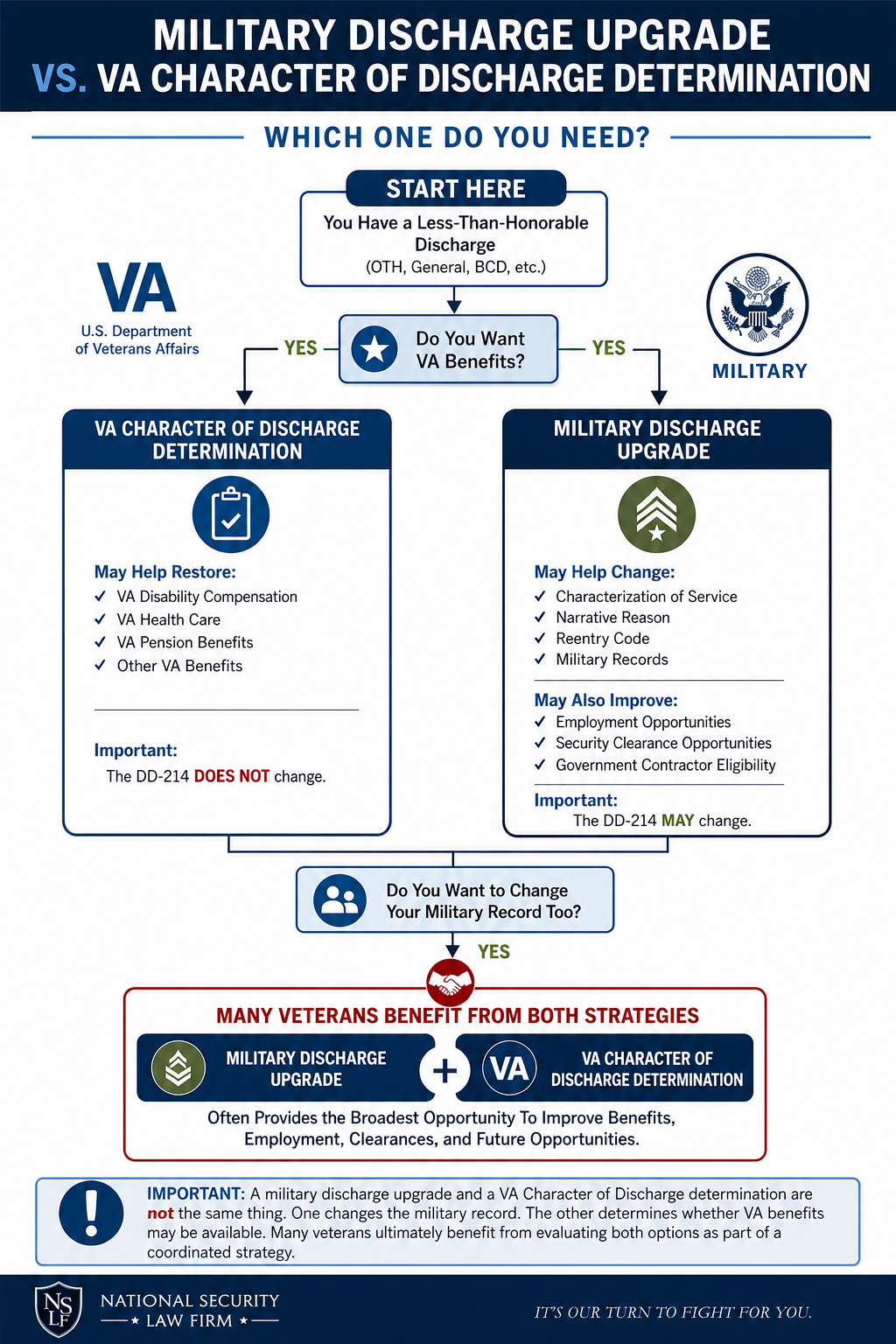
A military discharge upgrade asks the military to change your military record.
A VA Character of Discharge Determination asks the Department of Veterans Affairs whether your service qualifies for VA benefits.
Those may sound similar, but they are not.
One process focuses on correcting military records.
The other focuses on determining benefits eligibility.
A veteran can win one and lose the other.
A veteran can pursue both at the same time.
And in many cases, the optimal strategy involves doing exactly that.
What Is a Military Discharge Upgrade?
A military discharge upgrade is a request for the military to change the characterization of service reflected on a veteran’s discharge paperwork and military records.
Depending on the circumstances, a veteran may seek:
- An upgrade from Other Than Honorable to General Under Honorable Conditions
- An upgrade from General Under Honorable Conditions to Honorable
- A change to the narrative reason for separation
- A change to reenlistment eligibility codes
- Correction of errors or injustices contained in military records
These requests are generally reviewed by either a Discharge Review Board (DRB) or a Board for Correction of Military Records (BCMR/BCNR), depending upon the age of the case and the relief requested.
Unlike VA proceedings, military discharge upgrades focus on whether the discharge was improper, inequitable, unjust, or should be corrected based on new evidence, changed circumstances, or evolving standards relating to PTSD, traumatic brain injury (TBI), military sexual trauma (MST), and other mitigating factors.
If successful, the veteran’s military record itself is changed.
The DD-214 may be corrected.
The characterization of service may be upgraded.
The official military record may be permanently modified.
This is why many veterans view discharge upgrades as the gold standard remedy.
For a detailed overview of the military correction process, visit our page on Military Discharge Upgrade Lawyers.
What Is a VA Character of Discharge Determination?
A VA Character of Discharge Determination serves a very different purpose.
Instead of asking whether the military record should be changed, VA asks a different question:
Does this veteran’s service qualify for VA benefits?
The Department of Veterans Affairs has authority to make its own determination regarding whether a veteran’s service was “other than dishonorable” for purposes of eligibility for VA benefits.
Importantly, VA does not need to change the DD-214 to make that determination.
The military record remains exactly the same.
The discharge characterization remains exactly the same.
The only thing VA decides is whether the veteran qualifies for VA benefits despite the existing discharge characterization.
This distinction surprises many veterans.
For example, a veteran with an Other Than Honorable discharge may assume they are automatically barred from disability compensation, health care, pension benefits, or other VA programs.
In reality, VA may conduct a Character of Discharge review and determine that the veteran’s service is still qualifying for VA purposes.
In that scenario:
- The DD-214 remains unchanged.
- The discharge remains Other Than Honorable.
- The veteran may still receive VA benefits.
That outcome is often impossible for veterans to believe until they see it happen.
Why Congress Created Two Separate Systems
Many veterans understandably ask why these processes exist separately.
The answer lies in the different missions of the military and the Department of Veterans Affairs.
The military is responsible for maintaining personnel records, enforcing standards of conduct, and preserving the integrity of military administrative systems.
VA has a different mission.
Its purpose is to administer benefits programs and determine who qualifies for those benefits.
As a result, Congress created separate legal frameworks.
The military evaluates whether a discharge should be corrected.
VA evaluates whether the veteran’s service is sufficiently honorable to justify benefits eligibility.
Because the questions are different, the answers may be different.
That is why a veteran can sometimes lose a discharge upgrade application but still obtain VA benefits.
It is also why a veteran can receive a discharge upgrade yet still need to address separate VA eligibility issues afterward.
Understanding this distinction is the foundation for building an effective strategy.
Side-by-Side Comparison: Military Discharge Upgrade vs. VA Character of Discharge Determination
Although these processes frequently overlap, they are designed to accomplish different objectives.
A military discharge upgrade focuses on correcting military records.
A VA Character of Discharge Determination focuses on benefits eligibility.
The following comparison helps illustrate the difference.
Who Decides the Case?
Military discharge upgrades are decided by the military branch that issued the discharge.
Depending on the circumstances, the case may be reviewed by a Discharge Review Board (DRB) or a Board for Correction of Military Records (BCMR/BCNR).
VA Character of Discharge Determinations are decided by the Department of Veterans Affairs.
The military has no role in that decision.
What Is the Decision Maker Being Asked to Do?
In a discharge upgrade case, the veteran is asking the military:
“Please correct my military records because the discharge was improper, inequitable, unjust, or no longer accurately reflects my service.”
In a Character of Discharge case, the veteran is asking VA:
“Please determine that my service qualifies for VA benefits despite the discharge characterization currently reflected on my DD-214.”
Does the DD-214 Change?
A successful discharge upgrade can change the DD-214 itself.
Depending on the circumstances, the military may:
- Upgrade the characterization of service
- Change the narrative reason for separation
- Correct administrative errors
- Modify reenlistment eligibility codes
- Correct injustices contained within military records
A favorable VA Character of Discharge Determination does none of those things.
The DD-214 remains exactly the same.
The military record remains exactly the same.
Only the veteran’s eligibility for VA benefits changes.
Can VA Benefits Be Restored?
Yes.
Both processes can potentially restore access to VA benefits.
This is where many veterans become confused.
A discharge upgrade may restore benefits because the military record itself has been corrected.
A favorable Character of Discharge Determination may restore benefits because VA independently decides that the veteran’s service qualifies for benefits despite the existing discharge characterization.
The result can look similar from the veteran’s perspective even though the legal path is entirely different.
Can Both Processes Be Pursued at the Same Time?
Absolutely.
In fact, many veterans should seriously consider pursuing both.
One process does not prevent the other.
A veteran may file a discharge upgrade application while simultaneously seeking VA benefits and requesting a Character of Discharge review.
In some situations, the VA process may produce results faster than the military correction process.
In other situations, a discharge upgrade may provide broader long-term benefits that extend beyond VA eligibility.
The best strategy depends on the facts of the individual case.
When a Veteran May Not Need a Discharge Upgrade at All
One of the biggest myths in the veterans community is that every veteran with an Other Than Honorable discharge must first obtain a discharge upgrade before pursuing VA benefits.
That is simply not true.
Consider a veteran who received an Other Than Honorable discharge after several unauthorized absences.
Years later, the veteran files a disability claim for combat-related PTSD.
VA reviews the service records, medical evidence, deployment history, and circumstances surrounding the misconduct.
VA then determines that the veteran’s service was not dishonorable for VA purposes.
The result?
The veteran may become eligible for disability compensation and other benefits despite never changing the DD-214.
Many veterans are shocked to learn this.
They spent years believing they had no options because they focused exclusively on the military discharge characterization rather than the separate VA eligibility analysis.
This does not mean a discharge upgrade lacks value.
It simply means veterans should not automatically assume that benefits are unavailable while a discharge upgrade is pending.
For a deeper discussion of how discharge status affects benefits eligibility, see our guide on Military Discharge Upgrades and VA Benefits.
When a Discharge Upgrade Is Still the Better Long-Term Solution
Even when VA grants benefits, a discharge upgrade may still provide substantial additional advantages.
Remember, a favorable Character of Discharge Determination affects only VA benefits.
It does not change the underlying military record.
That distinction can matter enormously.
An unfavorable discharge characterization may continue to create obstacles involving:
- Federal employment opportunities
- Security clearance eligibility
- Government contracting positions
- Law enforcement careers
- State licensing boards
- Professional certifications
- Military reenlistment opportunities
- Reputation concerns associated with the discharge
A discharge upgrade may remove or reduce many of these barriers because it changes the military record itself rather than merely altering benefits eligibility.
For that reason, many veterans pursue a discharge upgrade even after obtaining a favorable VA determination.
Example #1: The Combat Veteran With PTSD
Imagine a soldier who deployed to Afghanistan and later developed severe PTSD symptoms.
After returning home, the soldier began experiencing sleep disturbances, hypervigilance, depression, anxiety, and increasing difficulty functioning.
Eventually, the soldier accumulated multiple periods of unauthorized absence and received an Other Than Honorable discharge.
Years later, the veteran seeks help.
The veteran obtains medical evaluations showing that PTSD substantially contributed to the misconduct that resulted in separation.
At this point, two separate opportunities may exist.
The veteran may seek a VA Character of Discharge Determination arguing that the service should qualify for benefits despite the discharge.
The veteran may also seek a military discharge upgrade based upon modern PTSD guidance requiring liberal consideration of mental health evidence.
Either path could succeed.
Both paths could succeed.
And together they may provide the strongest opportunity to restore both benefits and military record integrity.
Example #2: Losing the Upgrade but Winning VA Benefits
Many veterans assume that if the military denies a discharge upgrade, the case is over.
That is not always true.
Imagine a veteran applies for a discharge upgrade and the review board concludes that the discharge should remain unchanged.
The veteran is disappointed and assumes all avenues have been exhausted.
However, VA later reviews the same service history and reaches a different conclusion.
Applying VA’s own standards, VA determines that the service was “other than dishonorable” for benefits purposes.
The veteran becomes eligible for disability compensation and health care despite losing the military upgrade case.
This outcome may seem strange, but it reflects the fact that the two systems answer different legal questions.
One focuses on correcting records.
The other focuses on benefits eligibility.
Because the standards differ, the outcomes may differ as well.
Example #3: Winning a Discharge Upgrade but Still Having Benefit Issues
Another common misconception is that a discharge upgrade automatically restores every VA benefit.
Unfortunately, the reality is often more complicated.
Imagine a veteran receives an Other Than Honorable discharge and later successfully upgrades the discharge to General Under Honorable Conditions.
The veteran understandably assumes that all VA benefits will immediately become available.
Sometimes that happens.
Sometimes it does not.
Certain VA programs have their own eligibility requirements that go beyond the discharge characterization itself.
For example, some education benefits may require an Honorable discharge rather than a General discharge. In other situations, questions may arise regarding effective dates, previously denied claims, prior appeals, or the procedural history of the veteran’s benefits applications.
The discharge upgrade may remove the primary barrier, but additional work may still be necessary to secure the benefits sought.
This is one reason veterans should view discharge upgrades and VA benefits claims as related but separate legal matters.
A discharge upgrade can create tremendous opportunities, but it does not automatically resolve every benefits issue.
For a more detailed discussion of how upgrades affect benefits eligibility, visit our guide on Military Discharge Upgrades and VA Benefits.
Can PTSD, TBI, or Military Sexual Trauma Help in Both Types of Cases?
Absolutely.
In fact, PTSD, traumatic brain injury (TBI), military sexual trauma (MST), sexual assault, and other mental health conditions are often among the most important pieces of evidence in both discharge upgrade proceedings and VA Character of Discharge cases.
Historically, many service members were discharged for misconduct that modern military and medical professionals now recognize may have been connected to untreated trauma or behavioral health conditions.
Examples include:
- Unauthorized absences
- Alcohol-related incidents
- Drug use
- Behavioral problems
- Failure to adapt
- Performance issues
- Conduct-related separations
Today, military review boards are required to give substantial consideration to evidence involving PTSD, TBI, MST, intimate partner violence, sexual assault, and related mental health conditions.
VA similarly evaluates whether these conditions affected the circumstances surrounding the veteran’s service and discharge.
As a result, the same evidence may support both proceedings.
A strong psychological evaluation, treatment records, service records, witness statements, and expert opinions may simultaneously strengthen a discharge upgrade application and a Character of Discharge determination request.
This is why developing a comprehensive evidentiary record is often far more important than simply completing the application forms.
Should You File Both at the Same Time?
In many cases, yes.
There is no universal rule that applies to every veteran, but pursuing both avenues simultaneously often creates significant strategic advantages.
When veterans pursue both processes, they may benefit from:
- Multiple opportunities for success
- Earlier access to benefits
- Greater flexibility if one proceeding is delayed
- Preservation of important rights and deadlines
- Additional opportunities to develop favorable evidence
Military discharge review boards can take months and, in some cases, more than a year to issue decisions.
Meanwhile, VA may be able to evaluate benefits eligibility through its own Character of Discharge process.
Rather than waiting for one system to finish before starting the other, many veterans benefit from developing a coordinated strategy that considers both.
The best approach depends on factors such as:
- Type of discharge
- Basis for separation
- Prior VA decisions
- Available medical evidence
- Time since discharge
- Desired benefits
- Long-term career goals
There is rarely a one-size-fits-all answer.
The key is understanding all available options before choosing a path forward.
Most Veterans Need Both: Our Combined Military Discharge Upgrade + VA Character of Discharge Package
One of the most common mistakes veterans make is treating a military discharge upgrade and a VA Character of Discharge determination as if they are the same thing.
They are not.
A discharge upgrade asks the military to correct the record.
A Character of Discharge determination asks VA to decide whether the veteran qualifies for benefits.
Because these are separate systems serving separate purposes, many veterans ultimately benefit from pursuing both strategies together.
That is why we offer a combined Military Discharge Upgrade and VA Character of Discharge package for $6,500 flat fee.
This allows us to evaluate the entire landscape from the beginning, including:
- Military discharge upgrade strategy
- VA Character of Discharge issues
- Potential disability compensation eligibility
- Effective-date considerations
- Potential retroactive compensation opportunities
- Military records corrections
- Future federal employment opportunities
- Security-clearance implications
- Long-term benefits planning
Approaching these issues together often produces a more coordinated strategy than addressing them one at a time.
For veterans who need only a discharge upgrade, our flat fee is $5,000.
For veterans who need only a VA Character of Discharge determination, our flat fee is $2,500.
However, because these issues frequently overlap, many veterans choose the combined package so that both systems can be evaluated simultaneously.
We also offer financing through Pay Later by Affirm, allowing many veterans to spread payments over time.
Most importantly, we encourage veterans to think beyond the legal fee itself.
For many veterans, the real question is not what a discharge upgrade or Character of Discharge determination costs.
The real question is what opportunities may become available if the strategy succeeds.
Those opportunities may include:
- VA disability compensation
- VA health care
- Educational benefits
- Federal employment opportunities
- Security-clearance opportunities
- Government contractor positions
- Home-loan eligibility
- Long-term financial stability
That is why we view these matters not simply as record-correction cases, but as opportunity-restoration cases.
Common Mistakes Veterans Make
Assuming They Must Win a Discharge Upgrade Before Applying for VA Benefits
This is perhaps the most common mistake.
Many veterans spend years delaying benefits applications because they incorrectly believe a discharge upgrade is a prerequisite for VA eligibility.
In reality, VA may independently determine that service qualifies for benefits through a Character of Discharge review.
Waiting unnecessarily can delay access to compensation, treatment, and other important benefits.
Assuming VA Automatically Follows the DD-214
Another common mistake is believing that VA simply accepts the discharge characterization at face value.
While the DD-214 is certainly important, VA often conducts its own analysis under federal law and regulations.
A veteran with an Other Than Honorable discharge should not automatically assume that VA benefits are unavailable.
Waiting Too Long to Gather Evidence
Military records, medical records, witness statements, and supporting documentation often become more difficult to obtain as time passes.
Witnesses relocate.
Records become harder to locate.
Memories fade.
The strongest cases are usually built by veterans who begin gathering evidence early.
Filing Without Medical Evidence
Many veterans submit applications containing little more than personal statements.
While personal statements are important, they are rarely enough by themselves.
PTSD diagnoses, mental health evaluations, treatment records, expert opinions, and other objective evidence often play a critical role in successful cases.
The goal is not simply to tell the story.
The goal is to prove it.
Why National Security Law Firm Handles These Cases Differently
Most discharge upgrade firms focus on one question:
Can we upgrade the discharge?
We focus on a different question:
How do we maximize everything that becomes possible after the discharge is upgraded?
That distinction matters.
Many veterans spend thousands of dollars obtaining a discharge upgrade only to discover later that they left VA benefits, retroactive compensation, military records corrections, or other opportunities on the table because nobody developed a comprehensive strategy from the beginning.
At National Security Law Firm, we view a discharge upgrade as part of a larger mission.
We Help Protect Potential VA Back Pay From Day One
One of the biggest mistakes veterans make is waiting until after a discharge upgrade is granted before thinking about VA benefits.
That delay can potentially cost veterans substantial retroactive compensation.
When appropriate, our team helps veterans evaluate whether a VA Notice of Intent to File should be submitted while the discharge upgrade case is pending.
Why?
Because preserving an effective date can sometimes mean the difference between receiving benefits going forward and receiving years of retroactive benefits.
Most discharge upgrade firms do not handle VA disability matters.
We do.
As a result, we are constantly looking beyond the discharge itself and evaluating how today’s decisions may affect tomorrow’s benefits.
We Are Veterans, Military Lawyers, and Federal Insiders
Many discharge upgrade firms are staffed entirely by civilian attorneys who have never served in the military.
Our team includes former military attorneys, veterans, former federal attorneys, and leaders who spent years advising commanders and federal agencies.
Our attorneys include former:
- Military prosecutors
- Military defense counsel
- National security attorneys
- Senior federal attorneys
- Military officers
- Federal administrative decision-makers
They have lived inside the systems that many veterans are now fighting.
That perspective matters.
We Understand the Military and the VA
Many firms handle discharge upgrades.
Many firms handle VA claims.
Very few do both.
A veteran’s discharge characterization often impacts:
- VA disability compensation
- Health care eligibility
- Character of Discharge determinations
- Military records corrections
- Future federal employment
- Security clearance opportunities
Because our firm handles military law, federal employment law, security clearances, and veterans-related matters, we can see the bigger picture.
We are not simply asking whether the discharge can be upgraded.
We are asking what opportunities that upgrade can unlock.
Our Results Matter
Some discharge upgrade services publicly advertise success rates below 20%.
Our discharge upgrade practice has historically achieved success rates exceeding 50%, with certain periods reaching significantly higher levels.
Every case is different and past results never guarantee future outcomes.
But veterans should understand that not all discharge upgrade representation is the same.
The quality of the evidence, the strategy, and the presentation can matter enormously.
The Attorney Review Board Advantage
Most firms assign your case to a single lawyer.
At National Security Law Firm, complex cases benefit from our proprietary Attorney Review Board process.
Multiple attorneys collaborate to identify:
- PTSD arguments
- TBI evidence
- MST issues
- Equity arguments
- Clemency considerations
- Procedural errors
- Record correction opportunities
- VA-related implications
No single attorney sees every angle.
Our system is designed to leverage the collective experience of multiple professionals.
Winning the Upgrade Is Often Only Step One
For many veterans, the discharge itself is not the real problem.
The real problem is what the discharge has prevented them from obtaining.
Benefits.
Health care.
Employment.
Professional opportunities.
Recognition.
Dignity.
Our objective is not simply to change a line on a DD-214.
Our objective is to help veterans maximize the opportunities that follow.
Related Military Discharge Upgrade Resources
If you are researching discharge upgrades, VA eligibility, or veterans benefits, you may also find the following resources helpful:
Our Complete Guide to Upgrading Your Military Discharge provides a comprehensive overview of the discharge review process.
Our page on Military Discharge Upgrade Lawyers explains how legal representation can assist throughout the correction process.
Veterans specifically concerned about benefits eligibility should review our guide on Military Discharge Upgrades and VA Benefits.
Ready to Determine Which Path Makes Sense for Your Situation?
Some veterans need a discharge upgrade.
Some veterans need a VA Character of Discharge determination.
Many veterans should pursue both.
The correct strategy depends on the facts surrounding your military service, discharge, medical history, and benefits goals.
The good news is that an unfavorable discharge does not always mean the door is closed.
Whether you are seeking disability compensation, health care benefits, educational benefits, employment opportunities, or simply a chance to correct your military record, there may be options available.
To discuss your case, schedule a free consultation through our online consultation page and learn which path may offer the strongest opportunity for success.
National Security Law Firm: It’s Our Turn to Fight for You.