
If you’ve started researching ways to remove negative online content, you’ve probably come across two very different recommendations. Some companies tell you they can remove the content. Others recommend suppression or online reputation management. Many people assume those are simply two different ways of describing the same service. They aren’t.
In fact, they represent two completely different strategies with two very different objectives. Understanding that difference may be the single most important decision you make before hiring anyone. One strategy attempts to permanently solve the problem. The other attempts to manage the problem over time. Neither approach is inherently right or wrong. The question is which one best aligns with your goals.
This guide will help you understand the differences, the advantages and disadvantages of each approach, and why National Security Law Firm believes clients should generally pursue removal first whenever there’s a legitimate opportunity to do so.
Understanding the Difference
Although people often use the terms interchangeably, removal and suppression are fundamentally different.
Content Removal
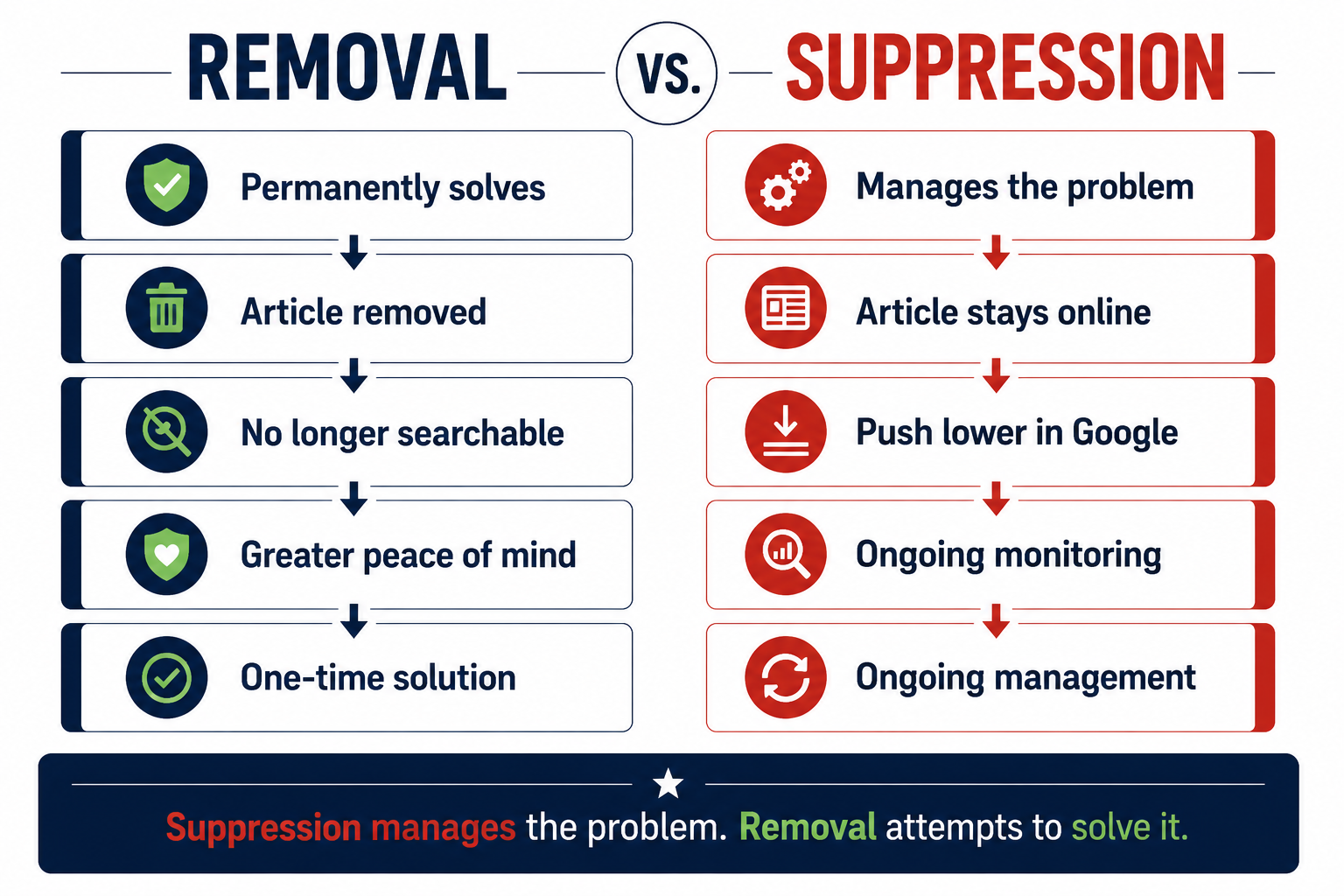
Content removal focuses on eliminating the problem whenever there’s a legitimate opportunity. That may involve:
- Removing the article from the publisher’s website.
- Removing your name or other identifying information (anonymization).
- Deindexing the page so it no longer appears in Google search results.
The goal is simple: prevent people from finding the content in the first place. Whenever there’s a legitimate opportunity, this is always our preferred approach.
Content Suppression
Suppression takes a completely different approach. Instead of attempting to remove the content, suppression attempts to make it less visible. Reputation management companies generally do this by creating or promoting positive online content—such as articles, blog posts, websites, business profiles, and other search-engine-optimized material—in an effort to push negative content farther down in Google search results.
The article itself isn’t removed. It simply becomes harder to find. For some people, suppression can be a reasonable solution. But it’s important to understand exactly what you’re buying. You’re not purchasing removal. You’re purchasing ongoing reputation management.
The Difference in One Sentence
We often explain it like this: suppression manages the problem. Removal attempts to solve it.
That doesn’t mean suppression is a bad strategy. It simply means it answers a different question. If your goal is to permanently eliminate the article whenever there’s a legitimate opportunity, removal is generally the better place to start. If permanent removal isn’t possible, suppression often becomes an excellent next step.
Why This Difference Matters
Imagine two people with the exact same arrest article appearing on the first page of Google.
The first person hires a reputation management company. Over the next several months, the article is pushed to page three of Google. It’s still online. It’s still indexed. It’s simply harder to find.
The second person pursues removal. If successful, the article is removed, anonymized, or deindexed. Instead of managing the article’s visibility, they’ve addressed the problem at its source.
Those are two very different outcomes. Neither is automatically right or wrong. The important thing is understanding the difference before deciding where to invest your time and money.
Key Takeaway
Removal and suppression are not competing versions of the same service. They are different strategies designed to accomplish different goals. The first question shouldn’t be “Which one costs less?” The first question should be “Which outcome am I actually trying to achieve?”
Why We Believe Clients Should Usually Pursue Removal First
People often ask us: “If suppression works, why not just do that first?” It’s a fair question. Our answer is simple. Whenever there’s a legitimate opportunity to permanently solve the problem, we believe that’s where clients should start.
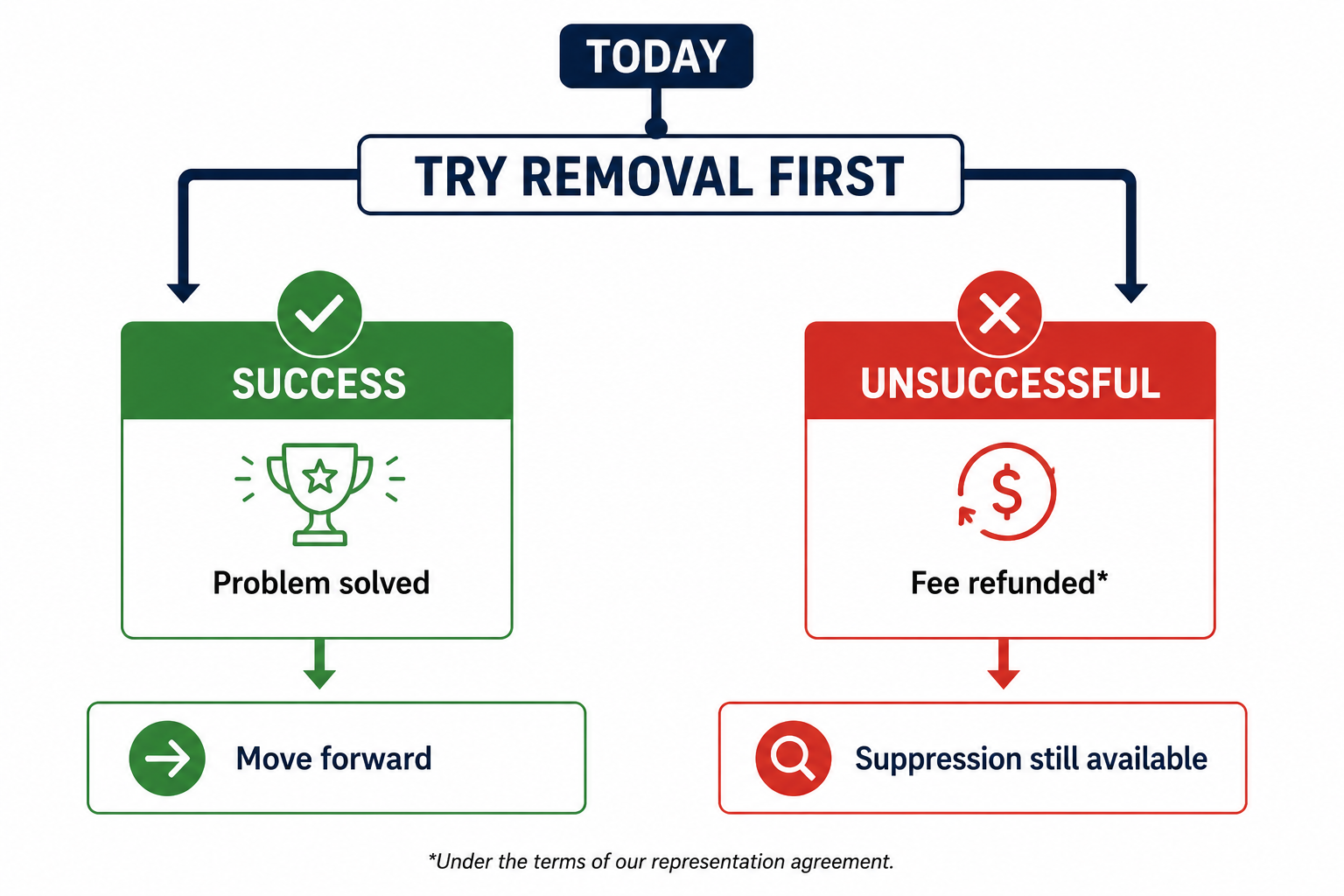
Here’s why. If you’re successful, you’ve permanently eliminated the problem. If you’re not, suppression is still available. The reverse isn’t true. If you begin with suppression, you’ll never know whether permanent removal was possible. That’s one of the biggest reasons we’ve structured our practice the way we have.
Our Philosophy Is Simple
Whenever there’s a legitimate opportunity, we believe clients should pursue the strongest possible outcome first. If we’re successful, you’ve achieved what we believe is the best possible result. The content has been removed, anonymized, or deindexed. You’ve permanently solved the problem—or come as close to that as possible.
If we’re unsuccessful under the terms of our representation agreement, you receive your legal fee back. At that point, every other option remains available. You can pursue suppression. You can hire another attorney. You can choose a different strategy entirely. Nothing has been taken away from you. You’ll simply know that you gave permanent removal every reasonable opportunity before moving on to another solution. We believe that’s the smartest way to approach these cases.
Why Our Business Model Matters
One of the biggest reasons people hesitate before pursuing removal is cost. They don’t want to spend thousands of dollars trying to remove an article only to
wonder later whether it was worth the risk. We understand that. That’s exactly why we built our practice differently.
If we’re unsuccessful under the terms of our representation agreement, we refund our legal fee in full. That allows our clients to pursue what we believe is the strongest possible outcome without permanently risking the money they invested in trying. We don’t know of another model that allows clients to pursue permanent removal first while preserving every other option if removal isn’t successful.
A Real-World Example
Imagine someone has five negative articles appearing in Google search results.
Option 1: Start with Suppression
They hire a reputation management company. Over time, the articles move farther down in Google. But all five articles still exist. If search rankings change, they may become visible again. The client often continues paying for ongoing suppression services to maintain those rankings.
Option 2: Start with Removal
Instead, the client first pursues removal. Let’s assume four of the five articles are successfully removed or deindexed. One remains. At that point, suppression becomes much easier. Much less expensive. And much more effective. Instead of trying to suppress five articles forever, they’re only managing one. That’s a completely different situation.
Is There Ever a Time When Suppression Makes Sense?
Absolutely. We simply don’t believe it should usually be Plan A. If removal or deindexing isn’t possible, suppression often becomes an excellent next step. It can reduce the visibility of remaining content and help improve a person’s online reputation. The difference is that you’ll know you’ve already pursued the strongest opportunity for a permanent solution first. That’s exactly why we believe the order matters.
We don’t believe clients should have to choose between removal and suppression. We believe they should pursue them in the right order. Whenever there’s a legitimate opportunity, start with permanent removal. If that isn’t successful, suppression remains available.
Why Do So Many Companies Recommend Suppression?
If you’ve researched online reputation management, you’ve probably noticed something. Many companies recommend suppression as the primary solution. That doesn’t necessarily mean they’re wrong. It usually means that’s the service they provide.
Reputation management companies are experts at improving search rankings. Their business is built around creating positive online content, optimizing websites, and helping clients improve what people see when they search their names. That’s valuable work. It’s just a different objective.
Our practice is built around a different question: “Is there a legitimate opportunity to permanently solve the problem?” If the answer is yes, we believe that’s where clients should begin. If the answer is no, suppression may become an excellent next step. The important thing is understanding that removal and suppression aren’t competing services. They’re often sequential strategies. One attempts to eliminate the problem. The other attempts to reduce its visibility.
Different Professionals Solve Different Problems
It’s helpful to think about it this way. A reputation management company is generally focused on search engine optimization (SEO). Our attorneys are focused on persuasion. We’re asking publishers, editors, website owners, and organizations to voluntarily reconsider content they generally have no legal obligation to remove. That requires a different skill set. It requires understanding:
- The publisher.
- The facts.
- The client’s story.
- Available legal arguments.
- Editorial policies.
- Privacy concerns.
- Rehabilitation.
- Public interest.
- Negotiation.
Sometimes those efforts are successful. Sometimes they aren’t. But they’re fundamentally different from creating new online content designed to improve search rankings.
We Don’t Think Suppression and Removal Are Competitors
One of the biggest misconceptions is that clients have to choose one or the other. We don’t see it that way. Whenever there’s a legitimate opportunity, we believe the smartest approach is:
- Pursue permanent removal or deindexing.
- If that isn’t successful, consider suppression for whatever remains.
That’s exactly why we’ve structured our practice the way we have. Our goal isn’t simply to win your business. Our goal is to help you choose the strategy that gives you the strongest opportunity to achieve your long-term goals.
Suppression isn’t the enemy. It’s simply a different solution to a different problem. Whenever there’s a legitimate opportunity, we believe permanent removal should usually be attempted first. If that isn’t possible, suppression often becomes an excellent next step.
Which Approach Is Right for You?
By now, you’ve probably realized that there isn’t a one-size-fits-all answer. The right strategy depends on your goals. That’s why we spend so much time understanding what our clients are actually trying to accomplish before recommending a particular approach.
Here are some general guidelines.
If Your Goal Is to Permanently Solve the Problem…
Whenever there’s a legitimate opportunity, removal or deindexing is usually the better place to start. If we’re successful, you’ve permanently removed the obstacle—or come as close to that as possible. If we’re unsuccessful under the terms of our representation agreement, your legal fee is refunded and every other option remains available.
If Your Goal Is to Improve Google Search Results…
Suppression may be an appropriate option. Its purpose isn’t to remove the content. Its purpose is to reduce its visibility by pushing it farther down in search results. For some people, that’s exactly what they’re looking for.
If Permanent Removal Isn’t Possible…
Suppression often becomes an excellent next step. Rather than viewing suppression as a competing strategy, we view it as an alternative strategy when removal or deindexing simply isn’t available.
If You’re Not Sure Which Strategy Makes Sense…
That’s completely normal. Every publisher is different. Every article is different. Every client’s goals are different. That’s exactly why consultations exist. One person’s best strategy may be completely wrong for someone else. Our role is to help you understand your options, explain the strengths and limitations of each, and determine which approach best aligns with what you’re trying to accomplish.
Our Recommendation
Whenever there’s a legitimate opportunity, we believe clients should pursue permanent removal first. Not because suppression doesn’t work. But because if permanent removal is possible, it almost always provides the strongest long-term outcome. If it isn’t possible, suppression remains available. That’s the philosophy behind our practice. It’s also why we’ve structured our business model the way we have.
Our recommendation isn’t based on what we sell. It’s based on the order we believe gives clients the best opportunity to achieve the strongest long-term result.
Still not sure which strategy is right for you?
Every content removal matter is different. If you’d like one of our attorneys to evaluate your situation, answer your questions, and explain whether we believe there’s a legitimate opportunity for removal or deindexing, we’d be happy to help. If we don’t believe we can meaningfully help, we’ll tell you. If we do, we’ll explain why. Either way, you’ll leave the consultation with a much better understanding of your options. No pressure. No obligation. Just an informed conversation about your situation.
Continue Exploring
If you’d like to learn more about content removal, these guides are a great place to continue.
👉 Content Removal Lawyers
📖 Complete Guide to Content Removal
📚 Content Removal Resource Center
❓ Frequently Asked Questions
📅 Schedule a Free Consultation
Related Articles
- What Is Deindexing—and Why It’s One of the Best Outcomes You Can Get
- Why You Should Hire a Lawyer—Not a Reputation Management Company
- How Much Does an Online Content Removal Lawyer Cost?
- How the Content Removal Process Works
- Flat-Rate vs. Hourly Retainers: Why NSLF’s Refund Model Is Different
- The Complete Guide to Content Removal