
Washington Dulles International Airport is different from most airports in the United States.
As the primary international airport serving the Washington, D.C. region, Dulles handles a significant volume of:
- federal employees,
- government contractors,
- security clearance holders,
- diplomats,
- international business travelers,
- and professionals whose careers often depend on maintaining favorable standing within federal systems.
As a result, a currency seizure at Dulles frequently raises questions that extend beyond the money itself.
Many travelers immediately ask:
Why did CBP seize my cash?
Others quickly realize a second concern may exist:
Could this affect my security clearance, federal employment, or government career?
That concern is often unique to Dulles.
Unlike many airports, a substantial percentage of international travelers moving through Washington, D.C. operate within federal systems where:
- trustworthiness,
- reliability,
- compliance,
- and administrative records
can have long-term consequences.
This is one reason Dulles Airport currency seizure cases often require a broader perspective than simply recovering the money.
For a broader overview of customs currency seizure matters generally, visit:
Cash Seizures at Dulles Airport Often Involve More Than the Money
Most travelers initially focus on the immediate issue:
How do I get the money back?
That question matters.
At Dulles, however, many travelers also need to consider whether the event could affect:
- security clearances,
- federal employment,
- government contracting,
- Global Entry,
- trusted traveler programs,
- or future federal investigations.
This is one reason Dulles Airport currency seizure cases frequently differ from similar matters at other airports.
Many travelers passing through Dulles hold positions that require:
- federal trust,
- access to sensitive information,
- professional licensing,
- government credentials,
- or security clearances.
As a result, the seizure itself is often only part of the analysis.
The administrative record created afterward may become equally important.
Why CBP Seizes Cash at Dulles Airport
Many currency seizures originate from recurring concerns involving:
- reporting requirements,
- declarations,
- source-of-funds documentation,
- travel circumstances,
- financial records,
- and supporting evidence.
Many people assume:
“The money belongs to me, so there should not be a problem.”
Federal agencies often evaluate additional questions.
For example:
- Was the currency properly reported?
- Can the source of the funds be documented?
- Are the explanations consistent?
- Does the available evidence support those explanations?
This is one reason many currency seizure cases become documentation cases rather than ownership disputes.
The government’s concern frequently extends beyond the cash itself.
The focus often shifts to the records surrounding the cash.
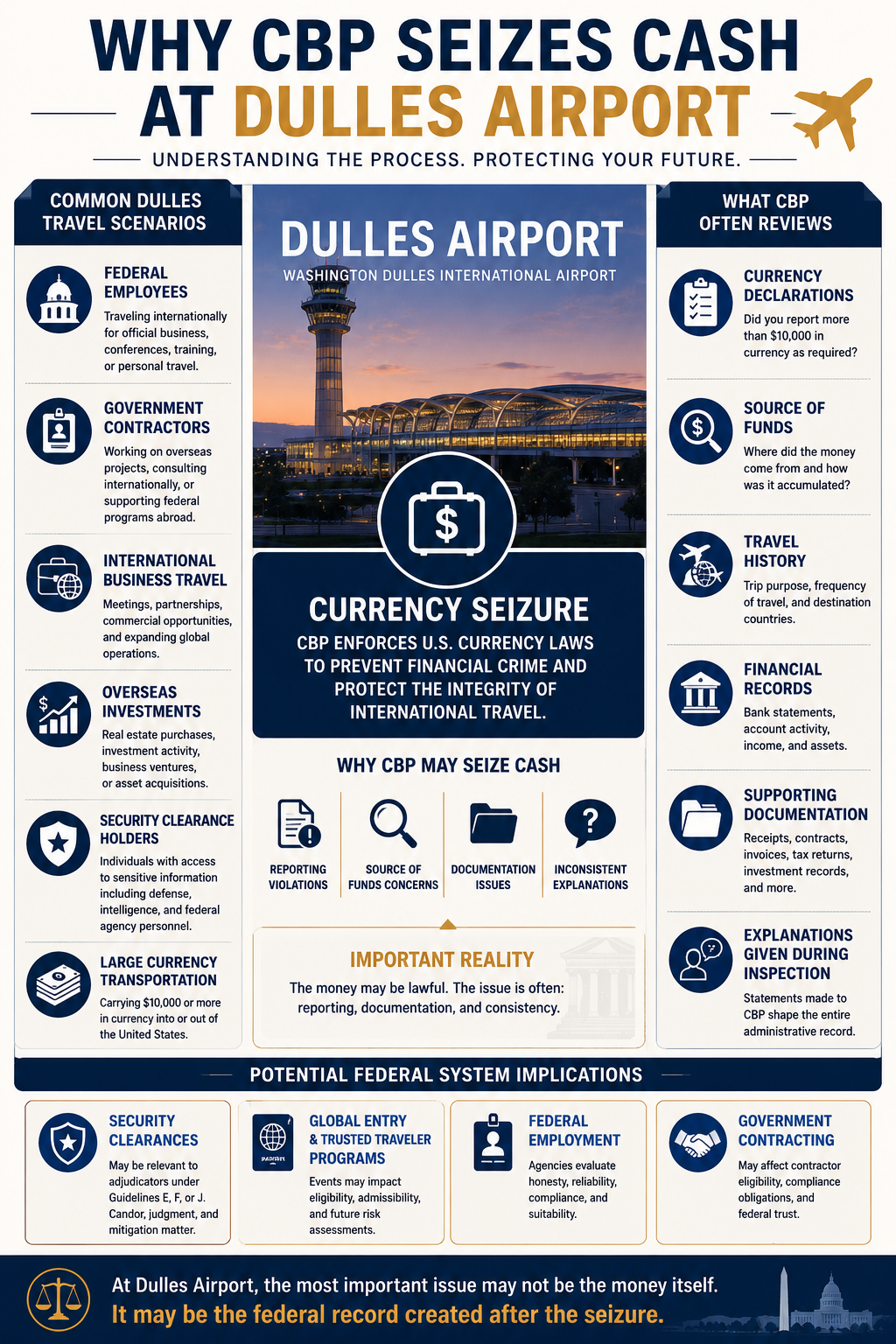
Why Dulles Is Different From Most Airport Currency Seizure Cases
Few airports in the country serve a population quite like Dulles.
The airport functions as a major international gateway for:
- federal employees,
- defense contractors,
- intelligence community personnel,
- government consultants,
- diplomats,
- and international professionals.
Because of that reality, a customs seizure occurring at Dulles may carry implications that do not arise as frequently elsewhere.
For example, many travelers passing through Dulles are subject to:
- security clearance reporting requirements,
- federal suitability standards,
- contractor compliance obligations,
- and other federal review processes.
The money may be the immediate issue.
The federal record often becomes the larger issue.
This is one reason Dulles Airport seizure matters frequently require analysis that extends beyond customs law alone.
What Happens After CBP Seizes Cash at Dulles Airport?
The airport encounter is often only the beginning.
After the seizure occurs, CBP generally begins the administrative forfeiture process.
Travelers may later receive:
- seizure receipts,
- Notices of Seizure,
- Elections of Proceedings,
- forfeiture documents,
- and other administrative paperwork.
At that point, the focus shifts from the airport inspection itself to the federal process that follows.
Questions frequently arise regarding:
- deadlines,
- procedural options,
- supporting documentation,
- evidence,
- and strategy.
Many of the most important decisions in the case occur after the seizure has already taken place.
For a deeper discussion of the process, see:
- CBP Notice of Seizure Letter Explained: What To Do Next
- What Happens After You Receive a CBP Notice of Seizure?
Many Dulles Currency Seizure Cases Involve Lawful Funds
One of the biggest misconceptions surrounding currency seizures is that CBP only seizes money connected to criminal activity.
That is not always the case.
Many Dulles Airport currency seizure matters involve:
- personal savings,
- investment funds,
- business proceeds,
- family funds,
- real estate funds,
- or other lawful sources of money.
The issue frequently becomes:
- reporting compliance,
- documentation,
- declarations,
- source-of-funds evidence,
- and consistency.
This is one reason travelers are often surprised when money is seized despite having a completely lawful explanation for possessing it.
The government’s inquiry frequently focuses on whether the available records support the explanation being provided.
Ownership is important.
Documentation is often equally important.