
One of the biggest misconceptions in airport cash seizure cases is the belief that carrying more than $10,000 is illegal.
In many situations, it is not.
People travel internationally with large amounts of money for completely legitimate reasons involving:
- businesses,
- real estate transactions,
- family obligations,
- gambling winnings,
- international purchases,
- cash-heavy industries,
- and personal savings.
Yet many travelers are shocked when crossing the border with cash suddenly turns into:
- secondary inspection,
- extensive questioning,
- currency counting,
- seizure paperwork,
- and accusations involving suspicious financial activity.
That confusion usually comes from misunderstanding the difference between:
- carrying cash,
and - reporting cash.
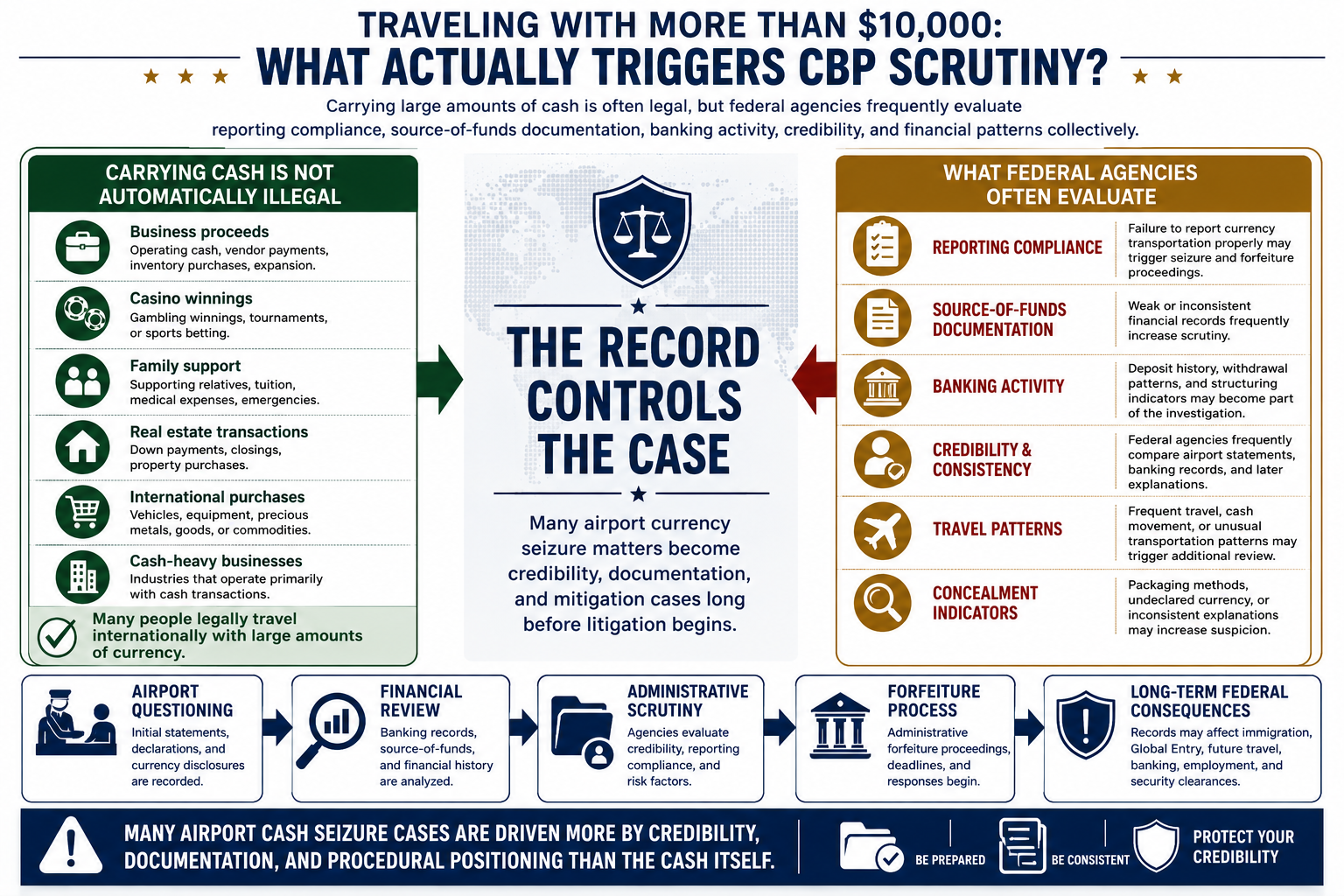
Federal agencies frequently evaluate airport currency transportation through a much broader institutional lens involving:
- reporting compliance,
- banking activity,
- source-of-funds documentation,
- travel patterns,
- credibility,
- and financial consistency.
As a result, many airport currency seizure matters quickly become:
- documentation cases,
- credibility cases,
- mitigation cases,
- and procedural strategy cases
long before courtroom litigation ever begins.
National Security Law Firm frequently emphasizes that the administrative record often controls the outcome of airport cash seizure matters. Additional discussion appears in CBP Money Seizure Lawyers: How to Get Seized Cash Back From Customs, What Happens When CBP Seizes Your Cash at the Airport?, and the broader Customs Seizure Lawyer Hub.
Carrying More Than $10,000 Is Usually Legal
Many travelers are genuinely surprised to learn that carrying large amounts of cash itself is generally lawful.
Federal law does not automatically prohibit people from transporting:
- business proceeds,
- casino winnings,
- family savings,
- or other legitimate currency.
The issue usually arises when federal agencies believe:
- reporting rules were violated,
- explanations appear inconsistent,
- banking activity raises suspicion,
- or the overall financial narrative appears unreliable.
This distinction is critically important because many travelers mistakenly believe:
“If the money is legal, there should not be a problem.”
Federal agencies often evaluate these situations differently.
In many airport currency seizure matters, the government is not evaluating only whether the cash itself was lawful. Investigators frequently evaluate whether:
- the transportation was reported properly,
- the financial story appears credible,
- the records support the explanation,
- and the overall circumstances trigger broader institutional suspicion.
That is one reason many travelers are shocked when legally earned money is still seized.
Additional discussion appears in Can CBP Keep Your Money Even If You Were Never Charged With a Crime? and Why CBP Thinks Carrying Large Amounts of Cash Is Suspicious.
What Is FinCEN Form 105 and When Is It Required?
Travelers entering or leaving the United States with more than $10,000 in currency or monetary instruments are generally required to report the transportation using FinCEN Form 105.
This reporting obligation often applies to:
- physical cash,
- cashier’s checks,
- money orders,
- traveler’s checks,
- and certain negotiable instruments.
One of the biggest misunderstandings involves aggregate amounts.
Federal agencies frequently evaluate the combined total of transported monetary instruments rather than isolated pieces individually. Travelers sometimes incorrectly assume:
- separating money among family members,
- splitting up cash,
- or carrying different instruments separately
eliminates the reporting obligation.
That assumption may create significant problems later.
Many airport seizure matters begin after investigators conclude:
- reporting requirements were not satisfied properly,
- explanations about ownership changed,
- or the transportation appears intentionally structured to avoid scrutiny.
Once that suspicion develops, the matter often evolves into a much broader financial and credibility review.
Additional discussion appears in Bulk Cash Smuggling Explained: What CBP Must Prove and CBP Notice of Seizure Letter Explained: What To Do Next.
Why Travelers Still Get Their Money Seized Even When the Cash Is Legal
One of the most frustrating realities for travelers is that airport currency seizures often occur even where:
- the money was lawfully earned,
- no criminal charges are filed,
- and the traveler insists the funds are legitimate.
That usually happens because federal agencies frequently evaluate patterns not simply possession of cash.
Investigators may begin reviewing:
- banking history,
- deposit patterns,
- withdrawal activity,
- source-of-funds documentation,
- travel timing,
- structuring indicators,
- and prior statements
collectively.
Federal agencies often associate large amounts of transported currency with:
- money laundering,
- structuring,
- reporting avoidance,
- narcotics trafficking,
- concealment activity,
- or bulk cash smuggling.
Again, that does not necessarily mean criminal conduct occurred. However, it often means investigators begin evaluating whether the overall financial narrative appears:
- coherent,
- documented,
- internally consistent,
- and administratively credible.
That broader institutional review is one reason airport cash seizure matters frequently become heavily:
- documentation-driven,
- credibility-driven,
- and mitigation-driven
long before litigation ever begins.
Additional discussion appears in CBP Seized My Cash for “Structuring”: What Does That Mean? and How CBP Actually Decides Seizure Cases.
The Airport Encounter Often Shapes the Entire Case
Many travelers underestimate how important the initial airport interaction becomes later.
Federal agencies frequently preserve:
- airport questioning,
- customs declarations,
- explanations about the money,
- emotional reactions,
- procedural behavior,
- and timeline statements
from the very beginning.
Investigators may later compare those statements against:
- banking records,
- mitigation submissions,
- tax filings,
- business records,
- and later explanations.
That means relatively small inconsistencies may later create:
- credibility concerns,
- mitigation problems,
- expanded scrutiny,
- or procedural complications.
Many travelers unintentionally weaken their own position by:
- overexplaining,
- speculating,
- rushing explanations,
- or attempting to reconstruct complicated financial activity from memory under stress.
Sophisticated customs seizure strategy often focuses heavily on:
- disciplined communication,
- procedural control,
- careful documentation review,
- and preserving credibility before inconsistencies expand.
Additional discussion appears in Why Early Statements to CBP Can Destroy Your Case and The Record Controls the Case: Why Your First Submission Matters.
What Strong Currency Reporting and Seizure Defense Strategy Often Looks Like
One of the biggest mistakes travelers make is assuming airport currency seizure cases are won simply by repeating:
“The money is legal.”
Strong cases are usually built much more strategically than that.
In many situations, sophisticated customs seizure strategy focuses on constructing a financial narrative that appears:
- coherent,
- documented,
- internally consistent,
- and administratively credible.
That often begins with organizing source-of-funds evidence carefully. Federal agencies frequently evaluate whether the traveler can clearly connect the transported currency to:
- documented withdrawals,
- business activity,
- tax records,
- contracts,
- invoices,
- gambling records,
- property transactions,
- or other legitimate financial sources.
Strong documentation frequently shapes leverage.
Weak or disorganized documentation frequently expands suspicion.
This is one reason sophisticated airport cash seizure strategy often begins with:
- reconstructing timelines,
- reviewing banking activity,
- identifying inconsistencies early,
- and strengthening documentation before major submissions are made.
Strong cases also usually involve:
- disciplined communication,
- consistent explanations,
- strategic mitigation,
- and procedural control.
Many travelers unintentionally weaken otherwise defensible cases by continuing to:
- revise explanations,
- speculate about financial history,
- overcommunicate with investigators,
- or submit poorly organized records reactively.
Federal agencies frequently interpret disorganization itself as:
- reduced credibility,
- increased risk,
- or administrative unreliability.
That broader institutional perspective is one reason airport currency seizure matters often become much more strategic than people initially realize.
In many situations, sophisticated administrative positioning creates substantially stronger leverage than emotional confrontation or rushed litigation threats. Strong mitigation and documentation frequently improve:
- settlement posture,
- procedural flexibility,
- administrative credibility,
- and overall recovery opportunities.
Additional discussion appears in How to Win a CBP Currency Seizure Case and The Biggest Mistakes People Make After CBP Seizes Their Money.
Traveling With Large Amounts of Cash Can Affect More Than the Airport Encounter
Many travelers initially view an airport cash seizure as:
- a temporary financial issue,
- an isolated customs dispute,
- or a misunderstanding that will eventually resolve itself.
In reality, airport currency seizures often create much broader federal consequences than people initially realize.
Depending on the allegations involved, the administrative record developed during the seizure may later affect:
- immigration proceedings,
- Global Entry eligibility,
- future border screening,
- federal employment,
- contractor eligibility,
- banking scrutiny,
- security clearances,
- and broader federal investigations.
Federal agencies frequently share information and evaluate these systems collectively rather than in isolation. That means the way a traveler handles:
- airport questioning,
- mitigation,
- documentation,
- procedural filings,
- and credibility issues
may later affect entirely separate federal systems months or even years later.
This broader institutional overlap is one reason sophisticated customs seizure strategy often requires thinking beyond:
“getting the money back.”
Strong representation frequently evaluates:
- how the administrative record may appear to future investigators,
- whether inconsistencies may trigger future scrutiny,
- whether financial activity may create broader institutional concerns,
- and how to preserve long-term federal credibility.
Additional discussion appears in Federal Agencies Share Information and Customs Seizure Cases Often Involve More Than Customs Law.
Why National Security Law Firm Is Different
Many law firms approach airport cash seizure matters primarily as isolated forfeiture disputes. The focus often becomes reacting procedurally after the government has already shaped the administrative record.
National Security Law Firm approaches these matters differently.
The firm represents clients nationwide in:
- airport cash seizure matters,
- administrative forfeiture proceedings,
- structuring-related seizures,
- export-control matters,
- federal administrative proceedings,
- and overlapping federal investigations.
National Security Law Firm focuses heavily on:
- strategic administrative positioning,
- source-of-funds analysis,
- mitigation strategy,
- credibility management,
- procedural leverage,
- and long-term federal implications.
That broader institutional perspective becomes especially important because airport cash seizure matters often intersect with:
- immigration,
- Global Entry,
- future border screening,
- banking scrutiny,
- federal employment,
- contractor eligibility,
- and security clearances.
The firm’s broader experience with:
- security clearances,
- export controls,
- federal employment,
- contractor-related matters,
- and national security systems
helps inform how airport cash seizure matters are strategically evaluated from the outset.
In many situations, the strongest airport cash seizure strategy is not reactive. It is deliberate, organized, and focused on preserving long-term administrative credibility before inconsistencies and procedural problems harden the government’s position.
National Security Law Firm frequently emphasizes that the administrative record often controls the outcome of the case.
For broader discussion of airport cash seizure strategy generally, visit CBP Money Seizure Lawyers: How to Get Seized Cash Back From Customs and the broader Customs Seizure Lawyer Hub.
Frequently Asked Questions
Is traveling with more than $10,000 illegal?
Generally, no.
Many travelers lawfully transport large amounts of currency for:
- business purposes,
- gambling winnings,
- family obligations,
- international purchases,
- real estate transactions,
- or personal savings.
The legal issue usually involves:
- reporting requirements,
- documentation problems,
- or broader federal suspicion regarding the financial activity surrounding the money.
What is FinCEN Form 105?
FinCEN Form 105 is a federal reporting form generally required when transporting more than $10,000 in currency or monetary instruments into or out of the United States.
Federal agencies frequently evaluate:
- aggregate amounts,
- ownership explanations,
- transportation patterns,
- and source-of-funds documentation
when reviewing compliance.
What happens if I fail to report cash properly?
Failure to report currency may result in:
- seizure of the money,
- administrative forfeiture proceedings,
- extensive questioning,
- and broader financial scrutiny.
In some situations, federal agencies may also begin evaluating:
- banking activity,
- structuring indicators,
- source-of-funds explanations,
- and travel patterns.
Can CBP seize legal money?
Yes.
Airport cash seizures frequently occur even where:
- the money was lawfully earned,
- no criminal charges are filed,
- and the traveler disputes wrongdoing.
Many cases ultimately revolve around:
- credibility,
- documentation,
- mitigation,
- and administrative positioning
rather than simply whether the money itself was legal.
Why does CBP view large amounts of cash as suspicious?
Federal agencies frequently associate large amounts of transported currency with:
- money laundering,
- structuring,
- reporting avoidance,
- narcotics trafficking,
- or concealment activity.
That does not necessarily mean criminal conduct occurred, but it often triggers broader financial scrutiny.
What is bulk cash smuggling?
Bulk cash smuggling generally involves allegations that currency reporting requirements were intentionally avoided while transporting money internationally.
Additional discussion appears in Bulk Cash Smuggling Explained: What CBP Must Prove.
Why do airport statements matter so much?
Federal agencies frequently compare:
- airport questioning,
- customs declarations,
- banking records,
- mitigation submissions,
- and later explanations
across the entire administrative process.
Even relatively small inconsistencies may later create:
- credibility concerns,
- expanded scrutiny,
- mitigation problems,
- or procedural complications.
What records help defend an airport currency seizure case?
Strong cases frequently involve:
- organized bank records,
- withdrawal history,
- tax records,
- contracts,
- invoices,
- business documentation,
- source-of-funds evidence,
- and consistent financial timelines.
Well-organized documentation often shapes leverage significantly.
Can a currency seizure affect immigration or Global Entry?
Yes.
Depending on the allegations involved, airport currency seizures may later affect:
- immigration,
- Global Entry,
- future border screening,
- security clearances,
- federal employment,
- contractor eligibility,
- and banking scrutiny.
What is the strongest strategy after a seizure?
In many situations, sophisticated strategy focuses on:
- preserving credibility,
- organizing documentation carefully,
- controlling procedural timing,
- avoiding inconsistent explanations,
- and developing strong mitigation early.
Reactive communication and rushed explanations frequently create avoidable problems later.
Speak With a Nationwide Airport Cash Seizure Lawyer
If CBP seized your cash at the airport or border, the strategic decisions made early in the process may significantly affect:
- mitigation opportunities,
- procedural leverage,
- credibility assessments,
- litigation exposure,
- and broader federal consequences.
Many airport cash seizure matters are heavily influenced by:
- source-of-funds documentation,
- consistency of explanations,
- procedural timing,
- mitigation strategy,
- and administrative positioning.
National Security Law Firm offers nationwide representation and free consultations for airport cash seizure matters.
The fastest and easiest way to get started is through the firm’s online booking system.
In many situations, same-day consultations are available, and the process typically takes less than a minute to schedule online.
Once booked, an attorney will personally call you at the scheduled time to discuss:
- the seizure,
- procedural deadlines,
- source-of-funds documentation,
- mitigation strategy,
- credibility concerns,
- and broader federal implications.
To schedule a consultation online, visit:
Book a Free Consultation Online
You may also contact the firm directly at:
Phone: (202) 600-4996
Additional related resources: