For many travelers, an airport cash seizure feels completely unreal.

One moment they are heading toward their gate, returning from an international trip, or preparing to board a flight with money they believe is perfectly legal. The next, federal officers are asking detailed questions about banking activity, counting large amounts of currency, searching luggage, and suggesting the money may be connected to criminal conduct.

Many people are shocked by how quickly the situation escalates. That confusion becomes even greater when:

  • the money was lawfully earned,
  • no drugs or contraband were found,
  • and no criminal charges are filed.

One of the biggest misconceptions in airport cash seizure cases is believing the airport encounter itself is the entire legal problem. In reality, the seizure is often only the beginning of a much larger federal administrative process that may involve source-of-funds analysis, banking review, credibility evaluation, mitigation strategy, procedural deadlines, and long-term federal consequences.

In many situations, the strategic decisions made during the first few hours and days after the seizure may shape the trajectory of the entire case. Federal agencies frequently begin evaluating:

  • whether the financial story appears credible,
  • whether records support the explanation,
  • whether statements remain consistent over time,
  • and whether the traveler appears administratively reliable.

That broader institutional review often begins immediately, long before any courtroom litigation is even discussed.

National Security Law Firm frequently emphasizes that the administrative record often controls the outcome of airport cash seizure cases. Additional discussion appears in CBP Money Seizure Lawyers: How to Get Seized Cash Back From Customs, Why CBP Thinks Carrying Large Amounts of Cash Is Suspicious, and the broader Customs Seizure Lawyer Hub.

Most Airport Cash Seizures Begin Before Travelers Realize They Are Being Investigated

Many airport cash seizures begin in ways that initially appear routine. A traveler may be referred to secondary inspection, selected for additional screening, or asked a few questions about international travel or currency reporting. At first, the interaction often feels informal.

Then the tone changes.

Officers may begin asking:

  • where the money came from,
  • why the traveler is carrying cash,
  • why the funds were withdrawn in cash rather than wired,
  • why certain deposits or withdrawals appear unusual,
  • or why the traveler’s explanation seems inconsistent with banking activity.

Many travelers do not initially realize that federal agencies are already evaluating credibility and financial plausibility in real time. What feels like an ordinary airport conversation may later become a critical part of the administrative record.

This is one reason airport cash seizure matters frequently become much more complicated than people expect. Investigators often preserve:

  • statements,
  • timelines,
  • procedural behavior,
  • explanations,
  • and inconsistencies

from the very beginning of the encounter.

Many individuals unintentionally weaken their own position early by:

  • overexplaining,
  • speculating about timelines,
  • making assumptions about banking activity,
  • reacting emotionally,
  • or attempting to answer complicated financial questions too quickly.

Additional discussion appears in Traveling With More Than $10,000: What You Need to Know Before Crossing the Border and Why Early Statements to CBP Can Destroy Your Case.

What CBP Is Actually Evaluating Behind the Scenes

One of the biggest mistakes people make after an airport cash seizure is assuming the government is evaluating only whether the money itself was legal. Federal agencies often evaluate something much broader: the overall financial story surrounding the cash.

That review may involve:

  • bank statements,
  • deposit history,
  • withdrawal patterns,
  • source-of-funds evidence,
  • travel activity,
  • customs declarations,
  • business records,
  • structuring indicators,
  • electronic communications,
  • and prior statements.

Federal agencies frequently begin from a position of institutional suspicion, especially where large amounts of transported cash are involved. Investigators often associate bulk cash movement with:

  • money laundering,
  • structuring,
  • narcotics trafficking,
  • reporting avoidance,
  • concealment activity,
  • or bulk cash smuggling.

That does not necessarily mean criminal conduct actually occurred. However, it often means the government immediately begins evaluating whether the overall narrative appears:

  • coherent,
  • documented,
  • internally consistent,
  • and administratively credible.

This is one reason airport cash seizure cases frequently become heavily documentation-driven and credibility-driven long before litigation ever begins. Even relatively small inconsistencies may later create administrative skepticism that expands scrutiny and reduces leverage.

Additional discussion appears in CBP Seized My Cash for “Structuring”: What Does That Mean? and How CBP Actually Decides Seizure Cases.
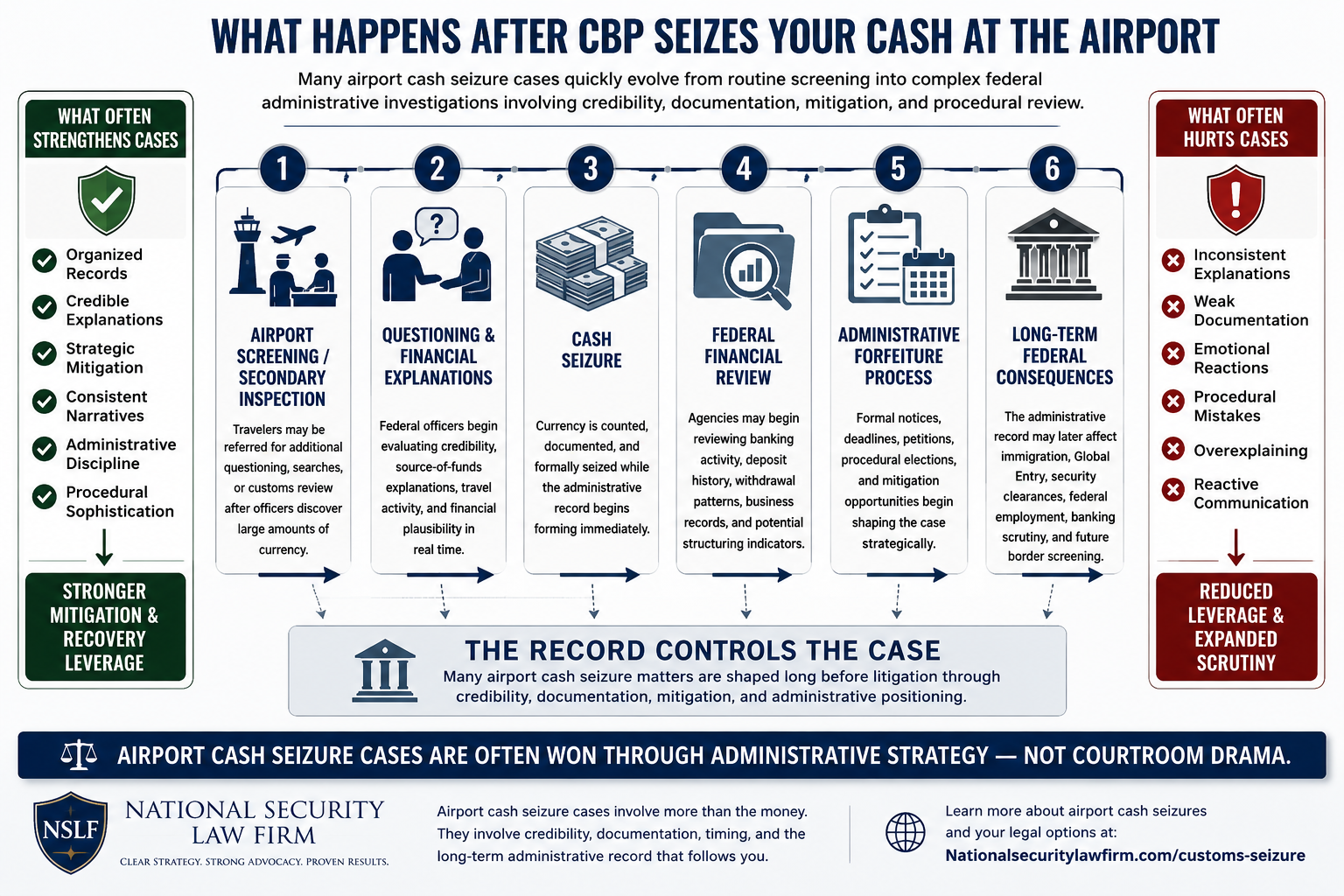
The Administrative Record Usually Begins at the Airport

Many travelers assume they will have an opportunity to fully explain the situation later, after emotions calm down and documents are organized. In reality, the administrative record often begins forming immediately during the airport encounter itself.

Federal agencies frequently compare:

  • airport statements,
  • banking records,
  • customs declarations,
  • mitigation submissions,
  • and later explanations

across the entire life of the case.

That means statements made under stress at the airport may later become important credibility issues months later during the forfeiture process.

Many airport cash seizure cases become significantly more difficult because early explanations:

  • changed over time,
  • conflicted with banking records,
  • or created procedural inconsistencies that investigators later viewed as suspicious.

Sophisticated customs seizure strategy often focuses heavily on:

  • disciplined communication,
  • careful documentation review,
  • consistency across explanations,
  • and preserving credibility from the very beginning.

That broader strategic approach frequently matters much more than people initially realize.

Additional discussion appears in The Record Controls the Case: Why Your First Submission Matters and Why Consistency Matters in Federal Seizure Cases.

What Usually Happens After the Cash Is Taken

After the cash is seized, many travelers expect the situation to resolve quickly. Some assume the government will immediately decide whether the money is returned. Others believe they simply need to provide a few records or explanations and the issue will disappear.

That is usually not how airport cash seizure cases unfold.

In many situations, the airport seizure quickly transitions into a federal administrative forfeiture case. Travelers are often given a receipt for the currency along with basic seizure paperwork, but very little explanation about what happens next. Then, weeks later, formal notices begin arriving in the mail.

Many people are surprised to learn the government’s review process may continue for months while federal agencies continue evaluating:

  • source-of-funds documentation,
  • banking activity,
  • mitigation,
  • credibility,
  • procedural behavior,
  • and narrative consistency.

The process often becomes far more administrative and documentation-driven than people initially expect.

Federal agencies may begin analyzing:

  • withdrawal history,
  • deposit patterns,
  • business records,
  • tax filings,
  • customs declarations,
  • and prior statements

collectively in order to determine whether the overall financial story appears credible and internally consistent.

At this stage, the case often stops feeling like:
“an airport incident”
and starts becoming:

a long-term federal administrative problem.

Many travelers underestimate how important procedural deadlines become during this phase. Formal seizure notices frequently include:

  • election forms,
  • response deadlines,
  • forfeiture instructions,
  • and procedural options that may substantially affect leverage later.

Failing to respond strategically — or responding emotionally and too quickly — often creates avoidable complications. In many situations, sophisticated customs seizure strategy begins with carefully evaluating:

  • procedural posture,
  • mitigation opportunities,
  • documentation strengths and weaknesses,
  • litigation exposure,
  • and administrative leverage

before major submissions are made.

This is one reason many strong airport cash seizure cases are shaped long before courtroom litigation ever occurs. Administrative positioning, mitigation, and credibility frequently drive recovery opportunities much more than people initially realize.

Additional discussion appears in CBP Notice of Seizure Letter Explained: What To Do Next, Election of Proceedings Form Explained, and What Is a Petition for Remission or Mitigation?.

The Biggest Mistakes Usually Happen in the First Few Days

One of the most dangerous parts of an airport cash seizure case is that many people unintentionally weaken their own position almost immediately after the seizure occurs.

The problem is rarely that travelers are trying to mislead the government. More often, people are:

  • overwhelmed,
  • embarrassed,
  • frightened,
  • angry,
  • or trying too hard to “clear things up quickly.”

That emotional pressure frequently produces the exact kind of inconsistencies federal agencies later view as suspicious.

Many travelers begin calling investigators repeatedly, sending rushed explanations, posting online about the seizure, or attempting to reconstruct complicated financial timelines from memory before carefully reviewing their records. Others begin changing or refining explanations after speaking with family members, accountants, business partners, or banks.

Federal agencies frequently compare:

  • airport questioning,
  • banking records,
  • mitigation submissions,
  • procedural filings,
  • and later explanations

across the entire life of the case.

That means even relatively small inconsistencies may later become:

  • credibility concerns,
  • mitigation problems,
  • procedural complications,
  • or expanded scrutiny.

One of the biggest hidden realities in airport cash seizure matters is that reactive communication often reduces leverage. Every additional explanation, clarification, or revised timeline potentially becomes another data point federal agencies may compare against:

  • financial records,
  • deposit history,
  • customs declarations,
  • and prior statements.

This is one reason sophisticated customs seizure strategy often focuses first on slowing the situation down and organizing the record carefully before major submissions are made.

Strong cases frequently involve:

  • disciplined communication,
  • organized financial records,
  • carefully reviewed timelines,
  • consistent source-of-funds explanations,
  • and strategic mitigation positioning.

Weak cases are often reactive. People continue talking before fully understanding:

  • what the government is evaluating,
  • what records exist,
  • how the banking history appears,
  • or how their statements may later be interpreted institutionally.

Many travelers also underestimate how dangerous social media and informal communications may become after a seizure. Posting publicly about:

  • the cash,
  • the seizure,
  • the trip,
  • business activity,
  • gambling,
  • travel,
  • or banking history

may later complicate credibility analysis significantly if those statements conflict with formal submissions or financial records.

That broader institutional review is one reason airport cash seizure matters frequently become much more strategic than people initially realize. In many situations, the strongest move early in the process is not:
“explaining more.”

It is:

  • organizing records carefully,
  • understanding procedural posture,
  • evaluating credibility risks,
  • and developing a coherent mitigation strategy before additional inconsistencies enter the record.

Additional discussion appears in The Biggest Mistakes People Make After CBP Seizes Their Money and Can Social Media or Prior Statements Hurt Your CBP Case?.

Many Airport Cash Seizure Cases Are Won Through Administrative Leverage — Not Courtroom Drama

One of the biggest misconceptions in airport cash seizure matters is believing the case will ultimately be won through a dramatic courtroom battle.

In reality, many successful currency seizure cases are shaped much earlier and much more quietly through:

  • documentation,
  • mitigation,
  • credibility,
  • procedural positioning,
  • and administrative leverage.

Federal agencies frequently evaluate whether the traveler appears:

  • organized,
  • consistent,
  • financially credible,
  • and administratively reliable.

That broader institutional review often influences:

  • settlement posture,
  • mitigation flexibility,
  • procedural leverage,
  • and overall recovery opportunities

long before litigation ever begins.

This is one reason sophisticated customs seizure strategy often looks very different from what people expect. Strong representation frequently focuses on:

  • organizing the financial narrative,
  • strengthening source-of-funds documentation,
  • narrowing areas of suspicion,
  • preserving credibility,
  • and avoiding procedural mistakes that may later harden the government’s position.

Many airport cash seizure matters are not ultimately lost because the money itself was illegal. They are lost because the administrative record became:

  • inconsistent,
  • reactive,
  • poorly documented,
  • or procedurally weak.

That distinction matters enormously.

Federal agencies often evaluate whether the overall financial story remains coherent across:

  • banking activity,
  • airport questioning,
  • customs declarations,
  • mitigation submissions,
  • and later explanations.

A case with:

  • organized records,
  • disciplined communication,
  • credible mitigation,
  • and consistent explanations

often creates substantially stronger leverage than a case dominated by:

  • emotional reactions,
  • changing narratives,
  • weak documentation,
  • or rushed procedural decisions.

This is also why sophisticated customs seizure strategy frequently focuses heavily on:

  • controlling the administrative narrative early,
  • strengthening mitigation before scrutiny expands,
  • and preserving long-term institutional credibility.

In many situations, litigation becomes only one piece of a much larger strategic process. Strong administrative positioning frequently improves litigation leverage later if judicial action eventually becomes necessary.

Additional discussion appears in How to Win a CBP Currency Seizure Case and Administrative Petition vs Federal Court Litigation.

Airport Cash Seizures Often Create Problems Beyond the Money Itself

Many travelers initially view an airport cash seizure as:

  • a temporary financial problem
    or
  • an isolated dispute about money.

In reality, airport cash seizure cases often create much broader federal consequences than people initially realize.

Depending on the allegations involved, the administrative record developed during the seizure may later affect:

  • immigration proceedings,
  • Global Entry eligibility,
  • future border screening,
  • federal employment,
  • contractor eligibility,
  • security clearances,
  • banking relationships,
  • and broader federal investigations.

Federal agencies frequently share information and evaluate these systems collectively rather than in isolation. That means the way a traveler handles:

  • airport questioning,
  • mitigation,
  • procedural filings,
  • documentation,
  • and credibility issues

may later affect entirely separate federal systems months or even years later.

This is one reason sophisticated customs seizure strategy often requires thinking beyond:
“getting the money back.”

Strong representation frequently evaluates:

  • how the administrative record may appear to future investigators,
  • whether inconsistencies may trigger additional scrutiny later,
  • whether banking activity could create broader financial concerns,
  • and whether the case may affect future federal opportunities or travel.

Many people underestimate how long administrative records may follow them. A poorly handled seizure can sometimes continue resurfacing during:

  • future international travel,
  • Global Entry reviews,
  • security clearance investigations,
  • contractor vetting,
  • or federal employment screening.

This broader institutional overlap is one of the reasons airport cash seizure matters frequently require substantially more strategic analysis than people initially expect. In many situations, the strongest legal strategy is not simply about recovering the seized currency. It is about preserving long-term federal credibility and limiting future institutional consequences.

Additional discussion appears in Federal Agencies Share Information and Customs Seizure Cases Often Involve More Than Customs Law.

Why National Security Law Firm Is Different

Many law firms approach airport cash seizure matters primarily as isolated forfeiture disputes. The focus often becomes:

  • fighting the seizure itself,
  • contesting probable cause,
  • or reacting procedurally after the government has already shaped the administrative record.

National Security Law Firm approaches these matters differently.

The firm represents clients nationwide in:

  • airport cash seizure matters,
  • administrative forfeiture proceedings,
  • structuring-related seizures,
  • export-control matters,
  • federal administrative proceedings,
  • and overlapping federal investigations.

More importantly, the firm approaches airport cash seizure cases through a broader federal-systems lens. That means evaluating not only:
“How do we respond to the seizure?”
but also:
“How will this administrative record affect the client long-term?”

National Security Law Firm focuses heavily on:

  • strategic administrative positioning,
  • source-of-funds analysis,
  • mitigation strategy,
  • credibility management,
  • procedural leverage,
  • and long-term federal implications.

That broader institutional perspective becomes especially important because airport cash seizure matters often intersect with:

  • immigration,
  • Global Entry,
  • federal employment,
  • contractor eligibility,
  • security clearances,
  • future border scrutiny,
  • banking scrutiny,
  • and broader federal investigations.

The firm’s broader experience with:

  • security clearances,
  • export controls,
  • federal employment,
  • contractor-related matters,
  • and national security systems

helps inform how airport cash seizure matters are strategically evaluated from the outset.

In many situations, the strongest airport cash seizure strategy is not reactive. It is deliberate, organized, and focused on building long-term administrative credibility before inconsistencies and procedural problems harden the government’s position.

That is why National Security Law Firm frequently emphasizes that the administrative record often controls the outcome of the case.

For broader discussion of airport cash seizure strategy generally, visit CBP Money Seizure Lawyers: How to Get Seized Cash Back From Customs and the broader Customs Seizure Lawyer Hub.

Frequently Asked Questions

What happens after CBP seizes cash at the airport?

After the seizure, the matter usually transitions into a federal administrative forfeiture process. Travelers often receive:

  • a receipt for the seized currency,
  • formal seizure notices,
  • procedural deadlines,
  • and instructions regarding forfeiture proceedings.

Federal agencies may continue evaluating:

  • banking records,
  • source-of-funds documentation,
  • mitigation,
  • credibility,
  • and procedural behavior

for months after the airport encounter itself.

Can CBP seize legal money?

Yes.

CBP may seize currency even where:

  • the money was lawfully earned,
  • no criminal charges are filed,
  • and the traveler disputes wrongdoing.

Airport cash seizure cases often focus less on whether the money existed legally and more on whether the overall financial narrative appears credible and properly documented.

Why does CBP think carrying cash is suspicious?

Federal agencies frequently associate large amounts of transported cash with:

  • money laundering,
  • structuring,
  • narcotics trafficking,
  • reporting avoidance,
  • or concealment activity.

That does not necessarily mean criminal conduct occurred, but it often triggers additional scrutiny and financial review.

What is secondary inspection?

Secondary inspection is an additional customs screening process where travelers may be:

  • questioned further,
  • searched,
  • asked about currency,
  • or referred for additional review by CBP officers.

Many airport cash seizure matters begin during secondary inspection.

Why do airport statements matter so much?

Federal agencies frequently compare:

  • airport questioning,
  • customs declarations,
  • banking records,
  • mitigation submissions,
  • and later explanations

across the entire administrative process.

Even relatively small inconsistencies may later create:

  • credibility concerns,
  • mitigation problems,
  • or procedural complications.

What mistakes hurt airport cash seizure cases most?

Some of the most common problems involve:

  • inconsistent explanations,
  • weak documentation,
  • overexplaining,
  • emotional reactions,
  • rushed procedural decisions,
  • and reactive communication after the seizure.

Can airport cash seizures affect immigration or Global Entry?

Potentially, yes.

Depending on the allegations involved, airport cash seizure matters may later affect:

  • immigration,
  • Global Entry,
  • future border screening,
  • federal employment,
  • contractor eligibility,
  • or security clearances.

Are airport cash seizure cases usually administrative cases?

Very often, yes.

Many airport currency seizure matters are heavily shaped through:

  • mitigation,
  • procedural positioning,
  • documentation,
  • credibility,
  • and administrative leverage

long before courtroom litigation ever becomes necessary.

Should I hire a lawyer quickly after the seizure?

In many situations, early strategic analysis may significantly affect:

  • procedural leverage,
  • mitigation opportunities,
  • documentation organization,
  • and credibility preservation.

This is especially important because the administrative record often begins forming immediately after the seizure occurs.

Speak With a Nationwide Airport Cash Seizure Lawyer

If CBP seized your cash at the airport or border, the strategic decisions made early in the process may significantly affect:

  • mitigation opportunities,
  • procedural leverage,
  • credibility assessments,
  • litigation exposure,
  • and broader federal consequences.

Many airport cash seizure matters are heavily influenced by:

  • source-of-funds documentation,
  • consistency of explanations,
  • procedural timing,
  • mitigation strategy,
  • and administrative positioning.

National Security Law Firm offers nationwide representation and free consultations for airport cash seizure matters.

The fastest and easiest way to get started is through the firm’s online booking system.

In many situations, same-day consultations are available, and the process typically takes less than a minute to schedule online.

Once booked, an attorney will personally call you at the scheduled time to discuss:

  • the seizure,
  • procedural deadlines,
  • source-of-funds documentation,
  • mitigation strategy,
  • credibility concerns,
  • and broader federal implications.

To schedule a consultation online, visit:

Book a Free Consultation Online

You may also contact the firm directly at:
Phone: (202) 600-4996

Additional related resources: