
One of the biggest mistakes travelers make after an airport cash seizure is assuming the initial questioning is:
- informal,
- temporary,
- or unimportant.
Many people believe they simply need to:
- explain themselves quickly,
- clear up confusion,
- and answer whatever officers ask in the moment.
In reality, early statements made during airport questioning often become one of the most important parts of the entire case.
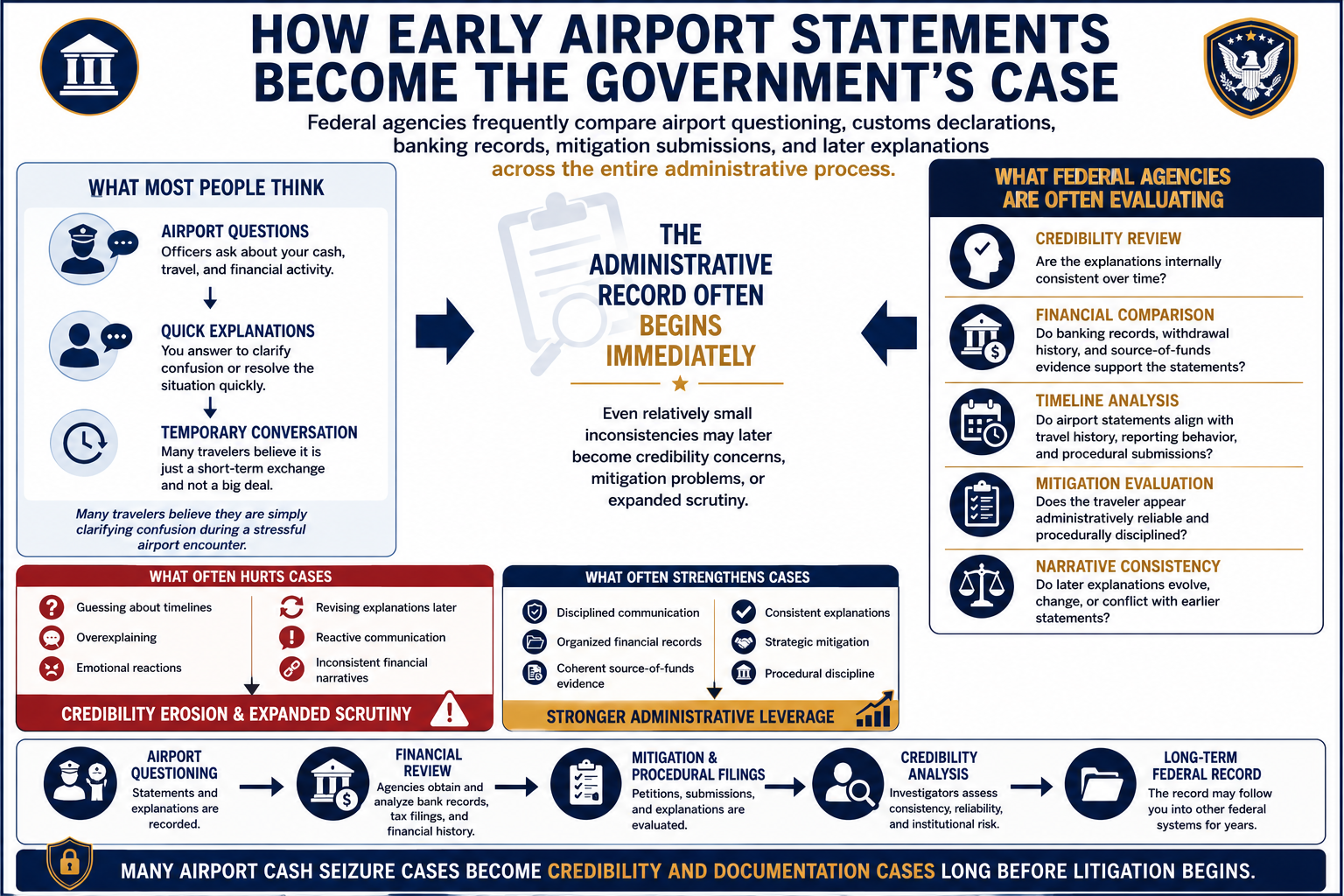
Federal agencies frequently preserve and later compare:
- airport questioning,
- customs declarations,
- banking records,
- source-of-funds explanations,
- mitigation submissions,
- and later procedural filings
across the entire life of the matter.
That means relatively small inconsistencies introduced during stressful airport questioning may later become:
- credibility concerns,
- mitigation problems,
- procedural complications,
- or expanded financial scrutiny.
Many travelers unintentionally weaken their own cases while trying to help themselves.
This is especially common where people:
- panic,
- speculate,
- guess about timelines,
- reconstruct banking activity from memory,
- or continue revising explanations after reviewing records later.
Once inconsistencies enter the administrative record, they frequently become much harder to unwind.
This is one reason airport cash seizure matters often become heavily:
- credibility-driven,
- documentation-driven,
- and mitigation-driven
long before courtroom litigation ever begins.
We discuss many of these broader procedural and strategic issues throughout our What Happens When CBP Seizes Your Cash at the Airport? page as well as our broader The Biggest Mistakes People Make After CBP Seizes Their Money guide.
Most Travelers Do Not Realize the Interview Has Already Become Part of the Case
Many airport cash seizure cases begin with what initially feels like casual questioning.
A traveler may be:
- referred to secondary inspection,
- asked about currency,
- questioned about travel plans,
- or asked to explain where the money came from.
At first, many people assume:
- the officers are simply gathering basic information,
- the interaction is temporary,
- or a quick explanation will resolve the issue.
Then the questioning becomes more detailed.
Federal officers may begin asking:
- when the money was withdrawn,
- why the traveler is carrying cash,
- why certain banking activity appears unusual,
- whether deposits were structured,
- why reporting requirements were not followed,
- or why the financial timeline appears inconsistent.
Many travelers do not initially realize that federal agencies are already evaluating:
- credibility,
- consistency,
- financial plausibility,
- and administrative reliability
in real time.
This is one reason airport cash seizure cases frequently become much more serious than people initially expect. What feels like:
“just answering questions”
may later become a central part of the administrative record.
Federal agencies frequently preserve:
- statements,
- explanations,
- timelines,
- and procedural behavior
from the very beginning of the encounter.
We discuss many of these early airport dynamics further in our pages on Traveling With More Than $10,000: What You Need to Know Before Crossing the Border and Why CBP Thinks Carrying Large Amounts of Cash Is Suspicious.
Why People Make Inconsistent Statements at the Airport
Most inconsistent statements are not intentional.
They are usually the result of:
- stress,
- panic,
- embarrassment,
- confusion,
- poor memory under pressure,
- or trying too hard to answer quickly.
Many travelers are suddenly asked detailed financial questions involving:
- deposit timelines,
- withdrawals,
- business activity,
- travel dates,
- source-of-funds history,
- or banking patterns
without access to records or time to review documentation carefully.
As a result, people frequently:
- guess,
- speculate,
- approximate timelines,
- or provide explanations that later change once records are reviewed more carefully.
Federal agencies may still interpret those inconsistencies seriously even where the traveler had no intent to mislead anyone.
This is one reason airport cash seizure matters often become heavily dependent on:
- credibility,
- narrative consistency,
- and procedural discipline.
Once investigators begin identifying inconsistencies, they frequently continue evaluating whether:
- the explanations remain stable,
- the records support the narrative,
- and the traveler appears administratively reliable over time.
Small inconsistencies often snowball institutionally.
We discuss many of these credibility issues in much greater detail in our pages on How Credibility Affects Customs Seizure Cases and Why Consistency Matters in Federal Seizure Cases.
Federal Agencies Frequently Compare Your Statements Against Everything Else
One of the most misunderstood aspects of airport cash seizure matters is how broadly federal agencies often compare information across the record.
Investigators frequently evaluate whether airport statements align with:
- bank records,
- customs declarations,
- withdrawal history,
- tax filings,
- mitigation submissions,
- business records,
- travel timelines,
- text messages,
- emails,
- and even social media activity.
This broader institutional review is one reason airport cash seizure cases frequently become:
- financial narrative cases,
- credibility cases,
- and documentation cases
rather than simple disputes about whether cash was found.
Federal agencies often evaluate:
- whether explanations evolve,
- whether timelines remain coherent,
- whether source-of-funds records support the narrative,
- and whether the traveler appears administratively reliable across systems.
Many travelers underestimate how long these records may follow them.
Statements made during airport questioning may later appear during:
- Global Entry reviews,
- security clearance investigations,
- federal employment vetting,
- contractor screening,
- or broader federal investigations.
This is one reason sophisticated customs seizure strategy frequently involves carefully evaluating:
- how explanations align across records,
- how financial timelines appear institutionally,
- and how to preserve long-term credibility before inconsistencies expand further.
We discuss these overlap issues in much greater detail in our pages on CBP Seized My Cash for “Structuring”: What Does That Mean? and Can Social Media or Prior Statements Hurt Your CBP Case?.
Small Inconsistencies Often Become Much Bigger Problems Later
One of the biggest hidden realities in airport cash seizure cases is that relatively small inconsistencies often become significantly more important over time.
Many travelers initially assume:
- “I already corrected that.”
- “It was just a minor mistake.”
- “I misspoke because I was nervous.”
- “They understand what I meant.”
Federal agencies often evaluate these situations differently.
Investigators frequently view:
- changing timelines,
- revised explanations,
- inconsistent banking descriptions,
- or evolving source-of-funds narratives
as potential indicators of:
- concealment,
- financial inconsistency,
- reporting avoidance,
- or reduced credibility.
This does not necessarily mean the traveler intended deception.
However, once inconsistencies appear in the administrative record, federal agencies frequently continue evaluating whether:
- the financial narrative remains coherent,
- the explanations align with the documentation,
- and the traveler appears administratively reliable over time.
This is one reason many airport cash seizure cases become increasingly difficult not because of new evidence, but because the administrative narrative slowly hardens around unresolved credibility concerns.
For example, investigators may later compare:
- airport questioning,
- banking records,
- mitigation submissions,
- tax filings,
- customs declarations,
- and later procedural explanations
against one another repeatedly throughout the life of the case.
What initially felt like:
- a rushed airport conversation,
- an innocent approximation,
- or a harmless clarification
may later become framed institutionally as:
- inconsistency,
- narrative drift,
- or evolving explanations.
This is also why reactive communication frequently creates additional problems. Many travelers continue trying to:
- clarify,
- revise,
- explain,
- or “fix” prior statements
without first understanding how the overall financial narrative appears across the record.
Sophisticated customs seizure strategy often focuses instead on:
- slowing the situation down,
- reviewing documentation carefully,
- reconstructing financial timelines methodically,
- and preserving credibility before additional inconsistencies expand scrutiny further.
In many airport cash seizure matters, credibility erosion happens gradually rather than dramatically. Small inconsistencies accumulate over time until federal agencies begin viewing the entire financial narrative through a lens of institutional skepticism.
We discuss these broader administrative review issues further in our pages on The Record Controls the Case: Why Your First Submission Matters and How CBP Actually Decides Seizure Cases.
What Strong Strategic Communication Usually Looks Like
Strong communication strategy in airport cash seizure matters is usually much calmer and more disciplined than people initially expect.
Many travelers assume the strongest approach is:
- aggressively defending themselves,
- talking constantly,
- or immediately trying to explain every detail from memory.
In reality, sophisticated customs seizure strategy often focuses first on:
- understanding how the government is interpreting the case,
- reviewing financial records carefully,
- identifying inconsistencies early,
- and preserving credibility before additional procedural damage occurs.
Strong cases frequently involve:
- disciplined communication,
- coherent financial timelines,
- organized source-of-funds documentation,
- strategic mitigation,
- and careful procedural positioning.
Federal agencies often evaluate whether:
- explanations remain consistent,
- records support the narrative,
- timelines align across submissions,
- and the traveler appears administratively reliable.
This broader institutional analysis frequently shapes:
- mitigation opportunities,
- settlement posture,
- procedural leverage,
- and recovery potential.
Sophisticated customs seizure strategy often involves:
- reconstructing financial timelines carefully before making additional statements,
- narrowing unresolved issues early,
- organizing documentation strategically,
- and avoiding unnecessary narrative changes once the administrative record begins forming.
In many situations, the strongest communication strategy is not:
- saying more,
- reacting emotionally,
- or constantly revising explanations.
It is building a coherent financial and procedural narrative that remains:
- stable,
- documented,
- internally consistent,
- and administratively credible over time.
We discuss these broader strategic concepts further in our pages on How to Win a CBP Currency Seizure Case and What CBP Looks for in a Petition for Remission.
Early Statements Often Affect More Than the Seizure Itself
Many travelers initially view airport questioning as:
- temporary,
- isolated,
- or relevant only to the seizure itself.
In reality, statements made during airport cash seizure investigations may later appear in entirely different federal contexts.
Depending on the allegations involved, the administrative record developed during:
- airport questioning,
- mitigation submissions,
- procedural filings,
- and source-of-funds explanations
may later affect:
- Global Entry eligibility,
- security clearances,
- federal employment,
- contractor eligibility,
- immigration matters,
- future border screening,
- and broader federal investigations.
Federal agencies frequently share information and evaluate these systems collectively rather than in isolation.
This broader overlap is one reason sophisticated customs seizure strategy often requires evaluating not only:
“How do we respond to the seizure?”
but also:
“How will these statements affect the client’s broader federal position later?”
This is also where we are uniquely positioned compared to most customs seizure lawyers.
We are one of the only federal law firms in the country that simultaneously handles:
- customs seizure matters,
- Global Entry appeals,
- TSA credential matters,
- security clearance cases,
- federal investigations,
- federal employment matters,
- export-control issues,
- and overlapping national security-related administrative proceedings.
These are highly specialized federal systems that many traditional customs seizure lawyers do not regularly handle or fully understand.
That distinction matters enormously because statements made casually during airport questioning may later follow a traveler into entirely different federal screening and investigative systems for years afterward.
Why National Security Law Firm Is Different
Many law firms approach airport questioning issues as isolated forfeiture or criminal-defense problems. The focus often becomes reacting to whatever statements were already made without fully evaluating how those explanations may affect the client across broader federal systems.
We approach these matters differently.
Our customs seizure practice is built around understanding how overlapping federal systems actually evaluate:
- credibility,
- financial consistency,
- reporting behavior,
- mitigation,
- and administrative reliability over time.
We regularly handle:
- airport cash seizure matters,
- Global Entry appeals,
- TSA credential matters,
- security clearance cases,
- federal investigations,
- federal employment matters,
- export-control issues,
- and overlapping national security-related administrative proceedings.
That combination is extremely uncommon.
Most customs seizure lawyers do not regularly practice in these adjacent federal systems. As a result, they may not fully evaluate how:
- airport questioning,
- banking explanations,
- procedural statements,
- mitigation submissions,
- or credibility findings
could later affect:
- security clearances,
- Global Entry,
- immigration,
- contractor eligibility,
- federal employment,
- or future border screening.
We evaluate airport cash seizure matters through that broader institutional lens from the beginning.
That often means analyzing:
- how the financial narrative will appear institutionally,
- whether explanations remain consistent across systems,
- how mitigation may affect future scrutiny,
- and how to preserve long-term administrative credibility before procedural problems harden the government’s position.
In many situations, the strongest strategic advantage is not:
- talking more,
- reacting emotionally,
- or trying to explain every detail immediately.
It is building a financial and procedural narrative that appears:
- coherent,
- documented,
- internally consistent,
- and administratively reliable across the entire federal record.
For broader discussion of airport cash seizure strategy generally, visit CBP Money Seizure Lawyers: How to Get Seized Cash Back From Customs and the broader Customs Seizure Lawyer Hub.
Frequently Asked Questions
Why do airport statements matter so much?
Federal agencies frequently compare:
- airport questioning,
- customs declarations,
- banking records,
- source-of-funds explanations,
- mitigation submissions,
- and later procedural filings
across the entire administrative process.
Even relatively small inconsistencies may later create:
- credibility concerns,
- mitigation problems,
- expanded scrutiny,
- or procedural complications.
Can inconsistent statements really hurt the case?
Yes.
Many airport cash seizure matters become heavily:
- credibility-driven,
- documentation-driven,
- and mitigation-driven.
Changing timelines or conflicting explanations frequently create administrative skepticism that becomes difficult to reverse later.
What if I accidentally guessed or misspoke?
That is extremely common.
Many inconsistencies result from:
- stress,
- panic,
- embarrassment,
- confusion about financial timelines,
- or trying too hard to answer quickly.
The important issue is often how those inconsistencies are later evaluated against:
- banking records,
- financial documentation,
- and procedural submissions.
Does CBP compare statements against bank records?
Frequently, yes.
Federal agencies often evaluate whether:
- banking activity,
- withdrawal timelines,
- source-of-funds explanations,
- and airport statements
remain coherent and internally consistent across the administrative record.
Can social media or text messages affect the case?
Potentially, yes.
Public statements, texts, emails, or online discussions that conflict with:
- customs declarations,
- mitigation submissions,
- or financial records
may later create additional credibility concerns.
What is the strongest communication strategy after a seizure?
In many situations, strong strategy involves:
- slowing the situation down,
- organizing financial records carefully,
- reconstructing timelines methodically,
- preserving consistency,
- and avoiding reactive explanations before fully understanding how the government is evaluating the case.
Why does credibility matter so much?
Federal agencies frequently evaluate whether:
- explanations remain stable,
- records support the narrative,
- timelines align,
- and the traveler appears administratively reliable over time.
This broader institutional review often shapes:
- mitigation opportunities,
- settlement posture,
- procedural leverage,
- and recovery potential.
Can early statements affect Global Entry or security clearances?
Potentially, yes.
Depending on the allegations involved, airport questioning and administrative findings may later affect:
- Global Entry,
- security clearances,
- immigration,
- contractor eligibility,
- federal employment,
- and future border screening.
What should I do if I already made inconsistent statements?
In many situations, strong strategy focuses on:
- reviewing financial records carefully,
- understanding where inconsistencies exist,
- preserving credibility moving forward,
- and developing a coherent financial narrative before additional procedural submissions are made.
Why are airport cash seizure cases so credibility-driven?
Because many airport cash seizure matters ultimately revolve around:
- financial consistency,
- reporting behavior,
- source-of-funds documentation,
- and administrative reliability
rather than traditional criminal prosecution alone.
Speak With a Nationwide Airport Cash Seizure Lawyer
If CBP seized your cash at the airport or border, the statements made during the first few hours and days after the seizure may significantly affect:
- credibility assessments,
- mitigation opportunities,
- procedural leverage,
- litigation exposure,
- and broader federal consequences.
Airport cash seizure matters are often heavily influenced by:
- source-of-funds documentation,
- banking analysis,
- consistency of explanations,
- procedural timing,
- mitigation strategy,
- and administrative positioning.
We offer nationwide representation and free consultations for airport cash seizure matters.
The fastest and easiest way to get started is through our online booking system.
In many situations, same-day consultations are available, and the process typically takes less than a minute to schedule online.
Once booked, one of our attorneys will personally call you at the scheduled time to discuss:
- the seizure,
- airport questioning,
- procedural deadlines,
- banking activity,
- source-of-funds documentation,
- mitigation strategy,
- credibility concerns,
- and broader federal implications.
To schedule a consultation online, visit:
Book a Free Consultation Online
You may also contact us directly at:
Phone: (202) 600-4996
Additional related resources:
- What Happens When CBP Seizes Your Cash at the Airport?
- How to Win a CBP Currency Seizure Case
- The Biggest Mistakes People Make After CBP Seizes Their Money
- Can Social Media or Prior Statements Hurt Your CBP Case?
- CBP Money Seizure Lawyers: How to Get Seized Cash Back From Customs
- Customs Seizure Lawyer Hub