Many people are surprised when CBP seizes a firearm part or accessory.

In many cases, the item was purchased openly from a retailer, shipped through ordinary channels, and does not appear unusual to the buyer.

As a result, one of the first questions people ask is:

“Why would customs seize this?”

The answer is that federal agencies often evaluate firearm-related items through a regulatory framework that is very different from the way most consumers view them.

Many people focus on what the item does.

Federal agencies often focus on:

  • how the item is classified,
  • whether import restrictions apply,
  • whether licenses were required,
  • whether declarations were accurate,
  • and whether applicable regulations were satisfied.

This is one reason firearms-part seizure cases frequently become compliance cases rather than ownership disputes.

The central issue is often not:

“Who bought the item?”

Instead, the question frequently becomes:

“Can this item lawfully enter the United States under the applicable regulations?”

Understanding that distinction is often the first step toward understanding why the seizure occurred and what options may exist moving forward.

For a broader overview of customs seizure matters generally, visit:

Why CBP Seizes Firearms Parts and Accessories

Many people assume customs only seizes complete firearms.

In reality, federal agencies may scrutinize a wide range of firearm-related products.

The government’s concern often involves:

  • import restrictions,
  • licensing requirements,
  • customs declarations,
  • classification issues,
  • regulatory requirements,
  • documentation concerns,
  • and other compliance-related issues.

In many situations, the item itself is not necessarily prohibited.

The dispute may instead involve questions regarding:

  • how it was imported,
  • how it was classified,
  • whether required authorizations existed,
  • and whether applicable federal requirements were satisfied.

This is one reason firearms-parts seizures often look very different from:

  • luxury goods seizures,
  • electronics seizures,
  • merchandise seizures,
  • or package seizures.

The government’s analysis frequently centers on regulatory treatment rather than consumer use.

As a result, many of these matters become heavily dependent on documentation and compliance records.

Not Every Firearms Part Is Treated the Same

One of the biggest misconceptions in these cases is the belief that all firearm-related items are regulated identically.

They are not.

Different products may be subject to different classifications, restrictions, and regulatory requirements.

As a result, two items that appear similar to a consumer may receive very different treatment from federal agencies.

This is one reason the precise nature of the product frequently becomes one of the most important issues in the case.

Federal agencies may evaluate:

  • the item’s specifications,
  • how it is classified,
  • how it is described in import documentation,
  • whether licensing requirements apply,
  • and what regulatory framework governs the product.

The government’s analysis is often driven by the classification of the item rather than the purchaser’s understanding of the item.

For many owners, this becomes one of the most surprising aspects of the process.

The issue frequently shifts from:

“What did I buy?”

to:

“How does the government classify what I bought?”

That distinction often drives everything that follows.
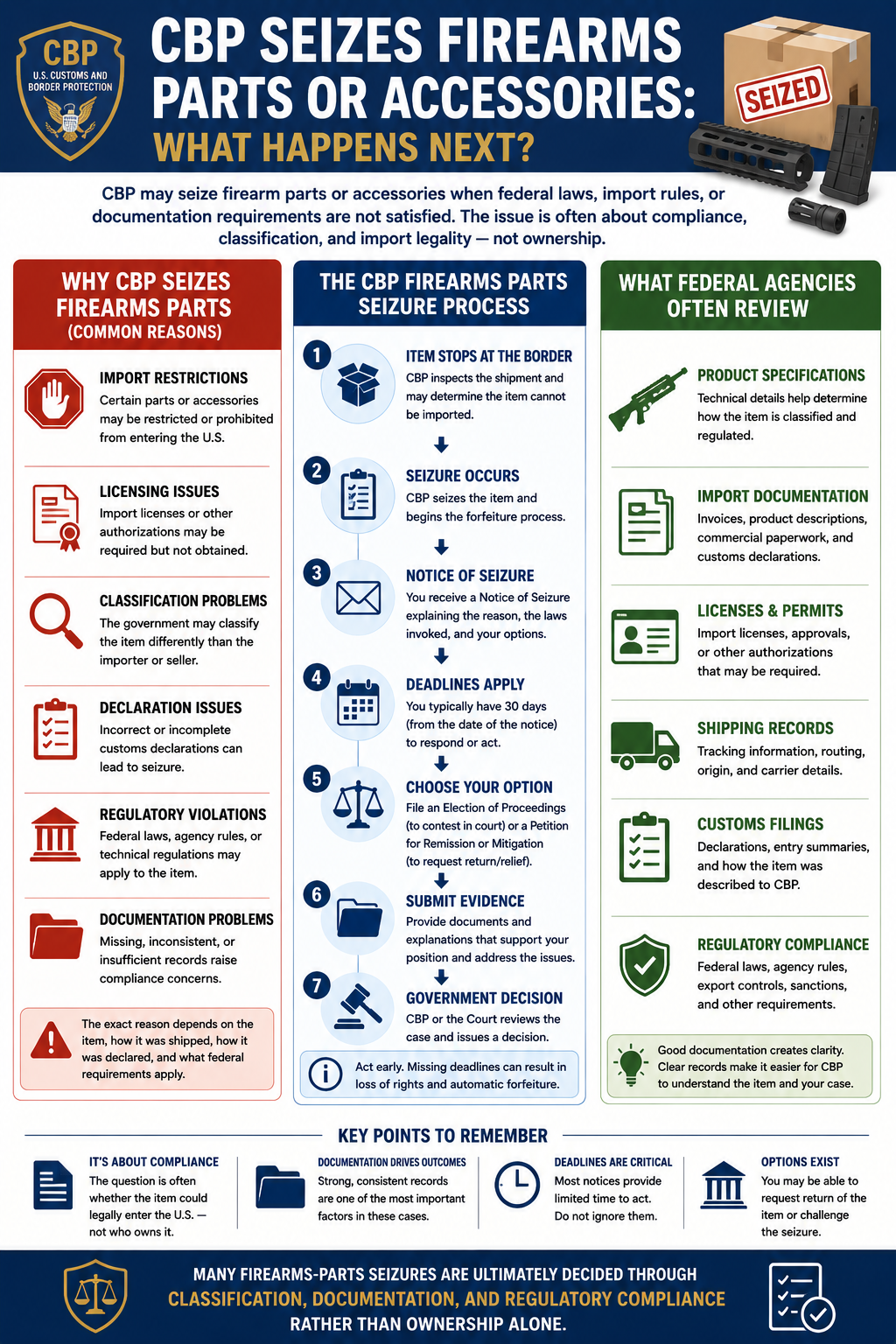
What Happens After CBP Seizes Firearms Parts?

For most people, the seizure itself is only the beginning of the process.

The immediate questions are usually practical:

  • Can I get the item back?
  • Was it permanently confiscated?
  • What happens now?
  • Did I do something wrong?
  • How long will this take?

At the same time, the federal administrative process is already moving forward.

Once a seizure occurs, CBP will generally begin the forfeiture process and eventually issue notices explaining:

  • why the item was seized,
  • applicable deadlines,
  • available procedural options,
  • and how the government intends to proceed.

This is often the point where people first encounter concepts such as:

  • Notices of Seizure,
  • Elections of Proceedings,
  • Petitions for Remission or Mitigation,
  • administrative forfeiture,
  • and judicial forfeiture.

Many owners mistakenly view this stage as a waiting period.

In reality, it is often one of the most important phases of the entire matter.

Federal agencies frequently continue reviewing:

  • product descriptions,
  • shipping records,
  • customs declarations,
  • invoices,
  • import documentation,
  • licensing records,
  • and other supporting materials

while the administrative process unfolds.

As a result, the government’s understanding of the case often develops long before a final decision is made.

This is one reason early documentation frequently matters.

The sooner the government’s actual concern is identified, the easier it often becomes to determine:

  • what evidence may be important,
  • what explanations may be relevant,
  • and what procedural options may still exist.

Many people initially focus on proving ownership of the item.

Federal agencies are often focused on a different issue entirely.

The central question frequently becomes:

“Should this item have been imported under the circumstances presented?”

Understanding that distinction often helps explain why these cases are typically resolved through documentation and regulatory analysis rather than emotional arguments about ownership.

The Government Is Often Evaluating More Than Ownership

One of the biggest misconceptions in firearms-part seizure cases is the belief that ownership resolves the issue.

Many owners understandably focus on proving:

“I bought the item.”

“The item belongs to me.”

“I purchased it legally.”

Those facts may be important.

However, federal agencies are often evaluating a much broader set of issues.

Depending on the circumstances, the government may examine:

  • product classification,
  • import legality,
  • licensing requirements,
  • customs declarations,
  • shipping history,
  • documentation,
  • and regulatory compliance.

In many situations, the issue is not whether someone owns the item.

The issue is whether the item could lawfully enter the country under the applicable regulatory framework.

This distinction appears repeatedly throughout customs seizure matters.

Federal agencies frequently focus on:

  • the transaction,
  • the import process,
  • the documentation,
  • and the regulatory requirements

rather than ownership alone.

As a result, firearms-parts seizures often become highly document-intensive.

Investigators may review:

  • invoices,
  • product specifications,
  • shipping records,
  • customs filings,
  • licensing documentation,
  • declarations,
  • and related materials

to understand exactly what was imported and how it was presented to customs authorities.

The government’s analysis often revolves around questions such as:

  • What is the item?
  • How is it classified?
  • What requirements apply?
  • Were those requirements satisfied?
  • Does the documentation support the importation?

This is one reason strong firearms-parts cases frequently involve a clear documentary record explaining:

  • what the product is,
  • how it was described,
  • how it was shipped,
  • and why the available documentation supports the owner’s position.

The clearer those issues become, the easier it often is for federal agencies to evaluate the matter.

What Evidence Helps Challenge a Firearms-Part Seizure?

In many firearms-parts seizure cases, the outcome is heavily influenced by documentation.

That is because federal agencies are often attempting to answer a series of practical questions:

  • What exactly was imported?
  • How was it described?
  • How was it classified?
  • Where did it come from?
  • What documentation accompanied the shipment?
  • Were any licenses or authorizations required?

As a result, firearms-parts seizures frequently become documentation cases.

The specific records that matter will vary depending on the item involved, but federal agencies often review:

  • purchase records,
  • invoices,
  • shipping records,
  • customs declarations,
  • product specifications,
  • manufacturer information,
  • licensing documentation,
  • permits,
  • import records,
  • and related correspondence.

Many owners assume that proving they purchased the item legally resolves the issue.

Federal agencies frequently evaluate something broader.

The question often becomes whether the available records support the legality of the importation itself.

For example, investigators may compare:

  • product descriptions,
  • customs filings,
  • shipping documents,
  • invoices,
  • and technical specifications

to determine whether the item was accurately presented and whether applicable requirements were satisfied.

This is one reason strong documentation often carries significant weight.

The government’s review frequently becomes easier when the records clearly explain:

  • what the item is,
  • how it was classified,
  • how it was imported,
  • and why the available documentation supports the owner’s position.

Weak documentation frequently creates additional questions.

The issue is often not whether documents exist.

The issue is whether the documents fit together logically and consistently.

That is why successful firearms-parts cases often focus on building a clear documentary narrative rather than simply gathering paperwork.

The strongest records frequently allow federal reviewers to quickly understand:

  • the product,
  • the transaction,
  • the shipment,
  • and the regulatory framework surrounding the importation.

Import Restrictions and Classification Issues Frequently Drive These Cases

One of the most misunderstood aspects of firearms-part seizures is the role that classification plays.

Many people assume the issue is straightforward.

They know what they purchased and how they intended to use it.

Federal agencies may be evaluating the item through an entirely different framework.

This is because customs enforcement frequently depends on how a product is classified under applicable laws and regulations.

In many situations, the central dispute is not:

“What did the buyer think the item was?”

The dispute may instead become:

“How does the government classify the item?”

That distinction can have significant consequences.

Different classifications may trigger different:

  • import restrictions,
  • documentation requirements,
  • licensing obligations,
  • regulatory standards,
  • and compliance expectations.

As a result, two products that appear similar to a consumer may receive very different treatment during customs review.

Many firearms-parts seizures ultimately revolve around:

  • classification,
  • documentation,
  • declarations,
  • and regulatory interpretation.

This is one reason these cases often become much more technical than many people initially expect.

The government’s focus is frequently on:

  • the regulatory status of the item,
  • how it was described,
  • how it was declared,
  • and whether applicable requirements were satisfied.

When the documentation clearly supports the importation, the government’s review often becomes substantially easier.

When the classification, declarations, or supporting records create uncertainty, scrutiny frequently increases.

That is why many firearms-parts seizure cases are ultimately decided through regulatory analysis and documentation rather than disputes over ownership alone.