
Few customs seizures are more confusing than the seizure of prescription medication.
Many travelers are genuinely surprised when it happens.
After all, they may have:
- a valid prescription,
- a legitimate medical condition,
- a physician’s recommendation,
- and no intention of violating any law.
As a result, one of the most common reactions is:
“I have a prescription. Why would customs take my medication?”
The answer is that federal agencies often evaluate much more than whether the medication was prescribed.
Prescription drug importation is governed by a complex set of federal laws and regulations involving:
- CBP,
- the Food and Drug Administration (FDA),
- the Drug Enforcement Administration (DEA),
- and other federal agencies.
This is one reason medication seizure cases often feel very different from:
- currency seizures,
- vehicle seizures,
- electronics seizures,
- or merchandise seizures.
The central issue is frequently not:
“Do you need the medication?”
Instead, the question often becomes:
“Was the medication lawfully imported into the United States?”
Understanding that distinction is often the first step toward understanding why the seizure occurred and what options may exist moving forward.
For a broader overview of customs seizure matters generally, visit:
- CBP Property Seizures: Vehicles, Merchandise, Electronics, Jewelry, and Luxury Goods
- Customs Seizure Lawyer Hub
Why CBP Seizes Prescription Medication
Many people assume that possessing a prescription automatically resolves any customs concerns.
Unfortunately, the rules are often more complicated.
Federal agencies may scrutinize medication because of:
- import restrictions,
- FDA regulations,
- controlled substance concerns,
- documentation issues,
- foreign prescriptions,
- labeling problems,
- quantity concerns,
- or declaration issues.
In some situations, the medication itself may be lawful in another country but subject to different rules within the United States.
In others, the issue may involve:
- how the medication was obtained,
- where it was purchased,
- how much was being imported,
- or whether supporting documentation accompanied the medication.
As a result, customs officials frequently evaluate a broader set of regulatory issues than many travelers initially realize.
This is one reason medication seizures often become compliance cases rather than disputes about medical need.
The government may fully understand that an individual wants or needs the medication.
The issue often becomes whether federal import requirements were satisfied.
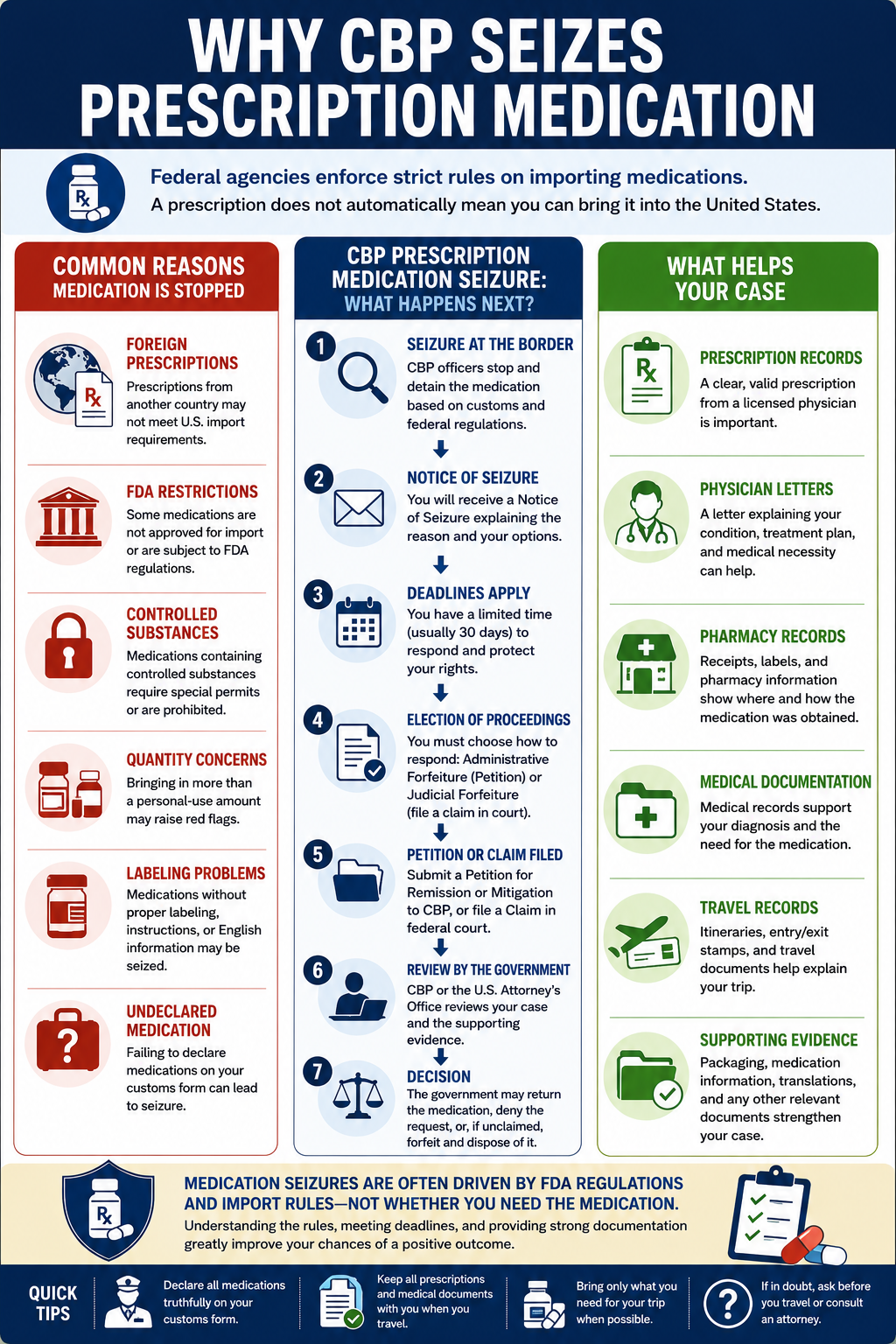
Having a Prescription Does Not Automatically Mean a Medication Can Be Imported
This is one of the most misunderstood concepts in prescription medication seizure cases.
Many travelers assume:
“If my doctor prescribed it, I can bring it into the United States.”
That is not always how federal import regulations work.
The existence of a prescription and the legality of importing a medication are often separate issues.
Federal agencies may evaluate:
- whether the medication is approved,
- whether import restrictions apply,
- whether the prescription originated in the United States,
- whether the medication was purchased from a foreign source,
- and whether applicable regulations permit importation.
This surprises many people because the medication may have been:
- legally prescribed,
- legally purchased,
- and lawfully possessed
before it was seized.
The government’s concern is often not whether the traveler possesses a prescription.
The concern may instead involve:
- import legality,
- regulatory compliance,
- documentation,
- or federal restrictions governing the product.
As a result, medication seizure cases frequently turn on regulatory questions rather than medical questions.
Many travelers understandably focus on proving:
“I need this medication.”
Federal agencies often focus on:
“Was this medication imported in compliance with applicable federal requirements?”
That distinction frequently shapes the entire case.
The stronger the documentation regarding the medication, prescription, physician, pharmacy, and import circumstances becomes, the easier it often is to evaluate the matter moving forward.