
Many people are surprised to learn that one of CBP’s largest enforcement missions has nothing to do with drugs, weapons, or immigration.
It involves counterfeit goods.
Every year, federal agencies seize enormous quantities of:
- replica watches,
- fake designer handbags,
- counterfeit jewelry,
- luxury accessories,
- apparel,
- electronics,
- and other products alleged to infringe intellectual property rights.
For the person whose property was seized, the experience is often confusing.
Many people immediately ask:
“How can customs take something I purchased?”
Others ask:
“What if I didn’t know it was counterfeit?”
Or:
“What if the item is actually authentic?”
The answer often depends on why the item was seized and what evidence exists regarding its authenticity.
Unlike many customs seizure cases, counterfeit goods matters frequently revolve around one central question:
Is the item genuine?
That question often drives everything that follows.
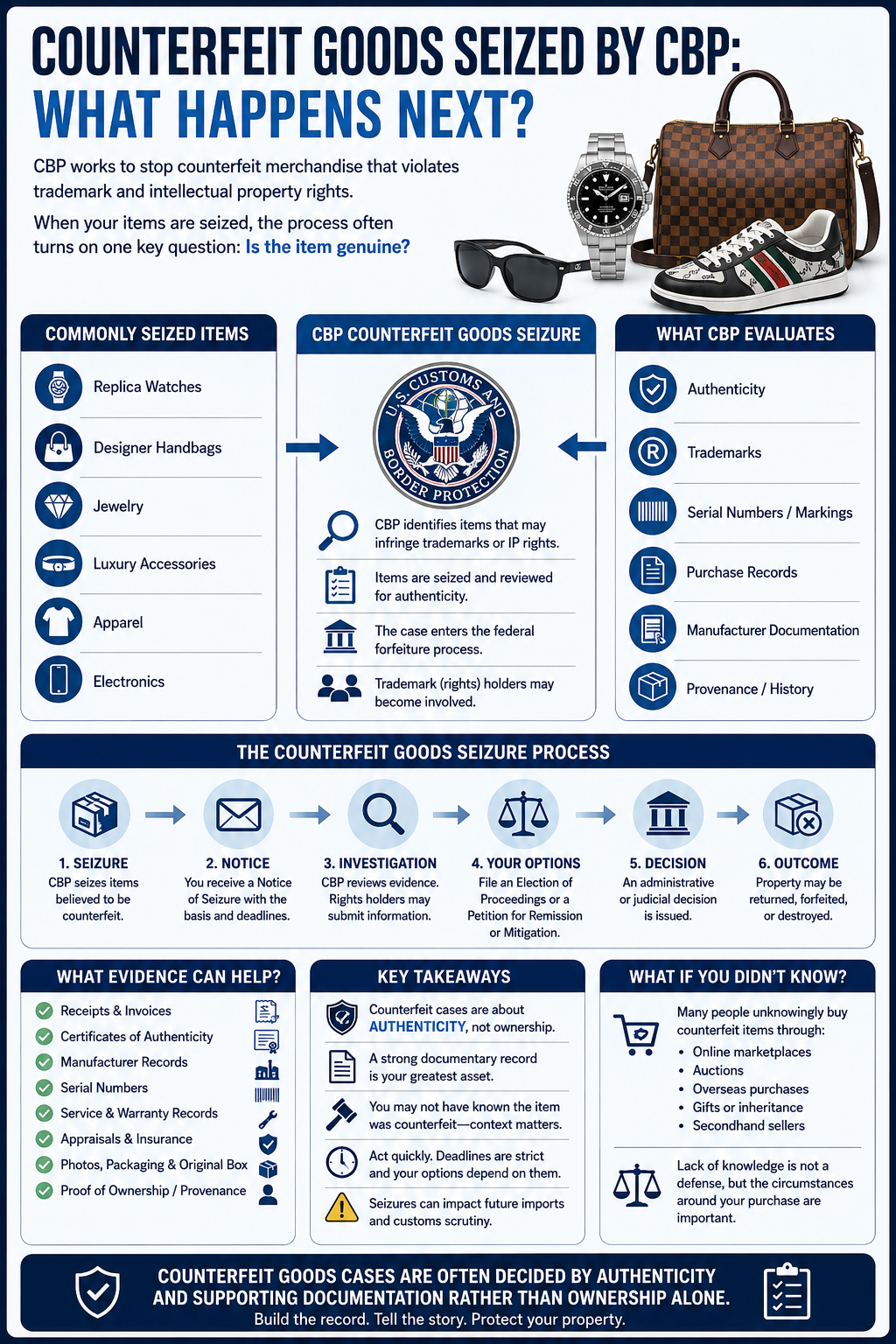
Federal agencies may evaluate:
- trademarks,
- serial numbers,
- manufacturer information,
- purchase records,
- authenticity documentation,
- and the overall history of the item.
As a result, counterfeit goods cases frequently become authenticity disputes rather than ownership disputes.
Understanding that distinction is often the first step toward understanding what happens next.
For a broader overview of property seizure matters generally, visit:
- CBP Property Seizures: Vehicles, Merchandise, Electronics, Jewelry, and Luxury Goods
- Customs Seizure Lawyer Hub
Why CBP Seizes Counterfeit Goods
Most people associate customs enforcement with border inspections and contraband interdiction.
However, trademark enforcement and counterfeit goods enforcement are also major CBP responsibilities.
Federal agencies regularly seize goods that are believed to infringe:
- trademarks,
- copyrights,
- intellectual property rights,
- or brand protections.
These seizures frequently involve:
- luxury watches,
- designer handbags,
- jewelry,
- luxury accessories,
- clothing,
- footwear,
- and consumer electronics.
The government’s concern is often not who owns the item.
Instead, the focus frequently becomes whether the item itself is genuine.
For example, CBP may examine:
- branding,
- packaging,
- markings,
- serial numbers,
- manufacturing details,
- and supporting documentation
to determine whether an item appears authentic.
This is one reason counterfeit goods seizures often feel different from many other customs matters.
The dispute frequently centers on the product itself rather than the person possessing it.
In many situations, federal agencies are attempting to determine whether the item violates intellectual property protections rather than whether the owner engaged in criminal conduct.
That distinction becomes important when evaluating potential options moving forward.
The First Question: Does CBP Believe the Item Is Actually Counterfeit?
One of the most important questions in any counterfeit goods seizure case is surprisingly simple:
Does the government actually believe the item is counterfeit?
That may sound obvious, but it often becomes the central issue in the entire case.
Many people assume a seizure automatically means the government has conclusively determined the item is fake.
That is not always how these situations develop.
Federal agencies may initially identify concerns involving:
- trademarks,
- product markings,
- authenticity indicators,
- packaging,
- or supporting documentation.
Those concerns may trigger further review.
As a result, there is often an important distinction between:
- a suspicion that an item is counterfeit,
and - a fully developed determination that the item is counterfeit.
This distinction frequently becomes critical in luxury goods cases involving:
- Rolex watches,
- designer handbags,
- jewelry,
- collectible items,
- and other high-value products.
Questions frequently arise regarding:
- provenance,
- authenticity,
- ownership history,
- manufacturer records,
- and supporting documentation.
The stronger the evidence supporting authenticity, the easier it often becomes to evaluate whether the government’s concerns are justified.
This is one reason authenticity documentation frequently becomes one of the most important components of the case.
A counterfeit goods seizure is often less about ownership and more about whether the available record supports the conclusion that the item is genuine.