
Having a phone, laptop, drone, camera, tablet, hard drive, or other electronic device seized by CBP can be particularly unsettling.
Unlike many other types of property, electronic devices often contain much more than their physical value.
They may hold:
- personal photographs,
- business records,
- communications,
- work product,
- proprietary information,
- travel records,
- and years of personal data.
As a result, many people are concerned not only about the loss of the device itself, but also about what happens next.
Common questions include:
“Why did customs seize my laptop?”
“Can CBP keep my phone?”
“How do I get my device back?”
“What happens to the information stored on it?”
The answer depends heavily on why the device was seized in the first place.
Many people assume customs only seizes electronics when they contain prohibited material.
In reality, federal agencies may seize electronic devices for a wide variety of reasons involving:
- import violations,
- export restrictions,
- customs declarations,
- licensing requirements,
- sanctions-related concerns,
- documentation problems,
- and broader regulatory issues.
This is one reason electronics seizure cases often become very different from:
- cash seizure cases,
- vehicle seizure cases,
- luxury goods seizures,
- or merchandise seizures.
The government is frequently evaluating issues that extend well beyond ownership alone.
Understanding those issues is often the first step toward determining what options may exist moving forward.
For a broader overview of property seizure matters generally, visit:
- CBP Property Seizures: Vehicles, Merchandise, Electronics, Jewelry, and Luxury Goods
- Customs Seizure Lawyer Hub
Why CBP Seizes Electronics and Devices
Many people are surprised to learn that customs seizures involving electronics are often driven by regulatory concerns rather than the devices themselves.
Federal agencies may scrutinize:
- phones,
- laptops,
- tablets,
- drones,
- cameras,
- communications equipment,
- hard drives,
- computer components,
- and other technology products
for a variety of reasons.
In some situations, the concern involves import compliance.
In others, the focus may involve:
- export restrictions,
- licensing requirements,
- sanctions programs,
- customs declarations,
- product classifications,
- or other federal regulations.
The issue is not always:
“What is the device?”
The issue may be:
“How did the device enter or leave the country, and were all applicable requirements satisfied?”
This distinction becomes important because many owners focus entirely on proving ownership.
Federal agencies may instead be evaluating:
- regulatory compliance,
- import documentation,
- export documentation,
- declarations,
- licensing,
- and supporting records.
That broader analysis often shapes the entire direction of the case.
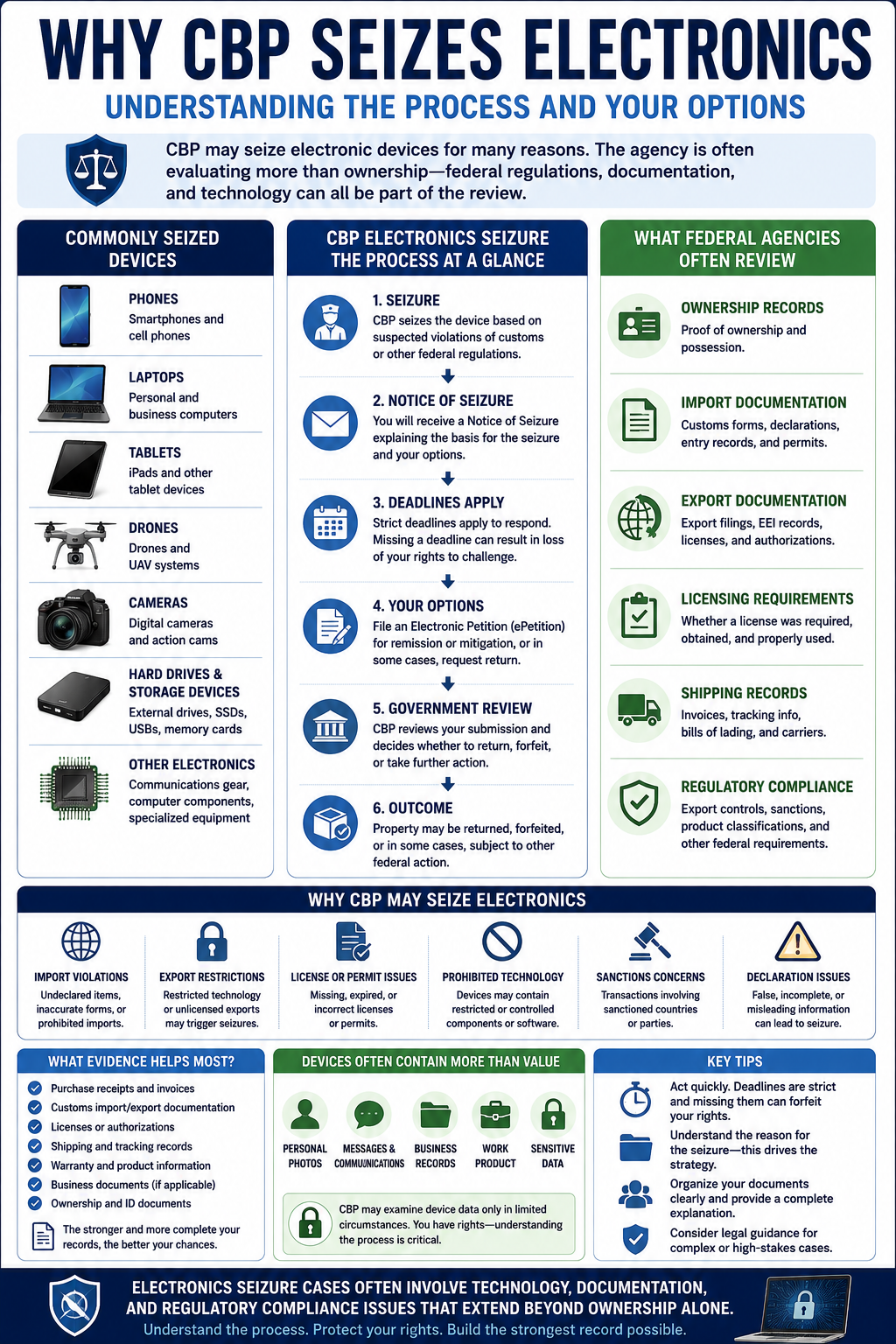
Electronics Seizures Often Raise Different Concerns Than Other Property Seizures
Electronic devices occupy a unique place within customs enforcement.
A seized watch, handbag, or piece of jewelry often raises questions involving:
- ownership,
- authenticity,
- valuation,
- and provenance.
Electronics cases frequently raise a different set of issues.
Federal agencies may evaluate:
- technology classifications,
- communications capabilities,
- export-control restrictions,
- licensing requirements,
- commercial use,
- and regulatory compliance.
This is particularly true with:
- drones,
- specialized equipment,
- communications devices,
- high-end technology products,
- and devices that may have commercial or technical applications.
As a result, electronics seizure cases frequently involve broader regulatory questions than many owners initially expect.
The government’s concern may have little to do with ownership and much more to do with:
- how the device was imported,
- how it was exported,
- whether licensing requirements applied,
- and whether regulatory requirements were satisfied.
That is one reason electronics seizures often require a different strategic analysis than other property seizure matters.