
Few things are more frustrating for an importer than learning that a shipment has been seized by CBP.
For many businesses, the merchandise represents:
- inventory,
- customer orders,
- cash flow,
- contractual obligations,
- and future revenue.
As a result, a seizure often creates immediate business concerns.
Importers typically want answers to questions such as:
Why was the shipment seized?
Is the merchandise gone permanently?
How do I get the shipment released?
What happens next?
Many people assume a seizure means the government believes the goods are illegal.
In reality, imported merchandise is often seized because of concerns involving:
- import compliance,
- customs declarations,
- valuation,
- classification,
- licensing,
- documentation,
- or regulatory requirements.
This is one reason imported merchandise seizures frequently become very different from:
- currency seizure cases,
- vehicle seizure cases,
- luxury goods seizures,
- or electronics seizures.
The issue is often not who owns the merchandise.
The issue is whether the merchandise was imported in compliance with applicable federal requirements.
Understanding that distinction is often the first step toward understanding what options may exist moving forward.
For a broader overview of customs seizure matters generally, visit:
- CBP Property Seizures: Vehicles, Merchandise, Electronics, Jewelry, and Luxury Goods
- Customs Seizure Lawyer Hub
Why CBP Seizes Imported Merchandise
One of the biggest misconceptions in import-related seizure cases is the belief that customs only seizes prohibited goods.
While prohibited merchandise is certainly seized, many seizures involve products that could have been lawfully imported if all applicable requirements had been satisfied.
Federal agencies may scrutinize shipments because of:
- improper declarations,
- inaccurate classifications,
- valuation concerns,
- country-of-origin issues,
- licensing requirements,
- intellectual property concerns,
- agency restrictions,
- or documentation deficiencies.
In many situations, the government is not asking:
“Is this merchandise legal?”
Instead, the question becomes:
“Was this merchandise imported properly?”
That distinction is critical.
Many importers purchased the goods lawfully and possess valid ownership documentation.
The seizure may nevertheless occur because federal agencies believe there are unresolved compliance concerns relating to the import process itself.
As a result, merchandise seizure cases frequently become heavily dependent on:
- customs entries,
- invoices,
- purchase orders,
- shipping records,
- declarations,
- certifications,
- and other import documentation.
The stronger the documentary record becomes, the easier it often becomes to evaluate the underlying issue.
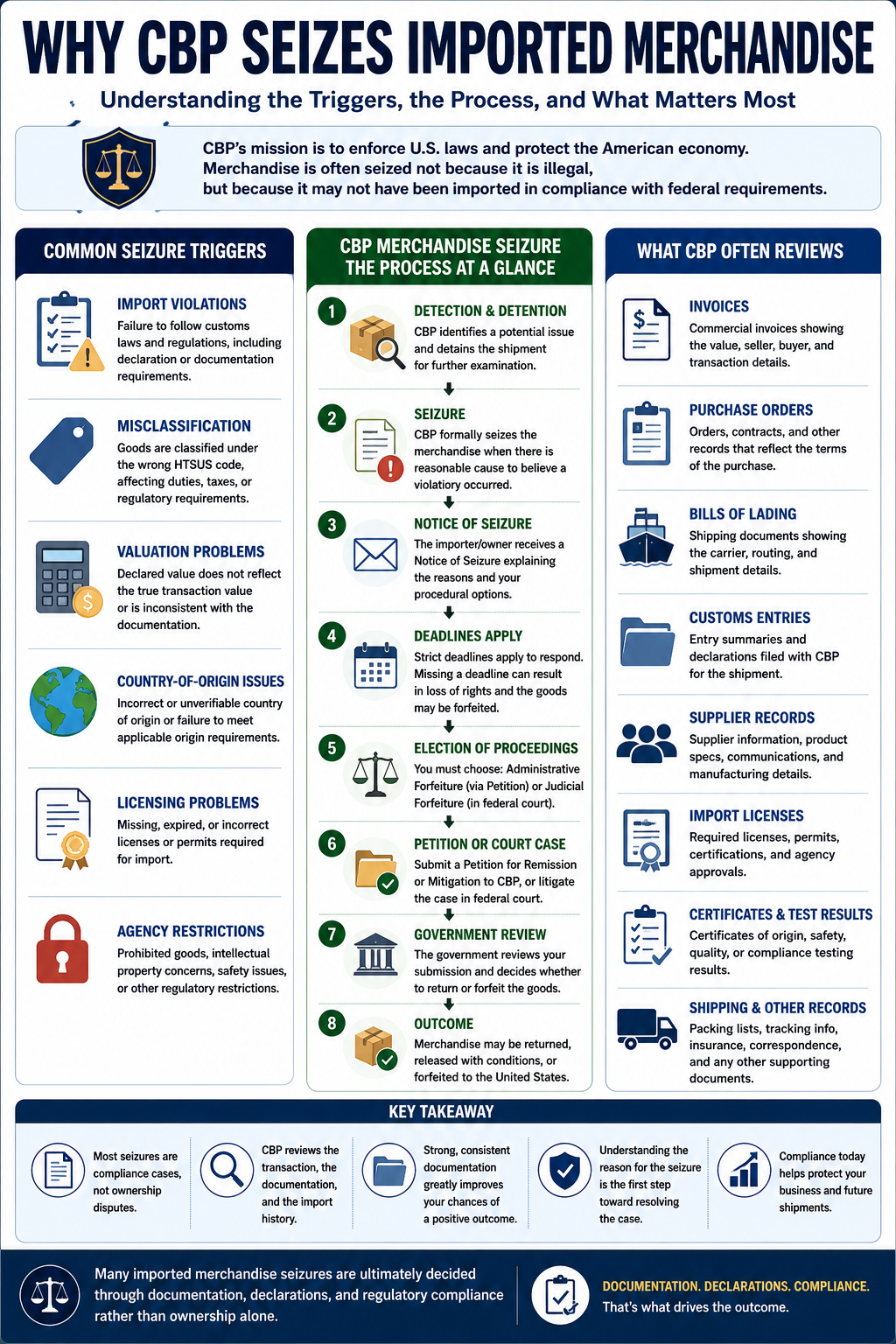
Imported Merchandise Seizures Are Often Compliance Cases
Many importers initially approach a seizure as if it were a dispute about ownership.
From a business perspective, that reaction makes sense.
After all, the company purchased the goods, paid for the shipment, and expected the merchandise to arrive.
Federal agencies often evaluate a different issue entirely.
In many cases, the central question becomes whether the import transaction complied with applicable requirements.
That may involve issues such as:
- classification,
- valuation,
- declarations,
- licensing,
- certifications,
- agency approvals,
- or country-of-origin requirements.
This is one reason imported merchandise seizures frequently resemble compliance reviews more than traditional property disputes.
Federal agencies often spend substantial time evaluating:
- what the merchandise is,
- how it was classified,
- how it was valued,
- where it originated,
- what documentation accompanied it,
- and whether applicable requirements were satisfied.
The dispute frequently centers on the transaction rather than the goods themselves.
As a result, many successful merchandise seizure cases focus heavily on reconstructing and documenting the import process.
The strongest cases often create a clear record explaining:
- what was imported,
- where it came from,
- how it was declared,
- and why the available documentation supports the importer’s position.
That documentary record frequently becomes one of the most important aspects of the case.
What Happens After CBP Seizes a Shipment?
For most importers, the seizure itself is only the beginning of the problem.
The immediate concern is usually practical:
- Where is the shipment?
- Can it still be released?
- How much inventory is involved?
- What happens to customer orders?
- How long will the process take?
At the same time, the federal administrative process is already moving forward.
After a seizure occurs, CBP will generally begin the forfeiture process and eventually issue formal notices explaining:
- why the merchandise was seized,
- what deadlines apply,
- what procedural options may be available,
- and how the government intends to proceed.
This is often the point where importers first encounter concepts such as:
- Notices of Seizure,
- Elections of Proceedings,
- Petitions for Remission or Mitigation,
- administrative forfeiture,
- and judicial forfeiture.
Many businesses mistakenly assume this period is simply a waiting period.
In reality, it is often one of the most important stages of the entire case.
Federal agencies frequently continue evaluating:
- customs entries,
- invoices,
- purchase orders,
- supplier information,
- declarations,
- shipping records,
- and supporting documentation
while the administrative process unfolds.
As a result, the government is often developing its understanding of the transaction long before a final decision is made.
This is one reason early procedural decisions frequently matter far more than importers initially realize.
Missed deadlines, incomplete submissions, and poorly organized documentation can significantly affect the trajectory of the case.
The strongest strategy often begins with understanding:
- the specific reason for the seizure,
- the procedural posture of the matter,
- the government’s apparent concerns,
- and what documentation will likely be important moving forward.
Many importers focus exclusively on getting the shipment released.
A more productive approach is often understanding why the shipment was stopped in the first place.
That issue frequently determines:
- what evidence matters,
- what options may exist,
- and what the government is likely to focus on during review.
The Government Is Often Evaluating More Than the Merchandise Itself
One of the biggest misconceptions in imported merchandise seizure cases is the belief that federal agencies are evaluating only the shipment that was seized.
In many situations, the shipment is simply the starting point.
Federal agencies frequently review a broader set of issues involving:
- import history,
- supplier history,
- customs declarations,
- valuation practices,
- country-of-origin information,
- classification decisions,
- and prior import activity.
As a result, the government’s inquiry often extends beyond:
“What is in this shipment?”
The broader questions may include:
“How has this merchandise been imported?”
“How has it been declared?”
“Does the documentation support the importer’s position?”
“Do the records appear consistent over time?”
This is one reason imported merchandise cases frequently become broader compliance reviews.
Federal agencies often evaluate patterns rather than isolated events.
For example, investigators may review:
- prior shipments,
- recurring suppliers,
- historical declarations,
- valuation practices,
- classification decisions,
- and import documentation
to determine whether the seized shipment fits within a larger pattern.
Many importers are surprised by how document-intensive this process can become.
The issue often evolves from:
“Why was this shipment seized?”
to:
“Does the overall import record support the explanation being presented?”
That distinction is important because it changes the type of evidence that frequently matters most.
Strong cases often involve documentation that creates a coherent explanation for:
- the merchandise,
- the supplier,
- the transaction,
- the valuation,
- and the import process itself.
When the records fit together logically, the government’s review often becomes much easier.
When the documentation contains gaps, inconsistencies, or unexplained issues, scrutiny frequently increases.
This is one reason imported merchandise seizures often become documentation and compliance cases rather than disputes about ownership alone.