Few customs seizure situations are more confusing than receiving a CBP seizure notice for a package that you never ordered, never expected, and may not have even known existed.

Many recipients immediately assume there must be some mistake.

After all, they did not:

  • place an order,
  • communicate with a seller,
  • make a payment,
  • or expect a shipment.

Yet the package was addressed to them.

The shipment was sent to their address.

And the seizure notice now bears their name.

As a result, one of the most common questions we hear is:

“Can CBP hold me responsible for a package that someone else sent to me?”

The answer is often more complicated than people expect.

One reason is that this situation is different from identity theft.

In an identity-theft case, someone may have pretended to be you.

In this type of case, the package may have been intentionally sent to you even though nobody was pretending to be you at all.

That distinction matters.

The central issue often becomes:

“What evidence exists connecting the recipient to the transaction itself?”

Understanding that question is often the first step toward understanding what options may exist moving forward.

For a broader discussion of package seizures generally, visit:

How This Situation Is Different From Identity Theft

Many people initially assume that a package arriving in someone else’s name must involve identity theft.

Sometimes that is true.

However, many package seizures arise under a completely different fact pattern.

In an identity-theft case, someone may:

  • use another person’s name,
  • use another person’s financial information,
  • use another person’s account,
  • or otherwise pretend to be someone else.

In the situations discussed in this article, the sender may not be pretending to be the recipient at all.

Instead, the sender intentionally chooses the recipient’s address as the destination for the shipment.

The sender may know exactly who the recipient is.

The recipient simply has no involvement in the transaction.

This distinction is important because it changes the nature of the case.

The question is often not:

“Did someone steal my identity?”

The question becomes:

“Why was this package sent to me?”

Understanding that distinction often helps explain why these cases can be so confusing.

Can Someone Really Send a Package to You Without Your Knowledge?

Yes.

In fact, it happens more often than many people realize.

Every day, packages are shipped to people who:

  • never placed an order,
  • never communicated with the sender,
  • never paid for the item,
  • and never expected the shipment.

Sometimes the explanation is innocent.

Sometimes it is not.

The important point is that a package arriving at a person’s address does not automatically prove that the person requested it.

Many people naturally assume:

“If it was sent to me, I must somehow be responsible.”

Federal agencies often look for additional evidence before reaching that conclusion.

The existence of the package is one fact.

The recipient’s connection to the transaction is a separate question.

That distinction becomes critically important in many customs seizure cases.

Common Reasons Someone Might Ship a Package to Another Person

There are many reasons why a package may be intentionally sent to someone who had no involvement in the purchase.

Some explanations are relatively benign.

Others are far more concerning.

Gifts, Surprises, and Unrequested Packages From Friends or Relatives

Not every package sent without the recipient’s knowledge involves fraud, identity theft, or wrongdoing.

Sometimes a package is exactly what it appears to be:

A gift.

Friends, family members, business associates, and acquaintances sometimes send items without informing the recipient beforehand.

For example:

  • a relative living overseas may mail a gift,
  • a friend may send a surprise package,
  • a family member may ship personal property,
  • or someone may simply assume the recipient would want the item.

In these situations, the recipient may genuinely have no idea the shipment exists until:

  • a delivery notice arrives,
  • customs contacts them,
  • or a seizure notice is issued.

The important point is that receiving a package is not necessarily the same thing as ordering a package.

A recipient may have:

  • never communicated with the seller,
  • never made a payment,
  • never placed an order,
  • and never expected the shipment,

even though the sender fully intended the package to reach them.

These situations often create a different type of evidentiary question.

The issue is frequently not:

“Who ordered this?”

Instead, the question may become:

“What did the recipient know about the shipment before it was sent?”

Documentation showing that the package originated from a known friend, family member, or acquaintance may sometimes help explain why the shipment appeared in the recipient’s name despite the recipient having no involvement in the purchase or shipment process.

Pranks and Practical Jokes

Some shipments are sent as jokes.

The sender may:

  • know the recipient,
  • know the address,
  • and intentionally arrange the shipment without the recipient’s knowledge.

The recipient may have no idea the package is coming.

Harassment and Retaliation

Unfortunately, not every shipment is sent with good intentions.

Former spouses, former partners, former friends, neighbors, or other individuals involved in personal disputes sometimes send packages as a form of harassment or retaliation.

The goal may be:

  • embarrassment,
  • inconvenience,
  • intimidation,
  • or creating problems for the recipient.

Former Spouses and Former Partners

These situations can be particularly difficult because former partners often know:

  • addresses,
  • contact information,
  • personal details,
  • and household information.

As a result, they may be capable of arranging shipments that appear connected to the recipient despite the recipient having no involvement.

Drop Shipments and Delivery Points

Sometimes the recipient is simply being used as a delivery location.

The sender may intend to:

  • retrieve the package later,
  • intercept delivery,
  • redirect the shipment,
  • or otherwise separate themselves from the transaction.

In these situations, the recipient may simply be an unwitting intermediary.

Wrong Recipient Situations

Not every package is sent maliciously.

A sender may intentionally ship an item to an address believing that:

  • the intended recipient still lives there,
  • the address belongs to someone else,
  • or the shipment will ultimately reach another person.

The current occupant may have no connection to the transaction whatsoever.

Being the Recipient Is Not Necessarily the Same Thing as Being the Purchaser

This is one of the most important concepts in the entire article.

Many people assume that if a package is addressed to someone, that person must have ordered it.

Federal agencies often evaluate the issue more carefully.

The fact that a package was shipped to a particular address does not automatically establish:

  • who ordered it,
  • who paid for it,
  • who expected it,
  • or who was involved in the transaction.

Those are separate questions.

For example, a package may be addressed to a person who:

  • never communicated with the seller,
  • never made a payment,
  • never maintained an account,
  • and never expected a delivery.

In those situations, the government’s focus often shifts toward determining what evidence actually connects the recipient to the transaction.

This is one reason customs seizure cases frequently become evidence cases.

The package itself is only part of the story.

The larger question often becomes:

“What evidence exists showing that the recipient actually participated in the purchase?”

That distinction frequently drives the entire analysis.
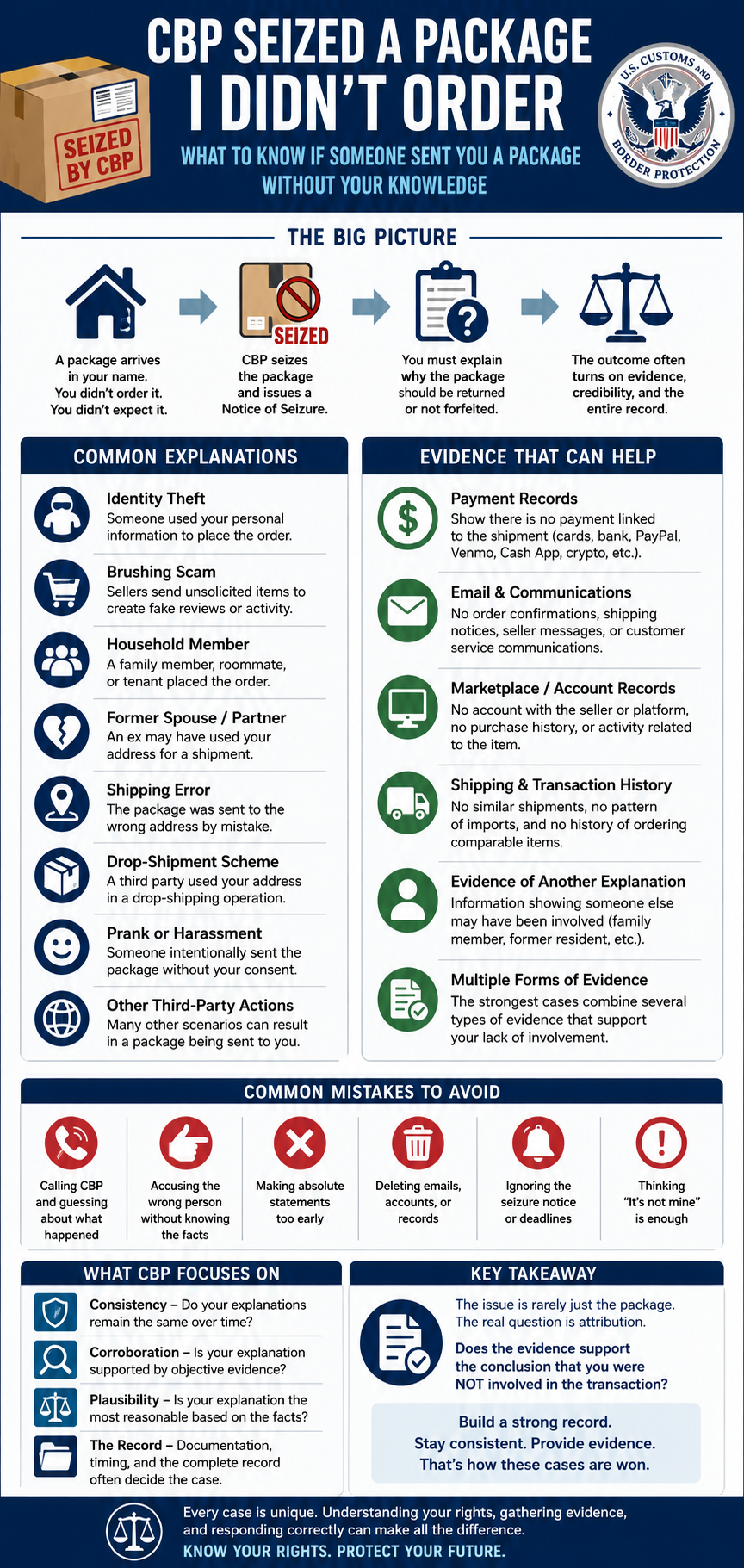
What Evidence Helps Show You Were Not Involved?

Once a recipient claims that someone else intentionally sent the package to them, the next question is usually:

“How do I prove that?”

That is often where these cases become challenging.

The recipient knows they did not order the item.

The problem is demonstrating that fact through objective evidence.

Federal agencies frequently evaluate whether there is documentation connecting the recipient to the transaction.

The stronger the evidence showing that no such connection exists, the stronger the claim of non-involvement often becomes.

Payment Records

One of the most important categories of evidence involves payment information.

Most purchases create some type of financial trail.

Examples may include:

  • credit card transactions,
  • debit card transactions,
  • PayPal payments,
  • Venmo payments,
  • bank transfers,
  • Cash App transactions,
  • cryptocurrency transfers,
  • or other payment records.

If the recipient can demonstrate that no payment exists corresponding to the shipment, that fact may become significant.

The argument often becomes:

“There is no evidence that I paid for this item.”

rather than simply:

“I don’t remember ordering it.”

Those are very different statements.

Email and Communication Records

Online transactions typically generate communications.

Federal agencies may expect to see:

  • order confirmations,
  • shipping notices,
  • tracking updates,
  • seller communications,
  • customer-service interactions,
  • marketplace messages,
  • or other records associated with the purchase.

When those records do not exist, that absence may help support the recipient’s position.

Again, the focus often shifts from denial to documentation.

Marketplace and Account Records

Many purchases originate through:

  • Amazon,
  • eBay,
  • Temu,
  • AliExpress,
  • Etsy,
  • Alibaba,
  • and other online platforms.

Federal agencies may naturally ask:

“If you ordered the item, where is the account activity?”

In many situations, recipients can demonstrate:

  • they never had an account with the seller,
  • they never used the platform involved,
  • they have no purchase history relating to the product,
  • or there is no account activity consistent with the shipment.

Those facts can help explain why the package appears disconnected from the recipient.

Shipping and Transaction History

Investigators frequently look for patterns.

For example:

  • Has the recipient received similar shipments before?
  • Is there a history of comparable transactions?
  • Have related products previously been imported?

One isolated shipment often looks very different than:

  • repeated shipments,
  • recurring imports,
  • or a history of ordering similar products.

Patterns do not necessarily prove involvement.

However, they frequently influence how federal agencies evaluate credibility and plausibility.

Evidence That Someone Else Was Involved

Sometimes the strongest evidence is evidence pointing toward another explanation.

For example:

  • communications from another person,
  • admissions by a household member,
  • evidence involving a former spouse,
  • records relating to a former resident,
  • identity-theft documentation,
  • or evidence showing someone else had access to the address.

The issue is often not simply disproving involvement.

The issue is providing a coherent explanation for what actually occurred.

The Strongest Cases Usually Combine Multiple Forms of Evidence

Federal agencies frequently evaluate the totality of the circumstances.

As a result, the strongest cases rarely depend on a single document.

Instead, they often involve a combination of:

  • no payment records,
  • no email records,
  • no marketplace activity,
  • no transaction history,
  • and evidence supporting an alternative explanation.

Taken together, those facts often create a much stronger narrative than any individual piece of evidence standing alone.

In many of these cases, the central question is not:

“Can the recipient prove who sent the package?”

The more important question is often:

“Does the available evidence support the conclusion that the recipient was not involved in the transaction?”

That distinction frequently drives the outcome of the case.

What If the Sender Cannot Be Identified?

One of the most frustrating aspects of these cases is that the recipient often has less information than anyone else involved.

The sender may know exactly what happened.

The marketplace may possess account records.

The payment processor may have transaction information.

The shipping company may have delivery records.

The recipient may have none of that information.

As a result, many people quickly encounter a practical problem:

“How am I supposed to prove I wasn’t involved if I can’t even identify who sent the package?”

Unfortunately, that situation is common.

Many Shipments Originate Overseas

A large percentage of customs seizures involve shipments originating from:

  • foreign sellers,
  • overseas marketplaces,
  • third-party vendors,
  • drop-shipping operations,
  • and businesses located outside the United States.

In many situations, the recipient has little ability to obtain information directly from those entities.

The sender may be:

  • anonymous,
  • unresponsive,
  • located overseas,
  • difficult to identify,
  • or simply unwilling to cooperate.

That can make the situation feel extremely unfair.

The recipient may be attempting to explain a shipment while lacking access to the very information that would explain how the shipment occurred.

Online Marketplaces Often Have Limited Incentives To Help

Many recipients assume they can simply contact the marketplace and obtain answers.

In practice, that is often much harder than expected.

Large marketplaces frequently possess information such as:

  • account records,
  • payment information,
  • login history,
  • shipping information,
  • and transaction records.

However, privacy policies, internal procedures, and legal restrictions often limit what information can be disclosed.

As a result, recipients frequently discover that obtaining information from:

  • Amazon,
  • eBay,
  • Temu,
  • AliExpress,
  • Alibaba,
  • and other platforms

is far more difficult than anticipated.

The Absence of Information Does Not Automatically Hurt the Case

Many people become discouraged when they realize they cannot identify the sender.

They assume:

“If I can’t prove who did it, nobody will believe me.”

That is not necessarily true.

Federal agencies understand that recipients frequently lack access to information held by:

  • sellers,
  • marketplaces,
  • payment processors,
  • and other third parties.

The central issue is often not whether the recipient can identify the sender with certainty.

The issue is whether the available evidence supports the recipient’s claim of non-involvement.

For example, a recipient may still be able to demonstrate:

  • no payment records,
  • no communications,
  • no marketplace activity,
  • no transaction history,
  • and no prior connection to the seller.

Those facts may still be significant even if the identity of the actual sender remains unknown.

Focus on What You Can Prove

One of the biggest mistakes people make is becoming consumed with proving who sent the package.

In many situations, that information may never be available.

A more productive approach is often focusing on the evidence that can actually be documented.

Questions frequently include:

  • Did you pay for the item?
  • Did you communicate with the seller?
  • Did you maintain an account associated with the transaction?
  • Did you expect the shipment?
  • Is there evidence connecting you to the purchase?

The stronger the answers become, the easier it often is to evaluate whether the recipient was actually involved.

In many of these cases, the inability to identify the sender is not the central issue.

The central issue is whether the available evidence supports the conclusion that the recipient was not the sender, purchaser, or intended participant in the transaction.

That distinction often becomes one of the most important concepts in the entire case.

What If the Package Contained Something Illegal, Restricted, or Highly Regulated?

Many of the easier cases involve ordinary consumer products.

For example:

  • household goods,
  • inexpensive merchandise,
  • accessories,
  • clothing,
  • or other common items.

The analysis often becomes more complicated when the package contains something that would naturally attract government scrutiny.

Examples may include:

  • prescription medication,
  • firearms parts,
  • counterfeit goods,
  • fake identification documents,
  • restricted electronics,
  • controlled substances,
  • export-controlled products,
  • or other highly regulated items.

In those situations, recipients often worry that federal agencies will automatically assume they were involved simply because the package was addressed to them.

That concern is understandable.

However, the fundamental question often remains the same:

“What evidence connects the recipient to the transaction?”

The nature of the item may increase scrutiny.

It does not automatically establish ownership, intent, or participation.

Why These Cases Are Often More Difficult

The challenge is that certain products naturally raise additional questions.

For example, federal agencies may reasonably wonder why someone would send:

  • prescription medication,
  • a fake ID,
  • firearms components,
  • counterfeit luxury goods,
  • or restricted technology

to a completely uninvolved person.

As a result, explanations that might be persuasive in an ordinary consumer-goods case may receive greater scrutiny when the package contains highly regulated products.

This does not mean the recipient ordered the item.

It simply means federal agencies may expect a more complete explanation supported by stronger evidence.

The Government Often Focuses on Attribution

Even when the package contains something highly regulated, the government’s inquiry frequently returns to the same core issue:

Who was actually involved in the transaction?

Federal agencies may attempt to determine:

  • who placed the order,
  • who paid for it,
  • who expected delivery,
  • who communicated with the seller,
  • and what evidence supports those conclusions.

The strongest cases frequently focus on objective facts.

For example:

  • no payment records,
  • no emails,
  • no marketplace activity,
  • no communications with the seller,
  • no transaction history,
  • and evidence supporting an alternative explanation.

Those facts may not answer every question.

However, they often help shift the analysis from:

“The package was addressed to you.”

to:

“Is there actually evidence that you participated in the transaction?”

That distinction is often where these cases are won or lost.

The More Serious the Item, the More Important the Documentation

In many situations, the seriousness of the item increases the importance of the evidence.

Federal agencies frequently place substantial weight on documentation that helps explain:

  • how the shipment occurred,
  • who was involved,
  • who was not involved,
  • and why the available evidence supports the recipient’s explanation.

This is one reason recipients are often in a much stronger position when they can present objective records rather than relying solely on denials.

The government is often evaluating more than the package itself.

The government is evaluating whether the available evidence supports the conclusion that the recipient actually participated in the transaction.

The stronger that evidence becomes, the easier it often is to separate:

  • the existence of the package,

from

  • responsibility for the package.

Some Fact Patterns Are Simply Harder Than Others

A brushing scam involving a $5 phone case may be relatively easy for investigators to understand.

A package containing:

  • a fake ID,
  • restricted medication,
  • firearms accessories,
  • or other heavily regulated items

often presents a more challenging factual picture.

That does not mean the recipient was involved.

It means the explanation will often need to be supported by stronger evidence, more detailed documentation, and a clearer understanding of how the shipment occurred.

In many of these cases, the issue is not whether the recipient can deny involvement.

The issue is whether the available evidence makes that denial the most credible explanation of what happened.

How CBP Evaluates Credibility in These Cases

One of the biggest misconceptions in these cases is that credibility is determined by whether someone appears sincere.

Most recipients genuinely believe:

“If I tell the truth, they should believe me.”

Federal agencies often evaluate credibility differently.

In many customs seizure matters, credibility is not determined primarily by:

  • confidence,
  • emotion,
  • certainty,
  • or how strongly someone denies involvement.

Instead, credibility is frequently evaluated through corroboration.

The central question often becomes:

“Does the available evidence support the explanation being offered?”

This is one reason these cases often look very different from what recipients expect.

Many people focus on telling their story.

Federal agencies frequently focus on whether the story is supported by:

  • payment records,
  • email records,
  • marketplace activity,
  • shipping records,
  • identity-theft documentation,
  • household circumstances,
  • and other objective evidence.

Consistency Matters

One of the first things investigators often evaluate is whether the explanation remains consistent over time.

For example, a recipient may initially say:

“I have never heard of this seller.”

Later, evidence reveals that the seller previously shipped products to the same address.

Or a recipient may state:

“Nobody in my household could have ordered this.”

Only to later discover that a teenager, roommate, or family member was involved.

These situations do not automatically mean the recipient was dishonest.

However, they can create questions about reliability and accuracy.

This is one reason it is often important to review the facts carefully before making definitive statements.

The strongest cases typically involve explanations that remain consistent across:

  • interviews,
  • written submissions,
  • financial records,
  • communications,
  • and other supporting evidence.

Corroboration Usually Carries More Weight Than Denial

Federal agencies hear denials every day.

As a result, a denial by itself often carries limited weight.

What tends to matter more is whether the denial is supported by objective evidence.

For example:

“I didn’t order it.”

is one fact.

But:

“I didn’t order it, there are no payment records, no emails, no marketplace activity, and no evidence connecting me to the transaction.”

is a much stronger factual presentation.

The second explanation provides corroboration.

And corroboration is often what transforms a denial into a persuasive narrative.

The Government Is Often Looking for the Most Plausible Explanation

In many situations, federal agencies are not attempting to determine absolute certainty.

Instead, they are often evaluating which explanation is most consistent with the available evidence.

Possible explanations may include:

  • identity theft,
  • a brushing scam,
  • a former resident,
  • a family member,
  • a shipping error,
  • an ex-spouse,
  • a prank,
  • a drop-shipment scheme,
  • or actual involvement by the recipient.

The stronger the evidence supporting one explanation over the others, the easier it often becomes to evaluate the claim.

This is one reason these cases are frequently won through:

  • documentation,
  • corroboration,
  • consistency,
  • and record-building

rather than through forceful denials alone.

The Record Often Becomes the Case

One theme appears repeatedly throughout customs seizure matters:

The record controls the case.

Federal agencies generally make decisions based on the information available to them.

That means:

  • documentation matters,
  • timing matters,
  • consistency matters,
  • and corroboration matters.

In many of these cases, the issue is not whether the recipient can deny involvement.

The issue is whether the available evidence makes that denial the most credible explanation of what actually happened.

That distinction frequently determines the difference between a weak claim and a persuasive one.

Common Mistakes People Make in These Cases

One of the most frustrating aspects of these cases is that recipients sometimes make their situation more difficult before they fully understand what happened.

That reaction is understandable.

Receiving a seizure notice for a package you did not order, did not expect, and may not even recognize is stressful.

Many people immediately begin trying to explain the situation before they have gathered the facts.

Unfortunately, that can create problems later.

Immediately Calling CBP and Guessing

One of the most common mistakes occurs when a recipient immediately contacts CBP and begins speculating about what may have happened.

For example:

“Maybe my son ordered it.”

“Maybe it was my ex-spouse.”

“Maybe it was a shipping mistake.”

“Maybe it was a gift.”

The problem is that these statements are often guesses rather than facts.

If additional information later reveals a different explanation, the inconsistency may create unnecessary credibility issues.

A better approach is often to first review:

  • payment records,
  • emails,
  • marketplace accounts,
  • shipping information,
  • and household circumstances

before offering definitive explanations.

Accusing the Wrong Person

Another common mistake is immediately blaming:

  • a spouse,
  • a child,
  • a roommate,
  • a former partner,
  • or another family member

without actually knowing what occurred.

Sometimes those suspicions prove correct.

Sometimes they do not.

The problem is that once an explanation enters the record, it can be difficult to walk back later if new facts emerge.

Making Absolute Statements Too Early

Many recipients make statements such as:

“I have never heard of this seller.”

“Nobody in my family could have ordered this.”

“I have never received anything like this before.”

The challenge is that people are often working from incomplete information.

Later they may discover:

  • an old online account,
  • a forgotten transaction,
  • a family member’s purchase,
  • a former resident,
  • or another fact they did not initially know.

Absolute statements can become problematic when additional information emerges.

Deleting Emails, Accounts, or Records

Some people panic when they receive a seizure notice.

They begin deleting:

  • emails,
  • marketplace accounts,
  • transaction histories,
  • shipping records,
  • or other information they believe may be connected to the shipment.

That is usually a mistake.

Even when done innocently, deleting records can make it much harder to reconstruct what actually happened.

In many cases, the strongest evidence comes from reviewing records rather than removing them.

Ignoring the Seizure Notice

Many recipients believe:

“I didn’t order it, so I shouldn’t have to do anything.”

Unfortunately, federal deadlines do not disappear simply because a person denies involvement.

Ignoring a seizure notice may significantly limit available options later.

Even when the recipient believes the package has nothing to do with them, understanding the procedural posture and applicable deadlines remains important.

Assuming “It’s Not Mine” Is Enough

This is perhaps the most common mistake of all.

Many people believe that a denial should resolve the issue.

The problem is that federal agencies often want more than:

“It wasn’t me.”

They frequently want evidence that supports that conclusion.

The strongest cases usually involve:

  • objective records,
  • corroborating documentation,
  • consistent explanations,
  • and a plausible account of what likely occurred.

A denial may be true.

But a denial supported by evidence is usually far more persuasive than a denial standing alone.

In many of these cases, the goal is not simply to deny involvement.

The goal is to build a factual record that allows someone else to understand why the package appeared in your name despite your lack of involvement in the transaction.

Why These Cases Are Often Harder Than They First Appear

At first glance, these cases can seem straightforward.

A recipient says:

“I didn’t order the package.”

The government has a package addressed to that recipient.

The dispute appears simple.

In reality, these matters are often far more complicated than they initially seem.

The reason is that both of the following statements can be true at the same time:

  • the package was addressed to the recipient, and
  • the recipient genuinely had nothing to do with the transaction.

The challenge is determining which explanation is supported by the evidence.

Unlike many customs seizure matters, these cases frequently involve reconstructing events that the recipient never participated in.

As a result, the recipient often starts with very little information.

They may know:

  • they did not place the order,
  • they did not make a payment,
  • they did not expect the shipment,

but they may have no idea:

  • who sent it,
  • who ordered it,
  • why it was sent,
  • or how it became associated with their name or address.

That creates a unique evidentiary problem.

Federal agencies often possess:

  • shipping records,
  • customs declarations,
  • package information,
  • tracking data,
  • sender information,
  • and other transaction-related records.

The recipient may possess almost none of that information.

Instead, they are often left trying to piece together a story from:

  • household circumstances,
  • payment records,
  • emails,
  • marketplace activity,
  • and other indirect evidence.

Many People Know What Did Not Happen, But Not What Did

This is one of the most challenging aspects of these cases.

Recipients are often confident about one thing:

“I didn’t order it.”

What they cannot explain is:

“Then who did?”

That uncertainty can be frustrating.

However, it does not automatically make the recipient’s explanation less credible.

Federal agencies understand that recipients often lack access to critical information held by:

  • sellers,
  • marketplaces,
  • payment processors,
  • shipping companies,
  • and other third parties.

The question is often not whether the recipient can solve the mystery.

The question is whether the available evidence supports the recipient’s lack of involvement.

These Cases Often Become Record-Building Exercises

Many people assume these matters are resolved through a single explanation.

In reality, they often become exercises in building a factual record.

The strongest cases typically involve:

  • documentation,
  • corroboration,
  • consistency,
  • and objective evidence.

The goal is not merely to deny involvement.

The goal is to create a record that explains:

  • why the package was associated with the recipient,
  • why the recipient denies involvement,
  • and why the available evidence supports that denial.

The stronger that record becomes, the easier it often is for federal agencies to evaluate the claim.

The Issue Is Often Attribution, Not the Package

Many recipients focus on the contents of the package.

Federal agencies frequently focus on attribution.

The central question often becomes:

“Who was actually involved in the transaction that caused this package to be shipped?”

That distinction is important because it explains why these cases often involve:

  • payment records,
  • emails,
  • marketplace accounts,
  • transaction histories,
  • identity-theft evidence,
  • and other documentation that may have nothing to do with the package itself.

In many situations, the outcome turns less on what was shipped and more on whether the available evidence connects the shipment to the recipient.

That is what makes these cases different from many other customs seizure matters.

And it is what makes them considerably more complex than they first appear.

Frequently Asked Questions

Can someone really send a package to me without my knowledge?

Yes.

Packages are sometimes sent to individuals who had no involvement in the purchase. Possible explanations include:

  • identity theft,
  • brushing scams,
  • former residents,
  • family members,
  • former spouses or partners,
  • shipping errors,
  • drop-shipment schemes,
  • or other third parties using the recipient’s address.

The specific explanation depends on the facts of the case.

Can CBP hold me responsible just because the package was addressed to me?

Not necessarily.

The fact that a package was addressed to a person does not automatically establish that the person:

  • ordered it,
  • paid for it,
  • expected it,
  • or participated in the transaction.

Federal agencies often evaluate additional evidence connecting the recipient to the shipment.

What if I never opened the package?

Whether the package was opened may be relevant in some situations, but it does not automatically answer the larger question of who ordered or expected the shipment.

Federal agencies frequently focus on the transaction itself rather than solely on whether the package was opened.

What if I do not know who sent it?

This is extremely common.

Many recipients know they did not order the package but have no idea who actually sent it.

The inability to identify the sender does not automatically prevent a recipient from demonstrating non-involvement.

The focus often becomes whether objective evidence connects the recipient to the transaction.

What if the sender used my address on purpose?

That can occur.

Examples may include:

  • former spouses,
  • former partners,
  • roommates,
  • family members,
  • harassment situations,
  • prank shipments,
  • or drop-shipment schemes.

The central issue often becomes whether the available evidence shows the recipient actually participated in the transaction.

What if my teenager ordered the package?

This occurs more often than many people realize.

Teenagers sometimes:

  • use prepaid cards,
  • use gift cards,
  • use a parent’s name,
  • use a friend’s account,
  • or conceal purchases from family members.

In those situations, the parent may genuinely have had no involvement in the transaction.

What if the package contained something illegal or highly regulated?

The nature of the item may increase scrutiny.

However, the central question often remains:

“What evidence connects the recipient to the transaction?”

The existence of a regulated item does not automatically establish who ordered it.

What if I never paid for the item?

The absence of payment records can be important.

Most online purchases create a financial trail.

If there is no evidence that the recipient paid for the shipment, that fact may support the claim of non-involvement.

Will CBP automatically believe me?

Not necessarily.

Federal agencies often evaluate:

  • documentation,
  • corroboration,
  • consistency,
  • plausibility,
  • and the overall factual record.

A denial supported by objective evidence is usually more persuasive than a denial standing alone.

What is the strongest evidence in these cases?

The strongest cases often involve multiple categories of evidence working together, such as:

  • no payment records,
  • no email confirmations,
  • no marketplace activity,
  • no communications with the seller,
  • no transaction history,
  • and a plausible explanation for how the package became associated with the recipient.

What if I have absolutely no idea what happened?

That is actually one of the most common situations.

Many recipients know only one thing:

“I didn’t order the package.”

The question is often not whether the recipient can identify the true sender.

The question is whether the available evidence supports the recipient’s lack of involvement in the transaction.

What if the package was a gift?

Not every package seizure involves a purchase made by the recipient.

Sometimes a friend, family member, relative, business associate, or other individual sends a package as a gift without informing the recipient beforehand.

In those situations, the recipient may genuinely have:

  • never placed an order,
  • never made a payment,
  • never communicated with a seller,
  • and never known the shipment was coming.

The fact that a package was intended as a gift does not automatically resolve customs or regulatory issues relating to the shipment itself.

However, it may help explain why the package was addressed to the recipient despite the recipient having no involvement in the purchase or shipping process.

Federal agencies often focus on questions such as:

  • who purchased the item,
  • who arranged the shipment,
  • what the recipient knew about the shipment,
  • and what evidence supports those facts.

Documentation showing that the package originated from a friend, family member, or other known sender may sometimes help clarify how the shipment became associated with the recipient.

The central issue is often not whether the recipient received the package.

The issue is whether the recipient actually participated in the transaction that caused the package to be shipped.

Additional Resources

Cases involving packages that were allegedly sent without the recipient’s knowledge often overlap with several broader customs seizure concepts.

If you are trying to better understand your situation, the following resources may be helpful.

Customs Seized My Package: What Are My Rights?

Many of the procedural issues discussed in this article arise in ordinary package seizure cases as well. This guide explains why packages are seized, what rights recipients may have, and what typically happens after a seizure occurs.

I Didn’t Order the Package: What If CBP Seized a Shipment Sent in My Name?

If your concern involves identity theft, brushing scams, family members, former residents, or other situations where a package was associated with your name, this guide explains how federal agencies often evaluate those claims.

What Evidence Helps Win a CBP Petition?

Many of these cases ultimately turn on documentation. This guide discusses the types of evidence that frequently carry the most weight during the administrative review process.

Why Early Statements to CBP Can Destroy Your Case

Many recipients contact CBP immediately and begin speculating about what may have happened. This guide explains why early statements can become part of the record and why understanding the facts first is often important.

How Credibility Affects Customs Seizure Cases

These matters frequently become credibility cases. This guide explains how federal agencies often evaluate corroboration, consistency, documentation, and competing explanations.

Why Consistency Matters in Federal Seizure Cases

One of the most common problems in customs matters occurs when explanations change over time. This guide explains why consistency frequently matters in federal administrative proceedings.

Federal Agencies Share Information: Why Your CBP Case Can Affect Other Areas of Your Life

In some situations, information developed during a customs seizure matter may later appear in other federal systems. This guide explains how customs investigations can intersect with broader federal records, screenings, and administrative processes.

Taken together, these resources provide a broader understanding of how federal agencies evaluate:

  • package seizures,
  • attribution disputes,
  • credibility issues,
  • documentary evidence,
  • and customs seizure strategy.

In many situations, understanding those broader concepts can be just as important as understanding the shipment itself.

Speak With a Nationwide Customs Seizure Lawyer

If CBP has seized a package that you claim was sent to you without your knowledge, one of the most important questions is often not:

“What was in the package?”

Instead, the question frequently becomes:

“What evidence actually connects me to the transaction?”

These cases are often very different from traditional customs seizure matters.

The central dispute is frequently not whether the package existed.

The dispute is whether the recipient:

  • ordered the package,
  • paid for the package,
  • expected the package,
  • communicated with the seller,
  • or otherwise participated in the transaction.

As this guide has discussed, many different scenarios can lead to a package being sent to someone who had no involvement in the purchase, including:

  • identity theft,
  • brushing scams,
  • former residents,
  • family members,
  • former spouses or partners,
  • shipping errors,
  • prank shipments,
  • drop-shipment schemes,
  • and other third-party actions.

The challenge is often not proving that a package arrived.

The challenge is building a factual record that demonstrates why the recipient was not responsible for the shipment.

These cases frequently turn on:

  • documentation,
  • corroboration,
  • consistency,
  • credibility,
  • and the overall strength of the administrative record.

We offer nationwide representation and free consultations for customs seizure matters.

During the consultation, we can discuss:

  • the seizure notice,
  • the nature of the shipment,
  • available documentation,
  • possible explanations,
  • procedural deadlines,
  • and potential strategies moving forward.

The fastest and easiest way to get started is through our online scheduling system:

Book a Free Consultation Online

You may also contact us directly at:

Phone: (202) 600-4996

Whether the issue involves identity theft, a family member, a former resident, a prank shipment, or a package sent without your knowledge for reasons that remain unclear, understanding what evidence exists—and what evidence does not—often becomes the most important part of evaluating the case.

In many of these matters, the strongest cases are not built around a denial alone.

They are built around a factual record that explains why the package appeared in the recipient’s name despite the recipient having no involvement in the transaction.