
One of the first questions many people ask after CBP seizes their money or property is:
“How much is this going to cost?”
That concern is understandable.
Many customs seizure matters arise unexpectedly and may already involve:
- financial pressure
- interrupted business activity
- travel disruption
- frozen assets
- uncertainty about broader federal consequences
At the same time, many people initially misunderstand what actually drives cost in a customs seizure matter.
In many situations, the biggest long-term expense is not necessarily:
- the legal fee itself
but rather: - weak administrative positioning
- procedural mistakes
- credibility problems
- poor documentation
- expanded federal scrutiny
- avoidable litigation escalation
That is one reason why sophisticated customs seizure strategy often focuses heavily on:
- mitigation
- leverage
- administrative positioning
- credibility management
- strategic timing
early in the process.
Additional discussion appears in Customs Seizure Lawyer Cost: Flat Fees, Contingency Fees, and What To Expect and the broader Customs Seizure Lawyer Hub.
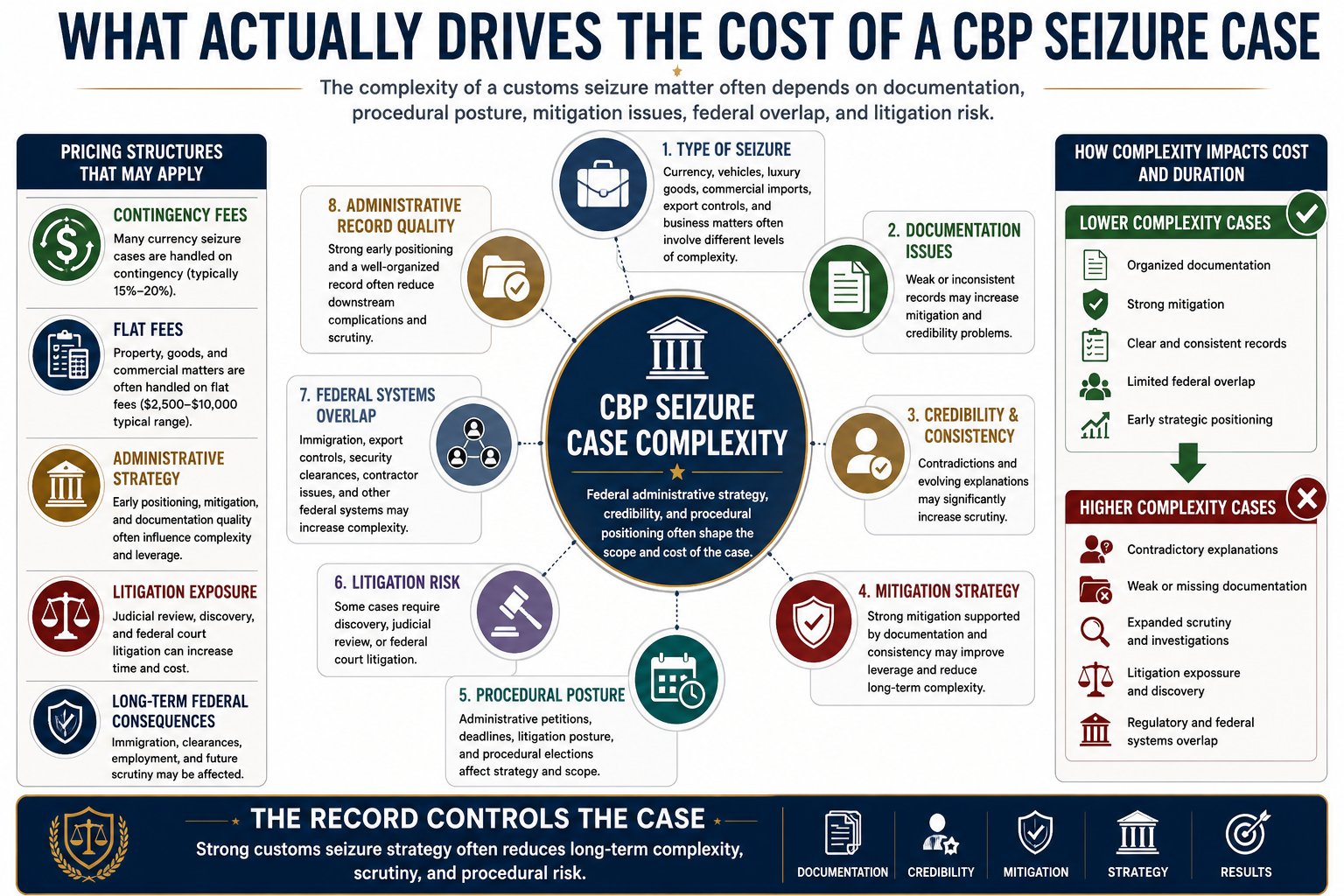
The Cost Depends Heavily on the Type of Seizure
One of the biggest misconceptions in customs forfeiture matters is assuming all CBP seizures involve the same level of complexity.
In reality, the cost often depends heavily on:
- the type of property seized
- the procedural posture
- the amount of documentation involved
- whether broader federal issues exist
- whether litigation may become necessary
Airport cash seizure matters frequently operate very differently from:
- commercial import/export seizures
- luxury goods seizures
- vehicle seizures
- FDA-related import matters
- export-control issues
- business-related enforcement actions
That distinction matters enormously because different types of seizures often involve:
- different procedural complexity
- different mitigation issues
- different documentation demands
- different litigation risk
- different federal overlap concerns
For example, many airport cash seizure matters are heavily focused on:
- source-of-funds documentation
- credibility
- mitigation
- administrative positioning
Commercial import/export matters may involve:
- regulatory compliance
- customs classification issues
- import documentation
- export controls
- business records
- broader federal regulatory concerns
That is one reason why pricing structures often vary substantially depending on the type of seizure involved.
Additional discussion appears in CBP Money Seizure Lawyers: How to Get Seized Cash Back From Customs and CBP Property Seizures: Vehicles, Merchandise, Electronics, Jewelry, and Luxury Goods.
Why Many Currency Seizure Cases Are Handled on Contingency
Many airport cash seizure matters are handled using contingency-fee structures.
At NSLF,
- the fee ranges from approximately 15% to 20% of the recovered amount
- there is no legal fee unless a recovery is obtained
This structure often works particularly well in:
- airport cash seizure matters
- border currency seizures
- administrative forfeiture proceedings involving seized money
Many individuals prefer contingency arrangements because they:
- reduce upfront financial pressure
- align incentives around recovery
- allow recovery efforts without substantial upfront legal expense
However, contingency matters still frequently require substantial strategic analysis involving:
- mitigation positioning
- documentation review
- credibility evaluation
- procedural strategy
- administrative leverage
That is one reason why sophisticated administrative positioning often remains critically important even in contingency-based cases.
Additional discussion appears in Do Customs Seizure Lawyers Work on Contingency? and Airport and Border Cash Seizure Lawyers Nationwide.
Why Goods and Property Cases Are Usually Flat-Fee Matters
Goods and property seizure matters are often structured differently from currency seizures.
In many situations, these matters are handled using flat-fee arrangements generally ranging from approximately:
- $2,500 to $10,000
depending on:
- the complexity of the matter
- the documentation involved
- the regulatory overlap
- aggravating allegations
- litigation exposure
- broader federal implications
These cases may involve:
- vehicles
- luxury watches and jewelry
- commercial merchandise
- electronics
- imported goods
- business shipments
- FDA-regulated products
Unlike many airport currency seizure matters, goods and property cases frequently require:
- extensive documentation review
- import/export analysis
- business records evaluation
- procedural strategy
- regulatory analysis
- mitigation positioning
Commercial and regulatory overlap often substantially increases complexity.
That is especially true where matters involve:
- import/export enforcement
- FDA issues
- export controls
- counterfeit allegations
- customs penalties
- business compliance concerns
Additional discussion appears in CBP Property Seizures: Vehicles, Merchandise, Electronics, Jewelry, and Luxury Goods and CBP Import and Export Seizure Lawyers for Businesses and Importers.
Litigation Is Not Always the Biggest Cost Driver
Many people initially assume courtroom litigation is automatically the most expensive part of a customs seizure matter.
In practice, however, weak administrative positioning often becomes a much larger long-term cost driver.
Federal agencies frequently evaluate:
- credibility
- documentation quality
- procedural behavior
- mitigation
- consistency across the record
long before litigation ever begins.
Weak early positioning may later create:
- expanded scrutiny
- procedural complications
- mitigation failures
- reduced leverage
- credibility concerns
- broader federal exposure
That is one reason why sophisticated administrative strategy frequently matters much more than people initially realize.
In many situations, strong mitigation and documentation strategy early in the process may:
- narrow disputes
- improve settlement posture
- reduce litigation risk
- preserve leverage
- strengthen credibility
That broader institutional reality is one reason why many sophisticated customs seizure matters are heavily shaped during the administrative phase rather than through courtroom litigation alone.
Additional discussion appears in Administrative Petition vs Federal Court Litigation and The Record Controls the Case: Why Your First Submission Matters.
The Hidden Cost of Weak Representation
Many people focus almost entirely on:
- hourly rates
- flat fees
- contingency percentages
In practice, however, weak representation may create much larger strategic costs later.
Generic or reactive representation may:
- weaken credibility
- create inconsistencies
- fail to strategically organize documentation
- miss mitigation opportunities
- increase scrutiny
- narrow procedural flexibility
That is especially true where representation fails to properly evaluate:
- administrative credibility
- procedural leverage
- federal overlap
- mitigation positioning
- long-term institutional consequences
Many customs seizure matters are ultimately shaped less by aggressive courtroom litigation and more by:
- strategic administrative positioning
- documentation quality
- credibility management
- disciplined communication
- procedural timing
That is one reason why sophisticated federal analysis often creates substantially better leverage than reactive representation focused only on procedural filings.
Additional discussion appears in Why Cheap Customs Seizure Lawyers Can Cost You More and How CBP Actually Decides Seizure Cases.
What Strong Customs Seizure Representation Often Includes
Many people initially assume they are paying a customs seizure lawyer primarily to:
- prepare petitions
- respond to notices
- communicate with CBP
- litigate if necessary
Sophisticated customs seizure representation often involves much more.
In many situations, strong representation focuses heavily on:
- documentation analysis
- mitigation positioning
- credibility evaluation
- procedural strategy
- administrative leverage
- federal systems analysis
- long-term strategic risk
Strong cases are often built deliberately.
Weak cases are frequently reactive.
That is one reason why many sophisticated customs seizure strategies focus heavily on:
- preserving leverage early
- avoiding contradictions
- strengthening credibility
- organizing records carefully
- strategically shaping the administrative record
Additional discussion appears in How To Choose the Best Customs Seizure Lawyer and Is Hiring a Customs Seizure Lawyer Worth It?.
Why National Security Law Firm Is Different
Many law firms approach customs seizure matters primarily as procedural forfeiture disputes.
National Security Law Firm approaches these matters differently.
The firm represents clients nationwide in:
- customs seizure matters
- administrative forfeiture proceedings
- export-control issues
- federal administrative proceedings
- contractor-related matters
- overlapping federal investigations
National Security Law Firm focuses heavily on:
- strategic administrative positioning
- mitigation analysis
- credibility management
- documentation review
- procedural leverage
- long-term federal implications
rather than simply reacting procedurally after the seizure occurs.
That broader federal-systems perspective becomes especially important because customs seizure matters often intersect with:
- immigration
- export licensing
- federal employment
- contractor eligibility
- security clearances
- future border scrutiny
- broader investigations
The firm’s broader experience with:
- security clearances
- export controls
- federal employment
- national security systems
helps inform how customs seizure matters are strategically evaluated from the outset.
That is why National Security Law Firm repeatedly emphasizes:
the record controls the case.
For broader discussion of customs forfeiture strategy generally, visit the firm’s Customs Seizure Lawyer Hub and Customs Seizure Lawyer Cost: Flat Fees, Contingency Fees, and What To Expect pages.
Frequently Asked Questions
How much does it usually cost to fight a CBP seizure?
That depends heavily on:
- the type of property involved
- the procedural posture
- the complexity of the allegations
- whether litigation becomes necessary
- the amount of documentation and mitigation analysis required
Many currency seizure matters are handled on contingency-fee structures.
Many property and goods matters are handled using flat-fee structures.
Do customs seizure lawyers work on contingency?
Many airport cash seizure matters are handled on contingency.
In many situations:
- the fee ranges from approximately 15% to 20% of the recovered amount
- there is no legal fee unless a recovery is obtained
Additional discussion appears in Do Customs Seizure Lawyers Work on Contingency?.
Why are some customs seizure cases more expensive than others?
Some matters involve:
- extensive documentation review
- commercial import/export issues
- regulatory overlap
- litigation exposure
- broader federal implications
- credibility disputes
- expanded investigations
Those factors may substantially increase complexity and strategy demands.
Are airport cash seizure cases usually handled differently?
Often, yes.
Many airport cash seizure matters are heavily:
- credibility-driven
- documentation-driven
- mitigation-driven
and frequently operate through administrative forfeiture systems rather than traditional courtroom litigation alone.
Additional discussion appears in Airport and Border Cash Seizure Lawyers Nationwide.
Does litigation automatically make a case stronger?
Not necessarily.
In many situations, strong administrative positioning creates substantial leverage before litigation ever becomes necessary.
Weak administrative positioning may later carry directly into federal litigation.
Can weak strategy become more expensive later?
Absolutely.
Weak early positioning may later create:
- expanded scrutiny
- reduced mitigation opportunities
- credibility concerns
- procedural complications
- additional litigation exposure
That is one reason why many sophisticated customs seizure strategies focus heavily on:
- mitigation
- credibility
- documentation
- procedural positioning
early in the process.
What does strong customs seizure representation usually include?
Strong representation often involves:
- documentation analysis
- mitigation strategy
- credibility evaluation
- procedural planning
- administrative positioning
- federal systems analysis
- long-term strategic risk evaluation
Why does administrative strategy matter so much?
Many customs seizure matters are heavily shaped long before courtroom litigation ever begins.
Federal agencies frequently evaluate:
- credibility
- consistency
- mitigation
- documentation quality
- procedural behavior
across the entire administrative record.
That broader institutional review often shapes:
- leverage
- settlement posture
- mitigation opportunities
- litigation risk
Can customs seizure cases affect other federal systems?
Potentially, yes.
Depending on the allegations involved, customs seizure matters may later affect:
- immigration
- Global Entry
- security clearances
- federal employment
- contractor eligibility
- export licensing
- future border scrutiny
That broader overlap is one reason why sophisticated federal analysis often matters much more than people initially realize.
Speak With a Nationwide Customs Seizure Lawyer
If CBP seized your money, merchandise, shipment, vehicle, package, or other property, the strategic decisions made early in the process may significantly affect:
- mitigation opportunities
- procedural leverage
- credibility assessments
- litigation exposure
- broader federal consequences
Many customs seizure matters are heavily influenced by:
- documentation quality
- consistency of explanations
- procedural timing
- mitigation strategy
- administrative positioning
That is why National Security Law Firm repeatedly emphasizes:
the record controls the case.
National Security Law Firm offers nationwide representation and free consultations for customs seizure matters.
The fastest and easiest way to get started is through the firm’s online booking system.
In many situations, same-day consultations are available, and the process typically takes less than a minute to schedule online.
Once booked, an attorney will personally call you at the scheduled time to discuss:
- the seizure
- procedural deadlines
- mitigation strategy
- documentation issues
- broader federal implications
To schedule a consultation online, visit:
Book a Free Consultation Online
You may also contact the firm directly at:
Phone: (202) 600-4996
Additional related resources: