
Most people think a customs seizure case begins and ends with Customs and Border Protection.
The logic seems straightforward.
CBP seized:
- money,
- a vehicle,
- imported merchandise,
- prescription medication,
- a package,
- or some other property.
Therefore, the issue must be limited to CBP.
In reality, federal systems often do not operate in isolation.
A customs seizure may begin with CBP.
The information developed during that seizure can sometimes become relevant in entirely different federal contexts months or even years later.
This surprises many people.
They assume:
Once the customs case is over, the issue is over.
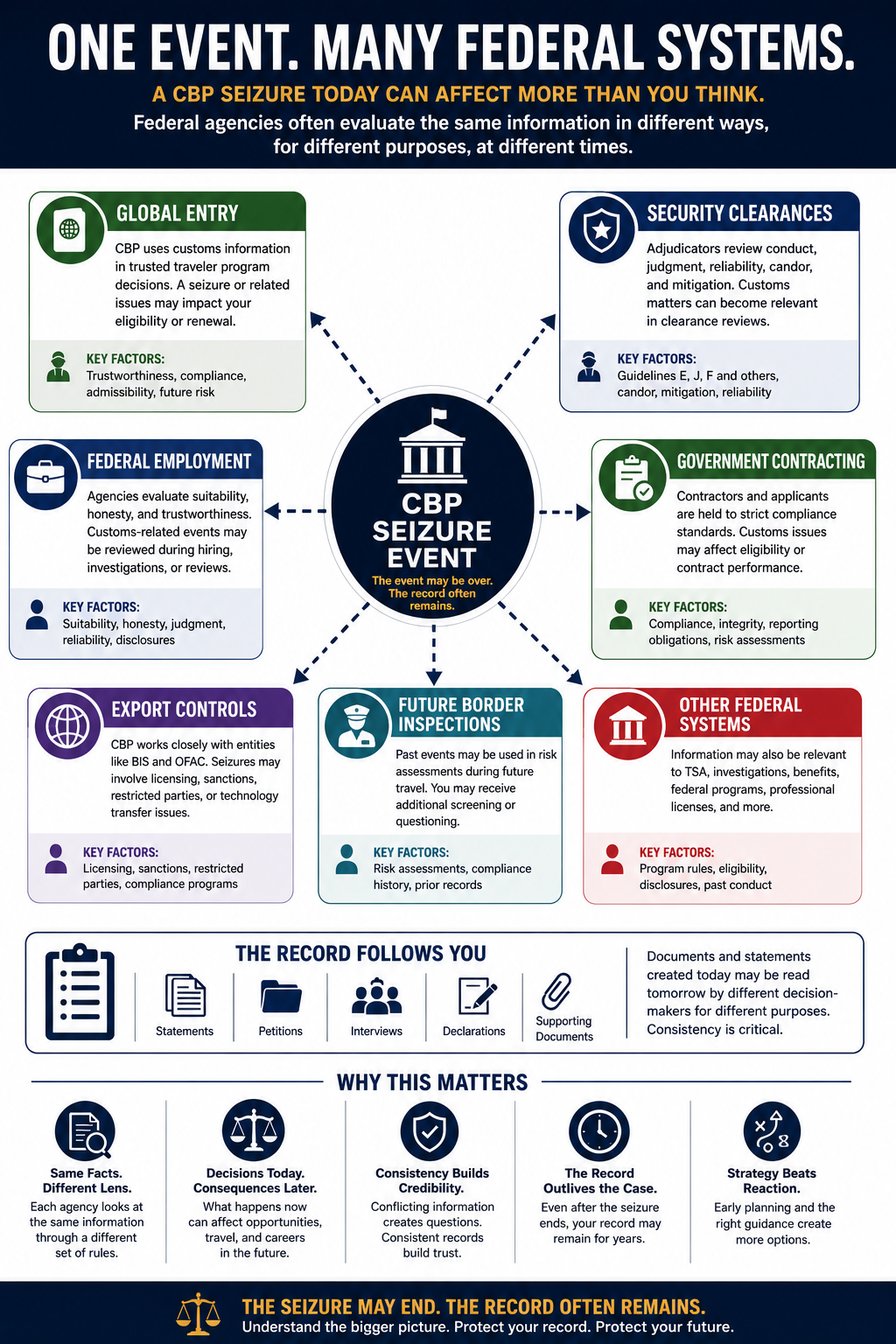
Federal agencies frequently evaluate the same underlying facts through different lenses.
The customs seizure may end.
The record often remains.
Understanding how federal systems interact is one of the most overlooked aspects of customs seizure cases and one of the reasons many people make decisions early in the process that create problems later.
Most People Think Their CBP Case Exists in Isolation
When property is seized, most people naturally focus on the immediate issue.
They want to know:
- why the property was seized,
- whether it can be returned,
- how long the process will take,
- and what options are available.
Those are important questions.
What many people fail to consider is that federal agencies frequently evaluate information long after the seizure itself has been resolved.
The issue is not necessarily that agencies are actively coordinating with one another.
The issue is that federal systems often evaluate the same conduct, the same records, and the same underlying events.
For example:
A customs seizure may involve:
- statements,
- declarations,
- financial information,
- travel information,
- ownership records,
- import records,
- export records,
- or supporting documentation.
Those same records may later become relevant in an entirely different federal proceeding.
This is one reason customs seizure cases often involve much more than customs law.
The property may be the reason the case began.
The administrative record frequently becomes the issue that follows.
Federal Agencies Often Evaluate the Same Facts Through Different Lenses
One of the most important concepts in federal administrative practice is that different agencies frequently evaluate the same underlying facts for different purposes.
The event itself does not change.
The decision-maker changes.
For example, consider a hypothetical customs seizure involving undeclared currency.
CBP may evaluate:
- reporting requirements,
- source of funds,
- declarations,
- and customs compliance.
A security clearance adjudicator may later evaluate:
- candor,
- judgment,
- reliability,
- and mitigation.
A Global Entry reviewer may evaluate:
- trustworthiness,
- compliance history,
- and future risk.
A federal employer may evaluate:
- suitability,
- honesty,
- and professionalism.
The underlying event remains the same.
The questions being asked become different.
This is one reason customs seizure cases often require a broader perspective than many people initially realize.
Federal agencies may not care about the same facts for the same reasons.
However, they are frequently evaluating many of the same records.
As a result, the way a matter is documented, explained, and addressed often becomes critically important.
A Customs Seizure Can Affect Global Entry
Many people are surprised to learn that customs-related issues may later become relevant in the context of Global Entry.
Global Entry is ultimately a discretionary trusted traveler program.
Applicants are evaluated not only on whether they have been convicted of crimes, but also on broader issues involving:
- compliance,
- admissibility,
- trustworthiness,
- and risk.
This is one reason customs-related events can become important.
The issue is often not:
Was criminal conduct proven?
The issue may instead be:
What does the event suggest about future compliance and reliability?
Because CBP plays a significant role in both customs enforcement and trusted traveler programs, many people are understandably concerned about how customs issues may affect future Global Entry eligibility.
Those concerns are often well-founded.
This is one reason many customs matters should be viewed through a broader federal-systems perspective rather than as isolated property disputes.
A Customs Seizure Can Affect Security Clearance Cases
This is an area where National Security Law Firm possesses a unique perspective.
Many customs lawyers do not regularly practice in the security clearance world.
We do.
Security clearance adjudicators frequently evaluate:
- judgment,
- reliability,
- trustworthiness,
- candor,
- compliance,
- and mitigation.
Those concepts often overlap with issues that arise during customs seizure matters.
Depending on the facts, customs-related events may later become relevant to questions involving:
- financial considerations,
- personal conduct,
- criminal conduct,
- foreign influence,
- foreign preference,
- or other adjudicative concerns.
The most important issue is often not the seizure itself.
The issue is how the event is documented, explained, and mitigated.
Security clearance cases frequently involve extensive review of prior statements and prior records.
This is one reason the administrative record created during a customs seizure matter can become important long after the forfeiture process has concluded.
Federal Employment and Suitability Reviews May Examine the Same Conduct
Federal employment systems frequently evaluate many of the same issues that appear throughout customs seizure cases.
For example:
Federal agencies often assess:
- trustworthiness,
- honesty,
- judgment,
- reliability,
- and compliance with laws and regulations.
As a result, a customs-related event may later be evaluated in a completely different context.
Again, the issue is often not whether criminal charges were filed.
The issue may be what the available record demonstrates regarding the individual’s conduct and decision-making.
This is one reason consistency frequently becomes so important.
Federal agencies routinely review:
- applications,
- disclosures,
- interviews,
- declarations,
- and supporting documentation.
When records conflict, questions often follow.
When records remain consistent, those questions are often easier to address.
Government Contractors and Defense Industry Professionals Face Additional Risk
For government contractors, defense industry professionals, and individuals working in sensitive sectors, customs-related matters often deserve particularly careful attention.
These industries frequently involve:
- security clearances,
- export controls,
- contractor screening,
- facility access,
- government customers,
- and federal compliance obligations.
As a result, customs seizure matters may intersect with a variety of federal regulatory systems.
The issue is often larger than:
Can the property be recovered?
The broader question may become:
How does this event affect my professional and regulatory environment?
This is one reason government contractors frequently benefit from evaluating customs matters through a broader federal-systems perspective.
Export-Control and Customs Matters Frequently Overlap
Many businesses mistakenly assume customs law and export-control law are separate disciplines.
In practice, they frequently overlap.
Customs matters may involve questions relating to:
- licensing,
- sanctions,
- export controls,
- restricted destinations,
- restricted parties,
- and technology transfers.
As a result, a customs issue may quickly become an export-control issue.
Similarly, an export-control issue may first become visible through a customs seizure.
This overlap is particularly common in industries involving:
- technology,
- aerospace,
- defense,
- software,
- communications,
- and advanced manufacturing.
Understanding how these regulatory systems interact is often one of the most important parts of understanding the case itself.