
Commercial customs seizures are often far more complex than most businesses initially realize.
Unlike many airport traveler seizure matters, import and export enforcement cases frequently involve overlapping federal regulatory systems, multiple agencies, substantial financial exposure, and long-term business consequences extending far beyond the shipment itself.
In many situations, CBP is not simply evaluating whether merchandise crossed the border improperly.
Instead, the government may be evaluating:
- import compliance systems
- customs declarations
- valuation practices
- export controls
- internal documentation
- regulatory oversight
- broader business credibility
- ongoing commercial activity
That broader institutional review is one reason why commercial customs seizure matters often require significantly more strategic analysis than businesses initially expect.
Why Commercial Customs Cases Often Become High-Stakes Matters
Many companies are surprised when what initially appears to be:
- a shipment delay
- an import hold
- a customs inquiry
- a documentation issue
quickly evolves into a much broader enforcement matter.
Depending on the allegations involved, commercial customs seizure cases may intersect with:
- FDA enforcement
- export-control restrictions
- OFAC sanctions concerns
- BIS regulations
- intellectual property enforcement
- contractor responsibility issues
- customs fraud allegations
- broader federal investigations
For importers, exporters, manufacturers, defense contractors, and technology companies, these matters may create risks involving:
- financial penalties
- import restrictions
- export licensing concerns
- government contracting eligibility
- reputational harm
- future customs scrutiny
- parallel regulatory investigations
Federal agencies often evaluate these matters collectively rather than in isolation.
A Federal-Systems Approach to Commercial Customs Enforcement
National Security Law Firm approaches commercial customs seizure matters through a broader federal-systems lens.
The firm’s experience with:
- federal administrative proceedings
- export-control issues
- contractor-related matters
- security clearance systems
- national security law
- overlapping federal investigations
informs how import and export seizure cases are strategically evaluated from the beginning.
Rather than viewing these matters as isolated shipping disputes, the firm focuses on:
- strategic administrative positioning
- documentation analysis
- compliance evaluation
- mitigation opportunities
- procedural leverage
- long-term federal implications
That broader perspective becomes especially important in cases involving:
- defense contractors
- technology exports
- commercial import operations
- FDA-regulated products
- sanctioned jurisdictions
- export-controlled goods
- recurring customs scrutiny
Why Documentation and Administrative Strategy Matter Early
Many commercial customs seizure matters are heavily influenced by:
- customs declarations
- invoices
- shipping records
- valuation documentation
- internal compliance procedures
- communications with brokers or suppliers
- mitigation submissions
- procedural positioning
In many situations, the administrative record developed early in the process heavily shapes how the government evaluates the matter moving forward.
That is why National Security Law Firm repeatedly emphasizes:
the record controls the case.
Nationwide Representation for Importers, Exporters, and Businesses
National Security Law Firm represents businesses nationwide in customs seizure and import/export enforcement matters involving:
- commercial import seizures
- export seizures
- FDA holds
- customs fraud allegations
- 19 U.S.C. § 1592 penalties
- liquidated damages claims
- OFAC and BIS-related issues
- agricultural seizures
- defense contractor customs matters
- administrative forfeiture proceedings
The sections below explain:
- how commercial customs seizures work
- what triggers import and export enforcement actions
- how CBP evaluates businesses and compliance systems
- how penalties and forfeiture proceedings operate
- why documentation and credibility often shape outcomes
- how businesses may strategically respond to customs enforcement actions
For broader discussion of customs forfeiture proceedings generally, visit the firm’s main Customs Seizure Lawyers Resource Hub page.
Why Commercial Customs Seizures Are Different
Commercial customs seizure matters often operate very differently from individual traveler seizures.
In many airport seizure cases, the government focuses primarily on:
- currency reporting
- personal declarations
- suspicious travel activity
- individual credibility issues
Commercial import and export cases are usually far broader.
In many situations, CBP evaluates not only the shipment itself, but also:
- the company’s compliance systems
- customs practices
- internal controls
- documentation quality
- prior import/export activity
- overall regulatory credibility
That broader institutional review is one reason why commercial customs enforcement matters frequently become significantly more complicated than businesses initially expect.
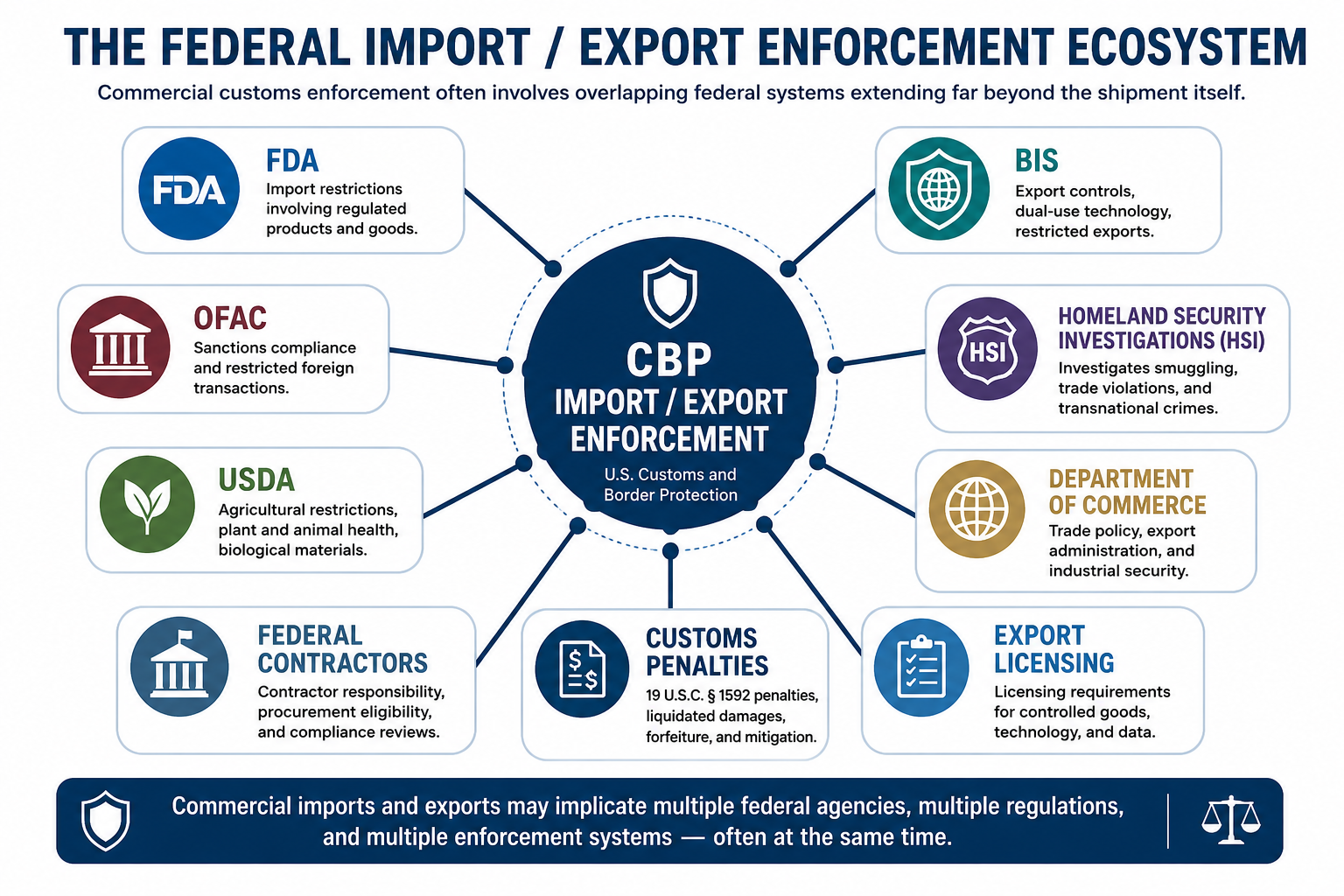
CBP Often Evaluates More Than the Shipment
Many businesses initially believe the issue involves only:
- one shipment
- one declaration problem
- one customs hold
- one documentation discrepancy
In practice, however, CBP and related agencies may begin evaluating:
- import history
- valuation practices
- tariff classifications
- country-of-origin representations
- broker communications
- invoices
- shipping records
- internal compliance procedures
Depending on the allegations involved, the government may also assess whether:
- the issue appears isolated
- broader customs fraud concerns exist
- prior compliance problems occurred
- additional federal agencies should become involved
That broader review often surprises companies that initially viewed the matter as a routine customs dispute.
Commercial Cases Frequently Trigger Broader Federal Review
Many commercial customs seizure matters intersect with overlapping federal regulatory systems involving:
- FDA enforcement
- export controls
- OFAC sanctions
- BIS regulations
- intellectual property enforcement
- contractor compliance
- agricultural restrictions
- customs fraud investigations
For businesses operating in:
- defense
- aerospace
- technology
- manufacturing
- telecommunications
- international trade
the consequences may extend far beyond the immediate shipment itself.
In some situations, customs enforcement matters may later affect:
- export licensing
- government contracting eligibility
- procurement relationships
- security clearance concerns
- future customs scrutiny
- broader regulatory investigations
Federal agencies often evaluate these matters collectively rather than in isolation.
Why Businesses Often Need Strategic Administrative Analysis Early
Many companies understandably focus first on:
- releasing the shipment
- minimizing operational disruption
- resolving the immediate customs issue
However, commercial customs seizure cases are often heavily influenced by:
- procedural positioning
- mitigation strategy
- documentation quality
- compliance credibility
- internal record consistency
- early communications with the government
That is one reason why many commercial customs matters are ultimately shaped long before formal litigation ever begins.
The strongest approach frequently involves careful early evaluation of:
- the government’s likely concerns
- the quality of the documentation
- potential compliance exposure
- broader federal implications
- long-term institutional risk
That is why National Security Law Firm repeatedly emphasizes:
the record controls the case.
Additional discussion of these strategic issues appears in CBP Detentions vs Seizures: Understanding the Difference and Customs Penalties and Liquidated Damages Explained.
What Triggers Import and Export Seizures?
Commercial customs seizures can arise from a wide range of import and export issues, many of which involve highly technical federal regulations that businesses do not fully appreciate until enforcement action begins.
In many situations, the government’s concerns extend far beyond whether a shipment simply crossed the border improperly.
CBP and related agencies often evaluate:
- customs declarations
- valuation practices
- tariff classifications
- country-of-origin representations
- licensing requirements
- shipping documentation
- internal compliance procedures
- broader commercial activity
That is one reason why many businesses are surprised when a shipment issue evolves into a much larger enforcement matter.
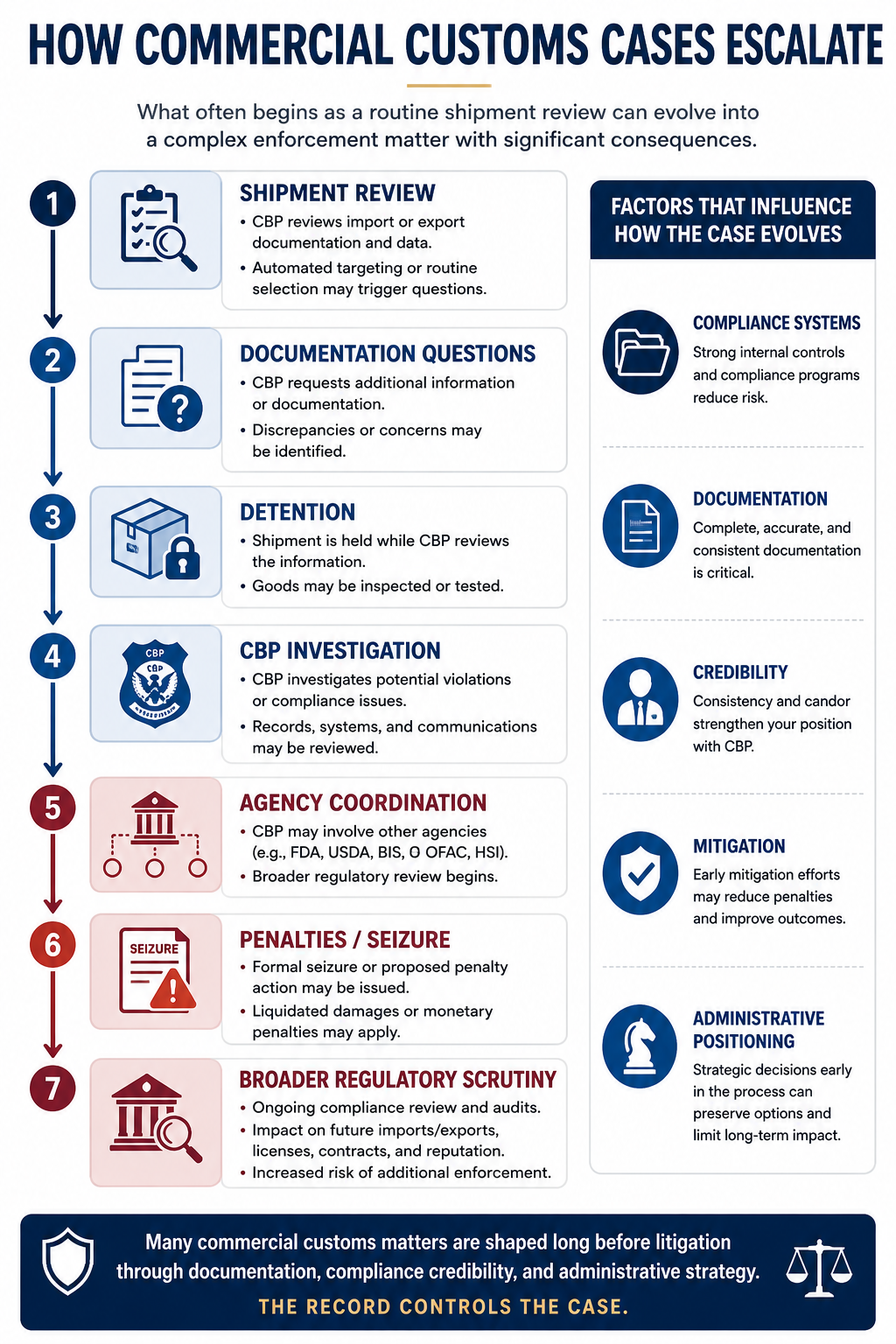
Import Compliance Problems
Many import seizures begin with allegations involving:
- undervaluation
- false customs declarations
- inaccurate classifications
- improper country-of-origin labeling
- tariff evasion
- incomplete documentation
- prohibited imports
In some situations, the issue may originate from:
- supplier errors
- broker mistakes
- internal compliance weaknesses
- inconsistent documentation
- misunderstanding of customs rules
However, once CBP believes a shipment may violate customs laws, the government often begins evaluating whether broader compliance concerns exist.
That institutional review frequently extends beyond the shipment itself.
Export-Control Concerns
Export-related seizures often involve a very different category of federal scrutiny.
In many export-control matters, the government may evaluate:
- restricted technologies
- sanctioned destinations
- export licenses
- dual-use goods
- controlled technical data
- end-user restrictions
- international business relationships
These cases frequently become especially sensitive where:
- defense contractors are involved
- national security industries are implicated
- advanced technology is exported
- federal contracting relationships exist
In some situations, agencies such as:
- BIS
- OFAC
- Homeland Security Investigations
- federal prosecutors
may become involved alongside CBP.
That broader federal overlap is one reason why export-control seizures often require sophisticated administrative and regulatory analysis early in the process.
Additional discussion appears in OFAC, BIS, and Export-Control Related Seizures.
Customs Fraud and Documentation Issues
Many commercial customs enforcement matters eventually center on documentation quality and regulatory credibility.
The government may evaluate whether:
- invoices are accurate
- declarations are internally consistent
- valuation methods appear reliable
- import records align with shipping activity
- supporting documentation resolves suspicious circumstances
Depending on the allegations involved, CBP may pursue:
- administrative penalties
- liquidated damages claims
- seizure and forfeiture proceedings
- customs fraud allegations under 19 U.S.C. § 1592
Importantly, many of these matters proceed administratively even where:
- no criminal charges are filed
- the business disputes the allegations
- the underlying shipment issue appears relatively small
That is one reason why commercial customs seizure matters frequently become heavily:
- documentation-driven
- credibility-driven
- procedure-driven
Commercial Customs Cases Often Become Strategic Administrative Proceedings
Many businesses initially assume the dispute concerns only the shipment itself.
In reality, commercial customs enforcement matters often become broader evaluations of:
- compliance systems
- internal controls
- regulatory credibility
- mitigation efforts
- procedural cooperation
- long-term business risk
That is why National Security Law Firm repeatedly emphasizes:
the record controls the case.
Understanding what triggers import and export seizures is important because many commercial customs enforcement matters are ultimately shaped less by dramatic courtroom litigation and more by documentation quality, procedural positioning, compliance analysis, and administrative strategy developed early in the process.
CBP Detentions vs. Seizures: Why the Difference Matters
Many businesses use the terms “detention” and “seizure” interchangeably.
In reality, the distinction can become extremely important because detentions and seizures often involve very different procedural and strategic consequences.
In many situations, companies initially believe their shipment is merely delayed, only to later discover the government is moving toward formal forfeiture or broader enforcement action.
Understanding the difference early may significantly affect:
- procedural strategy
- documentation efforts
- mitigation opportunities
- business operations
- regulatory exposure
What Is a CBP Detention?
A detention generally means CBP is temporarily holding merchandise while the government:
- reviews documentation
- verifies compliance
- conducts inspections
- evaluates regulatory concerns
- coordinates with other agencies
In many situations, detentions involve questions relating to:
- customs declarations
- FDA compliance
- intellectual property concerns
- import restrictions
- export controls
- tariff classifications
- labeling issues
- agricultural restrictions
At the detention stage, the government may still be evaluating whether the shipment can ultimately be released.
That is one reason why early documentation and strategic communication often become critically important.
What Is a CBP Seizure?
A seizure generally means the government has formally taken the position that the merchandise, shipment, or property is subject to forfeiture under federal law.
Once a seizure occurs, the matter typically enters a formal administrative forfeiture process through CBP’s Fines, Penalties, and Forfeitures (“FP&F”) office.
The government may then issue:
- a Notice of Seizure
- Election of Proceedings materials
- administrative forfeiture deadlines
- penalty or mitigation procedures
At that point, the procedural and strategic posture of the case often changes significantly.
Additional discussion appears in CBP Notice of Seizure Letter Explained: What To Do Next.
Why Detentions Sometimes Escalate Into Seizures
Many businesses are surprised when a detention later evolves into a formal seizure.
In some situations, that escalation occurs because investigators believe:
- documentation remains inconsistent
- import restrictions were violated
- counterfeit concerns exist
- declarations were inaccurate
- export-control issues are implicated
- broader compliance concerns are present
Depending on the circumstances, the government may also begin evaluating:
- prior import activity
- internal compliance systems
- broker communications
- valuation practices
- shipping history
- regulatory credibility
That broader institutional review often extends far beyond the shipment itself.
Why the Distinction Matters Strategically
The difference between a detention and a seizure may significantly affect:
- procedural rights
- deadlines
- mitigation opportunities
- litigation posture
- negotiation leverage
- business disruption
- broader federal exposure
At the detention stage, there may still be opportunities to:
- provide clarifying documentation
- resolve compliance issues
- address agency concerns
- avoid escalation
Once a formal seizure occurs, however, the case often becomes much more:
- procedure-driven
- deadline-driven
- documentation-driven
- credibility-driven
That is one reason why many commercial customs matters require strategic administrative analysis before the situation escalates further.
Commercial Customs Cases Often Become Broader Compliance Reviews
One of the most important realities in commercial customs enforcement is that CBP frequently evaluates more than the shipment itself.
In many detention and seizure matters, agencies may assess:
- compliance procedures
- import practices
- internal controls
- documentation systems
- prior regulatory issues
- overall business credibility
That broader institutional review is one reason why commercial customs cases often create risks extending beyond:
- the detained goods
- the seized merchandise
- the immediate shipment
In some situations, the matter may later affect:
- import privileges
- export licensing
- contractor eligibility
- future customs scrutiny
- broader regulatory investigations
Early Administrative Strategy Often Shapes the Outcome
Many commercial customs detention and seizure matters are ultimately influenced less by courtroom litigation and more by:
- documentation quality
- procedural positioning
- mitigation strategy
- credibility
- compliance analysis
- administrative record development
That is why National Security Law Firm repeatedly emphasizes:
the record controls the case.
Understanding the distinction between CBP detentions and seizures is critical because many commercial customs enforcement matters are heavily shaped by early administrative strategy, documentation, and procedural positioning long before formal litigation ever begins.
Customs Fraud, Penalties, and 19 U.S.C. § 1592
One of the most serious areas of commercial customs enforcement involves allegations arising under 19 U.S.C. § 1592, the primary federal statute governing customs fraud and materially false import declarations.
Many businesses are surprised to learn that customs penalty exposure may arise even where:
- no criminal charges are filed
- the company believed the declarations were accurate
- third parties handled portions of the import process
- the underlying shipment issue initially appeared minor
In practice, CBP often evaluates whether the overall import activity reflects:
- negligence
- gross negligence
- fraud
- broader compliance concerns
- systemic documentation problems
That is one reason why § 1592 matters frequently become highly strategic administrative proceedings long before courtroom litigation ever begins.
How CBP Evaluates Customs Fraud Allegations
In many commercial customs enforcement matters, the government examines whether import declarations contained materially false statements involving:
- valuation
- tariff classifications
- country of origin
- product descriptions
- quantity reporting
- customs documentation
- import restrictions
Importantly, CBP does not always need to prove intentional fraud to pursue substantial penalties.
In many situations, the government may allege:
- negligence
- gross negligence
- reckless disregard of customs obligations
- systemic compliance failures
That broader enforcement framework often surprises businesses that initially believed the issue involved only a documentation mistake or broker error.
Why Documentation and Compliance Systems Matter
Many § 1592 cases ultimately become heavily:
- documentation-driven
- compliance-driven
- credibility-driven
The government may evaluate:
- invoices
- internal communications
- broker instructions
- customs declarations
- import records
- shipping documentation
- compliance procedures
- internal controls
In some situations, investigators also examine whether:
- the company ignored warning signs
- prior compliance concerns existed
- corrective actions were taken
- management exercised reasonable oversight
- the documentation appears internally consistent
That institutional review frequently extends far beyond the shipment itself.
Administrative Penalties vs. Criminal Exposure
Many businesses incorrectly assume a customs fraud allegation automatically means criminal prosecution is imminent.
In reality, many § 1592 matters proceed administratively through:
- civil penalties
- mitigation negotiations
- customs enforcement proceedings
- administrative forfeiture systems
However, depending on the circumstances, certain matters may also create broader federal concerns involving:
- criminal investigations
- import fraud allegations
- export-control issues
- contractor responsibility concerns
- broader regulatory scrutiny
That is one reason why commercial customs enforcement matters often require strategic analysis extending beyond simply responding to a penalty notice.
Why Prior Disclosures Sometimes Matter
In some situations, businesses may attempt to reduce potential exposure through a prior disclosure to CBP.
A properly structured prior disclosure may sometimes:
- reduce penalty exposure
- improve mitigation opportunities
- demonstrate cooperation
- strengthen administrative positioning
However, prior disclosures are highly strategic and fact-specific.
Poorly handled disclosures may create:
- additional scrutiny
- expanded investigations
- documentation conflicts
- broader regulatory concerns
That is one reason why these decisions often require careful analysis before submissions are made.
Additional discussion appears in Prior Disclosure to CBP: Can It Prevent Penalties?.
Commercial Customs Penalty Cases Are Often Won Through Administrative Strategy
Many businesses initially assume customs fraud matters will ultimately depend on courtroom litigation.
In reality, § 1592 matters are often heavily shaped by:
- documentation quality
- procedural positioning
- mitigation strategy
- compliance credibility
- administrative negotiations
- record development
That is why National Security Law Firm repeatedly emphasizes:
the record controls the case.
Understanding customs penalties and § 1592 enforcement is important because many commercial customs cases are ultimately shaped less by dramatic litigation and more by compliance analysis, documentation, credibility, and administrative strategy developed early in the process.
FDA, Agriculture, and Restricted Import Seizures
Many commercial customs seizures involve products regulated by agencies beyond CBP itself.
In these matters, Customs often works alongside:
- the FDA
- the U.S. Department of Agriculture
- other federal regulatory agencies
to evaluate whether imported goods comply with federal import restrictions and public safety regulations.
What surprises many businesses is that products may be detained or seized even where:
- the goods were lawfully manufactured
- the company believed the imports complied with regulations
- the shipment had previously cleared customs
- no criminal conduct is alleged
That is one reason why FDA and agriculture-related seizures frequently become highly technical administrative matters.
FDA Import Holds and Seizures
FDA-related import seizures often involve:
- pharmaceuticals
- supplements
- cosmetics
- food products
- medical devices
- health-related consumer goods
In many situations, the government evaluates whether:
- labeling complies with federal regulations
- import approvals are required
- restricted ingredients are involved
- declarations are accurate
- documentation appears sufficient
- the products may pose health or safety concerns
Many businesses initially believe the issue is temporary and will resolve through routine clarification.
In practice, however, FDA-related holds sometimes escalate into:
- formal seizures
- refusal of admission
- destruction orders
- broader import compliance investigations
That is one reason why these matters frequently require careful administrative analysis early in the process.
Additional discussion appears in FDA Import Seizures and Holds.
Agricultural Enforcement and Border Restrictions
CBP agriculture seizures often involve:
- plants
- seeds
- food products
- biological materials
- agricultural goods
- animal products
These cases frequently arise because federal agencies attempt to prevent:
- invasive species
- agricultural contamination
- prohibited biological imports
- undeclared food or plant products
Many businesses and importers do not fully appreciate how aggressively agricultural restrictions are enforced at the border.
Even seemingly minor documentation or declaration issues may trigger:
- detention
- seizure
- destruction of goods
- broader compliance review
Additional discussion appears in CBP Agriculture Seizures.
Why Legitimate Products May Still Be Held or Seized
One of the most misunderstood aspects of FDA and agriculture enforcement is that products may still be detained or seized even where:
- the products themselves are lawful
- the importer acted in good faith
- no criminal allegations exist
- the business believed the shipment complied with regulations
In many situations, the government’s concerns involve:
- import procedures
- labeling requirements
- licensing issues
- declaration accuracy
- documentation consistency
- restricted import classifications
That broader regulatory framework often surprises businesses that initially viewed the matter as a simple customs delay.
These Cases Often Become Compliance and Documentation Matters
FDA and agricultural seizure cases frequently become heavily:
- documentation-driven
- compliance-driven
- procedure-driven
Investigators may evaluate:
- import records
- shipping documentation
- labeling materials
- supplier records
- compliance procedures
- communications with brokers
- prior import activity
Weak or inconsistent documentation may significantly affect:
- mitigation efforts
- release negotiations
- procedural strategy
- regulatory credibility
That is one reason why many FDA and agricultural customs matters are ultimately shaped less by dramatic litigation and more by administrative positioning, compliance analysis, and documentation quality developed early in the process.
OFAC, BIS, and Export-Control Related Seizures
Some of the most sensitive and high-risk commercial customs seizure matters involve export controls, sanctions enforcement, and national security-related regulations.
These cases often extend far beyond ordinary customs compliance issues.
In many situations, CBP works alongside agencies such as:
- the Bureau of Industry and Security (“BIS”)
- the Office of Foreign Assets Control (“OFAC”)
- Homeland Security Investigations (“HSI”)
- federal prosecutors
to evaluate whether imported or exported goods violate federal export-control or sanctions laws.
That broader federal overlap is one reason why export-related seizures frequently require significantly more sophisticated strategic analysis than ordinary shipment disputes.
Export-Control Enforcement
Export-control seizures often involve allegations relating to:
- restricted technologies
- dual-use goods
- export licensing violations
- unauthorized exports
- controlled technical data
- restricted end users
- sanctioned destinations
In many situations, businesses are surprised to learn that products appearing commercially ordinary may still trigger export-control scrutiny because of:
- technical specifications
- end-user restrictions
- military applications
- national security concerns
- destination-country regulations
For technology companies, manufacturers, defense contractors, and exporters, these matters may create significant long-term federal consequences extending well beyond the shipment itself.
OFAC and Sanctions-Related Risks
OFAC-related seizures often involve allegations concerning:
- sanctioned countries
- restricted entities
- blocked transactions
- prohibited exports
- financial sanctions compliance
These cases may become especially sensitive because sanctions enforcement frequently intersects with:
- national security policy
- financial compliance systems
- international business relationships
- federal contracting concerns
In some situations, investigators evaluate not only the shipment itself, but also:
- internal compliance procedures
- customer screening systems
- export documentation
- business communications
- transaction history
- broader international operations
That broader institutional review often surprises businesses that initially viewed the matter as a routine customs issue.
Why Export Cases Often Become Highly Sensitive
Export-control and sanctions-related seizures frequently receive heightened scrutiny because the government may associate these matters with:
- national security concerns
- sensitive technologies
- military applications
- restricted foreign actors
- broader regulatory violations
As a result, these cases often become heavily:
- documentation-driven
- compliance-driven
- credibility-driven
- procedure-driven
In some situations, agencies may evaluate:
- licensing history
- technical specifications
- internal compliance systems
- employee communications
- export procedures
- prior government disclosures
- contractor relationships
That is one reason why export-related seizure matters often require careful administrative positioning early in the process.
Defense Contractors and Technology Companies Face Unique Risks
For defense contractors and businesses operating in national security industries, customs seizures may create broader concerns involving:
- contractor responsibility determinations
- export licensing
- security clearances
- procurement eligibility
- future government relationships
- ongoing federal scrutiny
Federal agencies often evaluate these matters collectively rather than in isolation.
That broader federal overlap is one reason why export-control seizure matters frequently require strategic analysis extending beyond simply recovering detained or seized property.
Administrative Strategy Often Shapes the Outcome
Many OFAC, BIS, and export-control-related customs matters are ultimately shaped less by courtroom litigation and more by:
- compliance credibility
- documentation quality
- procedural positioning
- mitigation strategy
- internal record consistency
- administrative cooperation
- early strategic analysis
That is why National Security Law Firm repeatedly emphasizes:
the record controls the case.
Additional discussion of these issues appears in OFAC, BIS, and Export-Control Related Seizures and Defense Contractor Customs and Export Seizures.
Defense Contractor and National Security Industry Seizures
Customs seizure matters involving defense contractors, aerospace companies, technology firms, and national security industries often create substantially higher levels of federal scrutiny.
In many situations, these cases involve far more than ordinary import or export compliance concerns.
Depending on the allegations involved, investigators may evaluate:
- export-control compliance
- contractor responsibility
- licensing procedures
- technical data handling
- international business relationships
- internal compliance systems
- broader national security implications
That broader institutional review is one reason why defense contractor customs matters frequently become highly sensitive federal administrative proceedings.
Why Defense Contractors Face Unique Risks
Businesses operating in defense and national security sectors often handle:
- controlled technologies
- dual-use products
- sensitive components
- government contracts
- restricted technical data
- export-controlled materials
As a result, customs seizures involving these industries may quickly intersect with:
- BIS enforcement
- OFAC sanctions concerns
- procurement regulations
- contractor responsibility reviews
- federal security requirements
- broader national security investigations
In some situations, the government’s concerns may extend well beyond the shipment itself and into:
- compliance culture
- internal controls
- disclosure obligations
- long-term contractor reliability
That is one reason why these matters frequently carry risks extending far beyond the immediate seizure.
Customs Seizures May Affect Government Contracting Relationships
Many businesses initially focus only on:
- recovering the detained goods
- resolving the customs issue
- minimizing operational disruption
However, for defense contractors and national security companies, customs enforcement matters may also affect:
- federal procurement eligibility
- contractor responsibility determinations
- security clearance issues
- export licensing
- agency relationships
- future contract opportunities
- broader federal scrutiny
Federal agencies often evaluate these matters collectively rather than in isolation.
That broader overlap is one reason why customs seizures involving defense contractors frequently require strategic analysis extending far beyond standard import compliance concerns.
Why Administrative Positioning Matters Early
Many defense contractor customs matters are heavily influenced by:
- compliance documentation
- procedural positioning
- mitigation strategy
- internal communications
- disclosure history
- administrative credibility
- consistency of explanations
The government may evaluate not only whether a violation allegedly occurred, but also:
- how the company responded
- whether corrective actions were taken
- whether internal controls appear reliable
- whether leadership exercised appropriate oversight
That institutional evaluation frequently begins very early in the process.
National Security Industry Cases Often Become Highly Strategic
Many customs seizure matters involving defense contractors and sensitive industries are ultimately shaped less by dramatic courtroom litigation and more by:
- documentation quality
- compliance credibility
- administrative strategy
- procedural timing
- mitigation positioning
- careful record development
That is why National Security Law Firm repeatedly emphasizes:
the record controls the case.
The firm’s broader experience with:
- national security law
- export-control issues
- contractor-related matters
- security clearance systems
- overlapping federal investigations
informs how these highly sensitive customs matters are strategically evaluated from the outset.
Additional discussion appears in Defense Contractor Customs and Export Seizures and OFAC, BIS, and Export-Control Related Seizures.
Why Commercial Customs Cases Often Become Documentation and Credibility Cases
Many businesses initially assume commercial customs disputes will ultimately turn on technical legal arguments alone.
In reality, CBP and related agencies often evaluate something much broader:
whether the company’s overall compliance record appears credible, consistent, and properly documented.
That is one reason why many import and export enforcement matters become heavily:
- documentation-driven
- compliance-driven
- credibility-driven
long before formal litigation ever begins.
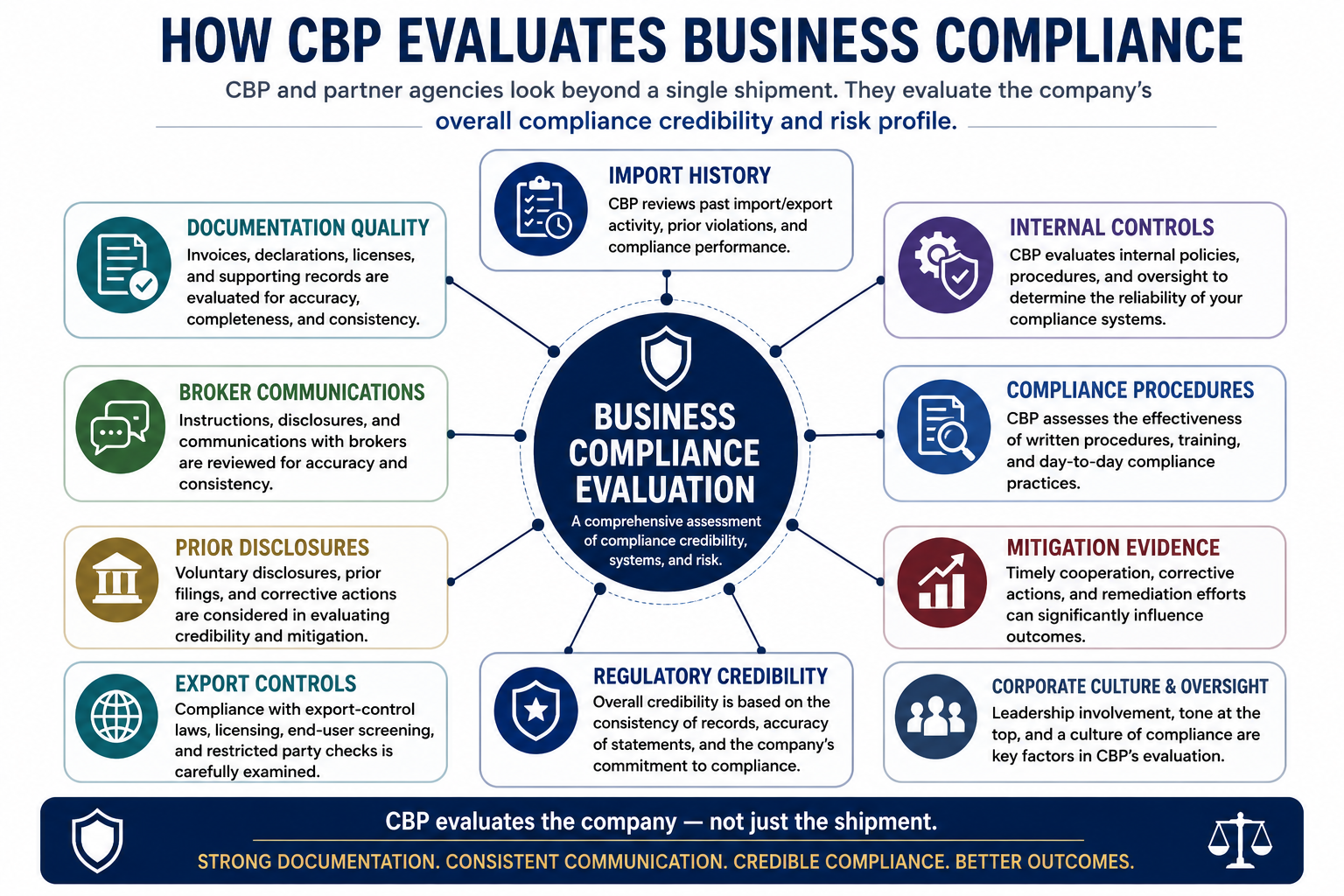
The Government Often Evaluates the Entire Compliance Record
In many commercial customs matters, agencies do not focus solely on the shipment that triggered the enforcement action.
Instead, investigators may evaluate:
- customs declarations
- invoices
- shipping records
- internal communications
- broker instructions
- valuation methods
- import history
- export procedures
- compliance systems
Depending on the allegations involved, the government may also examine whether:
- prior issues existed
- internal controls appear reliable
- corrective actions were implemented
- the company exercised reasonable oversight
- documentation appears internally consistent
That broader institutional review frequently becomes one of the most important aspects of the case.
Why Weak Documentation Creates Risk
Commercial customs enforcement matters often rise or fall based on documentation quality.
In many situations, the government evaluates whether records:
- support the declarations submitted
- align with import or export activity
- appear internally consistent
- resolve suspicious circumstances
- strengthen mitigation arguments
Weak, incomplete, or inconsistent documentation may significantly affect:
- mitigation opportunities
- penalty exposure
- settlement posture
- procedural leverage
- regulatory credibility
That is especially true where agencies believe:
- declarations evolved over time
- invoices appear inconsistent
- valuation methods changed
- supporting records conflict with prior submissions
Administrative Positioning Often Shapes the Outcome
Many businesses initially assume the dispute will eventually be resolved through courtroom litigation.
In practice, however, many commercial customs matters are heavily shaped much earlier through:
- procedural positioning
- mitigation strategy
- administrative cooperation
- documentation quality
- credibility assessments
- compliance analysis
The government frequently evaluates not only whether a technical violation allegedly occurred, but also:
- how the company responded
- whether corrective measures were implemented
- whether the business appears cooperative and credible
- whether broader compliance concerns remain unresolved
That institutional evaluation often begins very early in the administrative process.
Why Early Statements and Submissions Matter
Many businesses unintentionally weaken their position by:
- rushing to provide explanations
- submitting incomplete documentation
- making unsupported claims
- failing to coordinate internally
- changing explanations later
- responding reactively rather than strategically
In many situations, agencies later compare:
- customs declarations
- invoices
- broker communications
- internal records
- prior disclosures
- mitigation submissions
- later litigation positions
Even relatively small inconsistencies may become significant if investigators believe the overall record appears unreliable.
That is one reason why disciplined communication and careful administrative positioning often become critically important in commercial customs matters.
Commercial Customs Cases Are Often Won Through Administrative Strategy
Many successful commercial customs resolutions ultimately result from:
- strong documentation
- credible mitigation
- procedural strategy
- careful compliance analysis
- disciplined administrative positioning
- consistent record-building
That is why National Security Law Firm repeatedly emphasizes:
the record controls the case.
Understanding how CBP evaluates documentation and credibility is important because many commercial customs enforcement matters are ultimately shaped less by dramatic courtroom litigation and more by compliance credibility, administrative strategy, and the quality of the record developed early in the process.
Why National Security Law Firm Is Different in Commercial Customs Cases
Many law firms approach commercial customs matters as isolated shipment disputes or technical compliance problems.
National Security Law Firm approaches these matters differently.
In many import and export enforcement cases, the shipment itself is only one part of a much broader federal regulatory picture involving:
- customs enforcement
- export controls
- federal contracting
- sanctions compliance
- national security concerns
- agency credibility
- long-term regulatory exposure
Federal agencies often evaluate these matters collectively rather than in isolation.
That broader institutional overlap frequently shapes how commercial customs matters should be strategically handled from the outset.
A Federal-Systems Approach to Commercial Customs Enforcement
National Security Law Firm represents businesses nationwide in:
- customs seizure matters
- export-control issues
- contractor-related matters
- security clearance cases
- federal administrative proceedings
- overlapping federal investigations
The firm’s broader federal-systems experience informs how commercial customs enforcement matters are strategically evaluated from the beginning.
Rather than treating these cases as simple import disputes, the firm focuses on:
- administrative positioning
- compliance credibility
- mitigation strategy
- procedural leverage
- documentation analysis
- long-term federal implications
That broader perspective becomes especially important in matters involving:
- defense contractors
- technology companies
- manufacturers
- exporters
- FDA-regulated imports
- sanctions-related concerns
- recurring customs scrutiny
Why Commercial Customs Cases Often Require Early Strategic Analysis
Many businesses initially focus only on:
- releasing the shipment
- minimizing operational disruption
- resolving the immediate customs issue
In practice, however, commercial customs enforcement matters often create broader concerns involving:
- compliance systems
- contractor eligibility
- export licensing
- procurement relationships
- agency credibility
- future enforcement scrutiny
That is one reason why National Security Law Firm emphasizes strategic analysis early in the process before:
- major submissions are made
- disclosures are filed
- mitigation positions become fixed
- procedural leverage narrows
Many commercial customs matters are heavily shaped by:
- documentation quality
- consistency of explanations
- compliance history
- mitigation positioning
- administrative record development
That is why National Security Law Firm repeatedly emphasizes:
the record controls the case.
More Than Just a Customs Dispute
Many commercial customs matters ultimately involve broader federal regulatory systems extending beyond CBP itself.
Depending on the allegations involved, businesses may later face scrutiny involving:
- BIS regulations
- OFAC sanctions
- FDA enforcement
- contractor responsibility reviews
- export-control compliance
- federal investigations
- procurement concerns
- national security implications
Understanding how those systems overlap is one of the major differences in National Security Law Firm’s approach.
Many firms focus only on the shipment.
National Security Law Firm evaluates:
- the immediate enforcement issue
- the administrative posture
- compliance credibility
- broader federal exposure
- long-term institutional risk
Nationwide Representation for Businesses and Importers
National Security Law Firm represents importers, exporters, manufacturers, defense contractors, and businesses nationwide in matters involving:
- commercial customs seizures
- export seizures
- FDA holds
- customs fraud allegations
- 19 U.S.C. § 1592 penalties
- OFAC and BIS-related enforcement
- import/export compliance disputes
- liquidated damages claims
- administrative forfeiture proceedings
If your business is facing a CBP seizure, customs penalty, export-control issue, or import compliance matter, early strategic analysis may significantly affect:
- mitigation opportunities
- procedural leverage
- penalty exposure
- broader federal consequences
For broader discussion of customs forfeiture and CBP enforcement matters generally, visit the firm’s main Customs Seizure Lawyers Resource Hub page.
Frequently Asked Questions About Commercial Customs Seizures
What is a CBP import seizure?
A CBP import seizure generally means the government has formally taken the position that imported merchandise is subject to forfeiture or enforcement action under federal law.
These matters may involve:
- customs declaration issues
- valuation disputes
- counterfeit allegations
- FDA restrictions
- export-control concerns
- customs fraud allegations
- import compliance problems
Many commercial import seizures proceed through administrative enforcement systems even where no criminal charges are filed.
What is the difference between a detention and a seizure?
A detention generally means CBP is temporarily holding merchandise while reviewing compliance or documentation issues.
A seizure generally means the government has formally initiated forfeiture or enforcement proceedings.
That distinction may significantly affect:
- procedural rights
- deadlines
- mitigation opportunities
- administrative strategy
- litigation posture
Additional discussion appears in CBP Detentions vs Seizures: Understanding the Difference.
What is a 19 U.S.C. § 1592 penalty?
19 U.S.C. § 1592 is the primary federal statute governing customs fraud and materially false import declarations.
CBP may pursue penalties involving allegations of:
- negligence
- gross negligence
- fraud
- inaccurate declarations
- undervaluation
- false country-of-origin representations
- improper tariff classifications
Importantly, many § 1592 matters proceed administratively rather than criminally.
Additional discussion appears in 19 U.S.C. § 1592 Penalties Explained.
Can CBP seize commercial merchandise without criminal charges?
Yes.
Many commercial customs enforcement matters proceed through administrative seizure and penalty systems separate from criminal prosecutions.
The government may pursue:
- forfeiture
- penalties
- liquidated damages
- import restrictions
even where: - no indictment is filed
- no criminal charges are brought
- the business disputes the allegations
What is a prior disclosure to CBP?
A prior disclosure is a voluntary disclosure process sometimes used by businesses to report customs violations to CBP before the government formally discovers them.
In some situations, a properly structured prior disclosure may:
- reduce penalty exposure
- improve mitigation opportunities
- strengthen administrative positioning
However, prior disclosures are highly strategic and fact-specific.
Additional discussion appears in Prior Disclosure to CBP: Can It Prevent Penalties?.
What happens after an FDA import hold?
FDA-related import holds may lead to:
- release of the shipment
- additional inspection
- refusal of admission
- detention
- seizure
- destruction orders
depending on the agency’s concerns and the documentation provided.
Additional discussion appears in FDA Import Seizures and Holds.
What is BIS?
The Bureau of Industry and Security (“BIS”) is the federal agency primarily responsible for many export-control regulations involving:
- restricted technologies
- dual-use goods
- export licensing
- controlled technical data
- national security-related exports
BIS-related issues frequently overlap with CBP export seizures and customs enforcement matters.
What is OFAC?
The Office of Foreign Assets Control (“OFAC”) administers federal sanctions programs involving:
- sanctioned countries
- restricted entities
- blocked transactions
- export restrictions
- financial compliance obligations
OFAC concerns may significantly increase the sensitivity of commercial customs and export enforcement matters.
Can customs issues affect federal contracts or contractor eligibility?
Potentially, yes.
For defense contractors and businesses operating in regulated industries, customs enforcement matters may sometimes affect:
- contractor responsibility determinations
- procurement eligibility
- export licensing
- security clearances
- broader federal relationships
Federal agencies often evaluate these matters collectively across multiple administrative systems.
Can businesses negotiate customs penalties?
In many situations, yes.
Commercial customs matters are often heavily influenced by:
- mitigation evidence
- documentation quality
- compliance credibility
- procedural strategy
- administrative negotiations
Depending on the facts involved, businesses may pursue:
- mitigation
- negotiated resolutions
- prior disclosures
- administrative petitions
- strategic settlement discussions
Do businesses need a lawyer for commercial customs seizures?
Not every customs matter requires representation.
However, many commercial enforcement cases involve:
- substantial financial exposure
- overlapping federal regulations
- strict procedural deadlines
- administrative penalties
- export-control concerns
- contractor implications
- broader federal scrutiny
The earlier the matter is strategically evaluated, the more procedural and mitigation options may remain available.
For broader discussion of customs forfeiture and CBP enforcement matters generally, visit the firm’s main Customs Seizure Lawyers Resource Hub page.
Speak With a Nationwide Import and Export Seizure Lawyer
If your business is facing a CBP seizure, customs penalty, FDA hold, export-control issue, or import compliance investigation, the decisions made early in the process may significantly affect:
- mitigation opportunities
- penalty exposure
- procedural leverage
- regulatory credibility
- broader federal consequences
Many commercial customs enforcement matters involve far more than simply releasing a shipment or resolving a paperwork issue.
Depending on the allegations involved, these cases may later intersect with:
- export licensing
- contractor responsibility
- federal procurement
- sanctions compliance
- security clearances
- future customs scrutiny
- parallel federal investigations
- broader national security concerns
That broader institutional overlap is one reason why many commercial customs matters require strategic administrative analysis from the beginning.
Strategic Representation for Businesses, Importers, and Exporters
National Security Law Firm represents businesses nationwide in matters involving:
- commercial customs seizures
- import detentions
- export seizures
- FDA import holds
- 19 U.S.C. § 1592 penalties
- liquidated damages claims
- OFAC and BIS-related enforcement
- customs fraud allegations
- defense contractor customs matters
- administrative forfeiture proceedings
The firm approaches these matters strategically with a focus on:
- compliance credibility
- administrative positioning
- procedural leverage
- mitigation strategy
- documentation analysis
- long-term federal risk management
Rather than treating commercial customs matters as isolated shipment disputes, National Security Law Firm evaluates how these cases may affect broader federal systems and long-term regulatory exposure.
Why Early Strategic Analysis Matters
Many commercial customs enforcement matters are heavily influenced by:
- customs declarations
- documentation quality
- consistency of explanations
- internal compliance systems
- mitigation evidence
- administrative record development
That is why National Security Law Firm repeatedly emphasizes:
the record controls the case.
In many situations, commercial customs matters are ultimately shaped less by courtroom litigation and more by:
- disciplined administrative strategy
- compliance analysis
- procedural timing
- credibility assessments
- careful record-building
Transparent Pricing for Commercial Customs Matters
Commercial customs seizure and import/export enforcement matters are generally handled using flat-fee structures depending on:
- the complexity of the matter
- the scope of the investigation
- the amount of documentation involved
- the level of regulatory exposure
- whether litigation may become necessary
- whether broader federal implications exist
In many situations, commercial customs matters are typically handled within a range of approximately:
- $2,500 to $10,000
More complex matters involving:
- export-control issues
- defense contractors
- OFAC concerns
- large-scale import operations
- overlapping federal investigations
may require more extensive strategic analysis and administrative work.
Free Consultation for Commercial Customs Enforcement Matters
National Security Law Firm offers nationwide representation and free consultations for airport and border cash and property seizure matters.
The fastest and easiest way to get started is through the firm’s online booking system.
In many situations, same-day consultations are available, and the process typically takes less than a minute to schedule online.
Once booked, an attorney will personally call you at the scheduled time to discuss:
- the seizure
- procedural deadlines
- recovery strategy
- documentation issues
- broader federal implications
To schedule a consultation online, visit:
Book a Free Consultation Online
You may also contact the firm directly at:
Phone: (202) 600-4996
Additional related resources:
- Export Seizures by CBP: What Businesses Need To Know
- CBP Detentions vs Seizures: Understanding the Difference
- 19 U.S.C. § 1592 Penalties Explained
- Prior Disclosure to CBP: Can It Prevent Penalties?
- Customs Penalties and Liquidated Damages Explained
- FDA Import Seizures and Holds
- OFAC, BIS, and Export-Control Related Seizures
- Defense Contractor Customs and Export Seizures
- Customs Seizure Lawyers Resource Hub
- Why Is My Shipment on Customs Hold?
- How Long Can Customs Hold Property?
- Voluntary Self-Disclosure vs Prior Disclosure: What’s the Difference?