Receiving a CBP Notice of Seizure can be intimidating.

Many people open the letter and immediately see:

  • legal citations,
  • deadlines,
  • references to forfeiture,
  • procedural options,
  • and unfamiliar government terminology.

The result is often confusion.

People frequently ask:

What does this letter actually mean?

What am I supposed to do with it?

Which parts are important?

What happens if I ignore it?

This guide is designed to answer those questions.

Rather than discussing customs seizures generally, this page focuses on the actual Notice of Seizure itself and explains the major sections that commonly appear in the document.

The goal is simple:

To help you understand what you are looking at before you decide what to do next.

For a broader explanation of what a Notice of Seizure means generally, see our companion guide:

I Received a CBP Notice of Seizure: What Does It Mean?

What This Customs Seizure Letter Usually Means

At its core, the Notice of Seizure serves one primary purpose:

The government is informing you that property has been seized and that a forfeiture process is beginning or continuing.

The notice is not simply informational.

It is the document that formally communicates:

  • what property was seized,
  • why the government believes it can be forfeited,
  • what deadlines apply,
  • and what procedural options may be available.

Many recipients immediately assume the letter means:

  • criminal charges are coming,
  • guilt has been established,
  • or the property is permanently lost.

The notice does not automatically mean any of those things.

Instead, it represents the government’s formal notification that it intends to proceed under applicable forfeiture procedures.

Understanding the specific sections of the letter is often the first step toward understanding what happens next.

The Seizure Number or Case Number

Near the beginning of the notice, recipients will usually find a seizure number, case number, or similar identifying reference.

Many people skip over this section because it appears administrative.

In reality, it is one of the most important identifiers in the entire file.

The seizure number functions as the government’s tracking number for the case.

Federal agencies frequently use it to:

  • identify the property,
  • track filings,
  • process correspondence,
  • and organize the administrative record.

If you later submit:

  • petitions,
  • documentation,
  • correspondence,
  • or other filings,

the seizure number will often be used to connect those materials to the correct case.

For that reason, it is generally important to preserve the number exactly as it appears in the notice.

The Property Description

The notice will generally contain a description of the property that was seized.

Depending on the case, this may involve:

  • currency,
  • a vehicle,
  • imported merchandise,
  • prescription medication,
  • electronics,
  • luxury goods,
  • packages,
  • firearms parts,
  • or other property.

Many recipients focus immediately on whether the description appears accurate.

That instinct is understandable because the property description frequently determines what type of seizure case you are dealing with.

For example:

A currency seizure case often raises different issues than:

  • a merchandise seizure,
  • a package seizure,
  • a medication seizure,
  • or an electronics seizure.

This is one reason the property description often provides an early clue regarding the government’s concerns.

The notice may look similar regardless of what was seized.

The underlying strategy often depends heavily on the property itself.

The Date and Location of Seizure

Most notices also identify:

  • when the seizure occurred,
  • where it occurred,
  • and the facility involved.

This information often appears straightforward.

However, it can become important later when evaluating:

  • timelines,
  • procedural deadlines,
  • travel records,
  • shipping records,
  • customs inspections,
  • and related documentation.

The location may involve:

  • an airport,
  • a border crossing,
  • a mail facility,
  • a cargo inspection site,
  • a seaport,
  • or another customs facility.

Many people overlook this section initially.

Federal agencies generally do not.

The date and location frequently become part of the broader factual timeline that develops throughout the case.
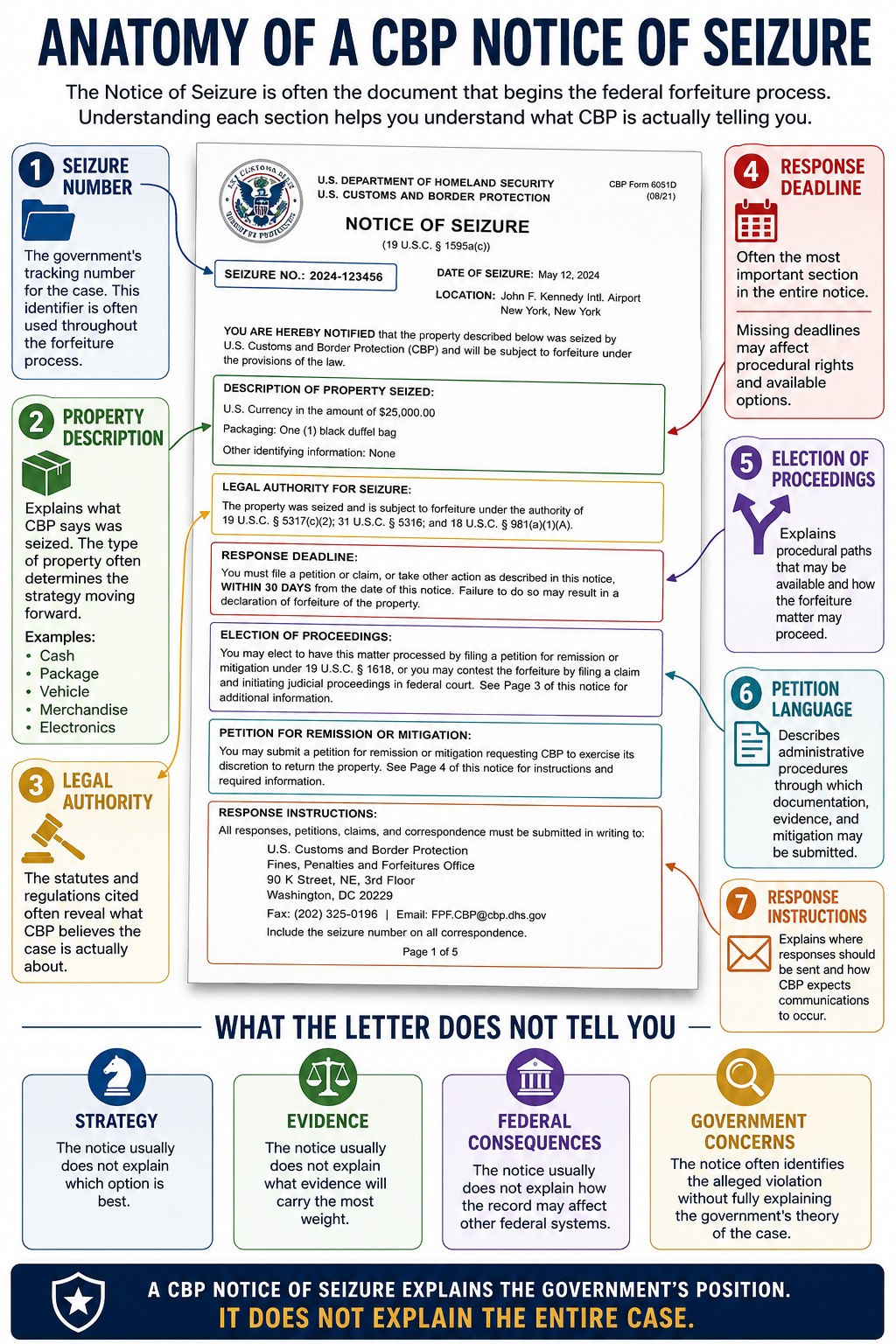
The Legal Authority or Alleged Violation

One of the first things many people notice in a Notice of Seizure is a series of legal citations.

The letter may reference:

  • statutes,
  • regulations,
  • customs authorities,
  • forfeiture provisions,
  • or other legal language that appears difficult to understand.

For many recipients, this is the point where the notice becomes intimidating.

The natural reaction is often:

“I have no idea what any of this means.”

Fortunately, the most important takeaway is usually much simpler than the legal citations themselves.

The legal authority section often tells you what CBP believes the case is about.

In other words, the statutes and regulations cited in the notice frequently provide the first meaningful clues regarding:

  • why the property was seized,
  • what concerns the government has,
  • and what issues are likely to drive the forfeiture process moving forward.

For example, a notice involving seized currency may reference authorities relating to:

  • reporting requirements,
  • bulk cash movement,
  • currency violations,
  • or related forfeiture provisions.

A notice involving imported merchandise may reference authorities relating to:

  • customs declarations,
  • import restrictions,
  • valuation issues,
  • or regulatory compliance.

A notice involving prescription medication may point toward:

  • FDA regulations,
  • import restrictions,
  • or controlled substance concerns.

Similarly, notices involving exports may contain references relating to:

  • licensing requirements,
  • export controls,
  • sanctions programs,
  • or other regulatory frameworks.

This is one reason the legal authority section is often more important than many people initially realize.

The statutes themselves may be difficult to understand.

The government’s theory of the case often is not.

The cited authority frequently reveals what CBP believes happened and what issue it intends to focus on moving forward.

Many recipients make the mistake of ignoring this section entirely because the legal language appears complicated.

In reality, this portion of the notice often provides one of the clearest indications of:

  • what the government thinks occurred,
  • what concerns are driving the seizure,
  • and what evidence may eventually become important.

The legal citation is not merely background information.

It frequently serves as a roadmap to understanding the government’s position.

The Deadline Section

If there is one part of the Notice of Seizure that deserves immediate attention, it is usually the deadline section.

Most recipients naturally focus on:

  • why the property was seized,
  • whether they can get it back,
  • and whether the government is accusing them of wrongdoing.

Those are important questions.

However, from a procedural standpoint, the deadlines are often the most consequential part of the entire document.

The reason is simple.

Federal forfeiture systems continue moving forward whether the recipient responds or not.

The deadlines in the notice generally establish the time period within which certain actions must be taken if the recipient wishes to preserve particular rights or options.

Many people assume that if they need more time, the government will automatically contact them again.

Others assume they can deal with the matter later after gathering information.

Unfortunately, federal administrative systems do not always operate that way.

Missed deadlines can significantly affect:

  • procedural flexibility,
  • available options,
  • administrative rights,
  • and the overall trajectory of the case.

This is one reason many customs seizure matters are won or lost through procedural decisions long before anyone reaches a hearing or courtroom.

The deadline section is often where those procedural decisions begin.

For a deeper discussion of the specific deadlines that frequently appear in seizure notices, see:

The most important thing to understand is that deadlines are rarely administrative formalities.

They often determine what choices remain available moving forward.

The Election of Proceedings Section

Many CBP Notices of Seizure contain language referring to an Election of Proceedings.

For many recipients, this is the most confusing section in the entire document.

The reason is that the notice often presents multiple procedural paths without fully explaining the strategic consequences of each option.

As a result, many people read the section and immediately ask:

Which one am I supposed to choose?

The answer is that the Election of Proceedings section is generally intended to identify the procedural route through which the forfeiture matter will move forward.

At a high level, the government is typically asking whether the recipient intends to pursue one procedural approach or another.

The notice may contain references to:

  • petitions,
  • judicial proceedings,
  • claims,
  • forfeiture actions,
  • or other procedural mechanisms.

The specific language varies depending on the type of seizure and the procedural posture of the case.

What is important to understand is that this section often affects how the dispute will be resolved.

Many people make the mistake of viewing the election as a simple administrative formality.

In reality, the choice may influence:

  • timing,
  • cost,
  • procedural complexity,
  • evidence presentation,
  • and overall case strategy.

This is one reason recipients should avoid treating the Election of Proceedings section as just another piece of paperwork.

It is frequently one of the most consequential portions of the entire notice.

The notice itself often provides only a brief explanation of the available options.

Understanding the practical differences between those options usually requires a broader analysis of:

  • the property involved,
  • the government’s theory,
  • the available evidence,
  • the procedural posture,
  • and the goals of the person receiving the notice.

For a detailed discussion of the Election of Proceedings process, see:

The key takeaway is that the Election of Proceedings section is not simply asking whether you want to respond.

It is often asking how you want the case to proceed.

The Petition or Remission Language

Another section that frequently causes confusion is the portion of the notice discussing petitions for remission or mitigation.

Many people assume this means:

“I get to tell my side of the story.”

While that is partially true, the process is often more structured than people initially expect.

A petition for remission or mitigation is generally an administrative request asking the government to exercise discretion regarding the seized property.

The notice may contain references to:

  • remission,
  • mitigation,
  • petitions,
  • supporting documentation,
  • or administrative review.

Many recipients initially assume the petition process is simply an opportunity to explain what happened.

Federal agencies are often evaluating something much broader.

Depending on the case, the government may review:

  • documentation,
  • ownership records,
  • source-of-funds evidence,
  • import records,
  • export records,
  • compliance history,
  • and other supporting materials.

This is one reason strong petitions frequently become evidence-driven submissions rather than narrative-driven submissions.

The government’s focus is often not:

“Can the claimant tell a compelling story?”

The focus is frequently:

“What does the available record demonstrate?”

Many successful petitions involve:

  • documentation,
  • chronology,
  • supporting records,
  • and coherent explanations that align with the evidence.

The petition section of the notice often receives far less attention than the deadlines.

In many cases, however, it becomes one of the most important procedural opportunities available.

For a deeper discussion of how petitions work, see:

Understanding that distinction often helps people read the petition language in the notice more accurately.

The government is not merely inviting a response.

It is describing a procedural mechanism through which evidence, documentation, and mitigation may be evaluated.

The Bond or Judicial Claim Language

Some Notices of Seizure contain language referring to judicial proceedings, claims, bonds, or federal court litigation.

For many recipients, this is one of the least understood sections of the letter.

The terminology is often unfamiliar, and the notice may not fully explain how these procedural options differ from the petition process discussed elsewhere in the document.

As a result, many people mistakenly assume that all response options are essentially the same.

They are not.

One of the most important distinctions in customs seizure matters is the difference between:

  • administrative remedies,
  • and judicial remedies.

The notice may contain references to:

  • filing a claim,
  • contesting forfeiture,
  • judicial proceedings,
  • federal court actions,
  • or other language indicating that the matter may proceed outside the administrative process.

This section is important because it often reflects a fundamentally different procedural path.

Many recipients focus on whether they should respond.

The more important question may be:

How should the case proceed?

That distinction frequently drives strategic decisions throughout the forfeiture process.

Different procedural paths may involve different:

  • timelines,
  • costs,
  • evidentiary considerations,
  • procedural requirements,
  • and litigation risks.

This is one reason the judicial language in a Notice of Seizure should not be viewed as a routine administrative formality.

It often reflects some of the most significant procedural decisions in the entire case.

The notice itself typically provides only a limited explanation of these options.

Understanding the practical consequences usually requires looking beyond the document and evaluating:

  • the type of property involved,
  • the government’s apparent theory,
  • the available evidence,
  • the procedural posture,
  • and the overall goals of the claimant.

For a deeper discussion of these issues, see:

The key takeaway is that the judicial language often concerns much more than whether the government seized the property.

It frequently concerns how the dispute itself will be resolved.

The Contact Information and Response Instructions

Toward the end of the notice, recipients will usually find instructions regarding where responses should be sent and how the government expects communications to occur.

Many people skim over this section.

That can be a mistake.

The response instructions often contain important information regarding:

  • filing procedures,
  • submission methods,
  • addresses,
  • deadlines,
  • and agency contacts.

From a practical standpoint, this section tells recipients how the government expects procedural communications to occur.

At first glance, the instructions may appear straightforward.

However, many people unintentionally create problems by treating communications with the government casually.

For example, recipients sometimes:

  • call without preparation,
  • make unnecessary statements,
  • provide incomplete information,
  • speculate about facts,
  • or communicate before fully understanding the issues involved.

This is one reason many experienced practitioners view communications with federal agencies as part of the broader administrative record.

Statements made during the process can sometimes become part of the information federal decision-makers later review.

The issue is not whether communication is permitted.

The issue is understanding that communications often have consequences.

This is particularly true when the government is evaluating:

  • credibility,
  • documentation,
  • compliance,
  • ownership,
  • import issues,
  • export issues,
  • or other factual questions.

For many recipients, the contact section appears administrative.

In reality, it is often where participation in the forfeiture process begins.

Understanding how communications fit into the larger case can be just as important as understanding where those communications are sent.

For a broader discussion of these issues, see:

The instructions tell you where to respond.

They do not necessarily tell you what should be said once the response begins.

What the Letter Does Not Tell You

One of the most important things to understand about a CBP Notice of Seizure is that the letter only tells part of the story.

The notice explains:

  • what property was seized,
  • the legal authority being asserted,
  • procedural deadlines,
  • and available response mechanisms.

What it generally does not explain is how federal agencies are likely to evaluate the case moving forward.

Many recipients assume that once they understand the letter, they understand the case.

In reality, the notice often leaves unanswered some of the most important strategic questions.

For example, the letter typically does not explain:

  • what evidence is likely to matter most,
  • what documentation may strengthen the case,
  • how federal decision-makers are likely to evaluate the facts,
  • what weaknesses may exist in the government’s position,
  • or how the administrative record is likely to develop over time.

Similarly, the notice often does not explain how different procedural choices may affect:

  • timing,
  • flexibility,
  • leverage,
  • evidence presentation,
  • and long-term strategy.

This is one reason two people can receive nearly identical Notices of Seizure and yet face dramatically different outcomes.

The letter may be similar.

The facts often are not.

The notice also does not explain how federal agencies frequently evaluate:

  • credibility,
  • consistency,
  • documentation,
  • compliance,
  • and administrative reliability.

These concepts often become critically important later, even though they may receive little or no attention in the letter itself.

In many customs seizure matters, the government’s ultimate decision is influenced less by the notice and more by the administrative record that develops afterward.

That record may eventually include:

  • petitions,
  • supporting documentation,
  • correspondence,
  • declarations,
  • financial records,
  • import records,
  • export records,
  • and other evidence.

This is one reason many experienced practitioners focus heavily on what happens after the notice arrives rather than focusing exclusively on the notice itself.

The letter starts the process.

The record that follows often determines how the process ends.

For a deeper discussion of how federal agencies evaluate customs seizure matters, see:

Why National Security Law Firm Is Different

Most people view a customs seizure letter as paperwork.

We often view it as the beginning of a federal administrative record.

That distinction matters.

A Notice of Seizure is not simply informing someone that property was taken.

It is often the document that starts a process through which federal agencies will evaluate:

  • documentation,
  • explanations,
  • compliance,
  • ownership,
  • credibility,
  • and supporting evidence.

Many law firms focus primarily on the notice itself.

We focus on the larger federal system surrounding the notice.

Depending on the circumstances, information developed during a customs seizure matter may later affect:

  • Global Entry eligibility,
  • security clearances,
  • TSA credential matters,
  • federal employment,
  • government contracting,
  • export-control matters,
  • and other federal administrative systems.

Most customs seizure lawyers do not regularly practice in those areas.

We do.

Because our attorneys regularly handle matters involving:

  • customs seizures,
  • security clearances,
  • federal employment,
  • export controls,
  • Global Entry appeals,
  • federal investigations,
  • and other federal administrative proceedings,

we often evaluate seizure notices through a broader federal-systems perspective.

That perspective influences how we think about:

  • documentation,
  • administrative positioning,
  • procedural decisions,
  • and long-term consequences.

We also believe one of the most important realities of federal administrative practice is that:

The record controls the case.

Federal agencies frequently make decisions based on:

  • documents,
  • submissions,
  • explanations,
  • and administrative records.

As a result, the strongest cases are often built through:

  • documentation,
  • preparation,
  • consistency,
  • and strategic record development.

Many seizure notices look similar.

The federal consequences that follow them often do not.

That is why understanding the notice is important.

Understanding the broader system behind the notice is often even more important.

Frequently Asked Questions

What is a customs seizure letter?

A customs seizure letter, often called a Notice of Seizure, is a formal document informing an individual or business that CBP has seized property and is beginning the forfeiture process.

The letter generally explains:

  • what property was seized,
  • why the government believes the seizure was lawful,
  • what deadlines apply,
  • and what procedural options may be available.

Is a customs seizure letter the same as a Notice of Seizure?

In most situations, yes.

Many people use the terms interchangeably.

The official title often varies slightly depending on the agency, type of property, and procedural posture, but the documents generally serve the same purpose: informing the recipient that property has been seized and explaining the next procedural steps.

Does receiving a seizure letter mean I am being charged with a crime?

Not necessarily.

A forfeiture proceeding and a criminal proceeding are often separate matters.

Receiving a Notice of Seizure does not automatically mean:

  • criminal charges have been filed,
  • a criminal investigation is ongoing,
  • or criminal liability has been established.

The letter typically concerns the government’s effort to forfeit property rather than prosecute an individual.

What does the seizure number mean?

The seizure number functions as the government’s identifying reference for the case.

Federal agencies frequently use it to:

  • track filings,
  • organize correspondence,
  • identify property,
  • and maintain the administrative record.

Because it serves as the primary identifier for the matter, it is generally important to preserve it exactly as it appears in the notice.

What if the property description appears inaccurate?

The property description is often one of the most important parts of the notice because it identifies what the government believes was seized.

If there are concerns regarding the description, those concerns should generally be evaluated in the context of the broader forfeiture process and the available documentation.

What is an Election of Proceedings?

An Election of Proceedings generally refers to a procedural choice regarding how the forfeiture matter will move forward.

The practical consequences of that choice can vary significantly depending on:

  • the type of property,
  • the available evidence,
  • the procedural posture,
  • and the goals of the claimant.

What is a petition for remission or mitigation?

A petition for remission or mitigation is generally an administrative request asking the government to exercise discretion regarding the seized property.

These petitions frequently involve:

  • documentation,
  • supporting evidence,
  • explanations,
  • mitigation,
  • and other information relevant to the seizure.

What is the most important part of the notice?

For many people, the most important section is the deadline section.

The reason is that forfeiture procedures often continue moving forward regardless of whether the recipient takes action.

Missing deadlines can significantly affect available options later.

What should I do before responding?

Most people benefit from first understanding:

  • what property was seized,
  • why the government says it was seized,
  • what deadlines apply,
  • what procedural options exist,
  • and what documentation may become important.

Many customs seizure matters ultimately turn on the quality of the administrative record developed after the notice arrives.

Speak With a Nationwide Customs Seizure Lawyer

If you have received a customs seizure letter or Notice of Seizure, understanding the document is often the first step toward understanding the broader forfeiture process.

The notice itself is important.

Equally important are:

  • the property involved,
  • the government’s apparent concerns,
  • the available evidence,
  • the applicable deadlines,
  • and the administrative record that will develop moving forward.

We offer nationwide representation and free consultations for customs seizure matters.

The fastest and easiest way to get started is through our online scheduling system.

During the consultation, we can discuss:

  • the Notice of Seizure,
  • the property involved,
  • the procedural posture,
  • available documentation,
  • applicable deadlines,
  • and potential next steps.

To schedule a consultation online, visit:

Book a Free Consultation Online

You may also contact us directly at:

Phone: (202) 600-4996

Additional related resources:

A customs seizure letter explains the government’s position. It does not explain everything that may matter in the case. Understanding the notice, the deadlines, the property involved, and the administrative record that follows is often far more important than many recipients initially realize.