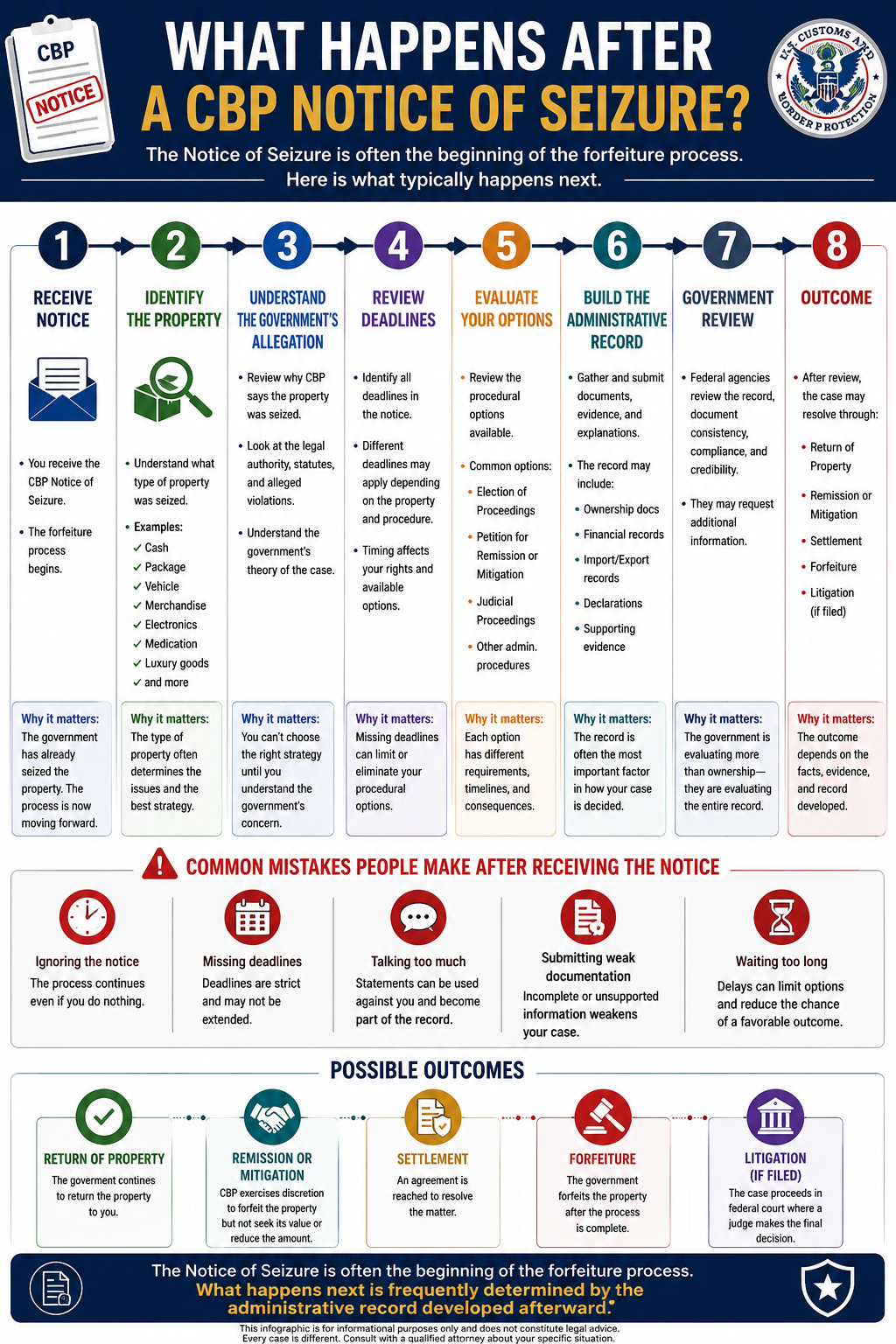
Receiving a CBP Notice of Seizure is often the moment people realize their case has entered a formal federal process.

The property has already been seized.

The notice is the government’s way of informing you that the forfeiture process is now moving forward.

For many people, this creates immediate questions:

What am I supposed to do now?

How much time do I have?

Can I still get the property back?

What happens next?

The answer depends on a variety of factors, including:

  • what property was seized,
  • why it was seized,
  • what deadlines apply,
  • and what procedural options may be available.

What is important to understand is that the Notice of Seizure is usually not the end of the story.

It is often the beginning of the next phase.

Understanding that process can help explain why the period immediately after receiving the notice is frequently one of the most important stages of the entire case.

For a broader explanation of what the notice itself means, see:

Step 1: Understand What Property Was Seized

The first step is understanding exactly what type of property is involved.

This may sound obvious.

However, the category of property often determines much of what happens next.

CBP Notices of Seizure commonly involve:

  • currency,
  • vehicles,
  • packages,
  • imported merchandise,
  • electronics,
  • prescription medication,
  • luxury goods,
  • firearms parts,
  • and other property.

Although the forfeiture process may look similar on paper, the underlying issues frequently differ dramatically.

For example:

A currency seizure case may involve:

  • reporting requirements,
  • source-of-funds issues,
  • or financial documentation.

A package seizure may involve:

  • counterfeit goods,
  • import restrictions,
  • or prohibited merchandise.

A medication seizure may involve:

  • FDA regulations,
  • import restrictions,
  • or prescription documentation.

This is one reason identifying the property category is often one of the most important first steps in evaluating the case.

The government’s concerns are frequently tied to the property itself.

Step 2: Identify Why CBP Says the Property Was Seized

After identifying the property, the next step is understanding why the government says the seizure occurred.

The Notice of Seizure usually contains references to:

  • statutes,
  • regulations,
  • legal authorities,
  • and alleged violations.

Many recipients immediately focus on the legal citations.

A more practical question is often:

What does CBP believe happened?

The answer frequently drives the entire case.

Depending on the circumstances, the government’s concerns may involve:

  • reporting violations,
  • import restrictions,
  • export controls,
  • licensing requirements,
  • sanctions concerns,
  • intellectual property issues,
  • declaration problems,
  • or regulatory compliance.

Understanding the government’s theory is often more important than understanding every legal citation appearing in the notice.

Before evaluating procedural options, it is generally helpful to understand what concern federal agencies are actually attempting to address.

Step 3: Determine What Deadlines Apply

Once the property and alleged basis for seizure are understood, attention usually turns to deadlines.

Most Notices of Seizure contain important timing requirements.

Many recipients underestimate how important these deadlines can become.

Federal forfeiture procedures continue moving forward regardless of whether the recipient feels prepared to respond.

This is one reason timing frequently affects:

  • available options,
  • procedural rights,
  • flexibility,
  • and overall strategy.

The purpose of this section is not to explain every possible deadline.

Instead, the key point is that deadlines often become one of the most important issues immediately after the notice arrives.

For more detailed discussions of specific timing requirements, see:

The important takeaway is simple:

The forfeiture process generally does not pause while recipients decide what they want to do.

Step 4: Understand Your Procedural Options

After identifying the property, understanding the government’s concerns, and reviewing the applicable deadlines, the next step is understanding what procedural options may be available.

This is often where the forfeiture process becomes confusing.

Many people assume there is only one way to respond to a Notice of Seizure.

In reality, the government may provide multiple procedural paths depending on the circumstances of the case.

The specific options vary, but recipients frequently encounter concepts such as:

  • Elections of Proceedings,
  • Petitions for Remission or Mitigation,
  • judicial proceedings,
  • administrative forfeiture procedures,
  • and other response mechanisms.

Many people immediately want to know:

Which option is best?

Unfortunately, there is rarely a universal answer.

The appropriate strategy often depends on:

  • the property involved,
  • the government’s theory,
  • the available evidence,
  • the procedural posture,
  • and the goals of the person receiving the notice.

This is one reason the procedural choice itself often becomes a significant strategic decision.

Many recipients make the mistake of treating these options as interchangeable.

They are not.

Different procedural paths may involve different:

  • timelines,
  • evidentiary standards,
  • costs,
  • procedural requirements,
  • and strategic considerations.

The most important point at this stage is not necessarily deciding immediately.

The most important point is understanding that the choice exists and that the choice may significantly affect how the case develops moving forward.

For more detailed discussions of these procedural options, see:

The Notice of Seizure often presents the options.

It does not necessarily explain the strategic consequences of choosing one over another.

Step 5: Begin Building the Administrative Record

Once the forfeiture process is underway, many people focus almost entirely on the property.

Federal agencies are often focused on something else:

The record.

This is one of the most important concepts in customs seizure matters.

Many recipients assume the case will ultimately turn on:

what happened.

Federal agencies frequently evaluate:

what can be documented.

As the process moves forward, the administrative record often begins expanding to include:

  • petitions,
  • supporting documentation,
  • correspondence,
  • declarations,
  • financial records,
  • import records,
  • export records,
  • ownership documentation,
  • and other evidence.

This is one reason many customs seizure cases are ultimately decided through documentation rather than argument.

Federal agencies frequently evaluate:

  • credibility,
  • consistency,
  • compliance,
  • chronology,
  • and evidentiary support.

Those evaluations are often based on the record being developed during this stage.

The strongest cases frequently involve records that clearly explain:

  • what occurred,
  • why it occurred,
  • what documentation supports the explanation,
  • and why the government’s concerns should be viewed in context.

The weakest cases often involve:

  • incomplete documentation,
  • inconsistent explanations,
  • missing records,
  • and unsupported assertions.

This is one reason we repeatedly emphasize a principle that appears throughout federal administrative systems:

The record controls the case.

Many recipients do not realize that the submissions made during this phase often become the foundation upon which later decisions are built.

Federal agencies frequently revisit:

  • prior statements,
  • prior submissions,
  • supporting documents,
  • and earlier explanations

throughout the life of the matter.

As a result, the administrative record frequently becomes one of the most important assets in the entire case.

For a deeper discussion of this concept, see:

Many people view the Notice of Seizure as the beginning of a legal dispute.

In many respects, it is also the beginning of a record-building process that may ultimately determine how the dispute is resolved.

What Federal Agencies Are Often Evaluating During This Stage?

One of the biggest misconceptions in customs seizure cases is that federal agencies are primarily focused on ownership.

Many recipients assume the central question is:

“Can I prove the property belongs to me?”

Ownership may be important.

However, federal agencies are often evaluating a much broader set of issues.

Depending on the type of property involved, investigators may be reviewing:

  • documentation,
  • compliance,
  • source information,
  • import records,
  • export records,
  • declarations,
  • financial records,
  • ownership history,
  • and supporting evidence.

In many situations, the government’s analysis extends well beyond the property itself.

Federal agencies frequently evaluate:

  • whether the available records are consistent,
  • whether explanations align with documentation,
  • whether supporting evidence exists,
  • and whether the overall record appears reliable.

This is one reason customs seizure cases often resemble other federal administrative proceedings.

The focus frequently becomes:

  • credibility,
  • consistency,
  • documentation,
  • and administrative reliability.

For example, federal decision-makers may examine:

  • whether statements match prior submissions,
  • whether records support the explanations being offered,
  • whether documentation contains gaps,
  • and whether the overall chronology makes sense.

These concepts often become particularly important because federal agencies frequently make decisions based on records rather than personal interactions.

The quality of the administrative record often affects how federal reviewers perceive:

  • the property,
  • the transaction,
  • the claimant,
  • and the government’s concerns.

This is one reason many successful customs seizure cases focus heavily on creating a record that is:

  • organized,
  • coherent,
  • documented,
  • and internally consistent.

The government’s review frequently involves more than determining what happened.

The review often involves determining whether the available record provides confidence regarding what happened.

That distinction frequently shapes the outcome of the case.

For a deeper discussion of how federal agencies evaluate seizure matters, see:

The Biggest Mistakes People Make After Receiving the Notice

Many customs seizure cases become more difficult not because of the seizure itself, but because of what happens afterward.

One of the most common mistakes is simply waiting too long.

Recipients often assume:

  • they have more time than they actually have,
  • the government will send additional warnings,
  • or they can deal with the matter later.

Meanwhile, the forfeiture process continues moving forward.

Another common mistake is focusing exclusively on the property while ignoring the government’s apparent concerns.

Many people become fixated on:

“I want the property back.”

That goal is understandable.

However, the more important question is often:

“Why does the government believe it can keep the property?”

Until that question is answered, it can be difficult to determine what evidence and strategy are likely to matter most.

A third mistake involves creating a weak administrative record.

Recipients sometimes:

  • submit incomplete information,
  • provide unsupported explanations,
  • fail to organize documentation,
  • or make statements that later become difficult to reconcile with the evidence.

Federal agencies frequently revisit earlier submissions.

As a result, information provided during the early stages of the case may continue influencing the government’s evaluation long after the initial notice is received.

Another common mistake is assuming that every seizure case follows the same path.

A seizure involving:

  • cash,
  • merchandise,
  • prescription medication,
  • electronics,
  • a package,
  • or an export shipment

may involve completely different issues and require completely different approaches.

This is one reason generic advice often proves less helpful than understanding the specific facts of the case.

The strongest first step is usually understanding:

  • what was seized,
  • why it was seized,
  • what deadlines apply,
  • and what evidence is likely to matter moving forward.

That understanding often creates significantly more flexibility than reacting to the notice without first understanding the broader context.

What Happens If You Do Nothing?

One of the most common questions people ask after receiving a Notice of Seizure is:

“What happens if I just ignore it?”

The answer is generally straightforward:

The forfeiture process usually continues.

Many people assume that if they do not respond, the government will eventually contact them again, explain their options a second time, or provide additional opportunities to participate.

Federal forfeiture systems do not always operate that way.

The Notice of Seizure is typically the government’s formal effort to provide notice and explain the procedural process.

Once that occurs, the responsibility often shifts to the recipient to decide whether and how they wish to participate.

As deadlines pass, procedural options may become more limited.

The government’s review continues.

The administrative process continues.

The case continues.

This is one reason doing nothing is often a decision even when it does not feel like one.

Many recipients do not intentionally choose inaction.

Instead, they become overwhelmed.

They may:

  • put the letter aside,
  • assume they will deal with it later,
  • become confused by the terminology,
  • or simply hope the matter resolves itself.

Meanwhile, the forfeiture process keeps moving forward.

The practical consequence is that opportunities that may have existed earlier can become more difficult to pursue later.

This is one reason timing frequently becomes one of the most important issues in customs seizure matters.

The government’s position may not change simply because the recipient delays making a decision.

The process generally continues according to the deadlines and procedures established by law.

That does not mean every case must be aggressively contested.

Nor does it mean every recipient should pursue the same strategy.

It simply means that understanding the available options before deadlines pass is often preferable to discovering those options after they have already become unavailable.

For a more detailed discussion of this issue, see:

Many customs seizure cases ultimately turn on procedural decisions made during the weeks immediately following the notice.

Doing nothing does not stop the process.

It usually means the process continues without your participation.

Why National Security Law Firm Is Different

Most people view a Notice of Seizure as a government letter.

We often view it as the beginning of a federal administrative record.

That distinction matters because federal agencies frequently make decisions based on:

  • documentation,
  • submissions,
  • explanations,
  • supporting evidence,
  • and the administrative record that develops after the notice arrives.

The notice itself is important.

The record that follows is often even more important.

Many law firms focus on the immediate procedural question:

“How do we respond to the notice?”

We often ask a broader question:

“How will this response affect the entire federal record being created?”

That perspective becomes particularly important because customs seizure matters frequently intersect with other federal systems.

Depending on the circumstances, information developed during a customs seizure matter may later affect:

  • Global Entry eligibility,
  • security clearances,
  • federal employment,
  • TSA credential matters,
  • government contracting,
  • export-control issues,
  • and other federal administrative proceedings.

Most customs seizure lawyers do not regularly practice in those systems.

We do.

Because our attorneys routinely handle matters involving:

  • customs seizures,
  • security clearances,
  • federal employment,
  • export controls,
  • federal investigations,
  • Global Entry appeals,
  • and other federal administrative proceedings,

we frequently evaluate seizure notices through a broader federal-systems perspective.

We also believe one of the most important realities of federal practice is that:

The record controls the case.

Federal agencies frequently revisit:

  • prior statements,
  • prior submissions,
  • supporting documentation,
  • and administrative filings throughout the life of a matter.

This is one reason we place significant emphasis on:

  • documentation,
  • consistency,
  • administrative positioning,
  • and long-term record development.

Many Notices of Seizure look similar.

The federal consequences that follow them often do not.

Understanding that difference is one of the reasons we approach customs seizure matters differently than many traditional forfeiture-focused firms.