
Many travelers receive a CBP Notice of Seizure and quickly encounter a term they have never heard before:
- Petition for Remission or Mitigation.
Most people understandably assume:
- the petition is routine paperwork,
- a simple request for mercy,
- or merely an explanation letter asking CBP to reconsider the seizure.
In reality, a Petition for Remission or Mitigation often becomes one of the most important strategic documents in the entire case.
Federal agencies frequently evaluate:
- source-of-funds documentation,
- banking activity,
- financial consistency,
- reporting behavior,
- mitigation,
- credibility,
- and procedural reliability
through the petition process.
That means the petition frequently shapes:
- how the government views the case,
- how much institutional suspicion exists,
- what leverage remains available,
- and whether the administrative narrative stabilizes or deteriorates moving forward.
Many customs seizure matters are effectively:
- strengthened,
- weakened,
- or procedurally hardened
during the petition stage itself.
This is one reason strong petitions are often much more sophisticated than people initially expect. In many situations, the petition becomes:
- the central factual narrative,
- the primary mitigation document,
- and the foundation of the administrative record moving forward.
We discuss many of these broader procedural issues throughout our CBP Notice of Seizure Letter Explained: What To Do Next guide as well as our page on Election of Proceedings Form Explained.
What Is a Petition for Remission or Mitigation?
A Petition for Remission or Mitigation generally asks CBP to:
- return seized property,
- reduce penalties,
- or otherwise mitigate the consequences of the forfeiture process through administrative review.
Many travelers mistakenly believe the petition process is:
- informal,
- emotional,
- or simply an apology letter asking the government for leniency.
That is often not how sophisticated customs seizure strategy works.
In many situations, strong petitions are heavily:
- documentation-driven,
- mitigation-driven,
- and credibility-driven.
Federal agencies frequently evaluate:
- banking records,
- source-of-funds evidence,
- reporting behavior,
- financial timelines,
- procedural posture,
- and administrative reliability
throughout the petition review process.
This is one reason petitions frequently become much more strategic than:
- “explaining what happened.”
A strong petition often attempts to:
- stabilize the financial narrative,
- narrow institutional suspicion,
- strengthen mitigation,
- preserve credibility,
- and organize the documentation coherently before the administrative record hardens further.
Many airport cash seizure matters are ultimately shaped heavily during:
- the petition process itself.
This is one reason procedural strategy during the administrative phase often matters enormously.
We discuss related procedural and negotiation concepts further in our pages on Offer in Compromise for CBP Seizures Explained and Petition vs Judicial Action in CBP Seizure Cases: Which Option Is Better?.
Why the Petition Often Becomes the Most Important Document in the Case
Many travelers underestimate how heavily federal agencies often rely on the petition when evaluating:
- credibility,
- mitigation,
- financial consistency,
- and administrative reliability moving forward.
In many customs seizure matters, the petition effectively becomes:
- the government’s primary roadmap for evaluating the traveler’s narrative.
Federal agencies frequently compare the petition against:
- airport questioning,
- customs declarations,
- banking records,
- source-of-funds documentation,
- mitigation submissions,
- travel history,
- and later procedural explanations
throughout the life of the case.
This is one reason relatively small inconsistencies introduced during the petition process may later become:
- credibility concerns,
- procedural complications,
- mitigation problems,
- or expanded financial scrutiny.
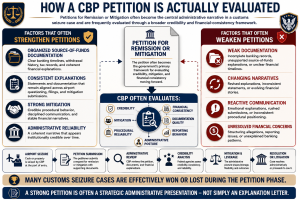
Many weak petitions fail because:
- the documentation appears disorganized,
- the financial narrative evolves repeatedly,
- explanations remain inconsistent,
- or the mitigation posture appears reactive rather than strategic.
Strong petitions frequently involve:
- organized source-of-funds documentation,
- coherent financial timelines,
- disciplined communication,
- stable mitigation narratives,
- and carefully structured factual explanations.
Federal agencies often evaluate whether:
- the records support the explanation,
- the timelines remain coherent,
- the traveler appears administratively reliable,
- and the overall narrative appears internally consistent over time.
This broader institutional review frequently shapes:
- leverage,
- mitigation flexibility,
- procedural posture,
- settlement opportunities,
- and long-term administrative positioning.
This is one reason many customs seizure matters are effectively:
- strengthened
or - weakened
during the petition phase itself.
We discuss these broader administrative record and credibility issues further in our pages on The Record Controls the Case: Why Your First Submission Matters and How CBP Actually Decides Seizure Cases.
What Federal Agencies Often Evaluate Inside a Petition
One of the biggest misconceptions in customs seizure matters is the belief that CBP primarily evaluates:
- whether the traveler says the money was legal.
In reality, federal agencies frequently conduct a much broader institutional review.
Investigators often evaluate:
- source-of-funds documentation,
- banking activity,
- withdrawal history,
- reporting behavior,
- financial consistency,
- travel timelines,
- mitigation posture,
- and credibility
collectively.
Federal agencies frequently assess whether:
- the records support the explanation,
- the financial narrative appears coherent,
- the mitigation posture appears credible,
- and the traveler appears administratively reliable over time.
This is one reason strong petitions often focus heavily on:
- organizing financial timelines clearly,
- stabilizing the narrative,
- identifying inconsistencies early,
- and strengthening mitigation before unresolved issues expand scrutiny further.
Many weak petitions become problematic because:
- explanations continue evolving,
- records remain incomplete,
- financial timelines conflict,
- or reactive communication creates additional inconsistencies.
Federal agencies frequently interpret:
- changing explanations,
- incomplete documentation,
- or unstable financial narratives
as indicators of reduced credibility and increased institutional concern.
In many customs seizure matters, the petition process becomes much more than:
- “telling your side of the story.”
It often becomes:
- an administrative credibility assessment,
- a financial consistency review,
- and a long-term institutional reliability analysis.
We discuss many of these broader credibility and administrative review concepts further in our pages on How Credibility Affects Customs Seizure Cases and Why Consistency Matters in Federal Seizure Cases.
Why Weak Documentation and Inconsistent Explanations Frequently Hurt Petitions
One of the biggest reasons petitions fail is not necessarily because:
- the money was illegal,
- criminal charges were filed,
- or the government proved wrongdoing conclusively.
More often, petitions become difficult because federal agencies view the:
- documentation,
- financial narrative,
- mitigation posture,
- or credibility landscape
as unreliable or inconsistent.
Many travelers unintentionally weaken their own petitions by:
- changing explanations repeatedly,
- reconstructing timelines from memory,
- submitting incomplete records,
- reacting emotionally,
- or continuing to revise the financial narrative after inconsistencies already exist.
Federal agencies frequently compare:
- airport questioning,
- customs declarations,
- banking records,
- source-of-funds documentation,
- mitigation submissions,
- and later procedural explanations
across the entire administrative record.
This is one reason relatively small inconsistencies frequently become much larger administrative problems over time.
For example, petitions often weaken where:
- withdrawal timelines continue changing,
- source-of-funds records remain incomplete,
- structuring concerns remain unresolved,
- or the financial narrative appears inconsistent across submissions.
Federal agencies frequently evaluate whether:
- the traveler appears administratively reliable,
- the mitigation posture appears credible,
- and the financial story remains coherent over time.
Strong petitions frequently depend heavily on:
- organized source-of-funds evidence,
- disciplined communication,
- coherent financial timelines,
- and stable mitigation narratives.
This is one reason sophisticated customs seizure strategy often focuses on:
- identifying inconsistencies early,
- organizing records carefully,
- preserving credibility,
- and stabilizing the administrative narrative before positions harden further.
In many customs seizure matters, perceived credibility becomes one of the most important variables in the entire petition review process.
We discuss many of these broader strategic issues throughout our pages on Why Early Statements to CBP Can Destroy Your Case and The Biggest Mistakes People Make After CBP Seizes Their Money.
Why Timing and Procedural Strategy Often Matter Enormously
Timing frequently changes leverage during the petition process.
Many travelers assume:
- they can organize records later,
- revise explanations later,
- or improve mitigation later if necessary.
In reality, administrative narratives often harden quickly.
Federal agencies frequently continue evaluating:
- source-of-funds explanations,
- financial consistency,
- mitigation posture,
- reporting behavior,
- and procedural reliability
throughout the petition process.
This is one reason strong customs seizure strategy often focuses heavily on:
- early documentation review,
- identifying inconsistencies immediately,
- preserving credibility,
- and strengthening mitigation before unresolved issues deepen institutional suspicion further.
Many travelers unintentionally weaken their own petitions by:
- delaying,
- missing deadlines,
- submitting incomplete materials,
- or continuing reactive communication after credibility concerns already exist.
As the administrative narrative hardens,:
- flexibility frequently narrows,
- leverage often weakens,
- and mitigation opportunities sometimes become more limited.
Strong early positioning often creates:
- greater procedural flexibility,
- stronger mitigation opportunities,
- more stable negotiation leverage,
- and a more coherent administrative record moving forward.
This is one reason sophisticated customs seizure strategy frequently focuses on:
- timing,
- procedural posture,
- credibility preservation,
- and narrative stability
long before litigation ever becomes necessary.
We discuss many of these broader leverage and timing issues throughout our pages on The 30-Day Deadline That Can Cost You Your Property and Why Hiring a Customs Seizure Lawyer Early Matters.
Petition Strategy Often Involves More Than the Seized Property
Many travelers initially view the petition process as:
- a narrow dispute about money,
- a procedural filing,
- or an attempt to recover seized property.
In reality, the administrative record created during the petition process may later affect substantially broader federal interests.
Depending on the allegations involved,:
- source-of-funds explanations,
- procedural submissions,
- mitigation narratives,
- credibility findings,
- and financial inconsistencies
may later affect:
- Global Entry eligibility,
- security clearances,
- contractor eligibility,
- immigration matters,
- federal employment,
- future border screening,
- banking relationships,
- and broader federal investigations.
Federal agencies frequently share information and evaluate these systems collectively rather than in isolation.
That means the petition frequently affects much more than:
- the forfeiture process itself.
This is one reason sophisticated customs seizure strategy often requires evaluating not only:
“How do we strengthen the petition?”
but also:
“How does this administrative record affect the client’s broader federal position long-term?”
This is also where we are uniquely positioned compared to most customs seizure lawyers.
We are one of the only federal law firms in the country that simultaneously handles:
- customs seizure matters,
- Global Entry appeals,
- TSA credential matters,
- security clearance cases,
- federal investigations,
- federal employment matters,
- export-control issues,
- and overlapping national security-related administrative proceedings.
These are highly specialized federal systems that many traditional customs seizure lawyers do not regularly handle or fully understand.
That distinction matters enormously because petition strategy often affects substantially more than:
- the seized property itself.
Why National Security Law Firm Is Different
Many law firms approach petitions for remission or mitigation as:
- simple explanation letters,
- procedural paperwork,
- or isolated forfeiture submissions.
We approach these matters through a much broader federal-systems lens.
Our customs seizure practice is built around understanding how overlapping federal agencies evaluate:
- credibility,
- mitigation,
- financial consistency,
- procedural behavior,
- reporting issues,
- and administrative reliability over time.
We regularly handle:
- airport cash seizure matters,
- Global Entry appeals,
- TSA credential matters,
- security clearance cases,
- federal investigations,
- federal employment matters,
- export-control issues,
- and overlapping national security-related administrative proceedings.
That combination is extremely uncommon.
Most customs seizure lawyers do not regularly practice in these adjacent federal systems. As a result, many do not fully evaluate how:
- petition narratives,
- mitigation submissions,
- credibility findings,
- procedural positioning,
- or financial explanations
could later affect:
- security clearances,
- Global Entry,
- immigration,
- contractor eligibility,
- federal employment,
- or future border screening.
We evaluate petition strategy through that broader institutional framework from the beginning.
That often means analyzing:
- how the government is already evaluating the financial narrative,
- how credibility affects leverage,
- how procedural timing affects flexibility,
- and how to preserve long-term administrative reliability before positions harden further.
In many situations, the strongest petition strategy is not simply:
- “telling your side of the story.”
It is building an administrative narrative that appears:
- coherent,
- documented,
- internally consistent,
- and institutionally credible across the entire federal record.
For broader discussion of customs seizure strategy generally, visit CBP Notice of Seizure Letter Explained: What To Do Next and the broader Customs Seizure Lawyer Hub.
Frequently Asked Questions
What is a Petition for Remission or Mitigation?
A Petition for Remission or Mitigation generally asks CBP to:
- return seized property,
- reduce penalties,
- or mitigate forfeiture consequences through administrative review.
Does filing a petition admit wrongdoing?
Not necessarily.
In many situations, petitions are strategic procedural submissions involving:
- mitigation,
- leverage,
- credibility,
- financial documentation,
- and administrative positioning.
What does CBP often evaluate inside a petition?
Federal agencies frequently evaluate:
- source-of-funds documentation,
- banking activity,
- financial consistency,
- reporting behavior,
- credibility,
- mitigation posture,
- and procedural reliability.
Why does credibility matter so much?
Many customs seizure matters become heavily:
- credibility-driven,
- documentation-driven,
- and mitigation-driven.
Federal agencies frequently evaluate whether:
- the financial narrative appears coherent,
- the explanations remain stable,
- and the traveler appears administratively reliable over time.
What documentation helps most?
Strong petitions frequently involve:
- organized source-of-funds records,
- coherent banking timelines,
- withdrawal history,
- tax records,
- business documentation,
- and consistent financial explanations.
Can weak records hurt the petition?
Absolutely.
Incomplete documentation, inconsistent explanations, and unstable financial narratives frequently weaken:
- credibility,
- mitigation posture,
- and procedural leverage.
Why does timing matter so much?
Administrative narratives often harden quickly.
Strong early positioning frequently preserves:
- procedural flexibility,
- mitigation opportunities,
- leverage,
- and credibility before unresolved issues expand further.
Can the petition affect Global Entry or security clearances?
Potentially, yes.
Depending on the allegations involved, petition submissions and administrative findings may later affect:
- Global Entry,
- security clearances,
- immigration,
- contractor eligibility,
- federal employment,
- and future border screening.
What is the strongest petition strategy?
Strong petition strategy frequently involves:
- organized documentation,
- disciplined communication,
- coherent financial timelines,
- strategic mitigation,
- and careful procedural positioning.
Should I talk to a lawyer before filing the petition?
In many situations, yes.
The petition frequently becomes one of the most important strategic documents in the entire case and may significantly affect:
- leverage,
- credibility,
- mitigation,
- procedural flexibility,
- and broader federal consequences later.
Speak With a Nationwide Customs Seizure Lawyer
If you are preparing a Petition for Remission or Mitigation in a CBP seizure case, the strategic decisions made early in the process may significantly affect:
- mitigation opportunities,
- procedural leverage,
- credibility assessments,
- litigation exposure,
- and broader federal consequences.
Strong petition strategy often depends heavily on:
- source-of-funds documentation,
- banking analysis,
- credibility,
- mitigation posture,
- procedural timing,
- and the government’s apparent concerns.
We offer nationwide representation and free consultations for customs seizure matters.
The fastest and easiest way to get started is through our online booking system.
In many situations, same-day consultations are available, and the process typically takes less than a minute to schedule online.
Once booked, one of our attorneys will personally call you at the scheduled time to discuss:
- the seizure,
- petition strategy,
- procedural deadlines,
- source-of-funds documentation,
- mitigation considerations,
- credibility concerns,
- and broader federal implications.
To schedule a consultation online, visit:
Book a Free Consultation Online
You may also contact us directly at:
Phone: (202) 600-4996
Additional related resources: