
An SOR Is the Government’s Case Against You
A Statement of Reasons is not a warning.
It is not a request for clarification.
It is not an invitation to explain yourself.
An SOR is the government formally laying out why it believes you should not hold a security clearance.
By the time an SOR is issued, adjudicators are no longer asking whether there might be a concern. They have already decided there is one. The only question left is whether the concern can be mitigated, controlled, and defended.
Most clearance holders do not understand this distinction.
This guide explains how adjudicators actually decide SORs, step by step, and why the SOR response phase is where most cases are won or permanently lost.
Who This Applies To
This analysis applies to:
• Current clearance holders responding to an SOR
• Federal employees whose job depends on clearance eligibility
• Government contractors facing loss of employment
• Military service members dealing with clearance-linked discipline or separation
If you have received an SOR, you are no longer in a preventive phase. You are in an adversarial phase, whether it feels that way or not.
What an SOR Really Means
An SOR reflects three things that have already happened internally:
• The government believes there is sufficient evidence of a concern
• The concern implicates one or more Adjudicative Guidelines
• The burden has shifted to you to mitigate the risk
At this stage, adjudicators are not neutral fact-finders. They are evaluating whether your response overcomes an already-identified risk.
This is why generic explanations, emotional defenses, and document dumps routinely fail.
For a step-by-step explanation of how SOR responses are evaluated, timed, and strategically framed, visit our Statement of Reasons (SOR) Response resource page.
How Adjudicators Read an SOR Response
Adjudicators do not read SOR responses the way lawyers read briefs.
They read them as risk narratives.
They are asking:
• Does this response acknowledge the concern accurately
• Does it accept responsibility appropriately
• Does it reduce future risk or merely explain the past
• Does it align with prior disclosures and records
• Does it create new questions or close existing ones
An SOR response that technically “answers” each allegation can still fail if it undermines credibility or control.
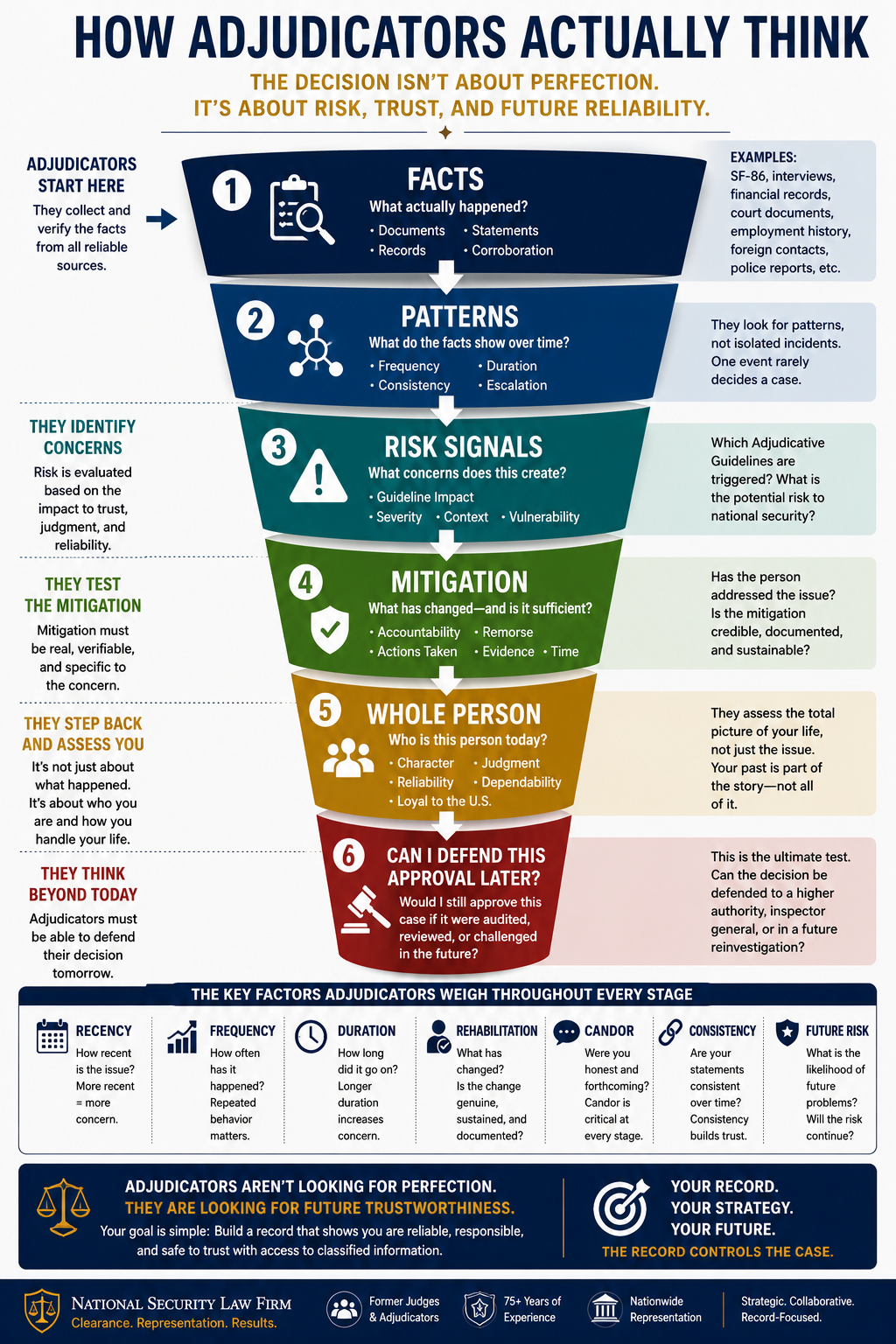
What Adjudicators Are Looking For First
Before adjudicators analyze mitigation, they look for structural credibility.
That includes:
• Clear admissions where facts are not disputable
• Disciplined denials where evidence is weak or misframed
• Consistency with the SF-86, interviews, and investigative record
• Absence of unnecessary detail
• Professional tone that reflects judgment and maturity
Over-explaining is one of the fastest ways to lose credibility at this stage.
How Guideline Analysis Actually Works in SOR Decisions
SORs are written by guideline, but they are not decided in silos.
Adjudicators evaluate:
• How allegations interact across guidelines
• Whether mitigation under one guideline worsens another
• Whether credibility issues trigger Guideline E exposure
• Whether conduct patterns emerge across time
For example, disputing facts aggressively under Guideline F while minimizing disclosure issues can quietly transform a financial case into a personal conduct case.
This is why understanding how adjudicators decide SORs requires understanding guideline interaction, not just guideline text.
Readers who want a deeper explanation of how adjudicators apply the whole-person concept across guidelines should review NSLF’s security clearance resource hub, which breaks down these decision patterns in detail.
Why Most SOR Responses Fail
Most failed SOR responses share the same problems:
• They argue fairness instead of risk
• They explain conduct instead of mitigating it
• They dispute immaterial facts
• They submit mitigation without sequencing
• They ignore downstream federal consequences
Adjudicators are trained to see these mistakes immediately.
An SOR response is not the place to vent frustration or tell your life story. It is a controlled, strategic document designed to survive discretionary review.
How Adjudicators Evaluate Mitigation in SORs
Mitigation is evaluated against one core question:
Has the risk been reduced to an acceptable level going forward?
Adjudicators look for mitigation that is:
• Sustained, not recent
• Independent of the clearance process
• Supported by objective evidence
• Proportional to the concern
• Presented in a logical sequence
Dumping every favorable document you can find often signals panic rather than control.
This is why NSLF does not allow SOR responses to be drafted in isolation.
Complex SOR responses are reviewed through a multi-attorney review process modeled after medical tumor boards, designed to stress-test admissions, denials, mitigation timing, and cross-domain risk before submission.
The Burden Shift After an SOR
Once an SOR is issued, the burden is no longer shared.
The government has met its threshold.
You now carry the burden of mitigation.
Adjudicators are evaluating whether your response would justify granting or continuing access if the decision were later questioned internally or in litigation.
This is why litigation readiness matters even when no hearing is scheduled.
How SOR Decisions Can Cascade Into Other Federal Actions
An adverse SOR decision rarely ends with the clearance alone.
Findings in an SOR response can be reused or referenced in:
• Federal employment discipline or removal actions
• MSPB or EEO proceedings
• Global Entry, TWIC, or HME denials
• FOIA disclosures that permanently follow your record
• Military separation or adverse discharge characterization
• VA disability complications tied to conduct findings
Many firms treat SOR responses as standalone clearance work.
National Security Law Firm does not.
NSLF is structurally built to coordinate SOR strategy with federal employment law, military law, FOIA risk, and litigation posture so that one response does not quietly damage another part of a client’s career.
What Not to Say in an SOR Response
Certain phrases routinely damage SOR responses, even when factually accurate.
These include:
• “I didn’t think it was important”
• “This was taken out of context”
• “I was under a lot of stress at the time”
• “I never intended for this to be an issue”
• “This has nothing to do with my clearance”
Adjudicators hear these as risk indicators, not mitigation.
Effective SOR responses reframe facts without minimizing responsibility or creating new concerns.
If you want a deeper breakdown of how to respond to a Statement of Reasons, what adjudicators actually look for, and how SOR responses succeed or fail in practice, see our detailed guide on responding to a security clearance SOR.
Read more: What DOHA Judges Require in SOR Responses
Choosing the Right SOR Security Clearance Lawyer
SOR representation is not about writing skill alone.
It requires understanding:
• How adjudicators read and weigh narratives
• How credibility findings are formed
• How mitigation sequencing affects outcomes
• How clearance issues intersect with employment and military consequences
Readers evaluating counsel should understand why visibility and marketing claims are not substitutes for insider experience. These resources explain what actually matters when choosing a security clearance lawyer:
- 18 Red Flags to Watch Out for When Hiring a Security Clearance Lawyer
- How to Find the Best Security Clearance Lawyer for Your Case
Why National Security Law Firm
National Security Law Firm is a Washington, D.C.–based federal and military law firm built to confront the federal government at its own level.
NSLF provides:
• Insider experience from former federal prosecutors, military JAGs, agency counsel, adjudicators, and national security attorneys
• A proprietary Attorney Review Board that reviews SOR strategy early across disciplines
• Integrated handling of security clearance, federal employment, military, FOIA, and litigation risk
• Flat-fee transparency that enables real collaboration
• Legal financing through Pay Later by Affirm with 3, 6, 12, or 24 month options and no impact on credit for eligibility checks
• Nationwide representation anchored in Washington, D.C.
This structure exists because SORs are not paperwork. They are inflection points.
Where This Fits in the Clearance System
Security clearance issues do not exist in isolation.
They they are disclosed, framed, and documented will directly affect:
- future reinvestigations and Continuous Evaluation
- subject interviews and polygraphs
- promotion eligibility and special duty assignments
- how adjudicators interpret credibility and judgment later
That’s why National Security Law Firm maintains the Security Clearance Insider Hub—a centralized library explaining how individual issues connect to the full clearance lifecycle.
Inside the Hub, you’ll find:
- how adjudicators weigh patterns, not events
- how early disclosures shape later decisions
- why some issues fade while others compound
- where mitigation actually works—and where it quietly fails
This article addresses one decision point.
The Resource Hub explains the system that decision point lives inside.
→ Explore the Security Clearance Insider Hub
Why National Security Law Firm Handles Security Clearance Cases Differently
Security clearance decisions are made inside a federal system that values consistency, credibility, and record integrity over storytelling or advocacy flair. National Security Law Firm is built specifically to operate inside that system.
True insiders: former judges, adjudicators, and government decision-makers
Our team includes former judges, adjudicators, and attorneys with direct experience inside the Defense Office of Hearings and Appeals (DOHA) and other government clearance decision environments. We understand how credibility is assessed, how mitigation is weighed, and how risk is evaluated because we have participated in security clearance decisions from the government’s side of the table.
→ Why insider experience changes security clearance outcomes
Federal Systems Defense™
Security clearance issues do not stay confined to the clearance process. They intersect with federal employment actions, investigations, criminal or quasi-criminal exposure, future reviews, and long-term career consequences. Our Federal Systems Defense™ approach treats your clearance case as part of a larger government system, not a standalone event.
→ How Federal Systems Defense™ protects clients across agencies and processes
Attorney Review Board (team-based case design)
Clearance cases involve judgment calls, not checklists. Our Attorney Review Board brings multiple experienced attorneys into the strategy process before critical submissions are made, similar to how complex medical cases are reviewed by a tumor board. This structure reduces blind spots and prevents avoidable damage to the record.
→ How NSLF’s Attorney Review Board works and why it matters
Record Control Strategy
The most important part of a clearance case is not the final decision, but what gets written into the permanent record. Our Record Control Strategy focuses on how issues are framed, whether concerns are fully resolved or left open, and how today’s language may be reused in future reinvestigations, polygraphs, promotions, or upgrades.
→ Why record control is critical in security clearance cases
Niche security clearance lawyers, not general practitioners
Security clearance law is its own discipline. Our clearance attorneys focus on clearance matters, our federal employment lawyers focus on employment cases, and our military lawyers focus on military law. This specialization is decisive. Lawyers who primarily handle unrelated areas of law often miss clearance-specific risks and downstream consequences.
→ Why niche clearance lawyers outperform general practitioners
Washington, D.C.–based with nationwide representation
We represent clients nationwide, but we are based in Washington, D.C., where clearance policy, adjudicative norms, and oversight originate. Proximity to the federal system matters when strategy, precedent, and institutional practice shape outcomes.
→ Why D.C. location matters in security clearance cases
Proven reputation and client trust
National Security Law Firm maintains a 4.9-star Google rating because we are transparent about risk, cost, timelines, and tradeoffs. In federal law, credibility matters, and reputation follows results.
→ Read verified client reviews
Transparent, standardized pricing
National Security Law Firm does not hide or obscure security clearance costs. Our fees are flat, standardized, and tied to the stage of the clearance process, so clients can assess risk and timing without guessing.
Typical security clearance fees include:
- SF-86 Review: $950
- LOI Response: $3,500
- SOR Response: $5,000 (includes a $3,000 credit if previously retained for the LOI)
- Hearing Representation (including travel): $7,500
These figures reflect the level of record review, strategy design, and institutional risk involved at each stage.
→ View detailed security clearance costs and what drives them
Payment plans to avoid strategic delay
Timing matters in clearance cases, and strategic delays can be costly. We offer payment plans through Pay Later by Affirm so clients can act quickly when early intervention can preserve options and limit damage.
→ How our payment plans work
The Security Clearance Insider Hub
We maintain a comprehensive Security Clearance Insider Hub with plain-English guidance on lawyer costs, strategy, timelines, common mistakes, and insider decision logic. It is designed to help clients understand how clearance decisions are actually made.
→ Explore the Security Clearance Insider Hub
Final Decision Point: When the Record Is Still Controllable
Security clearance cases become harder to fix—not easier—the longer they go unaddressed. Once statements are made, explanations submitted, or findings written into the record, those decisions can follow you for years.
We offer free, confidential strategy consultations so you can understand your risk, your options, and your timing before irreversible decisions are made.
→ Schedule a confidential strategy consultation
The Record Controls the Case.