
The government has formally identified why it believes your security-clearance eligibility should be denied or revoked. Your response may determine whether you keep your clearance, your position and your career.
An effective Statement of Reasons response must do more than tell your side of the story. It must:
- Answer every allegation accurately;
- Correct incomplete or inaccurate information;
- Explain the surrounding circumstances;
- Present evidence that rebuts or mitigates the concerns;
- Address the applicable adjudicative guidelines;
- Protect your credibility; and
- Prepare the record for a possible hearing or appeal.
National Security Law Firm provides nationwide, attorney-led representation for federal employees, military personnel, government contractors, intelligence professionals and clearance applicants responding to an SOR.
$5,000 Flat Fee · Attorney-Drafted SOR Response · Supporting Exhibits · Government Records Investigation · Attorney Review Board
Former Federal Clearance Judge · Former Government Adjudicators · Former GS-15 Intelligence Counsel · Direct Defense Office of Hearings and Appeals Experience · Experienced Hearing Counsel
Your deadline and hearing election may already be running. Follow the instructions in your actual notice. Send us the complete SOR—including the transmittal letter, every allegation, attachments, election form, and stated deadline—as soon as possible. Do not assume that contacting or retaining a lawyer extends the deadline.
Read: How Long Do You Have to Respond to an SOR?
★★★★★ 4.9 Stars From 300+ Google Reviews
Investigation · Personnel Security · Adjudication · DOHA · Hearings · Appeals
★★★★★“Far Exceeded Anything I Could Have Submitted on My Own”
“The final response was professionally written and far exceeded anything I could have submitted on my own. If you’re on the fence about hiring legal representation for an SOR response, I highly recommend doing so—and I wholeheartedly believe National Security Law Firm is a trustworthy and exceptional choice.”
T., Security Clearance SOR Client · Google Review
Security Clearance Guidance Before and After an SOR
- Security Clearance Lawyers — Main Service Overview
- Letter of Interrogatory (LOI) Representation
- Security Clearance Hearing Representation
- Security Clearance Appeals
- Security Clearance Services and Pricing
- Security Clearance Resource Center
What Does a Statement of Reasons Mean?
A Statement of Reasons is a formal notice identifying the security concerns that may support denying or revoking your eligibility for access to classified information.
An SOR ordinarily identifies one or more adjudicative guidelines, lists the factual allegations against you and explains how and when you must respond.
Receiving an SOR does not necessarily mean the final decision has been made. It means the government believes the available information raises unresolved concerns serious enough to require a formal response.
Depending on the procedure governing your case, you may need to:
- Admit, deny or qualify individual allegations;
- Provide written explanations;
- Submit documents that rebut, explain or mitigate the concerns;
- Elect between available procedures, such as a written decision, personal appearance or hearing; and
- Meet a deadline that may affect your ability to challenge the proposed action.
The exact notice controls. Procedures may differ for federal employees, military personnel, intelligence-community employees, Department of Energy clearance holders and employees of government contractors.
Read more: I Received a Statement of Reasons—What Should I Do Now?
Your SOR Response Becomes Part of the Government Record
The response is not simply a private letter explaining what happened. It may be compared against:
- Your SF-86 or eApp;
- Investigative interviews;
- Prior self-reports and disclosures;
- A Letter of Interrogatory and your response;
- Financial, criminal, employment or military records;
- Statements maintained by other government offices;
- Future testimony;
- Hearing exhibits;
- Appeal arguments; and
- Information obtained during continuous vetting or a later investigation.
An inaccurate admission, unsupported denial or careless explanation can create a new credibility concern. A carefully prepared response gives the government a supported basis to resolve the concerns favorably while protecting your position if the case continues.
Read more: Why SOR Responses May Be Used Against You Later
Everything Included in the $5,000 Flat Fee
You are not hiring NSLF merely to edit a letter. The flat fee covers an attorney-led process for developing the covered written SOR response.
1. Immediate Review of the Notice and Deadline
We review the complete SOR, transmittal letter, allegations, instructions, election documents and stated deadline.
We identify what must be answered, what procedure appears to govern and what immediate decisions may be required.
2. Attorney Strategy Conference
You meet with an attorney to discuss:
- The allegations and underlying events;
- Your clearance and employment status;
- Earlier disclosures and investigative interviews;
- Prior government proceedings;
- Facts you dispute;
- Mitigation already completed; and
- Evidence that may support your response.
3. Allegation-by-Allegation Case Plan
We break the SOR into its individual allegations and determine:
- What each allegation claims;
- Which facts are accurate, inaccurate or incomplete;
- What should be admitted, denied or qualified under the applicable procedure;
- What evidence supports your position;
- What security concern the government is attempting to establish; and
- What rebuttal, mitigation and whole-person evidence may address it.
4. Timeline and Consistency Review
We compare the proposed response with available forms, interviews, prior statements and records.
The purpose is to identify inconsistencies before filing, verify uncertain facts and explain genuine differences without creating unnecessary new concerns.
5. Evidence and Mitigation Plan
Depending on the allegations, relevant evidence may include:
- Financial records, payment histories, tax documents or repayment agreements;
- Court dispositions, police records or evidence of completed obligations;
- Treatment, counseling, testing or rehabilitation records;
- Foreign-contact, travel, citizenship or property information;
- Employment, military and security-compliance records;
- Evidence of self-reporting, cooperation or corrective action;
- Statements from people with relevant firsthand knowledge; and
- Documents correcting an allegation that is inaccurate or incomplete.
Every exhibit should serve an identified purpose. More documents do not necessarily produce a stronger response.
6. Government Records Investigation
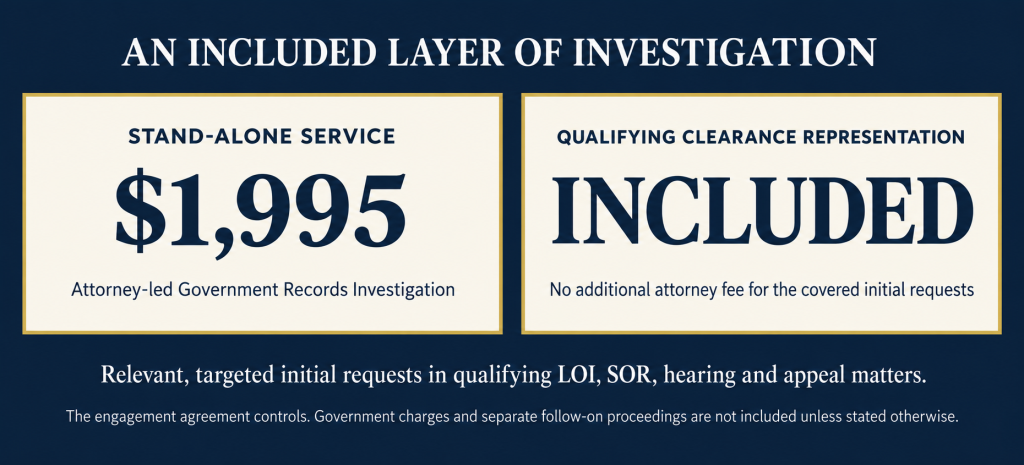
In qualifying SOR matters, NSLF prepares targeted Freedom of Information Act and Privacy Act requests for relevant government records at no additional attorney fee.
These requests may help uncover information that is missing from the SOR and the documents already in your possession.
Learn About the NSLF Government Records Investigation
7. Attorney-Drafted Response and Supporting Exhibits
An attorney prepares the covered written response using the verified facts, available evidence and agreed strategy.
When appropriate, the final package may include:
- An allegation-by-allegation answer;
- A supporting factual statement or legal memorandum;
- Rebuttal, explanation, extenuation and mitigation;
- Application of the relevant adjudicative standards;
- References to supporting evidence;
- An exhibit index and organized exhibits; and
- A conclusion explaining why the record supports favorable eligibility.
8. Attorney Review Board and Finalization
Covered SOR matters receive collaborative review through the NSLF Attorney Review Board.
The review may draw on investigative, adjudicative, judicial, national-security and litigation perspectives. The purpose is to identify unresolved allegations, unsupported claims, credibility risks, procedural problems and cross-system consequences before the response is finalized.
You review the draft for accuracy and completeness before the submission-ready package is completed.
Read more: What Does an SOR Lawyer Actually Do?
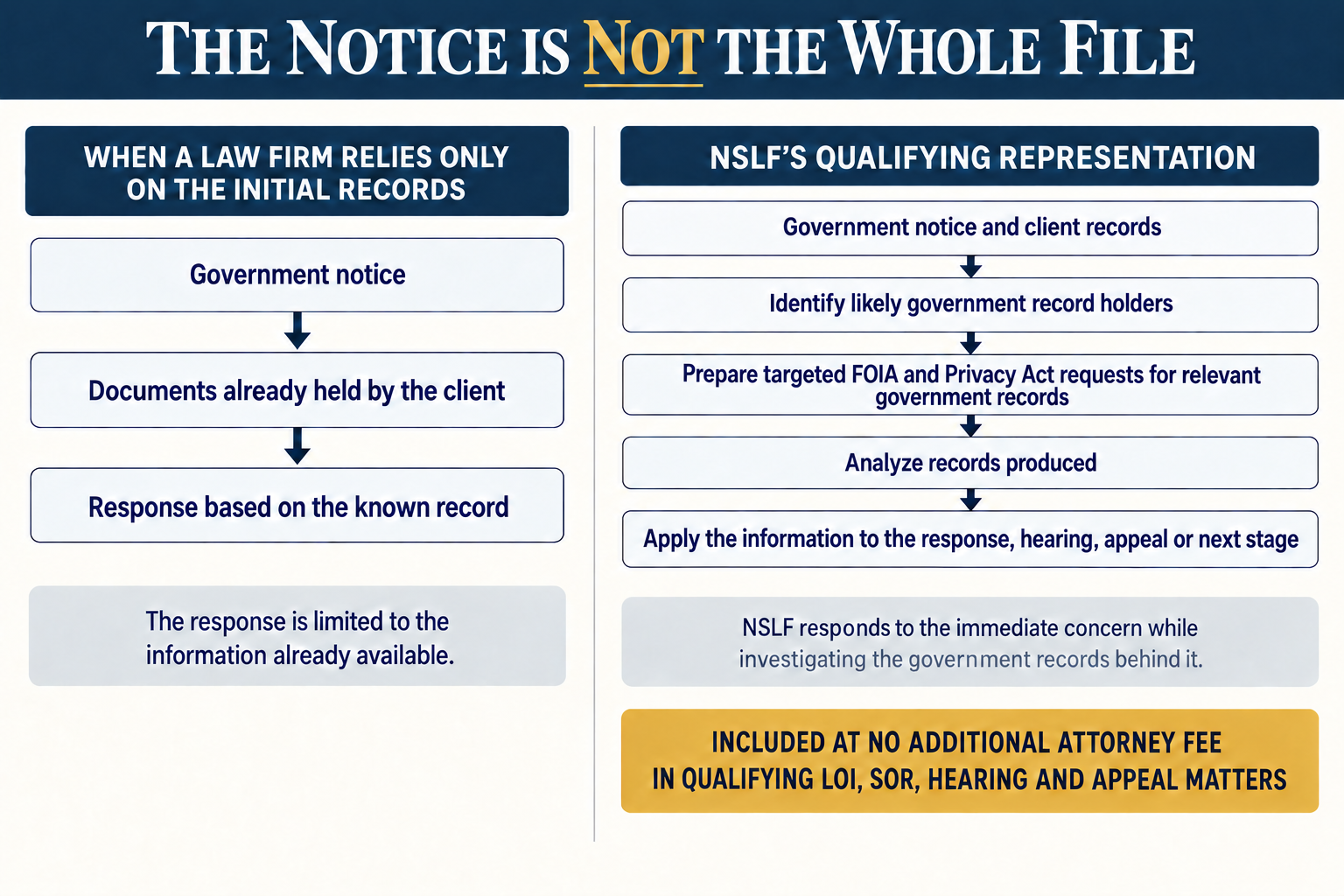
The Notice Is Not the Whole Government File
An SOR tells you what the government is alleging. It may not tell you:
- Where the information originated;
- What the original source actually reported;
- How the information changed as it moved between offices;
- Whether an investigator documented favorable facts;
- Whether you previously disclosed the information;
- Whether records contain different dates, amounts or descriptions;
- What information was omitted from the notice; or
- Whether another government office maintains a more complete version.
That is why NSLF does not automatically limit its review to the notice and the records the client already possesses.
In qualifying matters, we identify potentially relevant government record holders and prepare targeted FOIA and Privacy Act requests for the records that may matter.
These are relevant, targeted requests—not a predetermined number of generic requests sent in every case.
How Government Records May Help Your Case
They May Provide Favorable Government Documentation
The government’s own records may show that you:
- Previously disclosed the issue;
- Cooperated with investigators;
- Gave an explanation consistent with your current account;
- Completed corrective action;
- Received favorable comments from supervisors or witnesses;
- Were candid about difficult facts; or
- Were previously found reliable despite the underlying event.
That matters because favorable information documented by the government may carry more weight than an unsupported statement made only after an SOR was issued.
They May Reveal an Inaccuracy or Missing Context
A later summary may omit qualifications contained in the original report. A date, debt amount, criminal disposition or witness statement may have been recorded incorrectly. Different offices may maintain inconsistent versions of the same event.
Finding the original information may allow the response to identify the error precisely and support the correction with records—not merely claim that the allegation is wrong.
They May Prepare You for a Hearing or Appeal
Records may reveal questions, inconsistencies or additional adverse information that could arise later.
Learning about those issues early gives counsel time to:
- Investigate the discrepancy;
- Locate supporting evidence;
- Prepare the client to explain it truthfully;
- Address it before it becomes a surprise; and
- Build a more complete hearing or appellate strategy.
They May Reveal a Separate Legal Option
Records may show that information was improperly obtained, maintained, disclosed or used. They may also reveal an inadequate agency search or a disputed withholding.
Depending on the facts, the client may have a separate basis to seek disclosure, request correction or amendment, pursue administrative review or consider judicial relief. Those proceedings are not automatically included in the SOR flat fee, but the records may reveal an option the client otherwise would not have known existed.
A government-records request may strengthen today’s defense—and reveal options that would otherwise remain hidden.
Will the Government Records Arrive Before My SOR Deadline?
They may not. Government response times vary, and your SOR deadline generally continues while a records request is pending.
The immediate defense should proceed according to the instructions and deadline in the controlling notice. NSLF does not allow a pending records request to replace the work necessary to prepare the timely response.
Even when records do not arrive before the initial deadline, they may become important—or even vital—during a later personal appearance, hearing, appeal, reconsideration, future adjudication or separate records proceeding.
Records received later may:
- Provide favorable government documentation;
- Confirm that information was previously disclosed;
- Identify errors in the original allegations;
- Reveal how the concern originated;
- Prepare the client for future questioning;
- Support a request to correct or amend an inaccurate record; or
- Identify another administrative or judicial option.
★★★★★ “A Detailed Plan of Execution”
“The National Security Law Firm first and foremost were able to evaluate the SOR and create a detailed plan of execution that resulted in an expeditious restoration of clearance.”
B.R., Security Clearance SOR Client · Google Review
The Government Used a Team to Build the Case. NSLF Uses a Team to Defend It.
An SOR may reflect the work of investigators, personnel-security professionals, adjudicators, agency counsel and other government officials.
Those perspectives are connected. Your defense should be too.
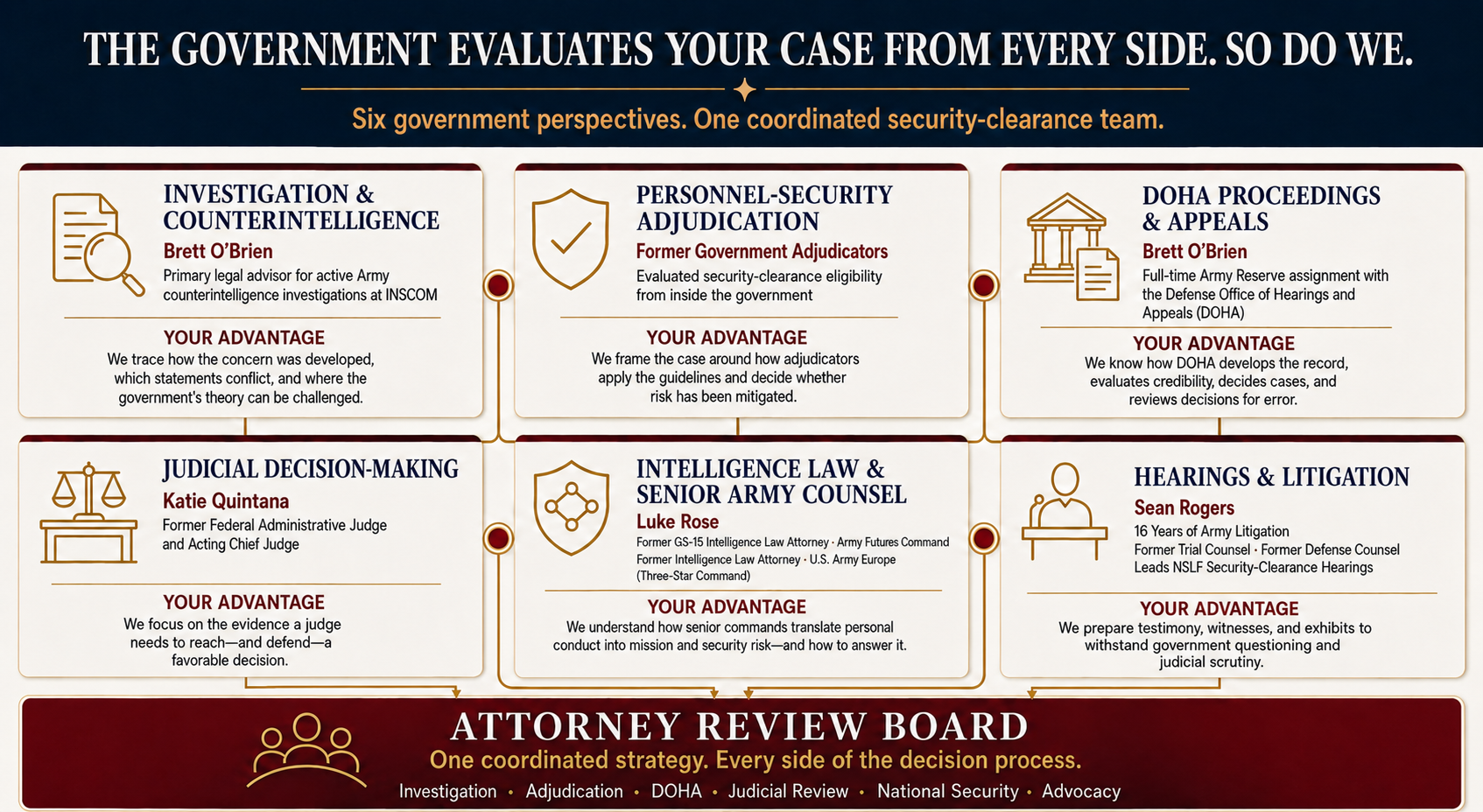
NSLF is structured to evaluate a clearance case from the corresponding sides of the government process:
- Investigation: Where did the allegations originate, and what was the investigator attempting to verify?
- Personnel security: What present risk does the government believe the conduct creates?
- Adjudication: What rebuttal, mitigation and whole-person evidence could support a favorable decision?
- Hearing and litigation: How will the written explanation and evidence withstand testimony and questioning?
- Appeal: Has the record been developed and preserved for later review?
- Related systems: Could the response affect employment, suitability, military, criminal or other government matters?
You have one lead attorney and one coordinated strategy. When the issues warrant it, that attorney can draw on other NSLF lawyers through the Attorney Review Board.
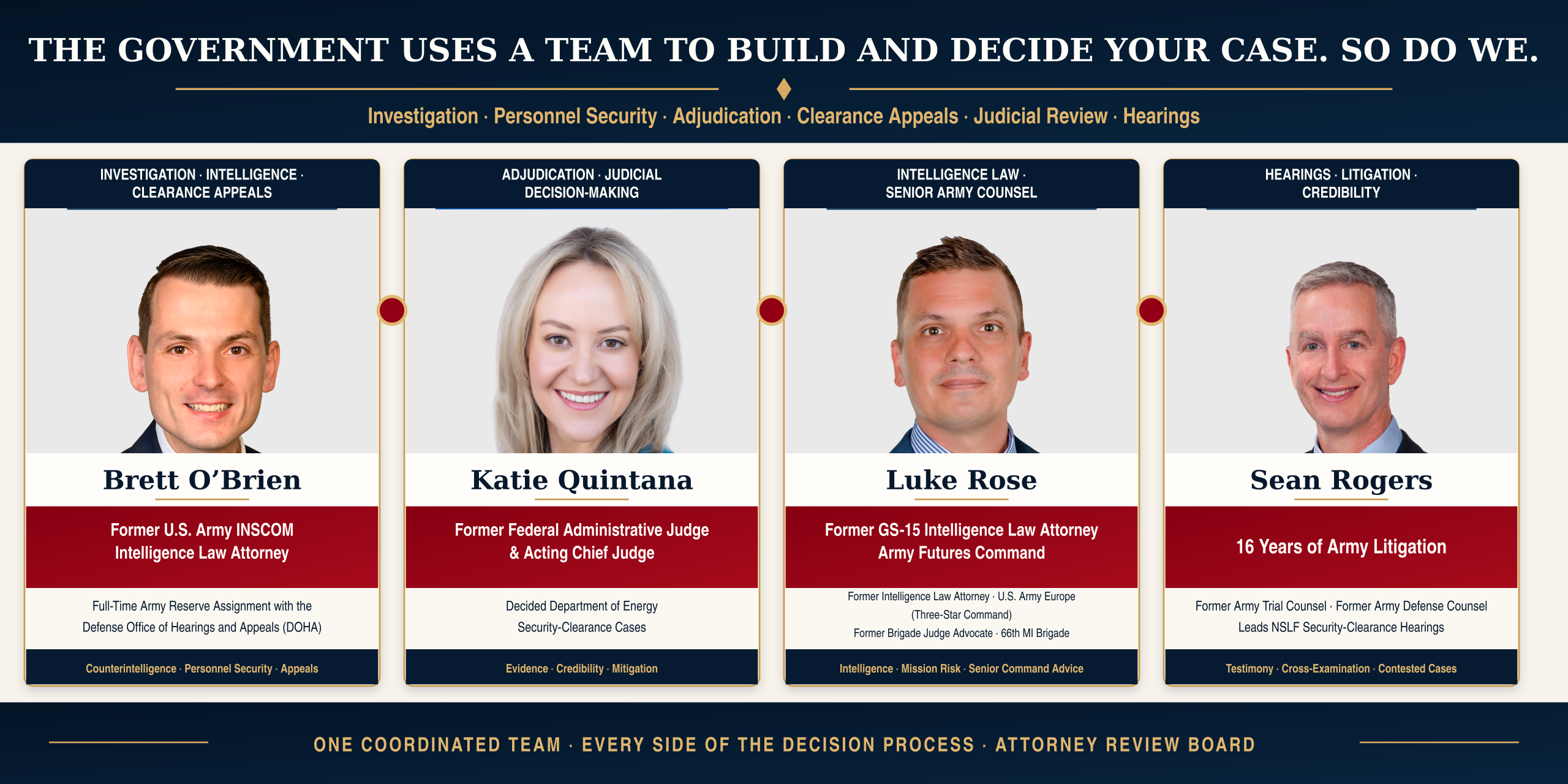
Investigation and Counterintelligence: Brett O’Brien
Brett O’Brien served as an Intelligence Law Attorney for U.S. Army Intelligence and Security Command and as the primary legal adviser for active Army counterintelligence investigations. He also served on a full-time Army Reserve assignment with the Defense Office of Hearings and Appeals (DOHA), the Department of Defense office that conducts significant security-clearance hearings and appellate reviews.
Why it matters: His background helps the team evaluate how allegations were developed, identify gaps or unsupported assumptions and anticipate how the response may be used in later proceedings.
Adjudication and Judicial Decision-Making: Katie Quintana
Katie Quintana served as a federal Administrative Judge and Acting Chief Judge deciding Department of Energy security-clearance cases. NSLF’s team also includes former government security-clearance adjudicators.
Why it matters: The response is tested against the questions a clearance decision-maker must answer: What facts are established? Is the explanation credible? Does the evidence mitigate the concern? Can a favorable decision be supported by the complete record?
Intelligence Law and Command Risk: Luke Rose
Luke Rose served as a GS-15 Intelligence Law Attorney for Army Futures Command, an Intelligence Law Attorney for U.S. Army Europe and Brigade Judge Advocate for the 66th Military Intelligence Brigade.
Why it matters: His experience helps the team understand how commands and intelligence organizations translate personal conduct into mission, access, vulnerability and national-security concerns.
Hearings and Contested Cases: Sean Rogers
Sean Rogers brings 16 years of Army litigation experience as both trial counsel and defense counsel. He leads NSLF’s security-clearance hearing work.
Why it matters: A hearing perspective helps identify vague explanations, weak evidence and credibility vulnerabilities before the written response becomes part of the permanent record.
Meet the NSLF Security Clearance Team
★★★★★ “Honest, Realistic Advice—No Guarantees”
“They listened to my story and gave me honest, realistic advice. They never sugarcoated the process or guaranteed a win.”
P.A., Security Clearance Client · Google Review
How the SOR Representation Process Works
Step 1: Send Us the Complete Notice
Provide the transmittal letter, complete SOR, attachments, instructions, election form and deadline. Tell us about any prior LOI response, extension request, election or submission.
Step 2: Review the Procedure and Protect the Deadline
If NSLF accepts the matter and you retain the firm, we confirm the scope and identify immediate procedural issues. The existing deadline remains controlling unless the appropriate authority grants an extension.
Step 3: Reconstruct the Record
We review the relevant information you provide, including prior forms, disclosures, interview information and records connected to the allegations. We build a timeline and identify missing evidence, inconsistencies and credibility risks.
Step 4: Develop the Response and Records Strategy
The attorney maps each allegation to the applicable concern, develops the rebuttal and mitigation plan and identifies relevant government records that should be requested.
Step 5: Draft, Organize and Review
An attorney prepares the response and supporting exhibits. You verify the facts. The covered matter proceeds through NSLF’s review process, and reasonable revisions are completed.
Step 6: Finalize the Submission
We provide the submission-ready package and filing guidance consistent with the procedure stated in your notice and the scope of the engagement agreement.
How a Decision-Maker Evaluates Your Response
A security-clearance decision is a national-security risk assessment. It is not simply a decision about whether you are a good person.
A persuasive response helps the decision-maker answer four questions:
What Facts Are Established?
Each allegation needs a clear and accurate answer supported by available evidence.
What Security Concern Do Those Facts Raise?
The response must address the government’s actual risk theory—not merely argue that the situation feels unfair.
What Rebuttal or Mitigation Changes the Risk Assessment?
The evidence may show that the allegation is inaccurate, the conduct was isolated, corrective action has been completed, vulnerability has been reduced or recurrence is unlikely.
Can a Favorable Decision Be Supported by the Whole Record?
Decision-makers may consider credibility, consistency, candor, cooperation, judgment, recency, frequency, rehabilitation and the likelihood of recurrence.
The objective is not to overwhelm the reviewer. It is to make the favorable reasoning clear and support it with usable evidence.
Read more: The Whole-Person Concept Explained
Written Response, Personal Appearance or Hearing?
The available procedure depends on the population, agency and notice involved.
Some covered industrial-contractor cases may proceed to an evidentiary hearing before a DOHA Administrative Judge or to a decision based on the written record.
Certain current Defense Counterintelligence and Security Agency Security Review Proceedings may offer a virtual administrative personal appearance before a senior adjudicator after the written response. That process is not the same as a full evidentiary hearing, and the attorney’s role may be limited.
Other federal agencies and intelligence-community components use different procedures.
The rights, choices and deadlines in your actual notice control. Programs and procedures may change, so the current notice and governing agency instructions must be reviewed before making an election.
The $5,000 SOR service includes advice concerning an election presented with the covered SOR. It does not include preparation for or attendance at a personal appearance, hearing or appeal unless the engagement agreement expressly includes that work.
Read more:
Learn About Security Clearance Hearing Representation
Why SOR Responses Commonly Fail
Answering With a General Story
A long narrative may leave individual allegations unanswered. Each allegation needs a deliberate, accurate position.
Arguing Only That the Process Is Unfair
The response must address the facts and the government’s security concern, even when an allegation is incomplete or unfairly characterized.
Using Generic Character Evidence
Awards and character letters may help, but they do not automatically resolve a specific financial, substance-related, foreign-influence, criminal or personal-conduct concern.
Creating a New Credibility Problem
Minimization, exaggeration, speculation and unexplained inconsistencies may turn the case into a candor or personal-conduct problem.
Copying a Sample Response
A sample cannot account for your disclosure history, prior interviews, evidence, applicable procedure or related government matters.
Waiting Until the Final Days
Obtaining records, declarations, evaluations and corrective-action evidence takes time. An early start creates more options.
Read more: Why Most Security Clearance SOR Responses Fail
Common Issues in SOR Cases
NSLF handles SORs involving one or multiple adjudicative guidelines, including:
- Allegiance to the United States;
- Foreign influence;
- Foreign preference;
- Sexual behavior;
- Personal conduct;
- Financial considerations;
- Alcohol consumption;
- Drug involvement and substance misuse;
- Psychological conditions;
- Criminal conduct;
- Handling protected information;
- Outside activities; and
- Use of information technology.
One event may implicate several guidelines and several government systems. For example, drug use may raise substance-misuse, criminal-conduct, personal-conduct and disclosure concerns.
The response must address how those concerns interact without creating contradictions between the clearance case and a related employment, suitability, military or criminal matter.
Read more:
Review the Security Clearance Adjudicative Guidelines
What Multiple Adjudicative Guidelines Mean
The $5,000 Flat Fee
| Covered service | Scope |
|---|---|
| Attorney-led SOR analysis | Review of the covered notice, allegations, procedure and deadline |
| Strategy conference | Attorney consultation concerning facts, risks and response strategy |
| Written response | Attorney-drafted allegation-by-allegation response |
| Evidence development | Targeted rebuttal and mitigation plan |
| Supporting package | Organization of covered exhibits and final submission materials |
| Government Records Investigation | Covered initial requests included at no additional attorney fee in qualifying SOR matters |
| Attorney Review Board | Collaborative review for covered SOR matters |
| Client revisions | Reasonable revisions based on timely feedback and supporting materials |
| Flat fee | $5,000 |
Read more: How Much Does an SOR Lawyer Cost?
Prior LOI Clients May Qualify for a Credit
If NSLF represented you in the preceding Letter of Interrogatory matter and the government later issued an SOR, a $3,000 credit may apply toward the $5,000 SOR response fee.
If approved, that would leave $2,000 due for the covered SOR response.
Eligibility, timing, scope and the relationship between the two matters are governed by the applicable engagement agreements.
What Is Not Included?
Unless expressly included in the engagement agreement, the $5,000 written-response service does not include:
- Preparation for or attendance at a personal appearance or hearing;
- An appeal, reconsideration request or later filing;
- Representation in a related employment, suitability, military, criminal or civil matter;
- Third-party witness interviews or private investigative services;
- Experts, evaluations, treatment, testing or other professional services;
- Government fees or other third-party expenses;
- Administrative appeals or litigation concerning records requests;
- Privacy Act amendment proceedings;
- Work involving materially expanded or new allegations; or
- A guarantee that clearance eligibility, access or employment will be granted or retained.
The engagement agreement controls the exact scope of representation.
Security Clearance SOR Frequently Asked Questions
How Quickly Should I Contact an Attorney?
Immediately. Your notice may impose a short deadline, and collecting records and developing mitigation takes time.
Should I Respond Before Speaking With an Attorney?
Avoid making a rushed submission merely to respond quickly. Your response becomes part of the government record and may be compared with prior or future statements. Continue following the notice, but obtain advice as early as possible.
What If an Allegation Is Wrong?
Identify precisely what is wrong and gather evidence supporting the correction. A bare denial may not be enough when the government believes it possesses contrary information.
Will the Government Records Arrive Before My Deadline?
Not necessarily. The immediate response should proceed while requests are pending. Records received later may still become important at a personal appearance, hearing, appeal, later adjudication or separate records proceeding.
Does the Flat Fee Include a Hearing?
No. The $5,000 fee covers the written SOR response described in the engagement agreement. Hearing preparation and attendance require a separate scope unless expressly included.
Does NSLF Guarantee That I Will Keep My Clearance?
No attorney can guarantee a security-clearance outcome. Decisions depend on the allegations, evidence, applicable standards, procedure and government decision-maker.
What Should I Send for the Consultation?
Send the complete SOR package, including:
- The transmittal letter;
- Every page of the SOR;
- All attachments;
- Response instructions;
- Election documents; and
- The stated deadline.
Also tell us whether you previously completed an LOI response, requested an extension, made an election or submitted any documents.
Additional Statement of Reasons Guides
- How to Respond to a Statement of Reasons
- How to Build a Strong Security Clearance SOR Case
- Do You Really Need a Lawyer for an SOR Response?
- Why SOR Allegations Are Often Written Broadly
- When Not to Challenge the Government’s SOR Evidence
- How the Government Evaluates Security Clearance Mitigation
Research Your Security Clearance Issue
The Security Clearance Resource Center organizes NSLF’s most important explanations, guides and legal resources by stage and issue.
Use it to learn more about:
- The security-clearance process;
- SF-86 and eApp preparation;
- Background investigations;
- Letters of Interrogatory;
- Statements of Reasons;
- Adjudicative guidelines;
- DOHA hearings;
- Appeals and reconsideration;
- Continuous vetting; and
- Government-records requests.
The Resource Center provides general information. If you already have an SOR and a deadline, consultation with an attorney should take priority over extended research.
Visit the Security Clearance Resource Center
Speak With a Security Clearance SOR Lawyer
An SOR is a formal government action. The response may shape the immediate decision, a later hearing or appeal and how the same information is evaluated across other federal systems.
NSLF combines government investigation, adjudication, administrative judging, intelligence law, DOHA and litigation experience through one coordinated legal strategy.
$5,000 Flat Fee · Nationwide Representation · Attorney-Drafted Response · Government Records Investigation · Attorney Review Board
Send us the complete notice as soon as possible. Do not assume that contacting or retaining an attorney extends your deadline.
This page provides general information and is not legal advice. Security-clearance procedures vary by agency, population and governing authority. The notice and current instructions applicable to your case control. Past results and client reviews do not guarantee a similar outcome. The exact scope of representation is governed by the signed engagement agreement. Contacting NSLF does not create an attorney-client relationship.