
Your case has reached the stage where the government’s evidence, your testimony, and your credibility may be tested before an Administrative Judge.
At a hearing before the Defense Office of Hearings and Appeals (DOHA)—the Department of Defense office that conducts and decides many industrial security-clearance cases—Department Counsel represents the government, witnesses may be questioned, exhibits become part of the record, and the judge evaluates whether the security concerns have been resolved.
National Security Law Firm prepares and presents the complete hearing case. Our team includes an attorney who served on a full-time Army Reserve assignment inside DOHA, a former federal Administrative Judge and Acting Chief Judge who decided Department of Energy clearance cases, former government adjudicators, senior Army intelligence-law counsel, and a military litigator with 16 years of courtroom experience who leads NSLF’s security-clearance hearings.
$7,500 Flat Fee · Evidence and Witness Development · Government Records Investigation · Testimony Preparation · Hearing Representation · Attorney Review Board
Your hearing date and prehearing deadlines control. Send us the hearing notice, Statement of Reasons, your SOR answer, government exhibits, correspondence, orders, and every stated deadline as soon as possible. Contacting or retaining counsel does not automatically postpone the hearing or extend any deadline.
★★★★★ 4.9 Stars From 300+ Google Reviews
Investigation · Personnel Security · Adjudication · DOHA · Hearings · Appeals
The Government Evaluates Your Hearing From Every Side. So Do We.
A security-clearance case is rarely built or decided by one government professional. Investigators develop the underlying facts. Personnel-security specialists and intelligence professionals evaluate risk. Adjudicators apply the national guidelines. Department Counsel presents the government’s case. An Administrative Judge evaluates the evidence, testimony, credibility, and mitigation.
Each professional may examine the same conduct from a different perspective. A fact that appears harmless in isolation may become more significant when compared with an earlier disclosure, an investigative interview, a Letter of Interrogatory response, or the answer to the Statement of Reasons.
NSLF brings corresponding experience to the defense. Covered hearing matters receive coordinated review through our Attorney Review Board, allowing the case to be tested from the investigative, adjudicative, DOHA, judicial, national-security, and litigation perspectives before the record closes.
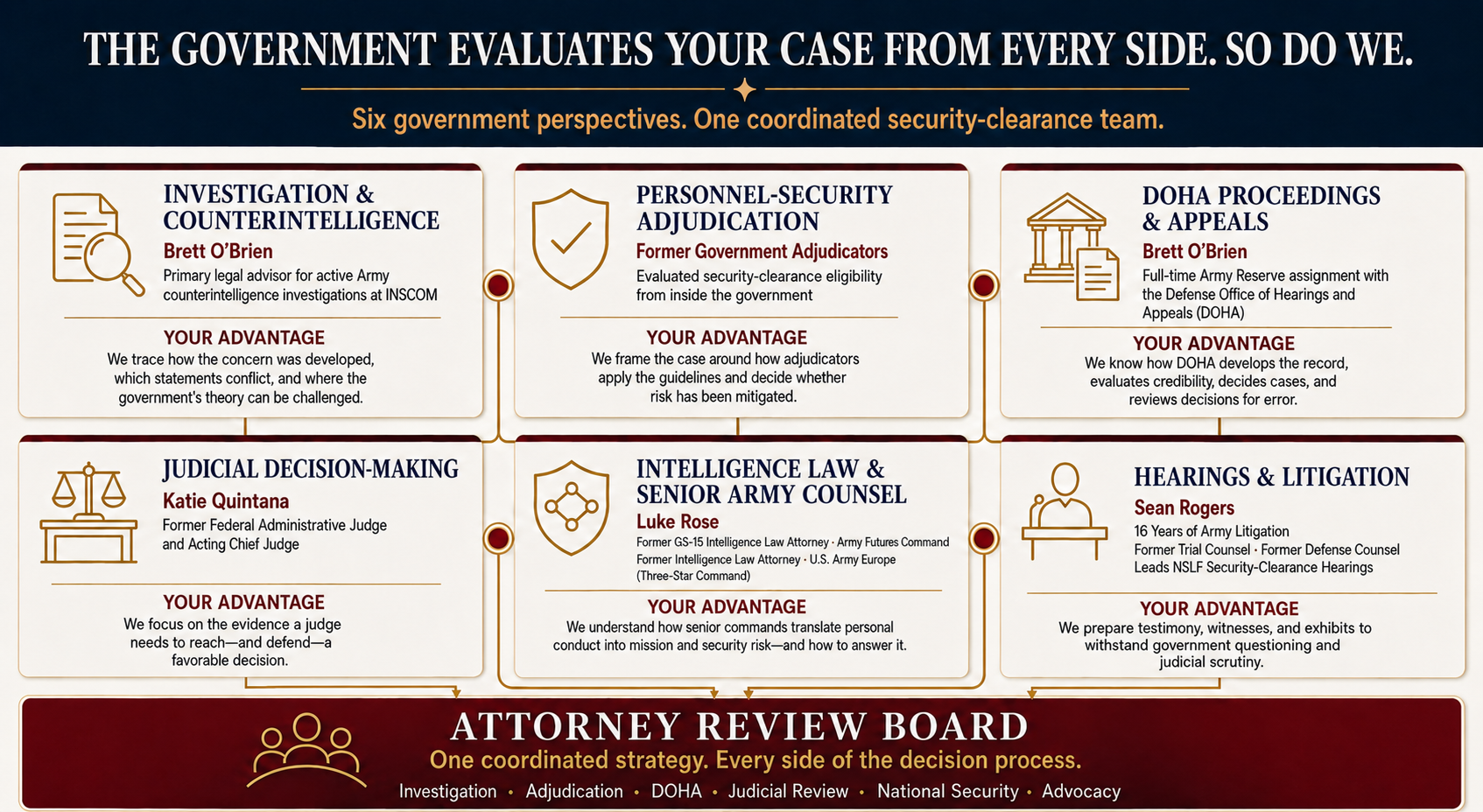
The objective is one organized hearing strategy: identify how the government developed the concern, determine what the evidence must establish, anticipate the questions the judge and Department Counsel may ask, and present a record capable of supporting a favorable decision.
Have Our Team Review Your Hearing Case
DOHA Hearing Representation — $7,500 Flat Fee
The flat fee covers attorney representation for the defined DOHA hearing stage. It includes the work required to prepare the case before the hearing—not merely an attorney’s appearance on the hearing date.
Included
- Review of the hearing notice, orders, Statement of Reasons, SOR answer, government exhibits, and available prior record
- Allegation-by-allegation hearing strategy
- Adjudicative-guideline and whole-person analysis
- Evidence-development plan
- Government Records Investigation, including targeted initial Freedom of Information Act and Privacy Act requests to relevant government record holders when appropriate in a qualifying matter
- Witness identification and preparation
- Applicant testimony and cross-examination preparation
- Exhibit organization and covered prehearing filings
- Attorney Review Board
- Final hearing preparation
- Attorney representation at the covered hearing
- Covered post-hearing guidance
Separate Engagement or Expense Generally Required
- Preparation of the initial SOR written response
- A DOHA Appeal Board appeal, response, or reply brief
- A reopened hearing, remand, or additional proceeding
- A separate military, federal-employment, suitability, fitness, access, criminal, or licensing matter
- Experts, evaluators, investigators, treatment providers, or other third-party professionals
- Travel, witness, records, transcript, testing, and other third-party costs
The signed engagement agreement controls the precise scope, fee, expenses, filing responsibilities, and conclusion of representation.
The Government Has Counsel. Your Hearing Case Should Be Fully Prepared.
A DOHA industrial security-clearance hearing is an adversarial administrative proceeding. Department Counsel represents the government and ordinarily relies on the investigative and documentary record supporting the allegations in the Statement of Reasons. The applicant is responsible for presenting the documents and witnesses offered to rebut, explain, extenuate, or mitigate the government’s case.
This is not an informal conversation with the judge. It is the proceeding in which the evidence is presented, explanations are tested, credibility may be assessed, and the record for any later appeal is created.
A hearing may include:
- preliminary procedural matters;
- opening statements;
- government documents and witnesses;
- the applicant’s documents and witnesses;
- direct examination and cross-examination;
- questions from the Administrative Judge;
- evidentiary objections;
- closing arguments applying the record to the adjudicative guidelines; and
- an official transcript.
The Administrative Judge generally does not announce the decision at the conclusion of the hearing. A written decision is issued later, after the record closes.
If the decision is appealed, the DOHA Appeal Board reviews the existing record for error and does not accept new evidence. Evidence omitted from the hearing ordinarily cannot be added later simply because it might have produced a different result.
The hearing is therefore not merely a chance to speak. It is the opportunity to build and present the evidentiary record on which the case will be decided and any appeal will be reviewed.
Everything Included in the $7,500 Flat Fee
You are not hiring NSLF simply to appear at the hearing. You are hiring a security-clearance team to reconstruct the record, isolate the issues that will be tested, develop the evidence and witnesses, prepare you to testify, and present the case before the Administrative Judge.
1. Hearing Notice, Order, and Deadline Review
We review the hearing notice, scheduling information, applicable orders, prehearing instructions, submission deadlines, and the procedure governing the covered matter. We identify immediate obligations and determine whether a preliminary request requires consideration.
Continuances and extensions are not automatic. The scheduled hearing and existing deadlines remain controlling unless the Administrative Judge or appropriate authority grants relief.
2. Review of the Government’s Case and Complete Available Record
We examine the Statement of Reasons, your written answer, the government’s proposed exhibits, investigative materials made available to you, relevant prior disclosures, Department Counsel’s position, and procedural correspondence.
The review is designed to identify:
- the allegations that remain disputed;
- facts already admitted or denied;
- evidence supporting the government’s allegations;
- inconsistencies or omissions likely to receive attention;
- findings or issues that may affect credibility;
- mitigation already established; and
- evidentiary gaps that should be addressed before the hearing.
3. Attorney Hearing-Strategy Conference
You meet with counsel to discuss the underlying events, existing record, current circumstances, potential witnesses, available supporting documents, and the professional consequences at stake.
Together, we develop the central theory of the case: which allegations must be rebutted, which facts must be acknowledged and mitigated, what the evidence must establish, and why the present record supports judgment, reliability, candor, rehabilitation, and reduced risk.
4. Allegation-by-Allegation Hearing Map
We organize each SOR allegation by the applicable adjudicative guideline, the government’s evidence, your prior answer, admitted and disputed facts, credibility considerations, and the evidence available for rebuttal or mitigation.
This keeps the hearing focused on the actual issues the judge must decide. A general life story—even if sincere—may not resolve the specific national-security concerns presented in the SOR.
5. Adjudicative-Guideline and Whole-Person Analysis
We evaluate the case under the applicable national security adjudicative guidelines, mitigating conditions, and whole-person considerations. Depending on the allegations, the analysis may address:
- the nature, seriousness, frequency, and recency of the conduct;
- the surrounding circumstances;
- candor, cooperation, and consistency;
- whether the conduct was voluntary, negligent, or undertaken with knowledge of its consequences;
- corrective action, rehabilitation, and changed circumstances;
- current vulnerability or external pressure;
- the likelihood of continuation or recurrence; and
- whether the complete record supports eligibility as clearly consistent with the interests of national security.
6. Personalized Evidence-Development Plan
We identify the records and other proof that may help rebut, explain, extenuate, or mitigate the allegations. Depending on the issues, this may include:
- tax documentation, payment records, budgets, credit reports, repayment evidence, or financial counseling;
- court dispositions, police reports, probation records, or proof of completed obligations;
- treatment, evaluation, testing, counseling, rehabilitation, or aftercare documentation;
- foreign-contact, citizenship, travel, residence, property, business, or financial records;
- security training, self-reporting, employment, or military records;
- proof of changed circumstances, compliance, sustained improvement, or passage of time;
- relevant declarations; and
- other objective evidence tied to a particular allegation or mitigating condition.
Every proposed exhibit should have a defined purpose. Unrelated material can distract from the strongest evidence and may introduce information requiring additional explanation.
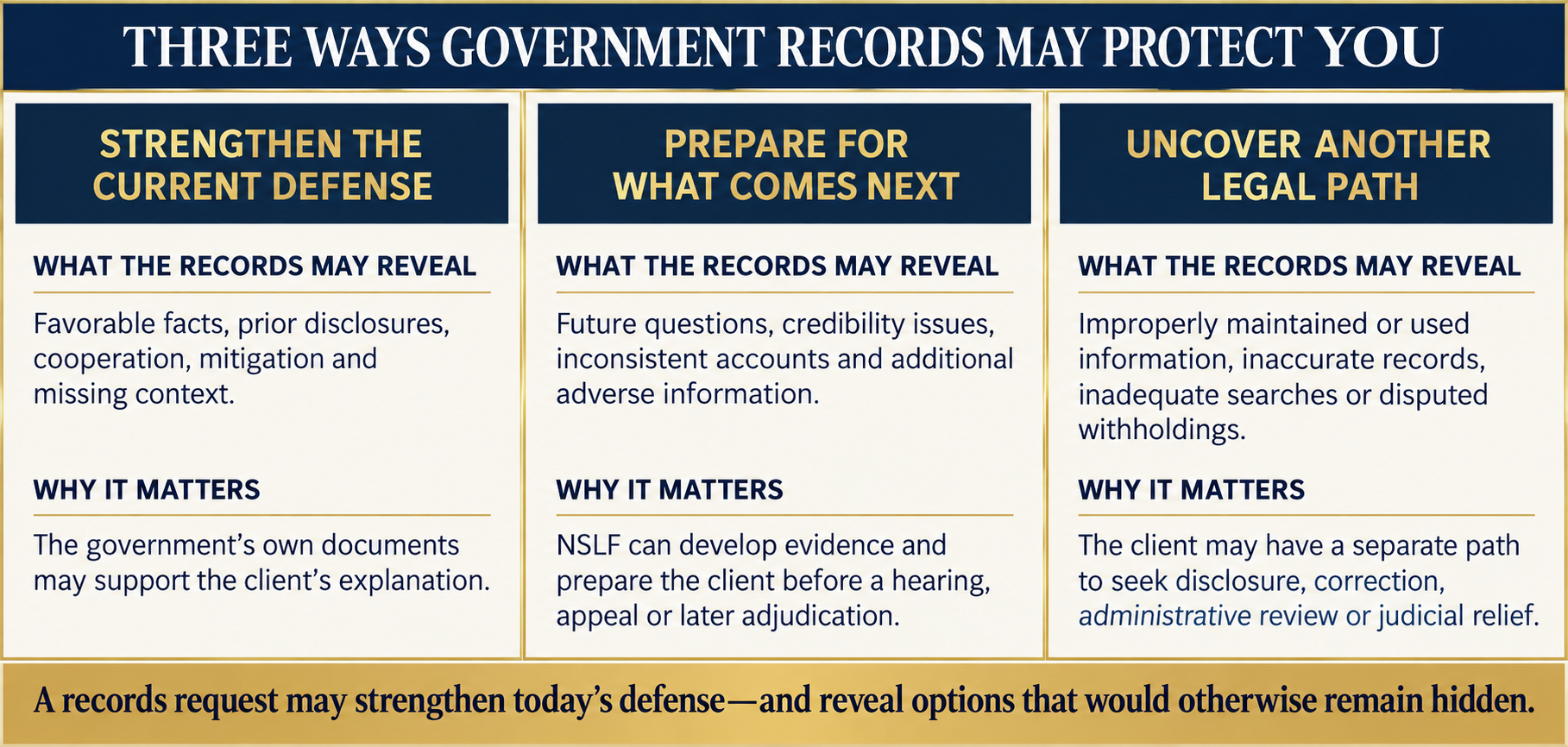
7. Government Records Investigation: The Government’s Exhibits May Not Be the Whole File
The government exhibit package may not contain every record relevant to the security concern. Different offices may possess background-investigation records, interview notes, adjudicative records, prior security questionnaires, personnel-security files, military or law-enforcement records, and other documents concerning the same issue.
Those records can matter in several important ways:
- They may support your explanation. Government records may document prior disclosure, cooperation, favorable facts, mitigating circumstances, or context that does not appear in the Statement of Reasons or exhibit package.
- They may reveal inaccuracies or inconsistencies. One government office may describe an event differently from another, or an allegation may have developed from incomplete, disputed, or incorrectly maintained information.
- They may help us prepare for difficult questions. Records can identify credibility concerns, conflicting accounts, or additional adverse information that should be addressed before you testify.
- They may reveal another legal option. In some cases, the records may provide a basis to evaluate a request for correction, an administrative challenge, or separate judicial relief.
When appropriate in a qualifying hearing matter, NSLF identifies the relevant government record holders and prepares targeted initial Freedom of Information Act and Privacy Act requests. We pursue those records while continuing to prepare the immediate hearing defense under the controlling orders and deadlines.
Government response times vary, so the requested records may not arrive before the hearing or before the record closes. If they arrive in time and the governing procedure permits their use, they may strengthen the documentary evidence, witness preparation, testimony, credibility analysis, or response to the government’s case.
Records received later may still help the client understand what happened, prepare for a future adjudication, or evaluate a separate avenue for obtaining, challenging, or correcting government information. They ordinarily cannot simply be introduced as new evidence in an appeal from a closed hearing record.
Included at no additional attorney fee in qualifying hearing matters: Attorney-led Government Records Investigation and the covered initial requests to relevant government record holders. The engagement agreement controls. Government charges, administrative appeals concerning the requests, Privacy Act amendment proceedings, litigation, and other follow-on matters are not included unless expressly stated.
8. Witness Identification and Preparation
We help determine whether a witness can materially strengthen the case, what firsthand knowledge the witness possesses, and whether live testimony or a written declaration is the better method under the circumstances.
When a witness will testify, preparation may address:
- the purpose of the testimony;
- the facts within the witness’s personal knowledge;
- anticipated direct-examination topics;
- possible cross-examination and judicial questions;
- the importance of truthful, specific, non-speculative answers; and
- the practical requirements for appearing remotely or in person.
The Administrative Judge generally lacks authority to subpoena a witness for the applicant. Witness participation must be planned and confirmed, and any associated costs are the client’s responsibility unless the engagement says otherwise.
9. Applicant Testimony Preparation
We prepare you for the experience of testifying—not by scripting an answer or coaching a preferred story, but by ensuring that you understand the record, the disputed issues, the government’s concerns, and the need to answer every question truthfully and directly.
Preparation may include:
- the structure and objectives of direct examination;
- likely questions from Department Counsel;
- questions the Administrative Judge may ask;
- difficult facts, omissions, or inconsistencies in the record;
- the difference between rebuttal, explanation, excuse, and mitigation;
- how to answer clearly without guessing or volunteering unrelated information; and
- conduct and technology expectations for a remote or in-person hearing.
10. Cross-Examination and Credibility Preparation
Department Counsel and the Administrative Judge may compare your testimony with prior forms, interviews, correspondence, documents, and written answers. We identify the areas most likely to receive scrutiny and prepare you to confront them accurately and without defensiveness, speculation, or minimization.
Credibility preparation is not about avoiding difficult questions. It is about understanding why they matter and ensuring that the testimony is truthful, direct, and consistent with the available evidence.
11. Exhibit Selection and Hearing Package
We help select, label, organize, and submit the proposed exhibits required for the covered hearing. When appropriate, the package may include an exhibit index and references designed to help the judge connect the evidence with the allegations it addresses.
We also review the government’s proposed exhibits and evaluate whether clarification, rebuttal evidence, or an evidentiary objection should be considered.
12. Covered Prehearing Filings and Coordination
Counsel handles reasonable prehearing filings and communications necessary for the covered hearing. Depending on the orders and posture of the matter, this may include:
- a notice of appearance;
- exhibit exchange;
- witness information;
- required prehearing submissions;
- scheduling communications; and
- appropriate procedural requests.
13. Attorney Review Board
Covered hearing matters receive collaborative review through NSLF’s Attorney Review Board. One attorney leads the representation, but the strategy is not confined to one lawyer’s professional background.
Depending on the issues, the review can draw on former clearance decision-maker, adjudicative, DOHA, intelligence-law, national-security, judicial, and litigation perspectives.
The review tests for:
- an allegation that has not been squarely answered;
- a factual position unsupported by the record;
- a conflict with an earlier disclosure or statement;
- evidence that does not establish the claimed mitigation;
- a credibility problem likely to concern the judge;
- testimony risk under cross-examination;
- an argument Department Counsel may exploit; and
- language that could create consequences in a separate government proceeding.
14. Final Hearing Preparation
Before the hearing, counsel confirms the presentation plan, exhibits, witness sequence, direct-examination subjects, anticipated cross-examination issues, technology or location arrangements, and the client’s remaining questions.
For a remote hearing, the client and witnesses remain responsible for having a private location, reliable connection, appropriate equipment, and the ability to comply with the judge’s instructions.
15. Attorney Representation at the Hearing
Counsel appears with you and presents the defense under the procedure established by the Administrative Judge. Representation may include:
- addressing preliminary matters;
- presenting an opening statement when strategically appropriate;
- responding to or making evidentiary objections;
- examining the applicant and other defense witnesses;
- cross-examining government witnesses, if any;
- responding to questions and issues raised during the proceeding;
- presenting and explaining documentary evidence; and
- delivering a closing argument connecting the hearing record to the adjudicative guidelines and requested determination.
16. Post-Hearing Guidance Within the Covered Stage
After the hearing, we explain the immediate next steps, respond to reasonable questions concerning the completed proceeding, and address any submission specifically authorized or ordered by the Administrative Judge that falls within the signed engagement agreement.
The judge ordinarily issues a written decision later. An appeal, remand, reopened hearing, new proceeding, or separate post-hearing matter is not included unless expressly stated in writing.
What the $7,500 Flat Fee Does Not Include
Unless specifically added to the engagement agreement, the hearing service does not include:
- preparing the initial SOR written response if that stage has not already been completed;
- a DOHA Appeal Board appeal, response, or reply brief;
- representation after a remand or at a reopened or additional hearing;
- representation in a separate federal-employee, service-member, or agency personal-appearance process;
- representation in a related access, employment, suitability, fitness, military, criminal, civil, debarment, licensing, or disciplinary proceeding;
- expert evaluations, testimony, testing, counseling, treatment, or other third-party professional services;
- witness expenses, expert fees, travel, lodging, records charges, or other third-party expenses;
- attorney travel time or expenses for an in-person hearing unless expressly included;
- private investigative services, witness-location services, compulsory process, or investigative work beyond the included Government Records Investigation;
- government records charges, administrative appeals concerning records requests, Privacy Act amendment proceedings, litigation, or other follow-on records matters unless expressly included;
- work involving new allegations or a materially expanded proceeding outside the covered matter; or
- any guarantee that eligibility, access, employment, or another status will be granted, retained, or restored.
Why Hearing Preparation Begins With the Existing Record
The hearing does not erase the SF-86, investigative interviews, Letter of Interrogatory response, SOR answer, self-reports, or other documents already in the case. It tests them.
Prior Statements Can Become Cross-Examination Material
An explanation offered for the first time at the hearing may be viewed differently from one documented earlier. Counsel must understand what was previously said, identify genuine inconsistencies, and determine what evidence can fairly explain them.
Evidence Must Be Connected to a Security Concern
General evidence of professional success or good character may contribute to the whole-person analysis, but it does not automatically resolve a particular allegation. The presentation should establish how the evidence rebuts a fact, satisfies a mitigating condition, demonstrates rehabilitation, or reduces the likelihood of recurrence.
Credibility Is Evaluated Across the Complete Record
The judge may evaluate not only what you say at the hearing, but how the testimony fits the documents, prior statements, and other evidence. Preparation helps you confront difficult facts directly without minimizing, exaggerating, or guessing.
The Hearing Record Controls a Later Appeal
The DOHA Appeal Board reviews the Administrative Judge’s decision for error. It does not provide a new hearing or accept evidence that was never presented to the Hearing Office judge. Important evidence ordinarily must be developed before or during the hearing under the governing procedure.
How DOHA Hearing Representation Works
Step 1: Send Us the Complete File and Every Deadline
Provide the hearing notice, SOR, SOR answer, government exhibit package, scheduling communications, orders, prior investigative materials available to you, and all deadlines. Tell intake immediately if the hearing is near.
Step 2: Confirm the Engagement and Immediate Obligations
If NSLF accepts the matter and you retain the firm, counsel confirms the scope, enters an appearance when appropriate, and evaluates pending deadlines and procedural requirements. Retaining counsel does not itself postpone the hearing.
Step 3: Reconstruct the Record and Build the Case Theory
We analyze the allegations and prior record, develop the chronology, identify disputed and admitted facts, and determine what the evidence and testimony must establish.
Step 4: Develop the Documents and Witnesses
You work with the team to obtain relevant documents and confirm witness availability. Counsel evaluates each proposed exhibit and witness against the allegations and mitigation strategy.
When appropriate in a qualifying matter, NSLF also identifies relevant government record holders and initiates covered Freedom of Information Act and Privacy Act requests. Because government response times vary, hearing preparation continues under the controlling orders and deadlines while those requests are pending.
Step 5: Prepare the Testimony and Presentation
We prepare the applicant and appropriate witnesses, organize the exhibits, anticipate the government’s arguments, and refine the direct examination, cross-examination strategy, and closing themes.
Step 6: Review the Case Through the Attorney Review Board
Before the hearing, the case is tested through the professional perspectives relevant to the issues presented. The assigned attorney then integrates that review into one coordinated hearing strategy.
Step 7: Appear and Present the Case
Counsel represents you at the hearing, presents the defense evidence and testimony, responds to the government’s case, and explains why the complete record supports the requested determination.
Step 8: Await the Written Decision
The Administrative Judge generally issues a written decision after the hearing. If the result is unfavorable—or Department Counsel appeals a favorable decision—appellate representation requires a separate evaluation and engagement.
Beginning early gives the team more time to obtain records, secure witnesses, analyze inconsistencies, and prepare testimony before the hearing date.
What the Administrative Judge Will Evaluate
A DOHA hearing is a national-security risk and credibility determination governed by the admitted record, the national adjudicative guidelines, and the applicable legal standard.
The judge may evaluate:
- whether the government established the controverted facts alleged in the SOR;
- whether admitted or proven conduct raises a security concern;
- whether the applicant rebutted, explained, extenuated, or mitigated that concern;
- whether the testimony is candid, consistent, and supported by other evidence;
- whether corrective action and rehabilitation are genuine and durable;
- whether the circumstances are likely to continue or recur;
- whether the record demonstrates vulnerability, questionable judgment, or unreliability; and
- whether granting or continuing eligibility is clearly consistent with the interests of national security.
The question is not simply whether the applicant is a good employee or good person. The question is whether the admitted evidence resolves the national-security concerns identified in the case.
Do You Need a Lawyer for a DOHA Hearing?
Applicants may represent themselves, retain an attorney at their expense, or use a personal representative. Hiring a lawyer is not legally required.
But Department Counsel represents the government, and the applicant is responsible for presenting the evidence and witnesses supporting eligibility. Representation deserves serious consideration when:
- the clearance is necessary for your current employment or career;
- the SOR contains multiple allegations or adjudicative guidelines;
- candor, credibility, or inconsistent statements are at issue;
- the case involves financial, medical, foreign-influence, criminal, or technical evidence;
- witnesses or expert evidence may be important;
- you are unfamiliar with examining witnesses or responding to objections;
- the record contains damaging statements or missing context;
- you have difficulty discussing the events without becoming defensive or overwhelmed; or
- you want the case tested from both decision-maker and litigation perspectives before the hearing.
The practical question is not whether you are permitted to proceed without counsel. It is whether you are prepared to build and present the evidentiary record on which the judge will decide the case.
The Attorneys Behind the Hearing Strategy
The government uses professionals with different responsibilities to investigate, adjudicate, litigate, and decide a security-clearance case. NSLF has assembled attorneys whose experience covers those same sides of the process.
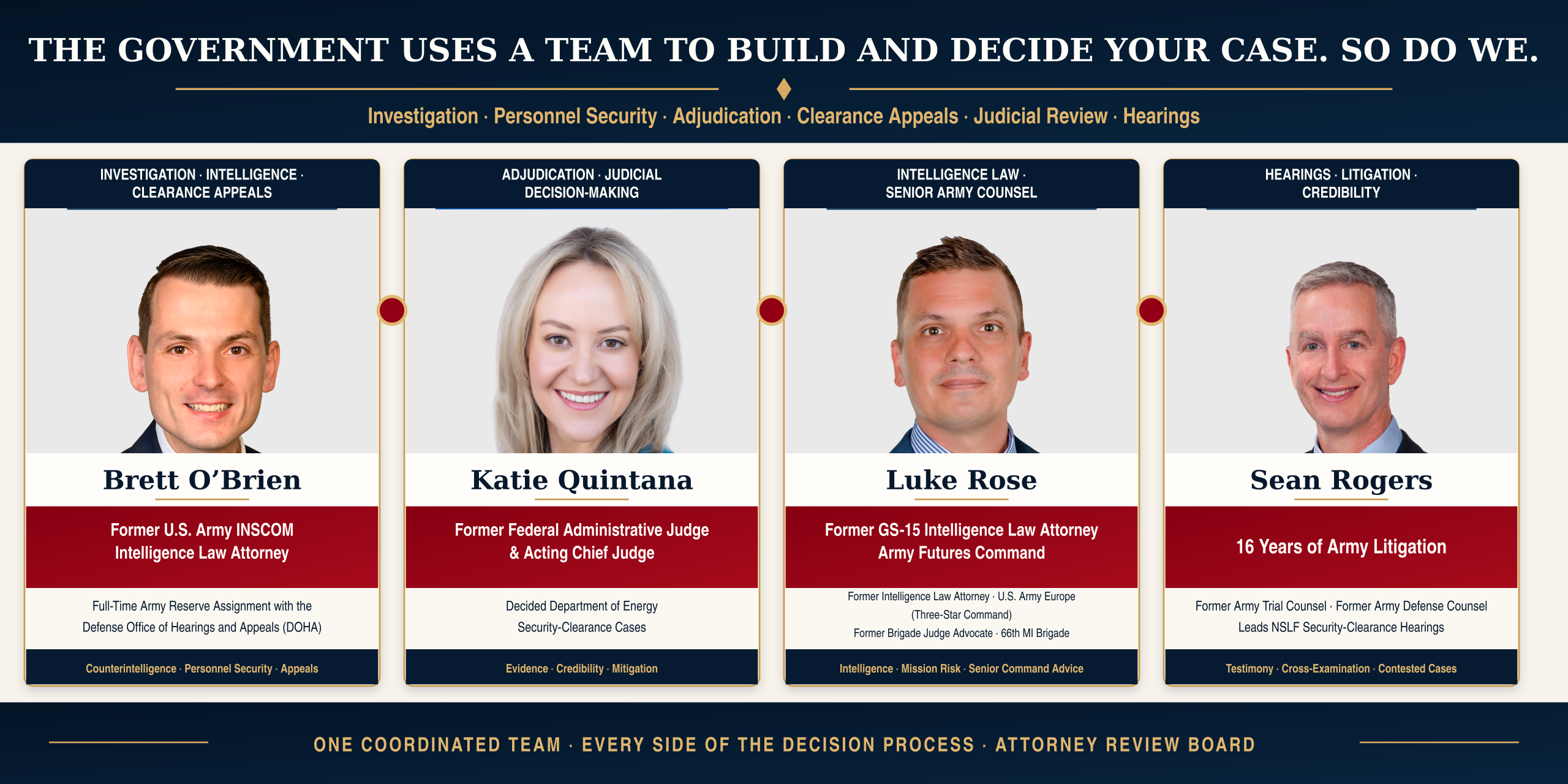
Brett O’Brien: Investigation, Counterintelligence, and DOHA
Brett O’Brien served as an Intelligence Law Attorney for U.S. Army Intelligence and Security Command (INSCOM) and as the primary legal advisor for active Army counterintelligence investigations. While serving as an Army Reserve Judge Advocate, he also completed a full-time assignment inside the Defense Office of Hearings and Appeals.
Why this matters at a hearing: Brett’s experience helps the team examine how investigators developed the concern, identify gaps or conflicts in the record, understand the DOHA environment, and anticipate how investigative facts may be presented as adjudicative or credibility problems.
Katie Quintana: Adjudication and Judicial Decision-Making
Katie Quintana served as a federal Administrative Judge and Acting Chief Judge deciding Department of Energy security-clearance cases. She evaluated evidence, testimony, credibility, mitigation, and national-security risk from the decision-maker’s side of the process.
Why this matters at a hearing: The team can test whether the documents and testimony give the judge a defensible basis to resolve every material concern—not merely whether the applicant has offered an explanation.
Luke Rose: Intelligence Law, Senior Commands, and Mission Risk
Luke Rose served as a GS-15 Intelligence Law Attorney for Army Futures Command, as an Intelligence Law Attorney for U.S. Army Europe when it was a three-star command, and as Brigade Judge Advocate for the 66th Military Intelligence Brigade.
Why this matters at a hearing: Luke’s experience helps the team understand how intelligence organizations and senior commands translate personal conduct into questions about access, vulnerability, judgment, mission risk, and reliability—and what evidence is needed to answer the government’s institutional concern.
Sean Rogers: Hearings, Litigation, and Credibility
Sean Rogers has 16 years of Army litigation experience, including service as both trial counsel and defense counsel. He leads NSLF’s security-clearance hearing practice.
Why this matters at a hearing: Sean prepares applicants and witnesses for direct examination, cross-examination, and questions from the judge. His role is to identify credibility problems before the hearing and develop a presentation capable of withstanding government scrutiny.
One Lead Attorney Supported by a Coordinated Team
Not every attorney personally performs every task in every matter. The assigned attorney leads the representation and communicates with the client. Through the Attorney Review Board, covered hearing cases can draw on the institutional perspectives relevant to the particular allegations and record.
The client receives one coordinated strategy—not disconnected opinions from several lawyers.
Meet the Security Clearance Team
What Hearing Clients Say About Working With NSLF
★★★★★ “I thought I could tell my story on my own, but I couldn’t have been more wrong. He masterfully articulated my truth in a way I never could.”
P.A. · Security Clearance Hearing Client · Google Review
★★★★★ “They were with me the whole time, fielding my frantic emails and translating them into coherent questions. And I can’t express my gratitude for the amount they have done for me.”
J.V. · Security Clearance Hearing Client · Google Review
★★★★★ “What stood out most was how incredibly prepared and invested Carl was. He took the time to deeply understand my background, anticipate every angle the government might raise, and help me present my case in the strongest, most honest way possible.”
P.K. · Security Clearance Client · Google Review
These excerpts describe individual client experiences. Names are abbreviated on this service page for privacy. Prior results and client reviews do not guarantee a similar outcome.
Common DOHA Hearing Mistakes
Believing Sincerity Will Replace Evidence
A sincere explanation matters, but it may not establish payment, treatment, changed circumstances, compliance, rehabilitation, or another disputed fact. Objective documentation and informed witness testimony may make the explanation more credible.
Treating the Hearing as an Opportunity to Tell an Unstructured Story
The judge must decide specific allegations under specific standards. A long narrative can introduce new issues while leaving the government’s actual concerns unresolved.
Waiting Too Long to Obtain Records or Secure Witnesses
Records can take weeks to obtain, and witnesses may have scheduling or technology problems. The Administrative Judge generally cannot compel witnesses to attend for the applicant.
Minimizing Difficult Facts
An applicant can acknowledge a poor decision while presenting meaningful mitigation. Minimization may create a credibility concern more serious than the original conduct.
Introducing a New Explanation Without Addressing Earlier Statements
A new explanation may be truthful, but the judge may ask why it differs from the SF-86, investigative interview, Letter of Interrogatory response, or SOR answer. The inconsistency must be confronted directly.
Preparing Only for the Questions Your Attorney Plans to Ask
Department Counsel may cross-examine each witness, and the Administrative Judge may ask questions. Preparation should account for all three perspectives.
Assuming More Documents Automatically Create a Stronger Case
Every exhibit should advance a defined part of the hearing strategy. Unfocused material can dilute the strongest proof or disclose information requiring further explanation.
Frequently Asked Questions About DOHA Hearings
What is a DOHA security-clearance hearing?
It is an administrative proceeding in which an Administrative Judge evaluates whether granting or continuing an applicant’s security-clearance eligibility is clearly consistent with the interests of national security. Department Counsel represents the government, and the applicant may present documents, testimony, witnesses, and argument under the governing procedure.
Will the government have an attorney?
Yes. Department Counsel represents the government and presents evidence and argument supporting the allegations in the Statement of Reasons.
Will my hearing be remote or in person?
Current prehearing guidance states that hearings are usually conducted through an online platform. In-person hearings may take place in DOHA hearing rooms or another approved location. The notice and orders issued in your case control.
Can the Administrative Judge question me directly?
Yes. Department Counsel may question witnesses, and the Administrative Judge may also ask questions. Applicant testimony should be prepared with both forms of questioning in mind.
Can the Administrative Judge subpoena my witnesses?
Current prehearing guidance states that the Administrative Judge lacks authority to issue a subpoena. The person offering a witness is responsible for securing the witness’s voluntary attendance and paying associated costs.
Will I testify under oath?
Current prehearing guidance states that witnesses are advised about 18 U.S.C. § 1001 rather than formally sworn. Knowingly and willfully making a materially false or misleading statement to the federal government can have serious consequences. Every answer must be truthful.
Does the judge decide the case at the hearing?
The Administrative Judge generally does not announce the decision at the end of the hearing. The judge issues a written decision after considering the record.
What evidence should I present?
That depends on the allegations. Evidence should be selected because it rebuts a disputed fact, explains the circumstances, demonstrates rehabilitation or corrective action, satisfies a mitigating condition, or otherwise supports the whole-person analysis.
Does the $7,500 fee include preparing my SOR response?
No, unless the signed engagement agreement expressly includes it. The SOR written response and hearing are separate stages and ordinarily require separate engagements.
Does the fee include an appeal?
No. A DOHA Appeal Board matter requires a separate evaluation and engagement. The Appeal Board reviews the existing record for error and does not accept new evidence.
Can NSLF represent me anywhere in the country?
NSLF evaluates DOHA hearing matters nationwide. Hearings may be remote or held at a location established by the tribunal. Acceptance remains subject to the specific case, timing, conflicts, and applicable professional rules.
Can a lawyer guarantee a favorable decision?
No. The outcome depends on the allegations, evidence, credibility, applicable standards, procedure, and Administrative Judge. NSLF can provide preparation, strategy, and advocacy, but no law firm can guarantee a security-clearance result.
How do I know whether my case is actually a DOHA case?
Not every federal employee, service member, intelligence professional, or clearance holder receives the same hearing or appeal rights. DOHA commonly handles industrial security-clearance cases involving contractor employees, while agencies and military components may use different procedures. Send us the notice so we can identify the governing process, available rights, and deadline.
What should I send before the consultation?
Send the hearing notice, Statement of Reasons, your SOR answer, government exhibit package, prior investigative or adjudicative materials available to you, scheduling correspondence, orders, and every stated deadline.
Explore the Security Clearance Resource Center
Understanding the process can help you recognize the decisions, deadlines, and evidence that may affect your case. The NSLF Security Clearance Resource Center brings together our most important guides covering investigations, security questionnaires, Letters of Interrogatory, Statements of Reasons, hearings, appeals, adjudicative guidelines, mitigation, and related clearance issues.
VISIT THE SECURITY CLEARANCE RESOURCE CENTER
Learn What Happens at a DOHA Hearing
This page explains NSLF’s hearing-representation service. Our educational companion provides a detailed, noncommercial explanation of the proceeding:
Related services and strategy resources:
- Security Clearance Statement of Reasons Lawyer
- Security Clearance Appeal Lawyers
- What Evidence Wins a Security Clearance Hearing?
- How to Choose the Best Security Clearance Lawyer
- Security Clearance Lawyer Pricing
- Security Clearance Lawyers and Services
Official Government Resources
- DOHA Industrial Security Program Overview
- DOHA Prehearing Guidance for Industrial Security Clearance and Trustworthiness Hearings
- DoD Directive 5220.6: Defense Industrial Personnel Security Clearance Review Program
- DOHA Industrial Security Clearance Hearing Decisions
- Security Executive Agent Directive 4: National Security Adjudicative Guidelines
Government procedures and links may change. The notice, orders, and instructions issued in your case control.
Put a Complete Security Clearance Hearing Team on Your Side
At the hearing, the government’s investigative record, your prior statements, documentary evidence, witness testimony, and credibility come together before the Administrative Judge. Preparation should begin before the hearing date—not after records become difficult to obtain, witnesses become unavailable, or important deadlines pass.
For a $7,500 flat fee, National Security Law Firm provides attorney-led record analysis, evidence and witness development, applicant preparation, covered prehearing coordination, Attorney Review Board review, a Government Records Investigation when appropriate in a qualifying matter, and representation at the covered hearing.
Have the hearing notice and complete available record ready when you schedule. Tell us the hearing date and every pending deadline.
Former Federal Clearance Judge · Former Government Adjudicators · Direct DOHA Experience · Former GS-15 Intelligence Counsel · 16 Years of Army Litigation · Attorney Review Board
Prior results and client reviews do not guarantee a similar outcome. Every security-clearance matter depends on its facts, evidence, governing procedures, and decision-makers. This website is an attorney advertisement and does not provide legal advice or create an attorney-client relationship. Representation begins only after the firm accepts the matter and a written engagement agreement is executed.
Attorney reviewer: Katherine O’Brien
Last reviewed: September 4, 2026