
Quick Answer
Security clearance omissions are not usually “caught” through a single source.
They are discovered when your timeline becomes inconsistent across records, interviews, and disclosures.
Most applicants are not denied for the issue they omitted.
They are denied because the omission creates a credibility problem.
The Core Misunderstanding
Most people think:
👉 “If I don’t disclose it, the investigator has to find it.”
That is not how the system works.
Security clearance investigations are not built around detection.
They are built around consistency.
Investigators compare:
-
your SF-86
-
your financial and employment records
-
your prior disclosures
-
what other people say about you
When those sources don’t align:
👉 the omission reveals itself
What This Means Before We Get Into the List
This list is not about “how investigators catch you.”
It is about how your record is tested.
Because in the security clearance system:
👉 nothing exists in isolation
👉 everything is compared
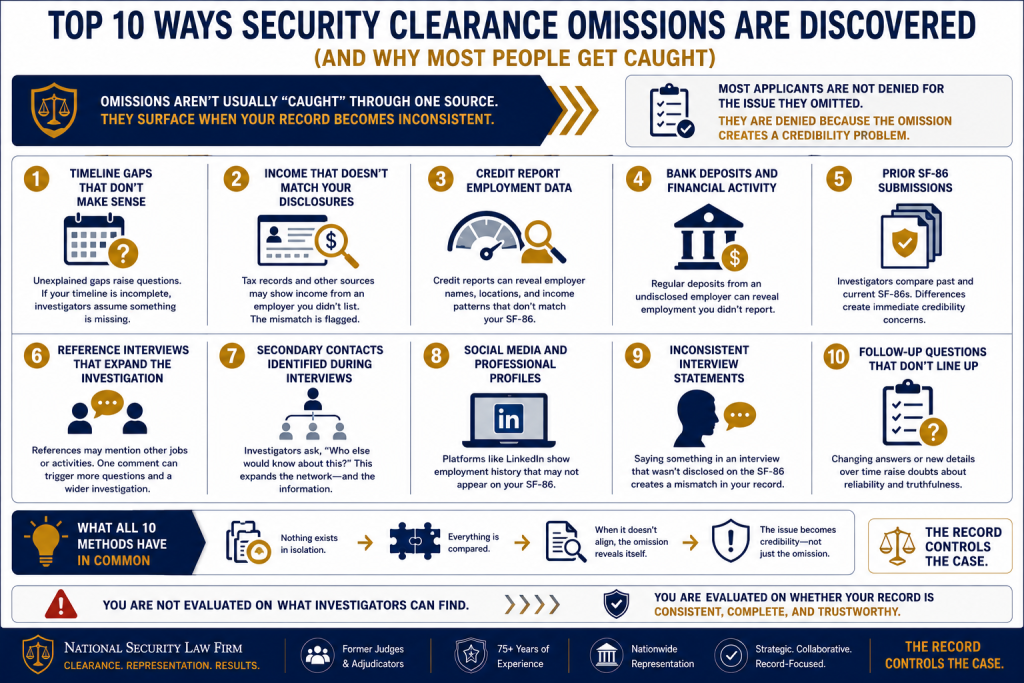
And that is why omissions surface—even when no one is actively searching for them.
1. Timeline Gaps That Don’t Make Sense
The most common trigger is also the simplest.
If your SF-86 shows a gap in time with no explanation:
👉 that gap will be questioned
Unless you clearly account for:
-
unemployment
-
school
-
caregiving
-
travel
the system assumes something is missing.
👉 This is often the first point where a case begins to shift.
2. Income That Doesn’t Match Your Disclosures
Your financial records often tell a parallel story.
If tax-related data or other records show income from an employer not listed:
👉 your timeline breaks
This creates a question:
👉 “Why is there income tied to a job that wasn’t disclosed?”
The issue becomes credibility—not employment.
3. Credit Report Employment Data
Investigators review your credit profile.
This can reveal:
-
employer names
-
geographic movement
-
income patterns
You may be asked to unfreeze your credit for this reason.
When your credit history doesn’t match your SF-86:
👉 the inconsistency is flagged
4. Bank Deposits and Financial Activity
In some cases, investigators request bank records or transaction history.
Regular deposits from an undisclosed employer can reveal:
👉 ongoing employment you didn’t report
At that point, the issue is no longer:
👉 “Did you forget?”
It becomes:
👉 “Why does your financial activity contradict your disclosures?”
5. Prior SF-86 Submissions
If you have ever completed an SF-86 before, that record still exists.
Investigators compare:
-
past disclosures
-
current disclosures
If something appears in one but not the other:
👉 it becomes a credibility issue immediately
Not because of the job itself.
But because your story changed.
6. Reference Interviews That Expand the Investigation
Investigators speak with:
-
supervisors
-
coworkers
-
personal references
And those conversations rarely stay narrow.
A reference might say:
👉 “I think they were also working somewhere else during that time.”
That single statement can trigger:
-
follow-up questions
-
additional interviews
-
deeper scrutiny
👉 This is one of the most common ways omissions surface.
7. Secondary Contacts Identified During Interviews
Investigators don’t just speak to the people you list.
They ask:
👉 “Who else would know about this?”
This expands the network.
And often leads to:
-
coworkers you didn’t list
-
managers from prior roles
-
people who knew you during the omitted time
This is where many applicants realize:
👉 the investigation is broader than they expected
8. Social Media and Professional Profiles
Platforms like LinkedIn create a public version of your employment history.
If your profile shows:
-
a company
-
a role
-
a time period
that does not appear on your SF-86:
👉 the inconsistency is obvious
This is one of the easiest ways omissions are identified.
No deep investigation required.
9. Inconsistent Interview Statements
Even if something isn’t initially flagged, it often comes out during your subject interview.
Applicants may:
-
mention a job casually
-
describe a timeline differently
-
clarify something that wasn’t disclosed
That creates a mismatch between:
-
written disclosures
-
verbal statements
👉 This is where many credibility issues begin.
10. Follow-Up Questions That Don’t Line Up
Investigators ask follow-up questions to test consistency.
If your answers:
-
change over time
-
add new information
-
contradict earlier statements
👉 the system begins to identify patterns
At that point, the issue is no longer the omission.
It is:
👉 whether your disclosures can be trusted
What All 10 Methods Have in Common
None of these methods rely on a “gotcha.”
They all rely on one principle:
👉 your record must remain internally consistent
When it does:
-
investigations move smoothly
-
issues stay contained
When it doesn’t:
-
the scope expands
-
credibility is evaluated
-
risk increases
Beyond the Obvious: Less Common Ways Security Clearance Omissions Are Discovered
Most articles stop at the obvious sources:
-
credit reports
-
references
-
employment verification
But in real cases, omissions are often revealed through less direct—and more subtle—signals.
These are not always about finding a specific job.
They are about identifying when your record no longer aligns with reality.
When Your Address History Doesn’t Match Your Employment
Investigators don’t just look at where you worked.
They look at where you lived—and whether those two timelines make sense together.
If your record shows:
-
living in one location
-
while claiming employment in another
-
without a clear explanation
👉 that creates friction in the timeline
Even short-term living arrangements—staying with friends, temporary housing, or transitions between locations—can raise questions when they don’t align with reported employment.
This is rarely flagged as “missing employment” at first.
It appears as:
👉 “The timeline doesn’t quite fit.”
And that is often where deeper inquiry begins.
When Your Pattern of Work Doesn’t Look Realistic
Investigators are trained to evaluate patterns—not just facts.
Even without a specific record of a missing job, they may notice:
-
repeated short gaps
-
inconsistent job transitions
-
periods of apparent unemployment with no explanation
-
industries or roles that commonly involve contract or gig work
This creates a different kind of signal:
👉 “Something is missing here.”
That alone can trigger:
-
expanded questioning
-
additional interviews
-
broader scope review
No single document reveals the omission.
👉 The pattern does.
When Your Financial Life Doesn’t Match Your Employment History
Even if no employer is directly identified, your financial behavior tells a story.
If your record shows:
-
consistent expenses
-
stable lifestyle
-
no reported income source during a period
the system begins asking:
👉 “How is this person supporting themselves?”
That question often leads to:
-
deeper financial review
-
scrutiny of deposits or transactions
-
identification of undeclared income
Again, the issue is not initially the job.
👉 It is the mismatch between your disclosures and your financial reality.
When Prior Government Records Don’t Align
Security clearance investigations do not exist in isolation.
Information can be cross-referenced with:
-
prior federal employment records
-
earlier background investigations
-
contractor onboarding processes
-
suitability or HR files
If an employment appears in one of those systems—but not on your SF-86:
👉 it creates a cross-system inconsistency
This is one of the least visible risks to applicants.
Because the omission is not discovered through investigation.
👉 It is revealed through comparison.
When Polygraph or Interview Disclosures Expand the Record
In some cases, employment issues surface indirectly.
During:
-
polygraph examinations
-
subject interviews
-
follow-up questioning
Applicants may casually mention:
-
side work
-
consulting
-
helping a business
-
informal or short-term jobs
If those were not disclosed previously:
👉 they are now part of the record
And once documented, they are compared against your original disclosures.
What felt like clarification becomes:
👉 a recorded inconsistency
When Foreign Travel and Work Timelines Don’t Align
Foreign travel introduces an additional layer of scrutiny.
If your record shows:
-
extended time abroad
-
or frequent travel
but your employment and financial activity suggest ongoing work:
👉 the timeline begins to conflict
This can lead investigators to explore:
-
remote work
-
foreign-based activity
-
undeclared employment relationships
In some cases, this expands beyond credibility into broader concerns under the
When Your Record Doesn’t Read Like a Coherent Story
This is the most advanced—and most important—concept.
Your case is not evaluated as isolated entries.
It is read as a narrative.
Investigators and adjudicators are effectively asking:
👉 “Does this person’s life history make sense as a whole?”
If something doesn’t fit:
-
a gap
-
an unexplained transition
-
an inconsistency across sources
👉 it stands out immediately
Even if the omission itself is minor.
Because the issue is no longer the job.
👉 It is the integrity of the story.
What These Less Obvious Methods Have in Common
None of these rely on a direct “discovery” of employment.
They all rely on one principle:
👉 your record must remain internally consistent across every source
When it does:
-
your case moves forward without friction
When it doesn’t:
-
the scope expands
-
credibility is evaluated
-
risk increases
Why This Matters More Than the Original Omission
Applicants often focus on the question:
👉 “Will they find it?”
But the system is not built around finding everything.
It is built around identifying when something doesn’t align.
And once that happens:
👉 the issue is no longer what you omitted
👉 it is whether your disclosures can be trusted
If You’re Recognizing This in Your Own Case
This is often the moment where people realize:
👉 “My timeline might not fully line up”
👉 “I didn’t think that mattered”
👉 “I may have created an inconsistency without realizing it”
That realization matters.
Because it usually means the case is no longer just about the underlying facts.
👉 It is about how those facts are being interpreted
How This Fits Into the Bigger Picture
Understanding how omissions are discovered is only part of the equation.
The more important question is:
👉 What happens once the inconsistency appears?
That is where cases move from:
-
factual review
to:
-
credibility evaluation
And that transition is what ultimately determines outcomes.
Closing Insight
The most important takeaway is not how many ways omissions can be discovered.
It is this:
👉 you are not being evaluated on what investigators can find
👉 you are being evaluated on whether your record makes sense
Why Omissions Become More Serious Than the Underlying Issue
Applicants focus on the omission itself.
Investigators focus on what the omission means.
Under the Adjudicative Guidelines:
-
a short-term job is rarely disqualifying
-
an inconsistent disclosure can be
Because the system is evaluating:
👉 long-term reliability and trustworthiness
The Moment Most People Realize It’s a Problem
There is a point where the case shifts.
It often happens when:
-
a follow-up question feels unexpected
-
an investigator asks about something you didn’t list
-
you realize your timeline doesn’t fully align
That moment is important.
Because it often means:
👉 your record is already being questioned
Why “Fixing It Later” Is Not a Simple Solution
Many applicants assume they can correct omissions later.
But timing changes how corrections are interpreted.
If you correct something:
-
early and proactively → it can help
-
after it’s identified → it can look reactive
👉 That difference affects outcomes.
Where This Leads in the Process
If inconsistencies persist, they can carry forward into adjudication.
At that stage, issues are often framed under:
👉 Guideline E (Personal Conduct)
And can result in a
focused not on the job—but on credibility.
What This Means for You Right Now
If you are reading this and thinking:
👉 “I may have left something out”
👉 “My timeline isn’t perfect”
👉 “I’m not sure everything lines up”
that is the point where the case begins to change.
Not because the issue is severe.
But because the record is no longer clean.
If You Want to Understand Your Risk
Understanding how omissions are discovered is only one piece of what is happening.
Because these issues do not exist in isolation.
They are part of a larger process where:
-
your disclosures are compared against independent sources
-
inconsistencies are identified and expanded
-
your credibility is quietly evaluated before any formal decision is made
What most applicants don’t realize is that by the time an omission surfaces:
👉 the investigation has already moved from fact-gathering into risk evaluation
And at that point, the way your record is interpreted—not just what it contains—begins to determine what happens next.
That is why it is critical to understand not just how investigators find issues, but:
👉 how the entire investigation stage works—and how cases escalate from there
If you want to see how your case is actually being built from start to finish, including what happens after inconsistencies appear, read:
👉 Security Clearance Investigation Process: How Your Case Is Actually Built and Evaluated
Or visit our main:
👉 Security Clearance Insiders Resource Hub
Because in most cases:
👉 problems are not created at the moment they are discovered
👉 they are created earlier—when the record is first being formed
A consultation can help clarify:
-
whether your situation presents real risk
-
how your record is likely being read
-
what decisions matter now
👉 Schedule a Free Consultation
If representation is needed, we use transparent flat-fee pricing:
👉 Security Clearance Lawyer Cost
And offer payment options:
Final Insight
Security clearance omissions are not discovered because investigators find everything.
They are discovered because:
👉 your record stops making sense
And once that happens:
👉 the issue is no longer what you omitted
👉 it is whether your disclosures can be trusted
The Record Controls the Case.