
Maybe it’s an old news article. A mugshot. A court record. A government press release. A Reddit post. Or another piece of online content that’s affecting your career, your reputation, or your peace of mind.
One of the first questions almost everyone asks is: “Can Google remove it?”
The honest answer is: Sometimes. But one of the biggest misconceptions about content removal is that people think Google controls everything they see in Google Search. It doesn’t. In most cases, Google doesn’t own the content. Google simply indexes it.
That distinction is incredibly important because it determines who you should be asking for help. Sometimes the best solution is to ask Google to remove a search result. Other times, the better strategy is to ask the website itself to remove, anonymize, or deindex the content. Understanding the difference can save you significant time, frustration, and money.
In this guide, we’ll explain:
- When Google will remove content from its search results.
- When Google will refuse.
- The difference between website removal and Google removal.
- Why many news articles remain in Google even after they’re years old.
- When a content removal attorney may be able to help.
- How National Security Law Firm approaches these cases differently.
The Biggest Misconception About Google
Before we discuss Google’s content removal policies, it’s important to understand one simple concept.
Google is usually not the publisher.
Think of Google like the index at the back of a textbook. The index doesn’t create the information. It simply tells you where to find it. Google works much the same way. Its search engine continuously scans billions of webpages across the internet, creates an index of those pages, and displays the ones it believes are most relevant when someone performs a search.
In many cases, Google has no authority to remove the underlying content because it doesn’t own or control the website where it’s published.
That’s why there are often two completely different paths to solving the problem:
- Ask the website to remove, anonymize, or deindex the content.
- Ask Google to remove the page from its search results if it qualifies under Google’s content removal policies.
Sometimes only one option is available. Sometimes both are. Part of our job is determining which path—or combination of paths—gives our clients the strongest opportunity for success.
In This Guide
In the sections below, we’ll walk through:
- The four ways content can disappear from Google Search.
- Google’s current content removal policies.
- The types of content Google will and won’t remove.
- Why Google often refuses to remove legitimate news articles.
- How our attorneys pursue both website removal and Google removal whenever there’s a legitimate opportunity.
- Why we believe clients should pursue the strongest opportunity for permanent removal first.
The Four Ways Content Can Disappear from Google Search
One of the biggest misconceptions about content removal is that there’s only one way to make content disappear from Google.
There isn’t.
In fact, there are four different ways content may stop appearing in Google Search.
Each works differently.
Each involves different decision-makers.
And each is appropriate in different situations.
Understanding the difference is essential because it helps determine which strategy makes the most sense for your particular case.
Option 1: Website Removal
Best Outcome
This is always our first choice whenever there’s a legitimate opportunity.
The publisher removes the article or webpage from its website entirely.
Once the content has been deleted, Google will eventually recognize that the page no longer exists and remove it from its search results.
If appropriate, we can also submit Google’s Outdated Content Tool request to encourage Google to refresh its index more quickly after the page has been removed.
General Result
✅ The content is removed from the website.
✅ It eventually disappears from Google Search.
Option 2: Website Anonymization (Redaction)
Sometimes a publisher isn’t willing to remove an article altogether but is willing to remove your name or other identifying information.
The article remains online.
However, because your identifying information has been removed, the article generally no longer appears when someone searches your name.
This solution is particularly common when an article discusses multiple people or multiple unrelated incidents and the publisher wants to preserve the article while removing one individual’s connection to it.
General Result
✅ Article stays online.
✅ Your name is removed.
✅ The article generally no longer appears when someone searches your name.
Option 3: Website-Initiated Deindexing
Sometimes a publisher is unwilling to delete an article or remove your name.
However, they may agree to prevent the page from appearing in search engines.
The most common way they do this is by adding a small piece of code to the webpage called a “noindex” meta tag.
That tag tells Google and other search engines:
“Do not include this page in search results.”
Once Google’s search crawler processes that instruction, the page is generally removed from Google’s search index.
The article still exists.
But it no longer appears when someone searches your name.
For many clients, this provides nearly the same practical benefit as complete removal because the overwhelming majority of people find articles through Google—not by manually searching a publisher’s archives.
General Result
✅ Article stays online.
✅ Removed from Google Search.
✅ Often an outstanding outcome when removal isn’t possible.
Option 4: Google-Initiated Removal
Sometimes the website refuses to take any action.
In those situations, Google may still remove the search result—but only if it falls within Google’s published removal policies.
Examples include:
- Non-consensual intimate images (revenge porn).
- AI-generated or manipulated explicit imagery (deepfakes).
- Doxxing or the publication of certain personal information.
- Certain exploitative websites.
- Copyright violations.
- Court orders requiring removal.
- Other limited circumstances recognized by Google.
It’s important to understand that Google removing a search result does not remove the underlying content.
The article or webpage still exists on the original website.
Google simply stops displaying it in its search results.
That’s why Google removal and website removal are two completely different processes.
General Result
❌ Article remains online.
✅ Removed from Google Search.
Only if Google’s policies apply.
Why We Usually Pursue More Than One Strategy
One of the things that makes our approach different is that we don’t assume there’s only one path to success.
Whenever there’s a legitimate opportunity, we evaluate every available option.
That may include:
- Asking the publisher to remove the content.
- Requesting anonymization.
- Negotiating website deindexing.
- Submitting a Google removal request when Google’s policies apply.
Rather than relying on a single strategy, we pursue every legitimate avenue that gives our clients the best opportunity to achieve the strongest possible outcome.
Key Takeaway
Google doesn’t control every webpage that appears in Google Search, and publishers don’t control Google’s search index. Understanding the difference is often the first step toward developing the right strategy.
What Google Will Remove from Search Results
One of the biggest misconceptions about Google’s content removal policies is that Google reviews every request on a case-by-case basis and simply decides what’s “fair.” That’s not how it works.
Google publishes specific categories of content that may qualify for removal from its search results. If your situation falls within one of those categories, Google may remove the search result. If it doesn’t, Google will usually deny the request—even if the content is embarrassing, outdated, or causing significant harm.
It’s also important to understand that removing a search result isn’t the same thing as removing the underlying content. In most cases, the content remains on the original website. Google simply stops displaying it in its search results.
Below are the most common situations where Google may remove or deindex content.
1. Non-Consensual Intimate Images (Revenge Porn)
Google may remove sexually explicit images or videos that were shared without your consent. Examples include:
- Private intimate photos that were later posted online.
- Images shared by a former partner without permission.
- Explicit photos or videos recorded without your knowledge.
- Other forms of image-based sexual abuse.
If Google approves the request, the search result is removed from Google Search. The underlying website may still need to be contacted separately if you want the content removed entirely.
General Outlook: Often favorable when Google’s policy requirements are met.
2. AI-Generated or Fake Explicit Images (Deepfakes)
Google also accepts requests involving explicit AI-generated or digitally manipulated images that falsely depict someone. As artificial intelligence has become more sophisticated, these requests have become increasingly common. If the content meets Google’s criteria, Google may remove the search result even if the original website continues hosting the image.
General Outlook: Often favorable when the policy applies.
3. Personal Information (Doxxing)
Google may remove search results that expose sensitive personal information, including:
- Home addresses
- Telephone numbers
- Government identification numbers
- Social Security numbers
- Bank account information
- Credit card numbers
- Login credentials
- Medical records
- Other sensitive personal information
Google may also consider removing search results that expose personal information in a way that creates a significant risk of harassment, stalking, identity theft, or physical harm.
General Outlook: Depends on the information disclosed and Google’s policies.
4. Exploitative Removal Practices
Google has adopted policies targeting certain websites that engage in exploitative conduct. Examples may include websites that:
- Charge people to remove harmful content.
- Remove content only after payment.
- Republish removed content on affiliated websites.
- Use deceptive practices designed to pressure individuals into paying removal fees.
These cases are highly fact-specific.
General Outlook: Depends on whether Google’s exploitative practices policy applies.
5. Copyright and Certain Legal Requests
Google also processes requests involving legal rights, including:
- Copyright infringement (DMCA requests)
- Certain trademark issues
- Valid court orders
- Other legal removal requests recognized under Google’s policies
These requests follow different procedures than Google’s personal information policies.
General Outlook: Depends on the applicable law and supporting documentation.
What Google Usually Will NOT Remove
This is the part many people find frustrating. Google generally does not remove search results simply because the content is:
- Embarrassing.
- Old.
- True.
- About an arrest.
- About a conviction.
- About a lawsuit.
- Harmful to your reputation.
- Affecting your employment.
In those situations, Google’s position is generally that the issue should be addressed with the website that published the content—not with Google itself. That’s why many successful content removal matters begin by working directly with the publisher rather than the search engine.
Key Takeaway
Google has very specific removal policies. If your situation falls within those policies, Google may remove the search result. If it doesn’t, the better strategy is often to pursue removal, anonymization, or deindexing directly with the website that published the content.
What Google Usually Won’t Remove (and What You Can Do Instead)
This is where many people become frustrated. They discover that their situation doesn’t fit Google’s removal policies and assume they’ve reached the end of the road. In many cases, they haven’t.
Google’s job is to decide whether content should appear in Google Search. Our job is to determine whether there’s a legitimate opportunity to remove, anonymize, or deindex the content at its source. Those are two very different questions.
For example, Google will generally not remove search results simply because the content is:
- An old news article.
- A truthful arrest report.
- A criminal conviction.
- A court opinion.
- A police blotter.
- A government press release.
- Embarrassing.
- Damaging to your reputation.
- Preventing you from getting a job.
- Hurting your business.
- Affecting your professional license or security clearance.
That doesn’t necessarily mean the content can’t be removed. It simply means Google isn’t the right decision-maker. Instead, the focus shifts to the publisher.
This Is Where Publisher-Based Removal Becomes Important
When Google’s policies don’t apply, we begin asking a different set of questions. Instead of asking “Will Google remove this?” we ask “Is there a legitimate reason the publisher should reconsider continuing to publish it?” That’s a very different analysis.
Depending on the circumstances, we may argue:
- The article no longer serves a meaningful public interest.
- The charges were dismissed.
- The record was later expunged.
- The client was found not guilty.
- The article is incomplete because important legal developments occurred after publication.
- The client has rebuilt their life.
- The continuing harm now outweighs the article’s remaining news value.
- The publisher’s own editorial policies support reconsideration.
- Deindexing or anonymization would be a reasonable compromise if complete removal isn’t possible.
Every publisher is different. Every case is different. Every strategy is different. That’s why there is never a one-size-fits-all approach.
Why Many People Give Up Too Soon
One of the biggest misconceptions we see is this: “Google said no, so removal must be impossible.” That’s simply not true.
Google only evaluates whether a search result qualifies under Google’s policies. It doesn’t decide whether a publisher is willing to voluntarily remove, anonymize, or deindex its own content. Those are completely separate decisions made by completely different organizations. In many of the matters we handle, Google isn’t the primary focus at all. The publisher is.
Our Approach
Whenever there’s a legitimate opportunity, we evaluate every available path. That may include:
- Requesting removal from the publisher.
- Requesting anonymization.
- Negotiating website deindexing.
- Submitting a Google removal request if Google’s policies apply.
- Using Google’s Outdated Content Tool after successful removal.
- Pursuing more than one strategy at the same time when appropriate.
Rather than assuming there’s only one solution, we evaluate every legitimate opportunity that may help our clients achieve the strongest possible outcome.
Key Takeaway
A denial from Google doesn’t necessarily mean your content can’t be removed. It simply means Google’s policies didn’t apply. The next question is whether the publisher itself presents a legitimate opportunity for removal, anonymization, or deindexing.
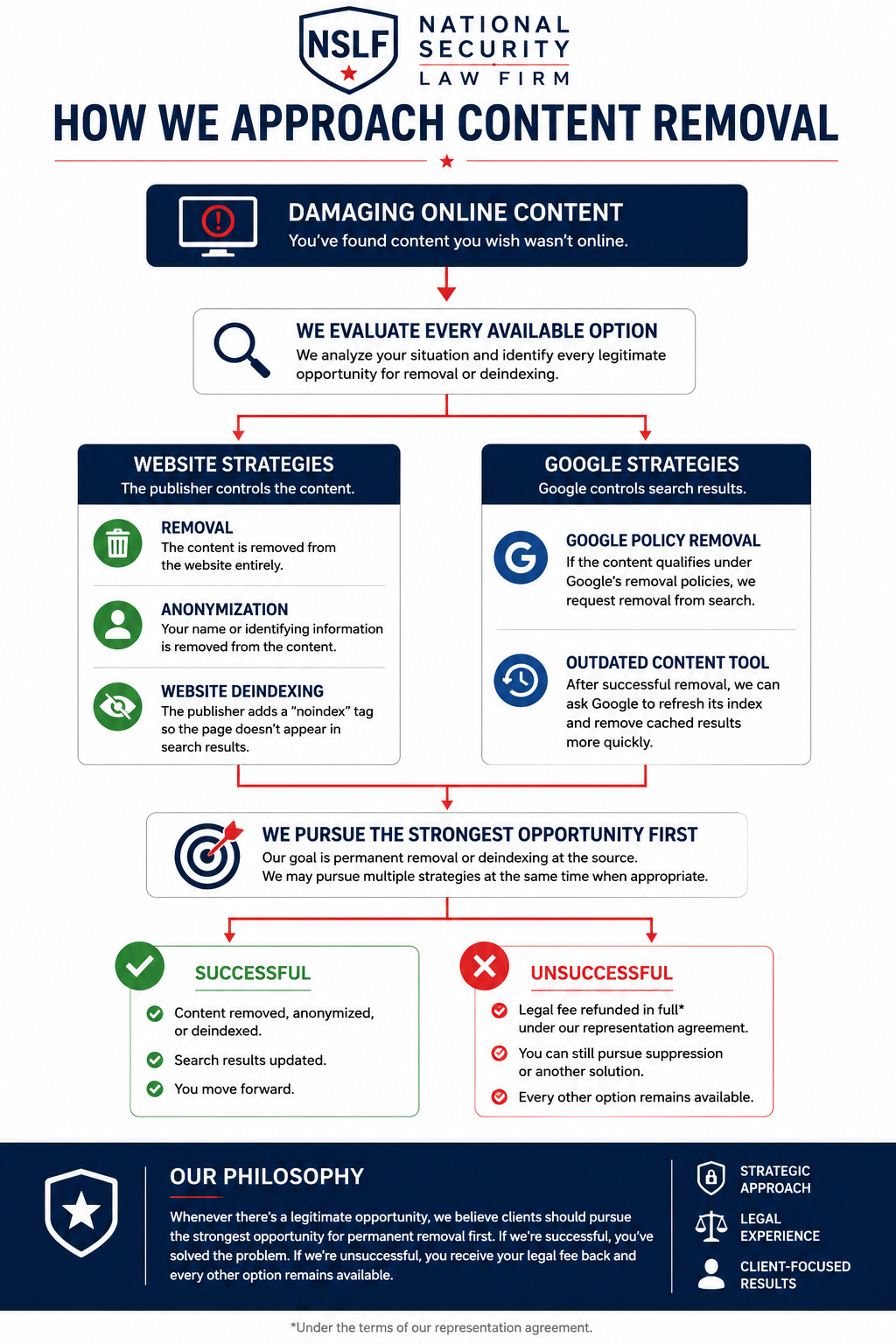 Why We Often Pursue More Than One Strategy
One of the biggest misconceptions about content removal is that there’s only one way to solve the problem. In reality, there are often multiple paths. One strategy may not work. Another might. That’s why we rarely approach a matter with only one possible solution in mind. Instead, we evaluate every legitimate opportunity to achieve the strongest possible outcome.
For example, depending on the circumstances, we may pursue:
- Removal of the article from the publisher’s website.
- Anonymization by removing your name or other identifying information.
- Website-initiated deindexing through a “noindex” tag.
- Google removal if the content qualifies under Google’s published policies.
- Google’s Outdated Content Tool after successful removal.
- Multiple strategies at the same time when appropriate.
Every matter is different. Sometimes only one option is available. Sometimes several are. Our job is to identify every legitimate opportunity and determine which combination of strategies gives our clients the best chance of success.
Why We Usually Start with the Publisher
One question we hear frequently is: “Why not just ask Google?”
The answer is simple. If the publisher removes the article, anonymizes it, or agrees to deindex it, you’ve often solved the problem at its source. That’s almost always a stronger outcome than simply removing a Google search result.
Think of it this way. If Google removes one search result today, the underlying content may still exist. Depending on the circumstances, another search engine—or even Google itself under different circumstances—may eventually discover or display that content again. If the publisher removes the content entirely, however, the article itself is gone.
That’s why, whenever there’s a legitimate opportunity, our first objective is almost always to work directly with the publisher. Google removal is often an important tool. It’s just not always the first one we reach for.
Our Philosophy
People often ask us: “Why don’t you just submit a Google request and see what happens?”
Because that’s only one piece of the puzzle. Our goal isn’t simply to remove a search result. Our goal is to help our clients permanently solve the problem whenever there’s a legitimate opportunity to do so. Sometimes that means working with Google. Sometimes it means working with the publisher. Sometimes it means pursuing both at the same time.
Every strategy begins with the same question: “What gives this client the best opportunity for the strongest possible outcome?” That’s the question our attorneys answer before we ever begin advocating on a client’s behalf.
Why Our Business Model Is Built Around That Philosophy
We understand why many people hesitate before pursuing removal. They don’t want to spend thousands of dollars trying to remove something only to wonder later whether it was worth the risk. That’s exactly why we’ve structured our practice the way we have.
If we’re unsuccessful under the terms of our representation agreement, we refund our legal fee in full. We believe clients should have the opportunity to pursue what we believe is the strongest possible outcome first—without permanently risking the money they invested in trying.
If we’re successful, you’ve achieved what we believe is the best outcome. If we’re unsuccessful, you still have every other option available. You can pursue suppression. You can hire another attorney. You can choose another path. Nothing has been taken off the table. You’ve simply given permanent removal every reasonable opportunity before moving on to other alternatives.
We believe that’s the smartest way to approach these cases.
Can My Type of Content Actually Be Removed?
Now that we’ve explained how content removal works, let’s look at the types of online content people most commonly ask us about.
One of the biggest mistakes people make is assuming that the answer depends entirely on the type of website. It doesn’t. As we explained earlier in this guide, the publisher is only one part of the analysis. Our attorneys also consider:
- The age of the content.
- What happened in the underlying case.
- Whether the content remains newsworthy.
- The ongoing harm it’s causing.
- The publisher’s policies.
- The available legal, factual, policy, and fairness arguments.
That’s why two articles published on the same website may present completely different opportunities for removal. Still, some categories of content generally present different challenges than others. Below is a general overview of the types of content we evaluate most often.
News Articles
General Outlook: 🟡 Depends on the publisher and the facts.
Many people assume newspapers never remove articles. That’s simply not true. Some publishers have formal editorial policies governing removal requests. Others consider requests on a case-by-case basis. Some are unwilling to remove an article but may consider anonymization or deindexing instead.
The strongest opportunities often involve older articles, dismissed charges, expungements, rehabilitation, or situations where the article no longer serves the same public interest it once did.
Learn more: How to Remove a News Article, Arrest Record, or Police Blotter
Mugshots
General Outlook: 🟢 Often favorable.
Many mugshot websites have removal procedures. Others operate in states with laws governing mugshot publication. The available strategy depends heavily on the website involved and the underlying facts.
Learn more: Complete Guide to Removing Mugshots from the Internet
Government Press Releases
General Outlook: 🟡 Case-specific.
Government agencies have different policies than private publishers. Some are willing to reconsider older press releases, particularly following an expungement or other significant legal development. Others are not. Each agency should be evaluated individually.
Learn more: How to Remove Government Press Releases
Court Opinions and Court Records
General Outlook: 🔴 Often challenging.
Court records and judicial opinions raise different issues than news articles. In many cases, the better question isn’t whether the record can be removed—but whether it can be sealed, expunged, anonymized, or otherwise addressed through the legal system. Websites that republish court records, however, often present different opportunities.
Learn more: Removing Court Records and Court Opinions
General Outlook: 🟡 Depends on the circumstances.
Reddit uses a unique moderation system. Whether a post can be removed depends on the subreddit, the moderators, Reddit’s policies, and the specific facts. Every Reddit matter requires an individualized evaluation.
Learn more: How to Remove Reddit Posts
Social Media
General Outlook: 🟡 Platform dependent.
Facebook, Instagram, X, LinkedIn, TikTok, YouTube, and other platforms all have different policies. The available options depend on the platform, the content, and who posted it.
Learn more: Removing Social Media Content
Blogs
General Outlook: 🟡 Highly individualized.
Blogs range from major commercial websites to private individuals. Every owner is different. Every strategy is different. These matters often involve careful communication and thoughtful negotiation.
Learn more: Removing Harmful Content from Blogs and Social Media Platforms
Other Websites
Millions of websites publish content online. Many don’t fit neatly into any single category. That’s why we don’t make blanket statements. Every matter begins with an individualized evaluation.
The Most Important Thing to Remember
One of the biggest misconceptions about content removal is this: “It’s a newspaper, so it can’t be removed.” Or “It’s Reddit, so there’s no point trying.” Or “Google denied my request, so that’s the end.”
Those assumptions are often wrong. The better question isn’t “What kind of website is it?” The better question is “Does this particular publisher, under these particular facts, present a legitimate opportunity for removal or deindexing?” That’s exactly what our attorneys evaluate every day.
Continue Learning
If you’re looking for information about a specific type of content, we’ve created detailed guides covering many of the most common situations:
What Should You Do Next?
If you’ve read this far, you probably fall into one of three categories.
1. Your situation appears to fit Google’s removal policies.
If your content involves things like non-consensual intimate images, certain forms of doxxing, exploitative removal practices, or other situations covered by Google’s published policies, the next step may be submitting a Google removal request. In some cases, you may also want to pursue removal directly with the website that published the content.
2. Google Probably Won’t Remove Your Content
This is where many people become discouraged. Don’t. Google declining to remove a search result doesn’t necessarily mean the publisher won’t voluntarily remove, anonymize, or deindex the content. In fact, many of the matters we handle begin after someone discovers that Google’s policies don’t apply. At that point, the focus shifts away from Google and toward the publisher.
3. You’re Not Sure Which Path Makes Sense
That’s completely normal. Most people who contact us aren’t sure whether they should:
- Contact Google.
- Contact the publisher.
- Try removing the content themselves.
- Hire a reputation management company.
- Hire an attorney.
- Or simply leave the content alone.
That’s exactly why consultations exist.
How We Can Help
During your consultation, one of our content removal attorneys will:
✓ Review your situation.
✓ Determine whether Google’s removal policies may apply.
✓ Evaluate whether the publisher presents a legitimate opportunity for removal, anonymization, or deindexing.
✓ Explain the strengths and challenges of your particular case.
✓ Answer your questions.
✓ Help you decide whether pursuing removal makes sense.
If we don’t believe we can meaningfully help, we’ll tell you. If we do, we’ll explain why. Either way, you’ll leave with a much better understanding of your options.
One More Thing…
One of the biggest reasons people hesitate before pursuing content removal is that they don’t want to spend thousands of dollars simply to find out whether removal was possible. We understand that. That’s one of the reasons we built our practice differently. If we’re unsuccessful under the terms of our representation agreement, we refund our legal fee in full. We believe clients should have the opportunity to pursue what we believe is the strongest possible outcome without permanently risking the money they invested in trying.
Schedule a Consultation
If you’d like us to evaluate your situation, we’d be happy to help. We’ll answer your questions, explain your options, and let you know whether we believe your matter presents a legitimate opportunity for removal or deindexing. No pressure. Just an honest conversation about your situation.
📅 Schedule a Free Consultation
Continue Exploring
Whether you’re just beginning your research or you’re ready to speak with one of our attorneys, here are the best places to continue.
👉 Content Removal Lawyers
📖 Complete Guide to Content Removal
📚 Content Removal Resource Center
❓ Frequently Asked Questions
📅 Schedule a Free Consultation