
What Guideline G Actually Means in Plain English
Guideline G is the part of the security clearance system that evaluates alcohol consumption.
In plain English, it asks:
👉 Does this person’s alcohol-related behavior create concern about judgment, reliability, self-control, trustworthiness, or future security risk?
That does not mean the government expects every clearance holder to avoid alcohol completely.
It does not mean social drinking automatically creates a problem.
And it does not mean one mistake always results in clearance denial.
Guideline G is not really about whether someone drinks alcohol.
It is about whether alcohol-related behavior suggests:
- impaired judgment
- instability
- unreliability
- loss of self-control
- recurring risky behavior
- or future vulnerability
At its core, Guideline G is a reliability guideline.
The government is evaluating whether alcohol-related conduct affects a person’s ability to:
👉 exercise sound judgment consistently while entrusted with classified information.
That distinction matters enormously.
Many applicants facing Guideline G concerns are not chronic alcoholics.
They are often:
- military members
- federal employees
- contractors
- intelligence professionals
- or applicants who experienced isolated incidents during stressful or unstable periods of life
Common Guideline G issues include:
- DUI or DWI arrests
- binge drinking
- alcohol-related fights or arrests
- blackouts
- workplace incidents involving alcohol
- alcohol abuse allegations
- counseling or treatment history
- repeated intoxication incidents
- relapse after treatment
- or inconsistent alcohol disclosures during investigations
At National Security Law Firm our security clearance lawyers include former adjudicators, military attorneys, federal insiders, and national security lawyers who understand how Guideline G is actually applied in real clearance decisions.
That insider perspective matters because many applicants misunderstand the issue.
They think the question is:
👉 “Do I drink alcohol?”
But adjudicators are usually asking a much more important question:
👉 “Does this alcohol-related conduct create unresolved concern about future judgment, reliability, or behavioral control?”
That is the real issue.
Two applicants may both have alcohol-related incidents and receive completely different outcomes.
One applicant may:
- seek treatment
- acknowledge the seriousness of the conduct
- demonstrate behavioral change
- avoid repeat incidents
- and present strong evidence of stability afterward
Another may:
- minimize obvious intoxication
- continue risky drinking
- refuse counseling
- blame everyone else
- or repeatedly engage in alcohol-related misconduct
Those are not the same security-clearance record.
In Guideline G cases, the issue is not simply:
👉 whether alcohol was involved.
The issue is:
👉 what the alcohol-related behavior suggests about future reliability and judgment going forward.
Quick Answer: Can Alcohol Affect Your Security Clearance?
Yes.
Alcohol-related conduct can absolutely affect your security clearance.
Guideline G concerns can result in:
- clearance delay
- additional investigation
- a Letter of Interrogatory
- a Statement of Reasons
- suspension
- denial
- or revocation
Common Guideline G issues include:
- DUI or DWI arrests
- repeated intoxication incidents
- binge drinking
- alcohol abuse allegations
- blackouts or memory-loss events
- alcohol-related criminal conduct
- workplace incidents involving alcohol
- treatment or rehabilitation history
- relapse after treatment
- or alcohol-related conduct suggesting impaired judgment
But this is the critical point:
👉 One alcohol-related incident does not automatically mean clearance denial.
Many applicants with DUIs hold security clearances.
Many applicants with prior treatment history hold security clearances.
Many applicants with past binge-drinking behavior successfully obtain or maintain clearances.
The issue is usually not:
👉 whether alcohol was consumed.
The issue is:
👉 whether alcohol-related conduct creates unresolved concern about future reliability, judgment, or self-control.
That is where cases become dangerous.
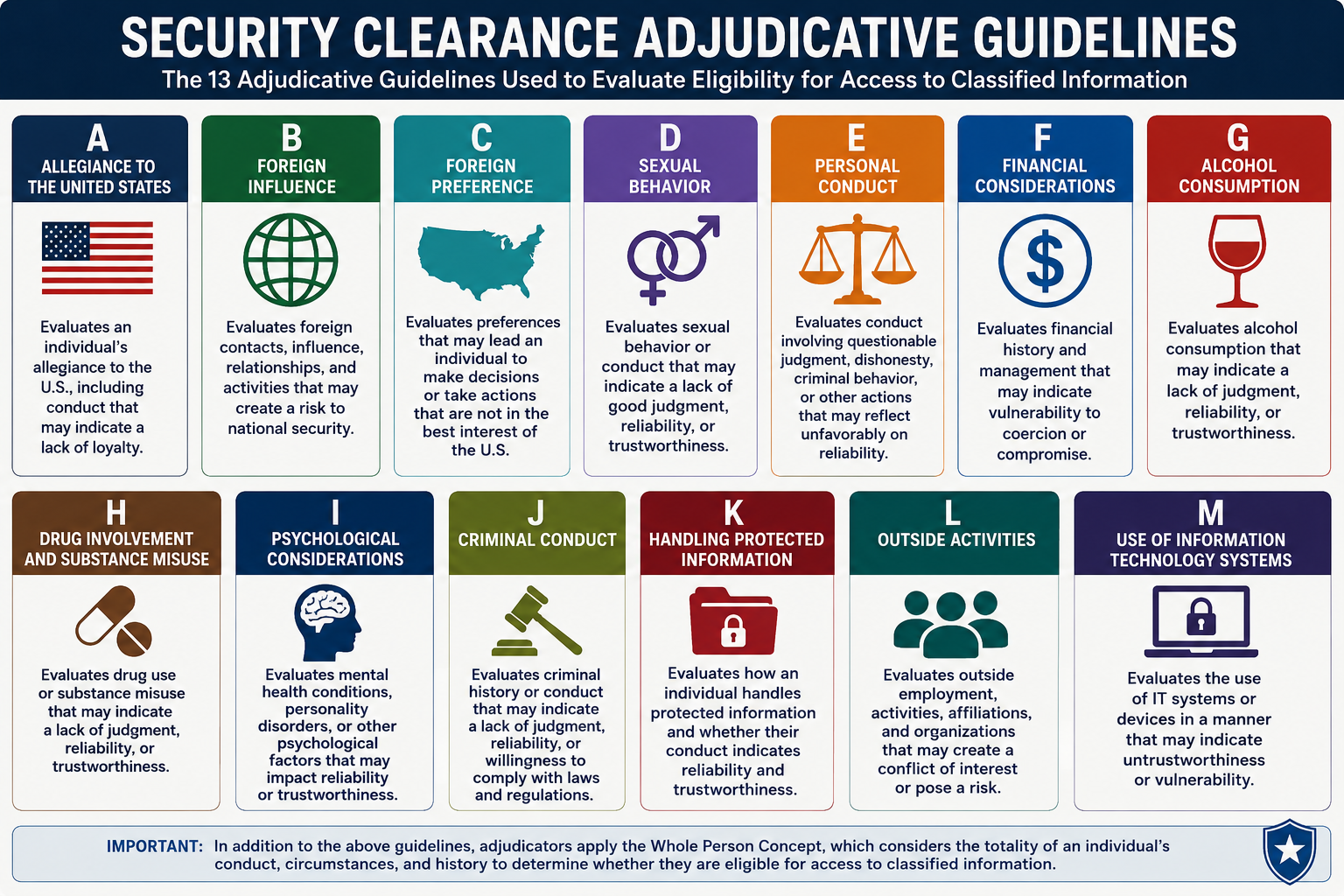
To understand how Guideline G fits into the broader clearance decision framework, review the
👉 Security Clearance Adjudicative Guidelines
Why Guideline G Is One of the Most Misunderstood Guidelines
Guideline G is heavily misunderstood because applicants often think the government is trying to police morality or punish people for drinking socially.
That is not usually what is happening.
The government is not primarily evaluating:
👉 whether someone drinks alcohol.
It is evaluating:
👉 whether alcohol-related behavior creates future security risk.
Applicants often panic because they assume:
- “One DUI means I’m finished.”
- “Counseling will make me look worse.”
- “If I admit drinking problems, I lose.”
- “The government thinks I’m an alcoholic.”
- “I have to prove I never drink.”
Those assumptions are often wrong.
In reality, adjudicators usually focus much more heavily on:
- patterns
- treatment
- recovery
- insight
- behavioral control
- and whether future alcohol-related incidents appear likely
This is why:
- treatment may actually strengthen mitigation
- counseling may help rather than hurt
- and honest acknowledgment of problems may improve credibility significantly
At the same time:
- denial
- minimization
- repeated incidents
- or refusal to address obvious concerns
can quietly make a case much more dangerous.
This is one of the most important realities of Guideline G:
👉 adjudicators are usually evaluating risk—not labels.
For example:
An applicant who completed treatment, stabilized behavior, and avoided repeat incidents may appear much less risky than:
👉 an applicant with fewer incidents who continues minimizing obvious alcohol-related problems.
That distinction matters enormously.
Why Guideline G Cases Feel So Personal
Alcohol-related clearance cases often feel deeply personal.
Applicants frequently feel:
- ashamed
- embarrassed
- judged
- or afraid their career is collapsing because of one mistake
This is especially true after:
- DUIs
- workplace incidents
- alcohol-related arrests
- treatment referrals
- or counseling evaluations
Many applicants immediately begin thinking:
👉 “The government thinks I’m irresponsible.”
Or:
👉 “The government thinks I’m an alcoholic.”
That emotional reaction often creates strategic mistakes.
Applicants begin:
- minimizing conduct
- over-explaining emotionally
- denying obvious intoxication
- or refusing treatment recommendations defensively
But adjudicators are not primarily evaluating shame or emotion.
They are evaluating:
👉 whether the applicant’s alcohol-related behavior creates unresolved concern about future reliability and judgment.
This is why emotional defensiveness often weakens cases.
The strongest Guideline G cases are usually built around:
👉 insight, stability, treatment, behavioral change, and future reliability.
Not emotional denial.
Why the Insider Perspective Matters in Alcohol-Related Cases
Most online discussions about Guideline G focus only on:
- DUI consequences
- alcoholism
- or treatment
That is not enough.
The harder question is:
👉 How do adjudicators actually decide whether alcohol-related conduct creates future security concern?
That is where insider perspective matters.
At National Security Law Firm, we approach Guideline G cases from the perspective of the decision-maker.
Our attorneys understand how adjudicators evaluate:
- isolated conduct versus patterns
- treatment participation
- counseling compliance
- blackout history
- binge drinking
- repeat incidents
- behavioral stabilization
- relapse risk
- honesty during investigation
- and future reliability
For example, adjudicators may ask:
- Was the incident isolated or recurring?
- Was treatment completed?
- Does the applicant understand why the conduct created concern?
- Has alcohol-related behavior changed meaningfully?
- Are there signs of dependency or poor control?
- Did the applicant minimize the issue?
- Is relapse risk low?
- Can approval be defended despite the alcohol history?
That last question matters enormously.
Because in security clearance cases, the issue is not only whether the applicant has an explanation.
The issue is whether the adjudicator can trust the applicant’s future judgment despite the alcohol-related conduct.
This is why Guideline G cases are often won or lost on:
👉 behavioral stability, insight, treatment, and credibility.
Not just the original incident itself.
What This Guide Will Help You Understand
If you are dealing with a Guideline G concern—or worried that one may arise—this guide will explain:
- what alcohol consumption actually means in clearance law
- how DUIs affect security clearances
- what adjudicators look for in alcohol abuse allegations
- why binge drinking and blackouts matter
- how treatment and counseling are evaluated
- when alcohol concerns overlap with other guidelines
- what mitigation actually works
- where applicants accidentally weaken their cases
- and how successful Guideline G cases are built around stability, insight, and future reliability
Most importantly, this guide will help you understand how the government views alcohol-related conduct from a security-risk perspective.
Because until you understand that:
👉 you may be trying to defend drinking behavior while the government is evaluating future reliability and control.
That mismatch is where many Guideline G cases begin to fail.
When Guideline G Actually Comes Up in Real Cases
Guideline G issues usually arise when the government believes:
👉 alcohol-related behavior may create concern about judgment, reliability, self-control, or future risk.
Sometimes the issue involves obvious serious misconduct.
More often, the issue begins with:
- repeated intoxication incidents
- risky drinking behavior
- DUI arrests
- binge drinking
- blackouts
- treatment history
- or concerning patterns revealed during investigation
That is why many applicants are surprised when Guideline G appears.
They often think:
👉 “I only made one mistake.”
Or:
👉 “Lots of people drink like this.”
But adjudicators are not evaluating drinking culture.
They are evaluating:
👉 whether the alcohol-related conduct creates unresolved security concern.
Below are some of the most common ways Guideline G appears in real clearance cases.
DUI and DWI Arrests
DUIs are one of the most common Guideline G triggers.
A single DUI does not automatically destroy a clearance case.
But adjudicators often evaluate several factors closely, including:
- BAC level
- injuries or aggravating circumstances
- whether multiple DUIs exist
- whether alcohol-related behavior continued afterward
- whether treatment occurred
- and whether the applicant minimized the seriousness of the incident
Applicants often mistakenly focus only on:
👉 “Will one DUI disqualify me?”
But adjudicators are usually evaluating a broader question:
👉 “What does this incident suggest about the applicant’s judgment and future alcohol-related risk?”
This is why:
- treatment
- counseling
- behavioral change
- and no recurrence
often matter much more than the arrest itself.
For deeper analysis, review:
👉 Can You Lose Your Security Clearance for a DUI?
Binge Drinking
Binge drinking is another major Guideline G concern.
Especially where drinking behavior appears:
- repetitive
- uncontrolled
- reckless
- or associated with dangerous conduct
Applicants often underestimate how concerning binge drinking can appear in security clearance cases.
Especially where it involves:
- blackouts
- risky behavior
- alcohol-related fights
- public incidents
- or repeated intoxication episodes
The issue is often not:
👉 social drinking itself.
The issue is:
👉 whether the drinking behavior suggests impaired judgment or lack of self-control.
Alcohol Abuse Allegations
Alcohol abuse allegations can arise through:
- treatment records
- counseling referrals
- workplace incidents
- arrests
- family reports
- or investigative interviews
Applicants frequently panic because they believe:
👉 “The government labeled me an alcoholic.”
But adjudicators are often evaluating something broader.
They are evaluating:
👉 whether alcohol-related behavior creates future security risk.
That may include concerns involving:
- dependency
- repeated intoxication
- impaired judgment
- blackouts
- loss of control
- or recurring alcohol-related instability
For deeper analysis, review:
👉 Can You Lose Your Security Clearance for Alcohol Abuse?
Blackouts and Memory-Loss Events
Blackouts create heightened concern because they suggest:
👉 severe impairment and loss of behavioral control.
Applicants sometimes attempt to minimize blackout events by saying:
- “I don’t remember exactly what happened.”
- “It was just one night.”
- “I drank too much once.”
But adjudicators may interpret blackouts as evidence of:
👉 dangerous drinking behavior and impaired judgment.
Especially where blackouts are:
- repeated
- recent
- or associated with risky conduct
Alcohol-Related Arrests
Guideline G often overlaps with alcohol-related criminal conduct.
Examples include:
- DUI
- disorderly conduct
- assault
- domestic disputes
- public intoxication
- or resisting arrest while intoxicated
The concern is usually not only the arrest itself.
It is:
👉 what the alcohol-related behavior suggests about future judgment and reliability.
Where repeated alcohol-related arrests exist:
👉 adjudicative concern increases significantly.
Workplace Alcohol Incidents
Alcohol-related workplace behavior can become especially dangerous because it may suggest:
- impaired professional judgment
- reliability problems
- or inability to maintain control in sensitive environments
Examples include:
- intoxication at work events
- alcohol use while on duty
- inappropriate workplace behavior while intoxicated
- or misuse of government resources during alcohol-related incidents
The more security-sensitive the position:
👉 the more serious these concerns may become.
Alcohol and Domestic Incidents
Alcohol-related domestic incidents often create overlap with:
👉 criminal conduct and personal conduct concerns.
Adjudicators frequently evaluate:
- whether the incident was isolated
- whether violence occurred
- whether alcohol contributed directly
- and whether behavioral stabilization occurred afterward
This is one reason alcohol-related domestic events often become significantly more serious than applicants initially expect.
Counseling and Treatment History
Applicants often become afraid that:
👉 treatment itself hurts the case.
That is usually not accurate.
In many situations:
👉 treatment and counseling may actually strengthen mitigation.
Adjudicators frequently view:
- voluntary counseling
- treatment participation
- compliance
- and recovery efforts
as evidence of:
👉 responsibility and insight.
This is one of the most misunderstood areas of Guideline G.
The government is often more concerned about:
👉 untreated and denied alcohol problems
than about applicants who responsibly addressed them.
Relapse
Relapse issues are highly fact-specific.
One relapse does not automatically destroy a clearance case.
But adjudicators often evaluate:
- how recent the relapse was
- whether treatment resumed
- whether accountability exists
- whether the relapse was hidden
- and whether behavioral control returned afterward
This is one reason post-relapse recovery documentation can become extremely important.
Polygraph Admissions
Many Guideline G issues emerge during:
👉 polygraph examinations.
Applicants often:
- disclose previously minimized drinking behavior
- revise prior disclosures
- admit blackouts
- or provide inconsistent alcohol history under stress
Those admissions frequently become:
👉 permanent parts of the investigative record.
And once multiple versions of the story exist:
👉 credibility concern increases rapidly.
Alcohol Combined With Drugs
Many alcohol-related cases overlap with:
👉 drug-related concerns.
Especially where applicants:
- combine substances
- engage in risky intoxication behavior
- or provide inconsistent disclosures involving both alcohol and drugs
This overlap often significantly increases adjudicative concern because it may suggest:
👉 broader behavioral-control problems.
For deeper analysis, review:
👉 Alcohol and Drugs in Security Clearance Applications
The Guideline G Statute (Full Text)
The full statutory language for Guideline G can be reviewed here:
👉 Guideline G — Alcohol Consumption (Full Text)
The regulation explains:
- what alcohol-related conduct raises concern
- how adjudicators evaluate alcohol-related behavior
- and what mitigating conditions may apply
But reading the statute alone is not enough.
Because Guideline G cases are rarely decided based solely on:
👉 the existence of alcohol use.
They are decided based on:
- pattern
- severity
- treatment
- insight
- behavioral control
- recurrence
- and whether the adjudicator believes future alcohol-related risk remains unresolved
That is why two applicants with similar drinking histories may receive completely different outcomes.
👉 The difference is often not the alcohol itself.
👉 It is how the record is built around the conduct afterward.
What the Government Is Actually Worried About
To truly understand Guideline G, you have to understand the government’s core concern.
The government is not trying to prohibit all alcohol use.
It is evaluating:
👉 whether alcohol-related behavior creates security risk.
That concern generally falls into several categories.
1. Impaired Judgment
This is one of the core Guideline G concerns.
Adjudicators worry that alcohol-related behavior may suggest:
- reckless decision-making
- impulsivity
- poor judgment
- or inability to assess consequences appropriately
This is why alcohol-related criminal conduct and blackouts are treated seriously.
2. Loss of Self-Control
Guideline G is heavily focused on behavioral control.
Adjudicators often evaluate whether alcohol-related behavior appears:
- compulsive
- escalating
- uncontrolled
- or difficult to stop
The concern is often not drinking itself.
It is:
👉 whether the applicant appears unable to control alcohol-related behavior reliably.
3. Future Reliability and Stability
Ultimately, Guideline G is predictive.
The government is asking:
👉 “Does this alcohol-related history suggest future security risk?”
That is the real issue driving most Guideline G decisions.
4. Vulnerability and Risky Conduct
Alcohol-related impairment may increase vulnerability to:
- coercion
- exploitation
- blackmail
- reckless disclosures
- or dangerous behavior
This is especially true where alcohol use contributes to:
- risky sexual behavior
- criminal conduct
- workplace incidents
- or repeated instability
5. Concealment and Credibility Problems
Once alcohol-related conduct is:
- minimized
- concealed
- or inconsistently explained
the case often becomes more serious.
This is where Guideline G frequently overlaps with:
👉 Guideline E — Personal Conduct.
How Adjudicators Actually Evaluate Guideline G Cases
This is where insider perspective matters most.
Adjudicators do not evaluate Guideline G mechanically.
They do not simply ask:
👉 “Does this person drink alcohol?”
They ask:
👉 “What does this alcohol-related conduct suggest about future judgment, reliability, self-control, and security risk?”
That distinction is critical.
Because many Guideline G cases are not really about alcohol consumption itself.
They are about:
👉 whether alcohol-related behavior creates unresolved concern about future reliability.
Adjudicators often evaluate several core questions.
Was the Conduct Isolated or Part of a Pattern?
This is one of the most important issues in Guideline G.
An isolated incident may be viewed very differently than:
👉 repeated alcohol-related behavior.
Adjudicators often evaluate:
- number of incidents
- spacing between incidents
- escalation over time
- and whether concerning behavior continues afterward
For example:
A single DUI followed by treatment and years of stability may look very different than:
👉 multiple alcohol-related incidents combined with continued binge drinking.
Patterns matter enormously.
Because patterns suggest:
👉 future recurrence risk.
Was There Evidence of Dependency or Loss of Control?
Adjudicators often evaluate whether alcohol-related behavior suggests:
- dependency
- compulsion
- inability to stop
- or impaired behavioral control
This is one reason blackouts, repeated intoxication, and escalating drinking behavior create heightened concern.
The issue is often not:
👉 whether the applicant technically meets a medical alcoholism definition.
The issue is:
👉 whether the conduct suggests unresolved future risk.
Did the Applicant Seek Treatment or Counseling?
Treatment participation is one of the most important factors in many Guideline G cases.
Adjudicators often evaluate:
- whether treatment occurred voluntarily
- whether recommendations were followed
- whether counseling was completed
- whether relapse occurred afterward
- and whether recovery appears stable
Applicants often mistakenly believe:
👉 treatment hurts the case.
But in many situations:
👉 treatment may significantly strengthen mitigation because it demonstrates insight and accountability.
Was There Behavioral Change After the Incident?
This is one of the most important strategic questions in Guideline G.
Adjudicators often evaluate whether the applicant:
- changed drinking behavior
- reduced alcohol use
- maintained sobriety
- avoided repeat incidents
- stabilized lifestyle patterns
- or demonstrated improved judgment afterward
The issue is not only what happened.
It is:
👉 whether the applicant appears different now.
Did the Applicant Minimize the Conduct?
This is where many Guideline G cases become much more dangerous.
Applicants often weaken their cases by:
- minimizing intoxication
- downplaying DUIs
- denying obvious impairment
- or insisting the conduct “wasn’t serious”
Adjudicators frequently interpret minimization as:
👉 lack of insight and increased future risk.
This is one reason honest acknowledgment often performs much better than defensive denial.
Was the Conduct Disclosed Honestly?
Once alcohol-related conduct becomes:
👉 a credibility problem
the case may expand into:
👉 Guideline E — Personal Conduct.
Applicants sometimes:
- omit incidents
- minimize drinking history
- deny blackouts
- or change explanations during interviews or polygraphs
This can significantly increase adjudicative concern.
Because now the issue is no longer only alcohol-related behavior.
It is:
👉 whether the applicant can still be trusted.
Can Approval Be Defended?
This is one of the most important insider concepts in clearance law.
Adjudicators constantly ask themselves:
👉 “Could I defend approving this applicant later if another alcohol-related incident occurred?”
That question drives many Guideline G outcomes.
If the file feels:
- stable
- honest
- documented
- and behaviorally controlled
approval becomes much more likely.
If the record feels:
- defensive
- unstable
- repetitive
- or difficult to trust
approval becomes much harder.
DUI and Security Clearances
DUIs are one of the most searched alcohol-related clearance topics because applicants often assume:
👉 “One DUI automatically destroys my clearance.”
That is not usually true.
Many applicants with DUI histories still maintain or obtain security clearances.
The issue is usually not:
👉 whether a DUI occurred.
The issue is:
👉 what the DUI suggests about future judgment and alcohol-related risk.
Adjudicators often evaluate:
- BAC level
- injuries or aggravating factors
- whether repeat DUIs exist
- whether treatment occurred
- whether the applicant minimized the incident
- and whether behavioral change followed afterward
This is why:
- counseling
- treatment
- no recurrence
- and stable conduct afterward
often matter more than the arrest itself.
For deeper analysis, review:
👉 Can You Lose Your Security Clearance for a DUI?
Alcohol Abuse and Security Clearances
Alcohol abuse allegations often create significant fear because applicants worry:
👉 “The government thinks I’m an alcoholic.”
But adjudicators are usually focused less on labels and more on:
👉 future risk.
They evaluate whether alcohol-related behavior suggests:
- impaired judgment
- dangerous conduct
- inability to control drinking
- dependency concerns
- or repeated instability
Strong mitigation often focuses on:
- treatment participation
- sobriety or behavioral stabilization
- insight
- and no recurrence
Weak mitigation often involves:
👉 denial despite obvious concerning conduct.
For deeper analysis, review:
👉 Can You Lose Your Security Clearance for Alcohol Abuse?
Alcohol and Drug Overlap Issues
Many Guideline G cases overlap with:
👉 drug-related concerns.
Especially where applicants:
- combine substances
- engage in risky intoxication behavior
- or provide inconsistent disclosures involving both alcohol and drugs
This overlap often significantly increases adjudicative concern because it may suggest:
👉 broader behavioral-control problems.
For deeper analysis, review:
👉 Alcohol and Drugs in Security Clearance Applications
False Positive Testing Issues
Testing disputes can create unique Guideline G and Guideline H complications.
Applicants sometimes face:
- false positives
- medication interactions
- testing irregularities
- or disputed toxicology findings
Strong cases often depend heavily on:
- immediate documentation
- stable explanations
- laboratory review
- and medical support
Because once explanations begin shifting:
👉 credibility problems can develop quickly.
For deeper analysis, review:
👉 Security Clearance Revoked Over a False Positive Drug Test: What the Government Is Actually Deciding
The “I’m Not an Alcoholic” Problem
This is one of the most misunderstood areas of Guideline G.
Applicants often become obsessed with labels.
They argue:
👉 “I’m not an alcoholic.”
But adjudicators are usually not deciding medical labels.
They are evaluating:
👉 behavior, judgment, reliability, and future risk.
A person does not necessarily need to meet a formal alcoholism diagnosis for alcohol-related conduct to create serious security concern.
This is why arguing labels often becomes weak strategy.
The stronger question is usually:
👉 “What has changed, and why is future alcohol-related risk now low?”
That is what adjudicators actually care about.
The “Paper Risk” Problem in Guideline G Cases
This is one of the most important concepts in security clearance law.
Even manageable alcohol-related conduct can become dangerous when:
👉 the record itself feels unstable or difficult to trust.
This is what we call:
👉 paper risk.
Examples include:
- inconsistent drinking history
- conflicting treatment records
- minimizing obvious intoxication
- emotionally reactive written statements
- unstable timelines
- denial despite evidence
- or unsupported claims about recovery
Once the file begins to feel:
- evasive
- defensive
- unstable
- or difficult to trust
👉 adjudicators become uncomfortable approving it.
That discomfort matters enormously.
Because adjudicators constantly ask themselves:
👉 “Can I defend approving this applicant later if another alcohol-related incident occurs?”
If the answer becomes uncertain:
👉 the case becomes much harder to win.
What Strong Guideline G Mitigation Actually Looks Like
Strong Guideline G mitigation is not built around emotional apology alone.
It is built around:
👉 behavioral stabilization, insight, treatment, and proof of future reliability.
That distinction is critical.
Because adjudicators are not simply evaluating whether the applicant regrets the incident.
They are evaluating:
👉 whether alcohol-related conduct still creates unresolved future risk.
Strong mitigation often includes several recurring themes.
Treatment and Counseling Participation
Treatment can become one of the strongest forms of mitigation in Guideline G cases.
Examples may include:
- alcohol counseling
- outpatient treatment
- inpatient rehabilitation
- AA participation
- substance-abuse evaluations
- or therapy focused on alcohol misuse
Applicants often mistakenly fear:
👉 treatment makes the case worse.
But adjudicators frequently view treatment as evidence of:
👉 accountability, insight, and willingness to address risk responsibly.
This is especially true when applicants:
- complete treatment
- follow recommendations
- and demonstrate stable behavior afterward
Behavioral Stabilization
Strong cases often show meaningful behavioral change after the alcohol-related concern emerged.
Examples may include:
- sobriety
- reduced alcohol use
- avoiding binge drinking
- healthier routines
- stable employment
- improved relationships
- or avoidance of high-risk environments
Adjudicators are heavily influenced by whether:
👉 the applicant’s current life appears stable and controlled.
No Repeat Alcohol-Related Conduct
One of the strongest mitigation themes in Guideline G is:
👉 absence of recurrence.
Applicants who avoid:
- additional DUIs
- alcohol-related arrests
- workplace incidents
- blackouts
- or repeated intoxication behavior
often present much stronger mitigation arguments.
This is because adjudicators frequently distinguish between:
👉 isolated poor judgment
and
👉 ongoing instability.
Insight Into the Problem
This is one of the most important mitigation concepts in Guideline G.
Adjudicators often want to see that the applicant:
- understands why the conduct created concern
- takes the issue seriously
- and appreciates the importance of behavioral control
This does not mean dramatic self-condemnation.
It means:
👉 mature insight into why the alcohol-related behavior mattered.
Applicants who continue insisting:
👉 “This was no big deal”
often create additional concern.
Because adjudicators may interpret that response as:
👉 lack of judgment or lack of insight.
Honest Disclosure and Stable Explanations
Alcohol-related cases often become much more dangerous when applicants:
- minimize drinking
- change timelines
- deny obvious intoxication
- or provide inconsistent alcohol history
Once alcohol-related conduct becomes:
👉 a credibility problem
the case may expand into:
👉 Guideline E — Personal Conduct.
Strong cases therefore usually involve:
- stable disclosures
- honest acknowledgment
- and disciplined explanations
Strong Whole-Person Evidence
Guideline G cases are heavily influenced by:
👉 the Whole Person Concept.
Adjudicators may consider:
- military service
- federal service
- performance evaluations
- treatment success
- counseling compliance
- character references
- and otherwise responsible life history
This is especially important where the alcohol-related conduct appears inconsistent with the applicant’s broader life pattern.
What Weak Guideline G Mitigation Looks Like
Weak mitigation usually shares one common theme:
👉 the applicant appears defensive instead of reliable.
Applicants often damage their cases by saying things like:
- “Everyone drinks.”
- “The police exaggerated.”
- “I wasn’t really intoxicated.”
- “It only happened once, so it shouldn’t matter.”
- “I don’t need counseling.”
- “The government is overreacting.”
Those explanations often fail because adjudicators may interpret them as:
👉 lack of insight, minimization, or unresolved future risk.
Over-Minimization Quietly Destroys Many Guideline G Cases
Applicants frequently weaken their cases by minimizing:
- blackouts
- binge drinking
- intoxication
- treatment recommendations
- or dangerous alcohol-related conduct
This often creates a major credibility problem.
Because adjudicators may begin believing:
👉 the applicant still does not fully understand the seriousness of the behavior.
And if the applicant lacks insight:
👉 adjudicators may worry the conduct will continue.
Reactive Treatment Is One of the Biggest Problems in Guideline G Cases
Applicants often wait until:
- the background investigation
- the LOI
- the SOR
- or the hearing
before seeking treatment or counseling.
Late treatment can still help.
But adjudicators often distinguish sharply between:
👉 proactive recovery
and
👉 treatment pursued only after clearance danger appeared.
That distinction matters enormously.
Undocumented Recovery Quietly Weakens Cases
Applicants often say:
👉 “I stopped drinking.”
Or:
👉 “I learned my lesson.”
But adjudicators frequently want documentation.
Strong cases often include:
- counseling records
- treatment evaluations
- completion certificates
- therapist letters
- AA participation records
- substance-abuse assessments
- or probation compliance records
Without documentation:
👉 recovery narratives often become much weaker.
Illustrative Guideline G Case Scenarios
The examples below are hypothetical scenarios based on common fact patterns seen in security clearance cases. They are designed to show how adjudicators typically evaluate Guideline G concerns—not to predict outcomes in any specific case.
Scenario 1 — Single DUI With Counseling and No Recurrence (Often Mitigable)
An applicant receives a DUI after a work event.
The applicant:
- completes all court requirements
- attends alcohol counseling
- demonstrates no additional incidents afterward
- and acknowledges the seriousness of the event
👉 Likely Outcome: Often mitigable
Why this works:
The incident appears isolated and the applicant demonstrates insight and behavioral correction.
Scenario 2 — Multiple Alcohol Incidents With No Treatment (High Risk)
An applicant has multiple alcohol-related incidents over several years but refuses counseling and continues binge drinking.
👉 Likely Outcome: Significant Guideline G concern
Why this creates concern:
The pattern suggests unresolved future risk and lack of behavioral control.
Scenario 3 — Binge Drinking During Military Service Followed by Long-Term Stability (Potentially Mitigable)
An applicant engaged in heavy drinking during early military service but has maintained stable behavior and no incidents for many years afterward.
👉 Likely Outcome: Often manageable
Why this works:
The conduct appears historical rather than ongoing.
Scenario 4 — Alcohol Treatment Completed Successfully (Strong Mitigation)
An applicant voluntarily enters treatment after recognizing alcohol misuse.
The applicant:
- completes treatment
- complies with recommendations
- maintains sobriety
- and provides strong documentation
👉 Likely Outcome: Strong mitigation
Why this helps:
Treatment participation and recovery documentation strongly support future reliability.
Scenario 5 — Continued Drinking After DUI While Minimizing Risk (High Risk)
An applicant continues heavy social drinking after a DUI and insists:
👉 “The incident was overblown.”
👉 Likely Outcome: Elevated concern
Why this fails:
The applicant appears to lack insight into the seriousness of the conduct.
Scenario 6 — Workplace Alcohol Incident With Behavioral Stabilization (Potentially Mitigable)
An applicant experiences an alcohol-related workplace incident but immediately seeks counseling and demonstrates stable conduct afterward.
👉 Likely Outcome: Fact-specific but often mitigable
Why this may work:
The applicant addressed the issue proactively rather than defensively.
Scenario 7 — False Positive Testing Dispute With Strong Documentation (Potentially Mitigable)
An applicant challenges a disputed alcohol or drug test and provides:
- medical records
- medication explanations
- laboratory review
- and stable consistent explanations
👉 Likely Outcome: Potentially manageable
Why this helps:
The explanation appears credible and well-supported.
Scenario 8 — Relapse Followed by Renewed Recovery (Fact-Specific)
An applicant relapses after prior sobriety but immediately reenters treatment and demonstrates renewed recovery effort.
👉 Likely Outcome: Highly fact-specific
Why this may still be mitigable:
Relapse alone does not automatically destroy mitigation if the response demonstrates accountability and recovery.
What Actually Gets Guideline G Cases Approved
Successful Guideline G cases usually share several characteristics.
The applicant typically:
- demonstrates insight into the problem
- completes treatment or counseling where appropriate
- avoids repeat incidents
- stabilizes behavior
- discloses issues honestly
- and demonstrates current reliability
Most importantly:
👉 the adjudicator ultimately believes the applicant’s alcohol-related behavior no longer creates meaningful future security risk.
That is the real issue in Guideline G.
Not perfection.
👉 future reliability and control.
What Causes Guideline G Denials
Guideline G denials usually stem from one core conclusion:
👉 the adjudicator believes alcohol-related risk remains unresolved.
That concern may involve:
- repeated incidents
- ongoing binge drinking
- refusal of treatment
- denial or minimization
- relapse without accountability
- dishonesty
- or unstable behavior continuing
This is one of the most important realities of Guideline G:
👉 the denial often happens because the adjudicator concludes future alcohol-related risk still exists—not simply because drinking occurred in the past.
Where Guideline G Cases Collapse
Most Guideline G cases do not fail because of one isolated mistake.
They fail during escalation.
This is one of the most important concepts in alcohol-related clearance law.
Stage 1 — Alcohol-Related Incident Occurs
Examples include:
- DUI
- binge drinking event
- blackout
- alcohol-related arrest
- workplace incident
- intoxicated misconduct
- or concerning polygraph disclosures
At this stage:
👉 the issue may still be highly manageable.
Stage 2 — Applicant Minimizes the Conduct
The applicant begins saying things like:
- “It wasn’t serious.”
- “Everyone drinks.”
- “The police exaggerated.”
- “I wasn’t really impaired.”
- “It only happened once.”
This is where the danger often begins.
Because adjudicators may interpret minimization as:
👉 lack of insight into the seriousness of the conduct.
Stage 3 — No Treatment or Behavioral Change Occurs
The applicant:
- refuses counseling
- ignores treatment recommendations
- continues binge drinking
- or makes no meaningful behavioral changes afterward
Now adjudicators begin seeing:
👉 unresolved future alcohol-related risk.
Stage 4 — Repeat Conduct Occurs
Additional incidents appear.
Examples may include:
- another DUI
- alcohol-related workplace behavior
- blackout episodes
- domestic incidents
- or continued intoxication concerns
At this point, adjudicators often begin viewing the conduct as:
👉 a pattern rather than an isolated lapse.
Stage 5 — Credibility Problems Develop
The applicant:
- changes explanations
- minimizes prior drinking history
- denies obvious intoxication
- or provides inconsistent disclosures
Now the case may evolve into:
👉 a Guideline E — Personal Conduct problem.
This is one of the most important realities of Guideline G:
👉 credibility collapse often becomes more dangerous than the original drinking conduct itself.
Stage 6 — The Entire File Becomes a Reliability Concern
At this point, adjudicators begin questioning:
- judgment
- behavioral control
- honesty
- future reliability
- and whether future alcohol-related incidents appear likely
This is where many Guideline G cases ultimately fail.
Stage 7 — SOR or Denial
The unresolved alcohol-related concern hardens into:
- an LOI
- a Statement of Reasons
- suspension
- denial
- or revocation
👉 Final outcome: clearance loss.
How Guideline G Interacts With Other Guidelines
Guideline G frequently overlaps with several other security clearance guidelines.
This is one reason alcohol-related cases can become more complicated than applicants initially expect.
Many cases that begin as:
👉 alcohol-consumption concerns
eventually become:
👉 broader judgment, credibility, or reliability cases.
Guideline E — Personal Conduct
This is one of the most common overlaps.
Examples include:
- minimizing alcohol use
- inconsistent drinking disclosures
- concealing alcohol-related incidents
- or changing explanations during investigation
In many cases:
👉 the dishonesty becomes more dangerous than the alcohol-related conduct itself.
See:
👉 Guideline E — Personal Conduct
Guideline H — Drug Involvement and Substance Misuse
Alcohol cases frequently overlap with:
👉 drug-related concerns.
Especially where applicants:
- combine substances
- engage in risky intoxication behavior
- or provide inconsistent disclosures involving both alcohol and drugs
See:
👉 Guideline H — Drug Involvement and Substance Misuse
Guideline J — Criminal Conduct
Alcohol-related arrests and misconduct may create overlap with:
👉 criminal-conduct concerns.
Examples include:
- DUI
- assault
- disorderly conduct
- domestic incidents
- or repeated intoxicated misconduct
See:
👉 Guideline J — Criminal Conduct
Guideline F — Financial Considerations
Alcohol-related instability sometimes contributes to:
👉 financial problems.
Examples may include:
- debt
- job loss
- reckless spending
- gambling
- or alcohol-related financial collapse
See:
👉 Guideline F — Financial Considerations
Guideline D — Sexual Behavior
Alcohol-related impairment sometimes contributes to:
👉 risky sexual conduct or judgment failures.
Examples may include:
- intoxicated misconduct
- risky behavior while impaired
- or alcohol-related relationship incidents
See:
👉 Guideline D — Sexual Behavior
Guideline M — Use of Information Technology Systems
Alcohol-related impairment sometimes contributes to:
👉 IT misuse concerns.
Examples include:
- inappropriate online activity while intoxicated
- misuse of government systems
- or reckless digital behavior during intoxication
See:
👉 Guideline M — Use of Information Technology Systems
👉 Once multiple guidelines begin overlapping, the mitigation burden often becomes much heavier.
This is one reason early strategic handling matters enormously.
How Guideline G Appears Throughout the Clearance Process
Alcohol-related concerns can emerge at nearly every stage of the security clearance process.
Many applicants mistakenly assume:
👉 “If I explain the incident once, the issue disappears.”
That is not how the system works.
Guideline G concerns often follow applicants throughout:
- the SF-86 process
- arrest-record review
- the background investigation
- subject interviews
- polygraphs
- treatment evaluations
- LOIs
- SORs
- hearings
- and future reinvestigations
This is why:
👉 early stabilization of the record matters enormously.
The SF-86 Stage
Many Guideline G issues first appear during completion of the:
👉 SF-86 Security Clearance Form
This is where applicants disclose:
- alcohol-related arrests
- treatment history
- counseling
- substance-use concerns
- and related incidents
The SF-86 becomes:
👉 the foundation of the alcohol-related investigative record.
If disclosures are:
- incomplete
- vague
- misleading
- or inconsistent
those problems often follow the applicant throughout the clearance process.
The Subject Interview
The:
👉 security clearance subject interview
is one of the most important stages in Guideline G cases.
Applicants frequently weaken their cases by:
- minimizing intoxication
- understating drinking history
- emotionally over-explaining
- denying obvious impairment
- or changing timelines under pressure
This is where many alcohol-related cases begin evolving into:
👉 broader credibility concerns.
The Polygraph Stage
Many Guideline G issues emerge during:
- lifestyle polygraphs
- CI polygraphs
- or follow-up examinations
Applicants often panic and:
- revise prior drinking disclosures
- admit additional incidents
- minimize alcohol misuse
- or provide inconsistent explanations under stress
Those admissions often become:
👉 permanent parts of the investigative record.
This is one reason stable and disciplined disclosure matters so much.
The Treatment and Evaluation Stage
Some Guideline G cases involve:
- substance-abuse evaluations
- counseling records
- rehabilitation documentation
- or treatment recommendations
Adjudicators often evaluate:
- whether treatment was completed
- whether recommendations were followed
- whether relapse occurred
- and whether recovery appears stable
This is one reason treatment documentation can become extremely important mitigation evidence.
The LOI and SOR Stages
If alcohol-related concerns remain unresolved, applicants may receive:
- a Letter of Interrogatory (LOI)
- or a Statement of Reasons (SOR)
At this stage, the government is often attempting to:
- clarify drinking history
- evaluate treatment participation
- assess recurrence risk
- and determine whether the issue is escalating
Poorly handled responses often become:
👉 the blueprint for later denial.
Related Guideline G Resources
For deeper analysis of the most common Guideline G issues, review:
👉 Can You Lose Your Security Clearance for Alcohol Abuse?
👉 Can You Lose Your Security Clearance for a DUI?
👉 Alcohol and Drugs in Security Clearance Applications
👉 Security Clearance Revoked Over a False Positive Drug Test: What the Government Is Actually Deciding
👉 How to Mitigate a Guideline G Alcohol Consumption Security Clearance Concern
How Guideline G Alcohol Concerns Are Actually Mitigated
Many applicants assume that once alcohol-related concerns appear in the clearance process, the case is effectively over.
That is not true.
In reality, many Guideline G cases are highly mitigable when the issue is handled strategically and the record is stabilized correctly.
The key is understanding what adjudicators are actually evaluating:
👉 treatment
👉 behavioral control
👉 insight
👉 relapse risk
👉 reliability
👉 and whether future alcohol-related conduct appears likely
Strong mitigation often involves:
- counseling or treatment
- behavioral stabilization
- documented recovery
- no repeat incidents
- honest disclosure
- and evidence of future reliability
For a deeper breakdown of what actually helps—and hurts—Guideline G cases, including DUI strategy, treatment issues, relapse concerns, blackout behavior, and alcohol-related risk analysis, review:
👉 How to Mitigate a Guideline G Alcohol Consumption Security Clearance Concern
The Record Controls the Case.
SECURITY CLEARANCE DENIED OR REVOKED
If you are appealing a security clearance determination, it is imperative that you obtain experienced legal representation. Doing so will provide you with the best opportunity to obtain or maintain your clearance.
Click Here For a No Obligation, Always Confidential Consultation