
What Guideline A Actually Means (In Plain English)
Guideline A is the part of the security clearance system that deals with loyalty to the United States.
At a basic level, it asks:
👉 Does anything in this person’s background suggest they might act against U.S. interests—or be perceived as a risk to national security?
That sounds extreme, but in practice, Guideline A is often triggered by much more ordinary situations, including:
- statements made online or in person that are taken out of context
- associations with groups or individuals that raise concern
- participation in political or activist activity that is misunderstood
- conduct that creates questions about judgment or alignment with U.S. interests
At National Security Law Firm, our security clearance lawyers include former security clearance judges, adjudicators, and decision-makers who have applied this exact guideline when deciding whether someone should be granted or denied a clearance.
That perspective matters, because what most applicants think this guideline means—and how it is actually applied—are very different.
Here is the key distinction:
👉 Guideline A is not about what you believe.
👉 It is about what your record suggests.
Adjudicators are not evaluating ideology.
They are evaluating:
- whether your conduct creates uncertainty
- whether that uncertainty is resolved
- and whether they can justify approving you despite it
That last point is critical.
Because in security clearance cases, the real question is never:
👉 “Did this violate the rule?”
It is:
👉 “Can I approve this person and defend that decision later?”
Quick Answer: Can Guideline A Affect Your Security Clearance?
Yes—Guideline A can absolutely affect your clearance.
If the government believes your actions, associations, or statements raise doubt about your loyalty, reliability, or judgment, your clearance can be:
- delayed
- suspended
- denied
- or revoked
But that is only part of the story.
Many Guideline A cases are approved, even when concerning facts exist.
Approval typically depends on whether:
- the issue is isolated or part of a pattern
- the context is clearly explained
- the record removes ambiguity
- and the adjudicator feels comfortable approving the file
That last point is what most people miss.
Security clearance decisions are not mechanical.
They are discretionary.
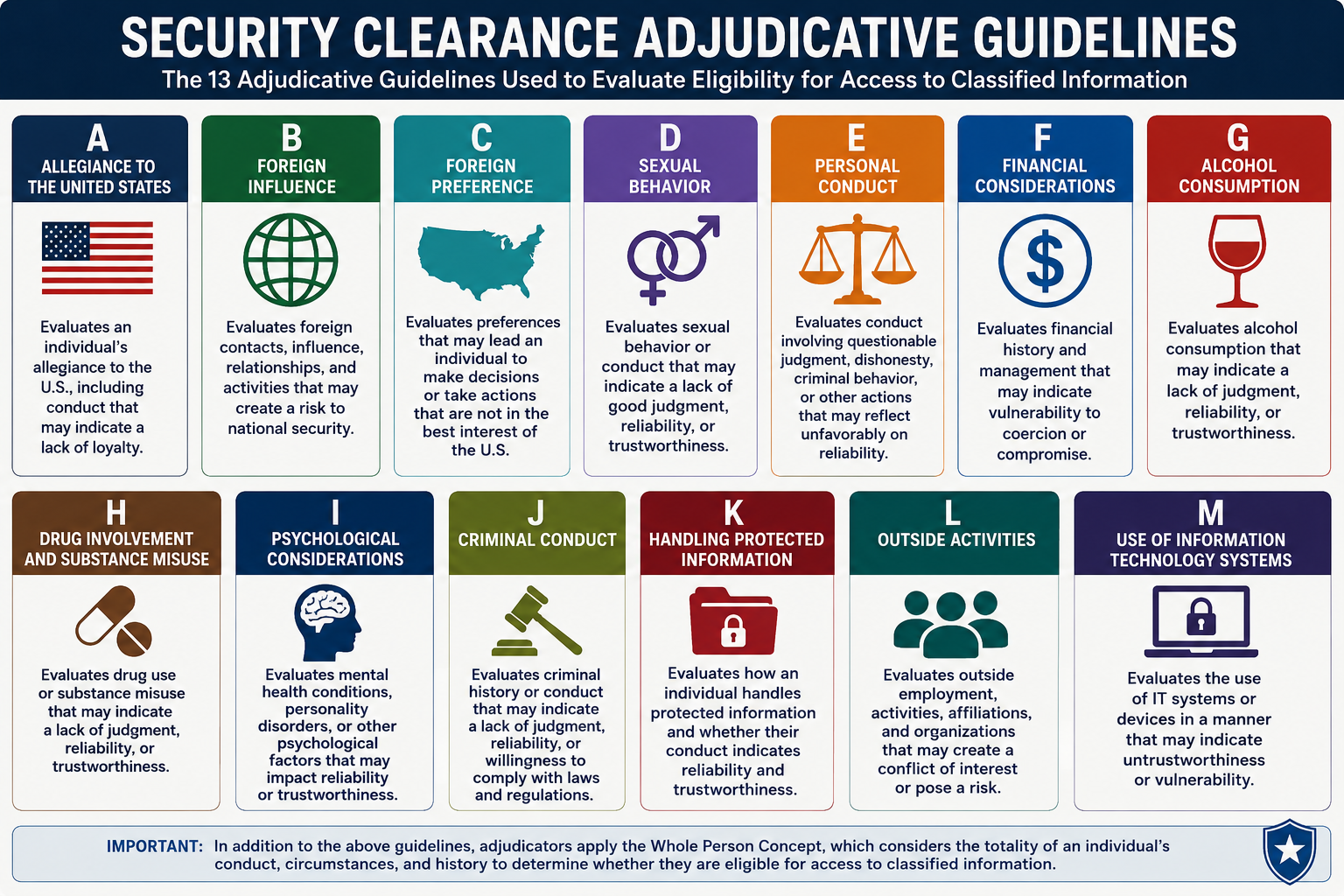
To understand how this discretion works across all guidelines, you can review the Security Clearance Adjudicative Guidelines, but what matters more is how those guidelines are actually used in real cases.
 Why This Guideline Confuses So Many People
Guideline A is one of the most misunderstood parts of the clearance process.
Most applicants assume:
- “This only applies to extreme cases.”
- “I didn’t do anything illegal, so this shouldn’t matter.”
- “This is about politics or beliefs.”
All of those assumptions are wrong.
Guideline A cases are rarely about clear-cut disloyalty.
They are about interpretation.
Something in the record—often something small—creates a question.
And once that question exists, it must be answered.
Not emotionally.
Not defensively.
But clearly, consistently, and in a way that removes risk.
The problem is that most applicants respond the wrong way.
They try to:
- argue the issue
- minimize the concern
- or explain it casually
But adjudicators are not looking for casual explanations.
They are looking for:
👉 resolution
And if they do not find it, even a relatively minor issue can become a basis for denial.
Why the Insider Perspective Matters From the Start
Most information online will tell you:
👉 “Here is what Guideline A says.”
Very little will tell you:
👉 “Here is how Guideline A is actually used to approve or deny a case.”
That difference is where cases are won or lost.
At National Security Law Firm, we approach these cases from the perspective of the decision-maker.
Our attorneys have:
- evaluated clearance cases inside the system
- written decisions under these guidelines
- reviewed files the same way adjudicators do
That means we focus on:
- how your record will be read
- where concerns will arise
- and what must be done to resolve them before a decision is made
This is why two people with similar facts can have completely different outcomes.
Because the outcome is not driven by the rule itself.
👉 It is driven by how the case is built under that rule.
What This Page Will Help You Understand
If you are dealing with a potential Guideline A issue—or trying to avoid one—this guide will walk you through:
- when and why this guideline is triggered
- what adjudicators are actually looking for
- how these concerns develop during the investigation
- what causes cases to fail
- and what actually works to resolve them
Most importantly, it will show you:
👉 how to think about your case the way the government does
Because until you understand that:
👉 you are reacting to the process instead of controlling it
When Guideline A Actually Comes Up in Real Cases
Guideline A does not usually appear in obvious, extreme situations.
In most real cases, it is triggered by something that initially seems minor—but becomes significant once it is documented and interpreted in the record.
Common triggers include:
- Social media activity
Posts, comments, or shared content that could be interpreted as anti-government, inflammatory, or aligned with controversial positions - Associations with individuals or groups
This does not require formal membership. Even informal or indirect connections can raise questions depending on context - Participation in protests or movements
Especially where the nature of the activity is unclear, mischaracterized, or connected to broader narratives - Statements made during interviews
Tone, wording, and phrasing matter. Offhand comments can become part of the investigative record - Online footprint and digital behavior
Investigators increasingly review publicly available information and may draw conclusions without full context
Here is what makes these cases difficult:
👉 The issue is often not the conduct itself
👉 It is how the conduct is interpreted and written into your file
Once something is recorded as a concern, it becomes part of the adjudicator’s decision framework.
What the Government Is Actually Worried About
To understand Guideline A, you have to shift how you think about the problem.
The government is not trying to determine whether you are “loyal” in a philosophical sense.
It is trying to determine whether your record presents unresolved risk.
That risk can take several forms:
- Judgment risk — Did your actions show poor judgment that could repeat?
- Reliability risk — Is your behavior consistent and predictable?
- Influence risk — Are you susceptible to pressure or persuasion?
- Perception risk — Would approving you create a defensibility problem for the agency?
That last category—perception—is one of the most important.
Because adjudicators are not only deciding whether you should be approved.
They are also deciding:
👉 whether they can defend approving you if that decision is later reviewed
This is why even ambiguous or misunderstood conduct can become a serious issue.
How Adjudicators Actually Evaluate Guideline A Cases
Adjudicators do not evaluate your case like a checklist.
They evaluate it like a narrative.
They are asking:
- What happened?
- What does it mean?
- Is it resolved?
- Can I defend approving this person?
This is where most applicants make a critical mistake.
They focus on explaining the event.
But adjudicators are focused on:
👉 whether the explanation removes uncertainty
If the answer is no, the case stalls or fails.
The “Paper Risk” Problem
Inside the system, there is a concept that rarely gets discussed outside of it:
👉 paper risk
Paper risk means:
- The facts may not be disqualifying
- But the way they appear in the record creates discomfort
Adjudicators are trained to avoid:
- unclear files
- conflicting explanations
- approvals that require too much justification
So even if your conduct is not severe, your case can still fail if:
- it is not clearly explained
- it appears inconsistent
- or it leaves unanswered questions
That is why:
👉 clarity matters more than perfection
👉 consistency matters more than explanation
What Raises Allegiance Concerns Under Guideline A
Now that you understand how adjudicators think, we can break down what actually triggers concern.
Guideline A issues generally fall into a few core categories:
1. Statements Interpreted as Anti-Government
This can include:
- strong criticism of government institutions
- language that appears hostile or extreme
- statements taken out of context
Important:
👉 The issue is rarely the statement itself
👉 It is how it is interpreted in the record
2. Association With Certain Groups or Individuals
Concerns can arise from:
- involvement with controversial organizations
- participation in events tied to those groups
- relationships that create perceived alignment
Even if:
- your involvement was minimal
- your intent was different
- or your beliefs were not aligned
👉 The association still has to be explained
3. Conduct That Suggests Divided Loyalty
This does not require disloyalty.
It can arise from:
- actions that appear inconsistent with U.S. interests
- behavior that raises questions about alignment
- patterns that suggest conflicting priorities
Again:
👉 perception drives the concern
4. Ambiguous or Poorly Explained Behavior
This is one of the most common triggers.
The issue is not what happened.
The issue is:
👉 the lack of a clear, credible explanation
Ambiguity creates risk.
And in this system:
👉 risk leads to denial
The Statute Itself — And Why It’s Not Enough
You can read the full language of Guideline A here:
👉 Guideline A – Allegiance to the United States (Full Text)
But this is critical to understand:
The statute does not tell adjudicators what decision to make.
It tells them:
👉 how to justify the decision they choose
That means:
- the same facts can lead to different outcomes
- the same guideline can be applied differently
- the result depends on how the record is built
Which is why:
👉 relying on the text alone is not enough
What Strong Mitigation Actually Looks Like
Mitigation is where most cases are won—or lost.
Strong mitigation under Guideline A does not argue.
It resolves.
It does four things:
1. Clarifies the Conduct
- What actually happened
- What did not happen
- What was misunderstood
2. Provides Context
- Why it happened
- What the intent was
- What the surrounding circumstances were
3. Demonstrates Resolution
- No ongoing involvement
- No repeated behavior
- Clear change or clarification
4. Removes Risk
- No ambiguity
- No unanswered questions
- No inconsistency in the record
If any of those are missing:
👉 the issue remains “unresolved”
And unresolved issues are what drive denials.
What Weak Mitigation Looks Like
Weak mitigation is easy to spot.
It usually sounds like:
- “That’s not what I meant”
- “This is being blown out of proportion”
- “It wasn’t a big deal”
Or it shows up as:
- inconsistent explanations
- incomplete disclosures
- over-explaining that creates contradictions
The biggest mistake:
👉 trying to minimize instead of resolve
How Guideline A Concerns Are Actually Mitigated
Many applicants assume that once a Guideline A issue appears, the case is already lost.
That is not true.
In reality, many Guideline A concerns are highly mitigable when the issue is handled strategically and the record is built correctly.
The key is understanding what adjudicators are actually evaluating:
👉 ambiguity
👉 perceived extremist alignment
👉 judgment
👉 credibility
👉 online activity
👉 reliability
👉 and whether the conduct still creates unresolved security concern
Strong mitigation often involves:
- clarifying context surrounding statements or online activity
- distancing from problematic associations or conduct where appropriate
- eliminating ambiguity in the record
- maintaining consistent explanations across interviews and disclosures
- avoiding credibility collapse during the investigation
- and demonstrating stability, maturity, and absence of ongoing risk
For a deeper breakdown of what actually helps—and hurts—Guideline A cases, including social media concerns, controversial statements, online activity, association issues, and investigator interpretation problems, review:
👉 How to Mitigate a Guideline A Security Clearance Concern
How to Actually Think About Your Case
If Guideline A is involved in your case, the question is not:
👉 “Did I do something wrong?”
The question is:
👉 “What does my record suggest—and does it create risk?”
Until that risk is clearly resolved:
👉 the case does not move forward
Advanced Strategy: How to Actually Win Under Guideline A
At this stage, most applicants understand the issue—but still approach it the wrong way.
They try to:
- explain more
- provide more detail
- argue why the concern shouldn’t matter
That instinct is understandable.
But it’s also why many cases fail.
Because Guideline A cases are not won by adding more information.
They are won by:
👉 controlling how the information is interpreted
Strategy Shift #1: From Explanation to Resolution
Explanation answers:
👉 “What happened?”
Resolution answers:
👉 “Why this is no longer a risk”
Adjudicators are not satisfied by explanations alone.
They need to see:
- clarity
- finality
- stability
If your explanation leaves room for interpretation:
👉 the issue remains open
Strategy Shift #2: Eliminate Ambiguity, Not Just Defend Yourself
Many applicants make this mistake:
They think:
👉 “If I explain this well enough, they’ll understand”
But the system doesn’t work on understanding.
It works on:
👉 certainty
Your goal is not to be understood.
Your goal is to make the file:
- clear
- consistent
- defensible
Strategy Shift #3: Consistency Across the Entire Record
Your statements are not evaluated in isolation.
They are compared across:
- your SF-86
- investigator notes
- subject interviews
- references
- prior disclosures
If anything conflicts—even slightly—it creates:
👉 credibility risk
And credibility issues often matter more than the underlying conduct.
Strategy Shift #4: Align With Adjudicator Thinking
The strongest cases are built with this mindset:
👉 “What does the adjudicator need to feel comfortable approving this?”
Not:
👉 “What do I want to say?”
That difference is everything.
Illustrative Case Scenarios (How Guideline A Plays Out in Real Situations)
The examples below are hypothetical scenarios based on common fact patterns seen in security clearance cases. They are designed to show how adjudicators typically evaluate risk under Guideline A—not to predict outcomes in any specific case.
Scenario 1 — Social Media Misinterpretation (Likely Approval)
An applicant has several social media posts flagged during the background investigation.
On their face, the posts appear critical of U.S. institutions.
However:
- full context is provided
- tone and intent are clearly explained
- there is no pattern of similar behavior
- there is no ongoing activity
👉 Likely Outcome: Approved
Why this works:
The concern is clarified early, and the record removes ambiguity. The adjudicator can reasonably conclude there is no ongoing risk.
Scenario 2 — Ongoing Association (High Risk of Denial)
An applicant maintains involvement with an organization flagged for anti-government rhetoric.
The applicant claims:
- they do not agree with all views
- their involvement is limited
However, the record reflects:
- continued association
- no clear distancing
- inconsistent explanations
👉 Likely Outcome: Denied
Why this fails:
The concern is not resolved. Ongoing involvement and lack of clarity create a risk that is difficult for an adjudicator to defend.
Scenario 3 — Past Conduct With Strong Mitigation (Likely Approval)
An applicant previously had involvement with a controversial group several years earlier.
However:
- involvement has clearly ended
- the applicant has distanced themselves
- explanations are consistent and supported
- there are no related concerns elsewhere in the record
👉 Likely Outcome: Approved
Why this works:
The issue is contained in the past and fully resolved. The record shows stability and no ongoing risk.
Scenario 4 — No Major Conduct, But Credibility Issues (High Risk of Denial)
An applicant does not have clearly disqualifying conduct under Guideline A.
However:
- explanations shift over time
- details are inconsistent across interviews and forms
- tone becomes defensive
👉 Likely Outcome: Denied
Why this fails:
The issue becomes credibility. Even without serious underlying conduct, inconsistency creates risk the adjudicator cannot resolve.
Scenario 5 — Over-Explaining Creates New Risk (High Risk of Denial)
An applicant attempts to provide extensive detail to clarify a concern.
Instead:
- new facts are introduced
- inconsistencies appear
- the record becomes more complicated
👉 Likely Outcome: Denied
Why this fails:
More explanation does not equal better mitigation. It can create ambiguity and increase perceived risk.
Scenario 6 — Minor Issue, Clearly Framed (Likely Approval)
An applicant has a minor concern related to a statement or association.
They address it early by:
- providing a clear, concise explanation
- maintaining consistency across all disclosures
- avoiding unnecessary detail
👉 Likely Outcome: Approved
Why this works:
The record is simple, consistent, and easy to approve. There is no ambiguity for the adjudicator to resolve.
Important Note
These scenarios are illustrative and not guarantees of any outcome. Security clearance decisions are fact-specific and depend on how the full record is developed, interpreted, and evaluated under the adjudicative guidelines.
What Actually Gets Clearances Approved Under Guideline A
Approved cases almost always share these characteristics:
- the issue is clearly identified
- the explanation is consistent
- the record is simple and coherent
- there is no ongoing concern
- the adjudicator does not need to “fill in gaps”
Most importantly:
👉 The file feels safe to approve
What Causes Denial Under Guideline A
Denials almost always come from:
- unresolved ambiguity
- inconsistent statements
- ongoing association or unclear separation
- defensive or minimizing tone
- lack of supporting evidence
Notice what’s missing:
👉 severity
Cases are often denied not because they are severe…
👉 but because they are unclear
Where Guideline A Cases Collapse
This is one of the most important sections.
Most cases do not fail at the beginning.
They fail during escalation.
Stage 1 — Initial Concern
Something small appears in the record.
Stage 2 — Poor Explanation
Applicant provides incomplete or inconsistent explanation.
Stage 3 — Record Expansion
Investigators follow up, gather more context.
Stage 4 — Credibility Issues
Statements don’t fully align.
Stage 5 — Unresolved Concern
Adjudicator cannot confidently approve.
👉 Final result: denial
How This Guideline Interacts With Others
Guideline A almost never exists alone.
It frequently overlaps with:
Guideline E — Personal Conduct
👉 credibility, honesty, disclosure issues
👉 often becomes the deciding factor
See:
👉 Guideline E – Personal Conduct
Guideline B — Foreign Influence
👉 association + external relationships
👉 increases perceived risk
See:
👉 Guideline B – Foreign Influence
Guideline J — Criminal Conduct
👉 if conduct overlaps with illegal activity
See:
👉 Guideline J – Criminal Conduct
👉 Once multiple guidelines apply, the case becomes exponentially harder.
How This Issue Appears in the Clearance Process
Guideline A concerns can emerge at multiple points:
- SF-86 disclosures
- background investigation findings
- subject interviews
- Letters of Interrogatory (LOI)
- Statements of Reasons (SOR)
To understand how issues develop, see:
👉 Security Clearance Investigations
What Actually Wins Clearance Cases
Most people read these rules looking for a clear answer.
They assume:
👉 “If I meet the standard, I should be approved.”
That’s not how this system works.
These regulations don’t decide your case.
👉 They justify the decision after it’s made.
What actually drives the outcome is:
- how your record is written
- how risk is framed
- whether the file supports approval
👉 The difference isn’t the rule
👉 It’s how the case is built under it
If you want to understand how to win:
👉 Security Clearance Mitigation Strategy
Decision Language Explained (What These Terms Actually Mean)
Certain phrases appear repeatedly in Guideline A cases.
Understanding them gives you a major advantage.
“Disloyalty”
This does not mean proven betrayal.
It means:
👉 conduct that could be interpreted as conflicting with U.S. interests
“Unresolved Concern”
This is one of the most important phrases in clearance law.
It means:
👉 the issue exists in the record—but has not been clearly resolved
Unresolved concerns lead directly to denial.
“Clearly Consistent With National Security”
This is the approval standard.
It does not mean:
👉 “probably fine”
It means:
👉 the adjudicator can confidently defend approval
If that confidence is missing:
👉 approval does not happen
Frequently Asked Questions About Guideline A
Can political opinions affect a security clearance?
No. The government does not deny clearances based on political beliefs alone.
However, conduct tied to those beliefs—such as associations or statements—can raise concerns.
Can social media posts cause clearance problems?
Yes. Posts can be reviewed and interpreted out of context, especially if they raise questions about judgment or intent.
Do I have to disclose controversial associations?
Yes. Failing to disclose is often more damaging than the association itself.
Can I recover from a Guideline A issue?
Often yes—if the issue is not ongoing and is clearly resolved with consistent, credible explanation.
What if my statements were misunderstood?
That is common—but misunderstanding must be corrected clearly and consistently in the record.
Is this guideline common?
Less common than others, but when it appears, it is taken seriously and requires careful handling.
Can this guideline be triggered accidentally?
Yes. Many Guideline A cases begin with conduct that was not intended to raise concern.
Does this guideline apply to past behavior?
Yes. Even old conduct can matter if it is not properly addressed or explained.
Can I explain this on my own?
You can—but many cases fail because explanations create inconsistency or ambiguity.
What matters more: what happened or how it’s explained?
👉 How it is explained—and how it appears in the record.
Why National Security Law Firm
Most law firms approach Guideline A by reading the rule and applying it to your facts.
That is not how these cases are decided.
At National Security Law Firm, our security clearance lawyers include:
- former administrative judges who decided clearance cases
- attorneys who worked inside federal agencies evaluating risk
- military and national security lawyers who understand how these decisions are made
We do not treat these as isolated legal issues.
We treat them as:
👉 record-building problems that must be solved at the decision-maker level
Complex cases are reviewed through our internal
👉 Attorney Review Board
This means:
- multiple attorneys evaluate your record
- arguments are tested before submission
- weaknesses are identified early
This mirrors how the government evaluates your case.
Most clients come to us after receiving advice focused on explanation.
But security clearance cases are not won through explanation.
👉 They are won through clarity, consistency, and defensibility
You can read what clients say about working with our team in our
👉 4.9-star Google reviews
Related Statutes and Guidance
Return to the full statute list in the
👉 Security Clearance Statutes and Regulations
Or explore how these rules are applied in real cases in the
👉 Security Clearance Lawyers Resource Center
If you want to go beyond the rule itself and understand how to actually win under it—how adjudicators evaluate risk, what mitigation works, and how strong cases are built—review our guide on
👉 how to win a security clearance case using proven mitigation and record-control strategies
Speak With a Security Clearance Lawyer Before the Record Works Against You
If Guideline A is part of your case, the most important question is not:
👉 “Did I do something wrong?”
It is:
👉 “How will this be interpreted by the decision-maker?”
Because once an issue is written into your file:
👉 it is reused
👉 it is re-evaluated
👉 and it can follow you across your entire clearance career
If you want to understand your position early—and avoid building a record that works against you—you can start here:
👉 Security Clearance Lawyer Free Consultation