
What Guideline B Actually Means (In Plain English)
Guideline B is the part of the security clearance system that deals with foreign influence.
At its core, this guideline asks:
👉 Could your foreign relationships, contacts, financial interests, or overseas ties create a situation where you could be pressured, manipulated, exploited, or influenced in a way that conflicts with U.S. national security interests?
This is one of the most feared and misunderstood guidelines in the entire security clearance process.
Many people immediately panic when they hear “foreign influence.”
They assume:
- “I can’t have a foreign spouse.”
- “My parents overseas will ruin my clearance.”
- “I should stop talking to my family.”
- “Foreign travel automatically makes me high risk.”
That is not how this system works.
At National Security Law Firm, our security clearance lawyers include former adjudicators, former government attorneys, and national security insiders who have applied Guideline B in real-world clearance decisions.
We understand something most applicants—and frankly many lawyers—do not:
👉 Foreign influence cases are not really about having foreign ties.
They are about:
👉 whether those ties create unresolved risk.
That distinction changes everything.
Because many people with:
- foreign spouses
- parents overseas
- extensive foreign travel
- dual-cultural backgrounds
- or foreign financial interests
still successfully obtain and maintain security clearances.
The government does not require you to eliminate every foreign connection from your life.
What it wants is confidence that:
- your loyalty to the United States is reliable
- your foreign ties are understood and transparent
- and those ties cannot realistically be used to pressure or exploit you
Quick Answer: Can Foreign Influence Affect Your Security Clearance?
Yes.
Guideline B can absolutely affect your security clearance.
If the government believes your foreign relationships, contacts, assets, or overseas ties create a vulnerability to coercion, pressure, or divided loyalty, your clearance can be:
- delayed
- suspended
- denied
- or revoked
But this is critical:
👉 Foreign ties alone do not automatically disqualify you.
In fact, many successful clearance holders have:
- foreign-born spouses
- immediate family overseas
- international business backgrounds
- extensive travel histories
- relatives living in countries considered high-risk
The issue is not whether foreign influence exists in the abstract.
The issue is:
👉 whether your record demonstrates manageable risk or unresolved vulnerability
That is why two applicants with nearly identical foreign contacts can receive completely different outcomes.
One file feels:
- transparent
- stable
- understandable
- low-risk
The other feels:
- unclear
- inconsistent
- vulnerable
- difficult to defend
And in security clearance law:
👉 the second file usually loses.
To understand how this guideline fits into the larger adjudicative framework, review the Security Clearance Adjudicative Guidelines.
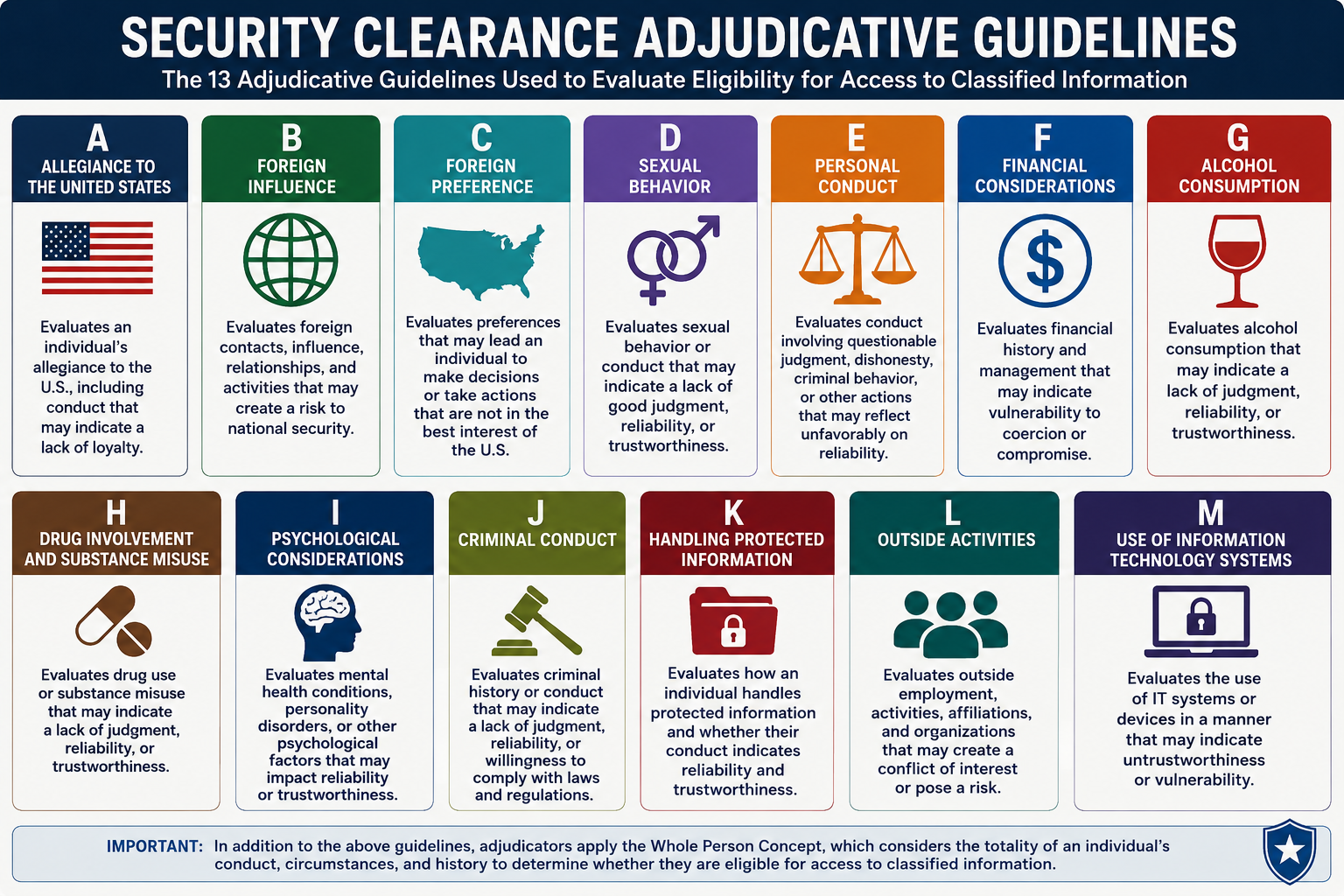
Why Foreign Influence Cases Terrify So Many People
Guideline B cases strike at something deeply personal.
Unlike financial issues or criminal conduct, foreign influence concerns often involve:
- your spouse
- your parents
- your children
- your culture
- your background
- your identity
That makes these cases emotionally difficult.
Applicants often feel:
👉 “I’m being punished for my family.”
Or:
👉 “How can I control where my parents live?”
Or:
👉 “Am I expected to cut off the people I love?”
Those fears are understandable.
But they also cause many applicants to approach the case emotionally instead of strategically.
That is one of the biggest mistakes people make under Guideline B.
Because adjudicators are not evaluating your emotional connection to your family.
They are evaluating:
👉 whether those relationships create unresolved national security risk.
And importantly:
👉 whether that risk is clearly addressed in the record.
Why This Guideline Is So Widely Misunderstood
Most people think Guideline B is about “foreign equals dangerous.”
That’s not accurate.
The government understands that:
- America is global
- many clearance holders come from immigrant families
- international relationships are normal
- business and travel are increasingly international
The concern is not foreign contact by itself.
The concern is whether a foreign relationship creates:
- leverage
- pressure
- influence
- divided priorities
- or concealment risk
This is why:
👉 disclosure matters enormously.
A properly disclosed foreign contact is usually far less dangerous than one that appears hidden, minimized, or inconsistently explained.
In many cases:
👉 the failure to report becomes more damaging than the foreign contact itself.
That is where Guideline B often starts overlapping with:
👉 Guideline E – Personal Conduct
Because once credibility problems enter the picture:
👉 the case becomes exponentially harder to win.
Why the Insider Perspective Matters in Foreign Influence Cases
Most online information about Guideline B simply repeats the statute.
It tells you:
- foreign contacts matter
- foreign family matters
- foreign assets matter
But it rarely explains:
👉 how adjudicators actually evaluate those issues inside the system.
That is where National Security Law Firm approaches these cases differently.
Our team includes attorneys who have:
- worked inside federal agencies
- advised on security clearance determinations
- handled national security legal matters
- reviewed cases from the government side
That perspective changes how we approach Guideline B.
Because these cases are not won by arguing:
👉 “I love America.”
They are won by building a record that demonstrates:
- transparency
- reliability
- low vulnerability
- and defensible risk management
That is a very different strategy.
What This Guide Will Help You Understand
If you are worried about foreign influence issues—or already dealing with one—this guide will explain:
- what actually triggers Guideline B concerns
- how adjudicators evaluate foreign relationships
- which foreign ties are viewed as most dangerous
- how country risk changes the analysis
- what mitigation actually works
- how these issues develop during investigations and interviews
- and how successful applicants resolve these concerns before denial occurs
Most importantly:
👉 this guide will help you understand how the government views your foreign ties from a national security perspective.
Because until you understand that:
👉 you are reacting emotionally instead of strategically.
When Guideline B Actually Comes Up in Real Cases
Foreign influence concerns arise in many different ways.
Some are obvious.
Others catch applicants completely off guard.
The most common triggers include:
Foreign Family Members
This is the biggest category.
Examples include:
- parents living overseas
- siblings who remain citizens of another country
- children abroad
- in-laws living in foreign countries
- relatives connected to foreign governments or military organizations
Importantly:
👉 you do not need to be financially supporting these relatives for concern to exist.
The government often focuses on:
- emotional closeness
- frequency of communication
- sense of obligation
- vulnerability to pressure
Foreign Spouses, Fiancés, or Romantic Partners
This is one of the highest-scrutiny categories under Guideline B.
Adjudicators evaluate:
- the country involved
- the spouse’s family ties
- immigration status
- ongoing foreign obligations
- financial interdependence
- and whether the relationship creates potential leverage
But here is the key:
👉 foreign spouses do NOT automatically cause denial.
Many clearance holders have foreign-born spouses.
The issue is whether the relationship creates:
👉 unresolved vulnerability.
Foreign Contacts and Friendships
Applicants are often surprised by how broad this category can be.
It may include:
- close friends abroad
- former classmates
- business associates
- recurring social contacts
- online-only relationships
The key issue is usually:
👉 how close the relationship actually is.
Foreign Travel
Travel itself is not disqualifying.
But it can create concern when:
- trips are frequent
- destinations are high-risk
- reporting is incomplete
- foreign contacts develop during travel
- or explanations are inconsistent
Foreign Financial Interests
Foreign financial interests are one of the most underestimated areas of Guideline B.
Applicants often assume:
👉 “It’s just an investment.”
Or:
👉 “It’s family property—I barely think about it.”
But adjudicators evaluate foreign financial interests very differently.
The concern is not simply whether you own something overseas.
The concern is:
👉 whether that interest creates leverage, dependence, or divided priorities.
Examples that commonly trigger scrutiny include:
- foreign bank accounts
- inherited property overseas
- rental properties abroad
- foreign business ownership
- significant investments in foreign companies
- overseas partnerships or joint ventures
- recurring foreign income streams
The larger the interest—and the more emotionally or financially important it is to you—the greater the concern becomes.
This is especially true if the foreign country is:
- hostile to U.S. interests
- politically unstable
- known for intelligence targeting
- or capable of exerting pressure over assets located there
What the Government Is Actually Worried About
This is where Guideline B becomes much clearer.
The government is not trying to punish people for:
- having immigrant families
- marrying foreign nationals
- traveling internationally
- or maintaining cultural ties
It is trying to assess:
👉 whether a foreign connection could realistically be used to influence, pressure, manipulate, or exploit you.
That concern generally falls into five major categories.
1. Coercion Risk
Could a foreign government pressure you through someone you care about?
Examples:
- parents living in a country with an aggressive intelligence apparatus
- relatives vulnerable to harassment or detention
- family dependent on you financially
The issue is not whether pressure has happened.
The issue is:
👉 whether it could happen.
2. Exploitation Risk
Could someone use your foreign relationships against you?
This includes:
- emotional leverage
- financial leverage
- concealed relationships
- vulnerable or dependent contacts
Again:
👉 perception matters enormously.
3. Divided Loyalty Concerns
This is one of the most misunderstood concepts in the clearance process.
The government is not assuming you are disloyal.
It is evaluating whether:
👉 competing obligations could create hesitation in a national security situation.
That concern becomes stronger when:
- relationships are extremely close
- obligations are ongoing
- or foreign ties dominate your personal or financial life
4. Concealment and Reporting Problems
Many Guideline B cases become dangerous not because of the foreign tie itself…
👉 but because the applicant failed to disclose it properly.
This is where Guideline B often merges with:
👉 Guideline E – Personal Conduct
Because adjudicators immediately ask:
- Why wasn’t this reported?
- Was the applicant trying to hide it?
- What else may be omitted?
Once credibility concerns enter the case:
👉 everything becomes harder to mitigate.
5. Country Risk
Not all countries are evaluated the same way.
This is uncomfortable for many applicants—but it is reality.
A relative in:
- Canada
- the United Kingdom
- Australia
is usually viewed differently than a relative in:
- China
- Russia
- Iran
- North Korea
Why?
Because adjudicators evaluate:
- intelligence threat level
- geopolitical tensions
- government coercive capability
- history of espionage activity
- ability to pressure citizens or relatives
This does not mean clearance is impossible with relatives in high-risk countries.
It means:
👉 the mitigation burden becomes higher.
The Guideline B Statute (Full Text)
The full statutory language for Guideline B can be reviewed here:
👉 Guideline B — Foreign Influence (Full Text)
The regulation explains:
- what types of foreign relationships and interests can raise concern
- how foreign influence is evaluated
- and what mitigating conditions adjudicators may consider
But reading the statute alone does not tell you:
👉 how foreign influence cases are actually decided in practice.
Because Guideline B cases are rarely about the existence of foreign ties alone.
They are about:
- perceived vulnerability
- leverage
- credibility
- country risk
- and whether the adjudicator believes the concern has been fully resolved
That is why two applicants with very similar foreign contacts can receive completely different outcomes.
👉 The difference is usually not the relationship itself.
👉 It is how the record is built around that relationship.
How Adjudicators Actually Evaluate Foreign Influence
This is where insider perspective matters most.
Adjudicators do not simply ask:
👉 “Does this person have foreign contacts?”
They ask:
👉 “How dangerous are these contacts in context?”
That evaluation usually turns on several factors.
How Close Is the Relationship?
This is huge.
A distant cousin you barely speak to is very different from:
- a spouse
- parent
- child
- fiancé
- lifelong best friend
Adjudicators evaluate:
- emotional closeness
- frequency of contact
- dependency
- obligation
The stronger the bond:
👉 the higher the perceived leverage.
How Often Do You Communicate?
Frequency matters because it changes the perceived importance of the relationship.
Questions include:
- daily communication?
- weekly?
- occasional holidays?
Again:
👉 context matters.
What Country Is Involved?
This can dramatically shift the case.
Adjudicators evaluate:
- intelligence threat level
- government stability
- ability to exert pressure
- anti-U.S. activity
Country context can turn:
- a manageable issue
into: - a major concern
Is There Financial Dependence or Obligation?
Financial ties significantly increase scrutiny.
Questions include:
- Are you financially supporting relatives abroad?
- Do they depend on you?
- Do you depend on them?
- Could foreign assets be leveraged?
Was Everything Properly Reported?
This is often the deciding factor.
Applicants who:
- fully disclose
- proactively report
- remain consistent
usually fare far better than applicants who:
- minimize
- delay disclosure
- or appear evasive
Transparency itself is a mitigating factor.
The Hidden “Paper Risk” Problem in Foreign Influence Cases
This is one of the most important concepts in Guideline B.
Even when the actual foreign relationship is relatively harmless…
👉 the way it appears in the file can still create denial risk.
This is what we call:
👉 paper risk
Examples:
- vague descriptions of foreign contacts
- inconsistent timelines
- unexplained travel
- foreign assets with unclear value
- relationship descriptions that keep changing
The adjudicator starts thinking:
👉 “I don’t fully understand this.”
And once uncertainty appears:
👉 the approval becomes harder to defend.
Why Some Foreign Influence Cases Feel Unfair
Many applicants feel frustrated because they cannot change certain facts.
You cannot:
- choose where your parents were born
- erase your heritage
- eliminate your spouse’s family
- control foreign political conditions
That frustration is understandable.
But the system is not asking you to erase your life.
It is asking:
👉 whether those realities create unresolved risk.
That is why these cases are won through:
- clarity
- transparency
- credibility
- and strategic mitigation
—not emotion.
The Biggest Mistake People Make Under Guideline B
The biggest mistake is:
👉 treating the concern like an accusation instead of a risk assessment.
Applicants often become defensive.
They argue:
- “This is unfair.”
- “I love America.”
- “My family would never do that.”
Those arguments rarely resolve the issue.
Because adjudicators are not evaluating your sincerity.
They are evaluating:
👉 whether the record removes vulnerability.
What Strong Mitigation Actually Looks Like
Strong Guideline B mitigation does not try to erase foreign ties.
It demonstrates:
👉 why those ties do not create meaningful security risk.
That is a critical distinction.
Strong mitigation usually includes:
- complete transparency
- timely disclosure
- consistency across all records
- clear explanation of relationship nature
- strong U.S. ties
- lack of financial dependence
- evidence of stability and reliability
- no indication of concealment
Weak mitigation usually looks like:
- minimizing the relationship
- vague explanations
- inconsistent descriptions
- incomplete disclosures
- emotional arguments instead of factual resolution
How Guideline B Foreign Influence Concerns Are Actually Mitigated
Many applicants assume that once foreign influence concerns appear, their clearance is effectively over.
That is not true.
In reality, many Guideline B cases are highly mitigable when the issue is handled strategically and the record is built correctly.
The key is understanding what adjudicators are actually evaluating:
👉 coercion risk
👉 foreign leverage
👉 emotional or financial vulnerability
👉 credibility
👉 disclosure consistency
👉 and whether the foreign relationship still creates unresolved national security concern
Strong mitigation often involves:
- demonstrating strong U.S. ties
- fully and consistently disclosing foreign contacts and relationships
- clarifying the true nature of foreign family or spouse relationships
- reducing perceived foreign leverage or dependence
- addressing foreign travel or financial ties strategically
- and avoiding credibility collapse during the investigation process
For a deeper breakdown of what actually helps—and hurts—Guideline B cases, including foreign spouse issues, foreign family concerns, foreign travel, overseas assets, disclosure mistakes, and coercion-risk analysis, review:
👉 How to Mitigate a Guideline B Foreign Influence Concern
How to Actually Think About Your Foreign Influence Case
If Guideline B applies to your situation, stop asking:
👉 “Do I have foreign ties?”
Almost everyone does.
Instead ask:
👉 “How would an adjudicator evaluate the risk created by those ties?”
That shift changes everything.
Because the strongest cases are built around:
👉 reducing perceived vulnerability.
Advanced Strategy: How to Beat a Foreign Influence Concern
Most applicants approach Guideline B the wrong way.
They focus on proving:
👉 “I’m loyal to the United States.”
That is not enough.
Adjudicators usually assume applicants believe they are loyal.
The real issue is different.
They are asking:
👉 “Could this person realistically be pressured, influenced, or compromised through their foreign ties?”
That means the strongest Guideline B cases are not built around emotion.
They are built around:
👉 risk reduction
Strategy Shift #1: Stop Defending the Relationship Itself
One of the biggest mistakes applicants make is trying to “justify” their family or foreign relationships.
They say things like:
- “My wife would never do that.”
- “My parents are good people.”
- “I trust my relatives completely.”
Those arguments usually miss the point.
Guideline B is not about whether your family members are good people.
It is about:
👉 whether someone could use those relationships as leverage.
That is a completely different analysis.
The strongest cases acknowledge the concern directly instead of dismissing it.
Strategy Shift #2: Build Around Transparency
Transparency is one of the most powerful mitigating factors in foreign influence cases.
Adjudicators are significantly more comfortable approving applicants who:
- disclosed everything early
- reported contacts consistently
- answered questions directly
- did not appear evasive or defensive
This is why unreported foreign contacts are so dangerous.
The issue quickly shifts from:
👉 “foreign influence”
to:
👉 “Why did the applicant hide this?”
At that point, the case often expands into:
👉 Guideline E – Personal Conduct
And once credibility issues appear:
👉 mitigation becomes much harder.
Strategy Shift #3: Reduce the Appearance of Leverage
The goal of mitigation is not to eliminate every foreign tie.
The goal is to demonstrate:
👉 the foreign relationship does not create meaningful leverage.
That usually means showing:
- financial independence
- emotional stability
- lack of foreign dependence
- strong U.S.-based life structure
- limited vulnerability to pressure
For example:
A foreign parent living overseas may still raise concern.
But if the applicant:
- rarely communicates with them
- does not support them financially
- has no foreign assets there
- and has an entirely U.S.-centered life
👉 the perceived leverage becomes much lower.
Strategy Shift #4: Country Context Matters More Than People Realize
This is uncomfortable, but it is real.
Country context can completely change how a case is evaluated.
A spouse from:
- Canada
- Germany
- Australia
is often analyzed differently than a spouse from:
- China
- Russia
- Iran
The issue is not ethnicity or nationality.
The issue is:
👉 the foreign government’s ability and willingness to exert pressure.
Strong mitigation therefore requires understanding:
- geopolitical context
- intelligence concerns
- and how adjudicators perceive country-specific risk
Strategy Shift #5: Avoid “Over-Mitigation”
Another common mistake:
Applicants provide massive amounts of unnecessary detail.
This often backfires.
Too much explanation can:
- create inconsistencies
- introduce new concerns
- expand the investigation
- make the record feel unstable
This is why experienced clearance strategy matters.
Because more information does not always improve the case.
👉 Sometimes it creates more risk.
Illustrative Case Scenarios (How Guideline B Plays Out in Real Situations)
The examples below are hypothetical scenarios based on common fact patterns seen in security clearance cases. They are designed to show how adjudicators typically evaluate risk under Guideline B—not to predict outcomes in any specific case.
Scenario 1 — Foreign Spouse From Allied Country (Likely Approval)
An applicant is married to a Canadian citizen.
The spouse:
- lives permanently in the United States
- has no government connections
- is pursuing permanent residency
- has minimal continuing ties overseas
The applicant:
- fully disclosed the relationship
- answered all questions consistently
- has strong U.S. financial and professional ties
👉 Likely Outcome: Approved
Why this works:
The relationship is transparent, low-risk, and creates minimal leverage concerns.
Scenario 2 — Foreign Parents in High-Risk Country (Moderate to High Risk)
An applicant’s parents remain in China.
The applicant:
- communicates frequently
- sends regular financial support
- travels back often
- initially minimized the relationship on the SF-86
👉 Likely Outcome: Increased scrutiny, possible denial if poorly mitigated
Why this creates concern:
The combination of close emotional ties, financial dependence, country risk, and inconsistent disclosure creates perceived vulnerability.
Scenario 3 — Foreign Contact Fully Disclosed (Likely Approval)
An applicant maintains a long-term friendship with a foreign national from Germany.
The relationship:
- was fully disclosed
- is casual and infrequent
- has no financial component
- involves no government or intelligence ties
👉 Likely Outcome: Approved
Why this works:
The relationship creates minimal leverage and is handled transparently.
Scenario 4 — Unreported Romantic Relationship (High Risk of Denial)
An applicant began dating a foreign national during the investigation process.
The applicant:
- failed to update disclosures
- minimized the seriousness of the relationship
- gave inconsistent timelines during interviews
👉 Likely Outcome: Denied
Why this fails:
The issue becomes concealment and credibility—not just foreign influence.
Scenario 5 — Foreign Property Creates Financial Leverage (Moderate Risk)
An applicant owns valuable inherited property overseas.
The property:
- generates significant income
- is located in a politically unstable country
- is difficult to liquidate
👉 Likely Outcome: Heavy mitigation burden
Why this creates concern:
The foreign financial interest creates ongoing leverage and dependence.
Scenario 6 — Foreign Relative Connected to Government (Moderate to High Risk)
An applicant’s sibling works for a foreign ministry.
Even though:
- the applicant has no involvement
- communication is limited
the government still evaluates:
- intelligence risk
- access potential
- vulnerability to pressure
👉 Likely Outcome: Depends heavily on mitigation
Scenario 7 — Frequent Foreign Travel Properly Managed (Likely Approval)
An applicant travels internationally several times per year for business.
However:
- all travel is properly reported
- contacts are documented
- no unexplained relationships develop
- there are no inconsistencies in disclosures
👉 Likely Outcome: Approved
Why this works:
The activity is transparent and professionally explainable.
Scenario 8 — Over-Explaining Creates Inconsistency (High Risk)
An applicant attempts to “fully explain everything” regarding foreign contacts.
Instead:
- timelines become inconsistent
- disclosures conflict
- unnecessary detail complicates the record
👉 Likely Outcome: Increased credibility concerns
Why this fails:
More explanation creates more ambiguity.
What Actually Gets Guideline B Cases Approved
Approved foreign influence cases usually share several characteristics:
- the applicant disclosed everything early
- relationships are explained clearly and consistently
- foreign ties are understandable and manageable
- there is little realistic leverage
- strong U.S. ties outweigh foreign influence concerns
- the adjudicator feels comfortable defending approval
Most importantly:
👉 the file feels stable and predictable.
What Causes Denial Under Guideline B
Foreign influence denials usually result from:
- incomplete or inconsistent disclosure
- concealment of relationships
- ongoing foreign obligations
- close ties in high-risk countries
- significant foreign financial dependence
- unclear or shifting explanations
- unresolved vulnerability
Notice again:
👉 severity alone is not the deciding factor.
Many severe-looking cases are approved.
Many seemingly minor cases are denied.
The difference is usually:
👉 clarity, credibility, and defensibility.
Where Foreign Influence Cases Collapse
Most cases do not fail because of the original foreign contact.
They fail because the issue escalates over time.
Stage 1 — Initial Foreign Tie
A relationship, trip, or asset appears in the record.
Stage 2 — Incomplete Disclosure
Details are vague, omitted, or minimized.
Stage 3 — Investigation Expansion
Investigators begin asking follow-up questions.
Stage 4 — Credibility Problems
Statements conflict with prior disclosures.
Stage 5 — Multiple Guidelines Trigger
Guideline B expands into Guideline E or other concerns.
Stage 6 — Unresolved Concern
The adjudicator cannot confidently approve the file.
👉 Final outcome: denial or revocation.
How Guideline B Appears Throughout the Security Clearance Process
Foreign influence issues can arise at almost every stage of the clearance process.
Understanding where and how these concerns develop is critical, because many applicants mistakenly believe the issue begins only after a denial or Statement of Reasons.
In reality:
👉 most Guideline B cases begin much earlier.
The SF-86 Stage
For many applicants, Guideline B first appears during completion of the
👉 SF-86 Security Clearance Form
This is where applicants disclose:
- foreign contacts
- foreign family members
- foreign travel
- foreign assets
- foreign business interests
- dual citizenship issues
- foreign passports
This stage is far more important than most people realize.
Because the SF-86 is not “just paperwork.”
👉 It becomes the foundation of the investigative record.
And once something is written incorrectly, incompletely, or inconsistently:
👉 it can follow the applicant throughout the entire process.
The Investigation Stage
Once the investigation begins, foreign influence concerns often expand.
Investigators may:
- interview references
- review travel history
- examine financial records
- evaluate communication patterns
- analyze social media and online activity
- compare disclosures against independent records
Many applicants underestimate how much verification occurs during this stage.
Learn more in:
👉 Security Clearance Investigations Explained
The Subject Interview
This is one of the most dangerous stages for Guideline B issues.
During the
👉 security clearance subject interview
investigators are evaluating:
- tone
- consistency
- credibility
- emotional reactions
- how relationships are described
This is where many cases unintentionally become worse.
Applicants often:
- over-explain
- change timelines
- minimize relationships
- become defensive
And once that happens:
👉 the issue often shifts from foreign influence to credibility.
The LOI Stage (Letter of Interrogatory)
If concerns remain unresolved, the government may issue a:
👉 Letter of Interrogatory (LOI)
This is usually the government’s attempt to:
- gather more information
- clarify concerns
- lock in explanations
This stage is extremely important.
Because what applicants say here often becomes:
👉 the blueprint for future allegations.
The Statement of Reasons (SOR) Stage
If the government believes unresolved security concerns remain, the applicant may receive a:
This formally outlines the government’s concerns.
At this stage:
👉 the issue is no longer informal.
The record has hardened.
And the applicant must now:
- rebut the allegations
- mitigate the concern
- and build a defensible approval case
The Hearing and Appeal Stage
Some Guideline B cases proceed to:
- DOHA hearings
- written appeals
- or agency review boards
At this point, the issue becomes heavily focused on:
👉 credibility and mitigation.
This is why strategic consistency across the entire record matters so much.
Learn more in:
👉 Security Clearance Hearings and DOHA Appeals
What Actually Wins Security Clearance Cases
Most people think security clearance cases are won through:
- technical arguments
- emotional appeals
- or proving they are “good people”
That is not how this system works.
Security clearance cases are won through:
👉 record control
This means:
- controlling how facts appear in the record
- reducing ambiguity
- eliminating perceived risk
- aligning explanations with adjudicator logic
- and building a file that can be safely approved
That is why two applicants with nearly identical foreign ties can receive completely different outcomes.
One file feels:
- stable
- transparent
- low-risk
- defensible
The other feels:
- uncertain
- inconsistent
- difficult to approve
👉 The rule itself does not determine the outcome.
👉 The structure of the record does.
If you want to understand how strong security clearance cases are actually built, review:
👉 How to Win a Security Clearance Case Using Proven Mitigation and Record-Control Strategies
Decision Language Explained (What These Terms Really Mean)
Foreign influence cases often contain vague or intimidating language.
Understanding what these terms actually mean gives you a major strategic advantage.
“Foreign Influence”
This does not mean the government believes you are disloyal.
It means:
👉 a foreign relationship or interest could theoretically create leverage or vulnerability.
“Divided Loyalty”
This does not mean the government thinks you are a traitor.
It means:
👉 the adjudicator worries that competing obligations could influence judgment under pressure.
“Vulnerability to Coercion”
This is one of the most important concepts in Guideline B.
It means:
👉 the government believes someone could potentially pressure you through a foreign relationship, obligation, or asset.
“Unresolved Concern”
This phrase drives many denials.
It means:
👉 the issue exists in the record, but the adjudicator does not believe it has been clearly resolved.
“Clearly Consistent With National Security”
This is the actual approval standard.
It means:
👉 the adjudicator feels comfortable defending approval if the case is later reviewed.
If that confidence does not exist:
👉 the clearance is usually denied.
Foreign Influence Issues: Deep-Dive Guides by Topic
Guideline B cases often become far more complicated once investigators begin analyzing the specific type of foreign relationship, contact, or activity involved.
For example, adjudicators may evaluate:
- whether a foreign relationship creates leverage or coercion risk
- whether foreign travel raises counterintelligence concerns
- whether foreign contacts were disclosed properly
- whether a foreign spouse creates ongoing vulnerability
- or whether foreign citizenship-related conduct overlaps with broader foreign influence concerns
For deeper analysis of the most common Guideline B risk areas, review:
👉 Can Foreign Contacts Cost You Your Clearance? (Guideline B)
👉 Can You Lose Your Security Clearance for Foreign Contacts?
👉 Can You Lose Your Security Clearance for a Foreign Spouse?
👉 Can You Lose Your Security Clearance for Foreign Travel?
👉 Can You Get a Security Clearance With Foreign Family Members?
Some foreign influence cases also overlap with foreign preference concerns involving dual citizenship, foreign passports, or foreign political participation. For those issues, review:
👉 Can You Lose Your Security Clearance for Dual Citizenship?
👉 Can You Lose Your Security Clearance for Holding a Foreign Passport?
👉 Can You Lose Your Security Clearance for Voting in a Foreign Election?
Frequently Asked Questions About Guideline B Foreign Influence
Can I get a security clearance with foreign family members?
Yes. Many clearance holders have foreign family members.
The key issue is whether those relationships create unresolved vulnerability or leverage.
Can I get a security clearance with a foreign spouse?
Yes. Foreign spouses do not automatically disqualify applicants.
The government evaluates:
- country involved
- closeness of relationship
- financial dependence
- government connections
- reporting and transparency
Does the country matter?
Yes.
Certain countries receive significantly more scrutiny because of intelligence or geopolitical concerns.
Do I have to cut off contact with foreign relatives?
Usually no.
But the relationships must be disclosed, explained, and evaluated properly.
Can foreign travel affect my clearance?
Yes—especially if:
- travel is frequent
- destinations are high-risk
- contacts are not reported
- or explanations are inconsistent
What if I forgot to report a foreign contact?
That can become a major issue because the concern may expand into:
👉 Guideline E – Personal Conduct
Can I own property overseas and still get a clearance?
Yes.
But significant foreign assets increase scrutiny, particularly if they create financial leverage or dependency.
Can I mitigate a Guideline B issue?
Absolutely.
Many Guideline B cases are approved with strong mitigation and proper strategy.
Why National Security Law Firm
Most law firms approach foreign influence cases by focusing only on the foreign relationship itself.
That is not enough.
At National Security Law Firm, our security clearance lawyers include:
- former administrative judges who decided clearance cases
- former government attorneys who evaluated national security risk
- military and federal lawyers with insider experience applying these exact guidelines
We approach Guideline B differently.
We do not simply ask:
👉 “What foreign ties exist?”
We ask:
👉 “How will an adjudicator interpret those ties—and what must be done to make the file defensible?”
That distinction changes outcomes.
Complex cases are reviewed through our internal
👉 Attorney Review Board
This means:
- multiple experienced attorneys review your record
- strategic weaknesses are identified early
- mitigation is tested before submission
- and your case is approached the same way the government evaluates it—through layered institutional review
Most clients come to us after receiving advice focused only on explanation.
But security clearance cases are not won through explanation alone.
👉 They are won through clarity, consistency, mitigation, and defensibility.
You can read what clients say about working with our team in our
👉 4.9-star Google reviews
Related Statutes and Guidance
Return to the full statute list in the
👉 Security Clearance Statutes and Regulations
Or explore how these rules are applied in real cases in the
👉 Security Clearance Lawyers Resource Center
If you want to go beyond the rule itself and understand how to actually win under Guideline B—how adjudicators evaluate risk, what mitigation works, and how strong cases are built—review:
👉 How to Win a Security Clearance Case Using Proven Mitigation and Record-Control Strategies
Speak With a Security Clearance Lawyer Before the Record Hardens
If Guideline B is part of your case, the most important question is not:
👉 “Do I have foreign ties?”
It is:
👉 “How will those ties be interpreted inside the clearance system?”
Because once concerns are written into your file:
👉 they are reused
👉 re-evaluated
👉 and often expanded over time
The earlier you address these issues strategically, the better your chances of avoiding escalation into an LOI, SOR, suspension, or denial.
If you want to understand your position before the record hardens against you, you can:
👉 schedule a confidential consultation with a security clearance lawyer