If you’re reading this, there’s a good chance something online is affecting your life.

Maybe you’re applying for a job.

Trying to obtain or keep a professional license.

Growing a business.

Maintaining a security clearance.

Protecting your family.

Or simply trying to move on from something that happened years ago.

If so, you’ve probably already discovered that there is no shortage of opinions about content removal.

One company tells you removal isn’t possible.

Another recommends suppression.

A lawyer offers to send a demand letter.

Everyone seems to have a different answer.

Unfortunately, very few resources explain how content removal actually works, what your realistic options are, or how to evaluate those options before investing thousands of dollars.

That’s why we created this guide.

Our goal isn’t simply to explain what our firm does.

It’s to help you understand:

  • Whether your content or news article presents a realistic opportunity for removal.
  • The difference between removal, deindexing, and suppression.
  • When hiring a lawyer makes sense—and when it may not.
  • The biggest mistakes people make before contacting a publisher.
  • How to evaluate content removal lawyers and reputation management companies.
  • The questions every prospective client should ask before making a decision.

Whether you ultimately hire National Security Law Firm, another attorney, a reputation management company, or decide to handle the matter yourself, our hope is that you’ll finish this guide with a much clearer understanding of your options and how to make an informed decision.

Before You Continue…

There is one idea we’d encourage you to keep in mind as you read.

Most people think they’re trying to remove an article.

In our experience, that’s almost never the real problem.

The article is simply the obstacle.

What people are really trying to recover is something much more important.

A career.

A business.

A professional license.

A security clearance.

A reputation.

A relationship.

Peace of mind.

Or simply the opportunity to move forward with their lives.

That’s why this guide isn’t just about removing online content.

It’s about understanding the strategies available to remove the obstacles standing between you and the future you’re trying to build.

Everything that follows is designed to help you make the best possible decision about how to accomplish that goal.

If, at any point, you’d like to learn more about our Content Removal Lawyers, our fee refund guarantee, or how we evaluate these matters, you can visit our Content Removal Lawyers page or schedule a free consultation.

Let’s begin.


Table of Contents


Understanding Your Options

If you’re researching content removal, you’ve probably come across three common terms:

  • Removal
  • Deindexing
  • Suppression

Unfortunately, those terms are often used interchangeably—even though they describe three very different approaches.

Understanding the difference is important because each option carries different benefits, different limitations, and different long-term implications.

More importantly, understanding these differences will help you evaluate the recommendations you’re likely to receive from content removal lawyers, reputation management companies, and other service providers.


Option 1: Removal

Removal is exactly what it sounds like.

The publisher permanently removes the article or webpage from its website.

Once removed, the page generally no longer exists. If someone clicks on the original link, they’ll typically receive an error message or be redirected because the page has been deleted.

Search engines like Google will eventually recognize that the page no longer exists and remove it from their search results as well.

From our perspective, this is always the best possible outcome.

The content is gone.

There is nothing left to search.

Nothing left to suppress.

Nothing left to continue affecting your future.


Option 2: Deindexing

Deindexing is probably the least understood concept in content removal.

Many people hear the word and immediately assume it means the case wasn’t successful.

In many situations, that’s simply not true.

Unlike removal, the article remains on the publisher’s website.

What changes is its visibility.

Instead of removing the article itself, the publisher prevents search engines like Google, Bing, and Yahoo from displaying it in search results.

For most people, that’s an extremely significant distinction.

The overwhelming majority of people find online content by searching Google—not by visiting a newspaper’s website and manually searching years of archived articles.

As a result, if an article no longer appears when someone searches your name, the practical effect is often very similar to removal.

Generally speaking, there are only two realistic ways someone could still locate a properly deindexed article:

  • They already know the exact web address (URL); or
  • They go directly to the publisher’s website and search its archives.

For most people, neither of those situations ever occurs.

That’s why deindexing is often far more valuable than people initially realize.

It’s also worth knowing that many publishers don’t routinely handle deindexing requests or understand the technical process involved. In appropriate cases, our Content Removal Lawyers explain the process, identify the appropriate technical solution, and work directly with the publisher to implement it correctly.


Option 3: Suppression

Suppression takes a completely different approach.

Instead of removing the article—or removing it from search results—the goal is simply to make it less visible.

Reputation management companies typically accomplish this by creating or promoting positive online content, such as:

  • Websites
  • Blog posts
  • Press releases
  • Social media profiles
  • Business profiles
  • Other search-engine-optimized content

The objective is to push the negative article farther down in Google search results.

The theory is straightforward.

Most people never look beyond the first page of Google.

If the article moves from page one to page five, fewer people are likely to find it.

The important thing to understand, however, is this:

Nothing has actually been removed.

The article still exists.

Anyone who searches long enough—or whose search results change in the future—may still find it.

Because search rankings constantly change, suppression often requires ongoing monitoring, additional content creation, and continued expense to maintain those rankings.

Suppression manages the problem.

It does not permanently solve it.
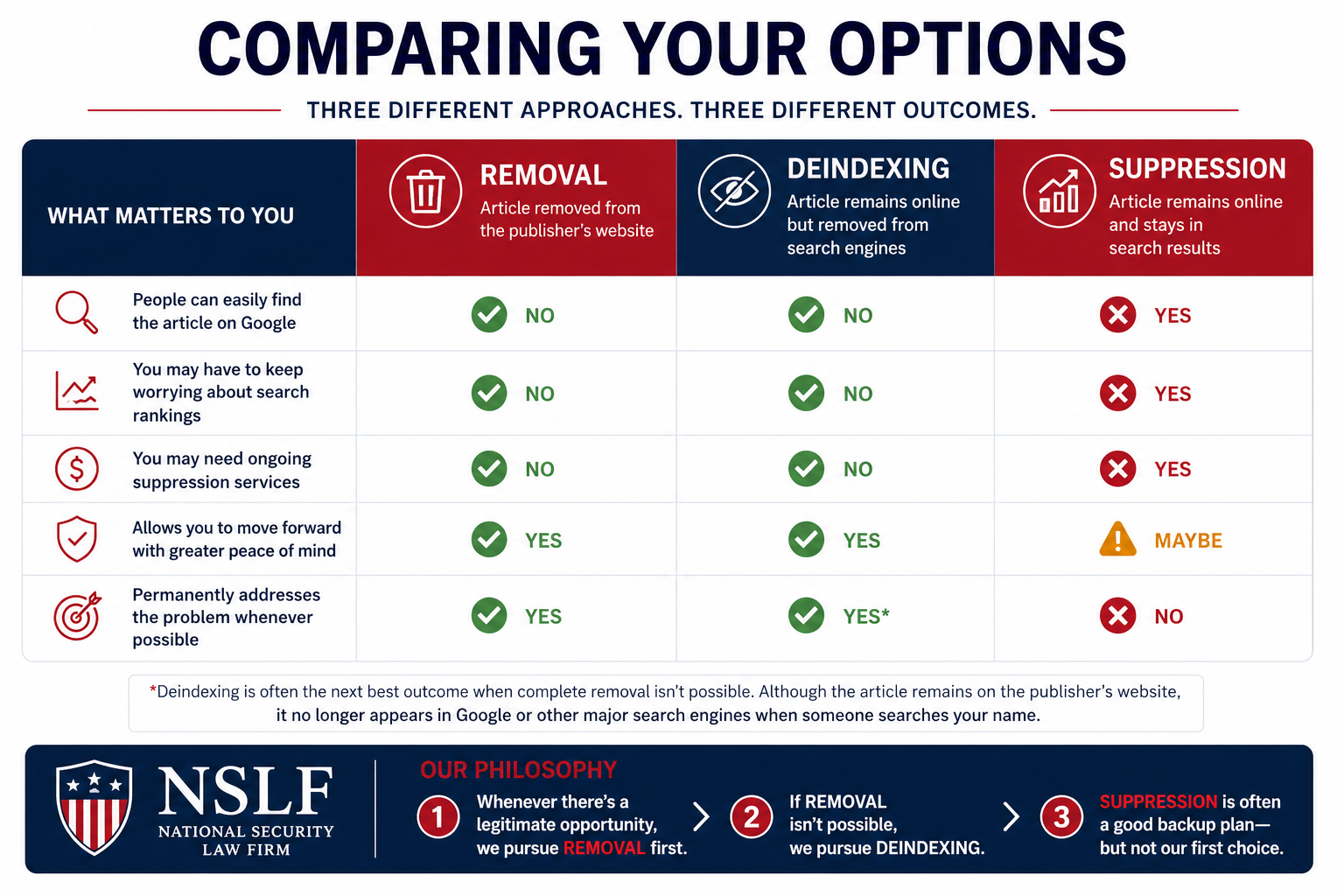
Which Option Should You Choose?

Whenever there’s a legitimate opportunity, we believe clients should pursue removal or deindexing before considering suppression.

The reason is simple.

If you’re successful, you’ve permanently solved the problem.

If removal or deindexing ultimately isn’t possible, suppression remains available afterward.

The reverse isn’t true.

If you immediately invest thousands of dollars suppressing an article, you’ll never know whether it could have been permanently removed.

We believe your first opportunity to permanently solve the problem is often your best opportunity.

You only get one opportunity to make a first impression with a publisher. We believe that opportunity should be approached thoughtfully and strategically—not wasted pursuing a temporary solution before determining whether a permanent one may be available.


Why We Built Our Practice This Way

One of the biggest reasons people hesitate to pursue removal first is cost.

They don’t want to spend thousands of dollars pursuing what they believe is the strongest possible outcome only to wonder later whether it was worth the risk.
We understand that concern.

In fact, it helped shape the way we built our Content Removal Practice.

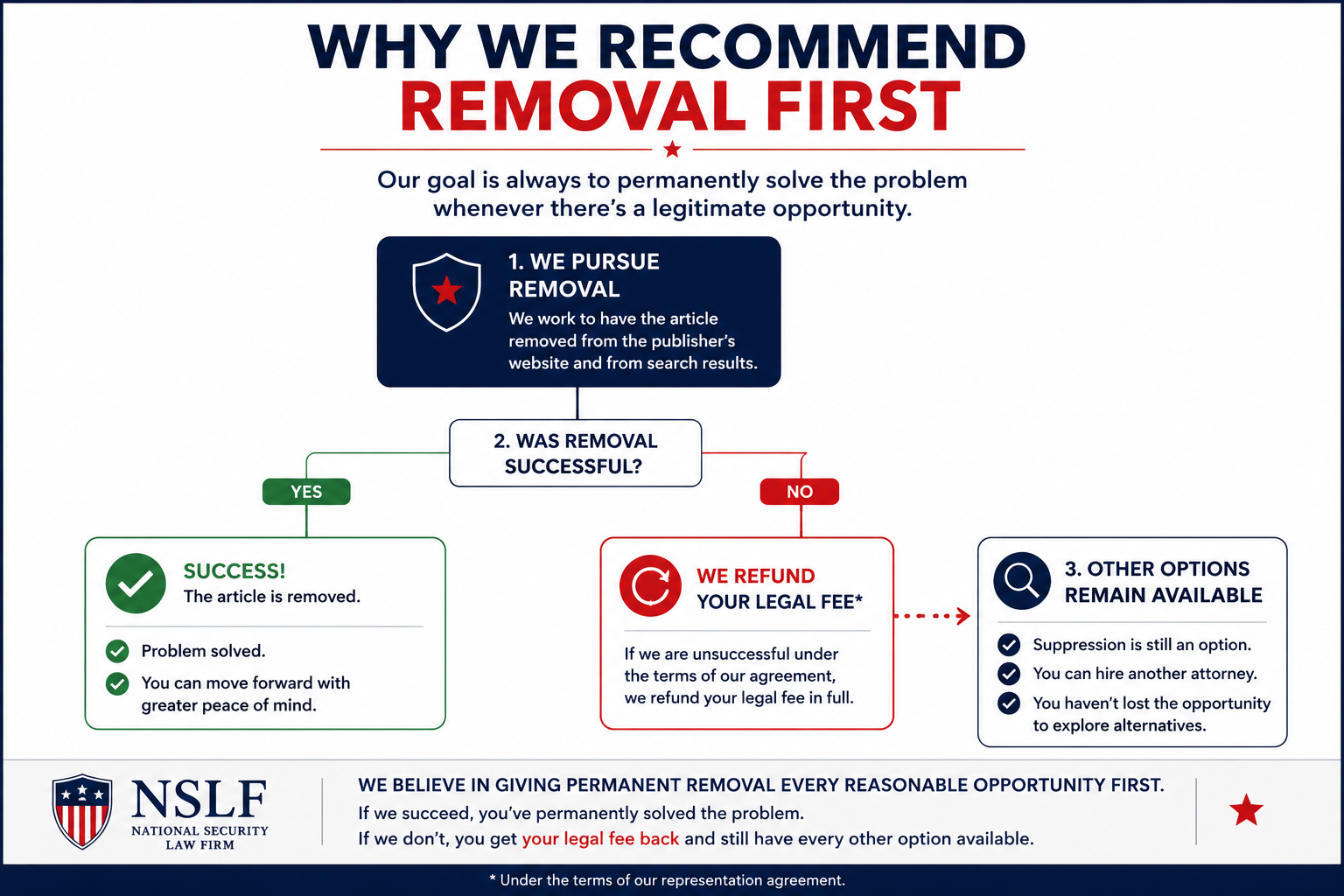
Rather than asking clients to permanently risk thousands of dollars pursuing what we believe is the strongest opportunity, we chose a different model.

If we’re unsuccessful under the terms of our representation agreement, we refund our legal fee in full.

We built our practice this way because we believe clients should have the opportunity to pursue permanent removal first without permanently risking the money they invested in trying.

If we’re successful, you’ve permanently solved the problem.

If we’re unsuccessful, you still have every other option available.

You can pursue suppression.

You can hire another attorney.

Or you can simply decide you’ve explored every reasonable opportunity.

You haven’t lost those options.

You’ve simply given permanent removal every reasonable opportunity first.

That’s the philosophy behind our practice.

And it’s the philosophy behind this guide.


Can My Content or News Articles Actually Be Removed?

This is probably the first question almost everyone asks.
The honest answer is:

It depends.

There isn’t one rule that determines whether online content can—or cannot—be removed.

Many people assume the answer depends entirely on the website.

For example:

  • “It’s a newspaper.”
  • “It’s Reddit.”
  • “It’s a government website.”
  • “It’s a mugshot site.”

In reality, that’s only one piece of the puzzle.

The better question isn’t:

“Can this website remove content?”

It’s:

“Does my particular case present a legitimate opportunity for removal or deindexing?”

Those are two very different questions.

When our Content Removal Lawyers evaluate a potential matter, we don’t simply look at the publisher.

We evaluate the entire picture.

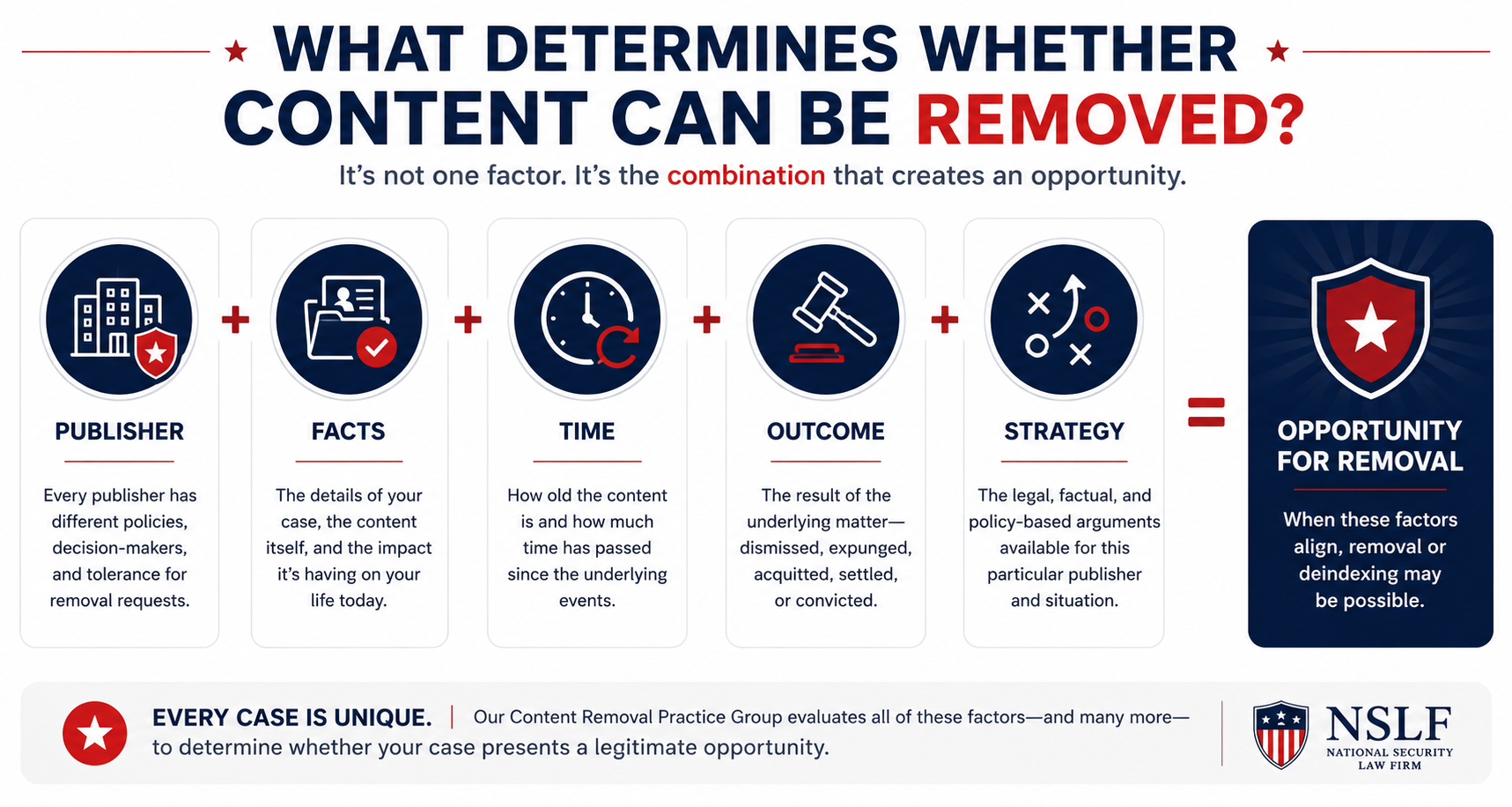
No single fact determines whether removal is possible.

Instead, we look at how multiple factors work together to determine whether we believe there’s a legitimate strategy worth pursuing.

Below are some of the most important factors we evaluate.

1. The Publisher

This is often the single most important factor.

Every publisher has different policies.

Different decision-makers.

Different editorial philosophies.

Some regularly review removal requests.

Some almost never remove content.

Others may be willing to anonymize or deindex an article even if they won’t remove it entirely.

That’s why we never make blanket statements like:

“Newspapers never remove articles.”

or

“That publisher never removes content.”

The publisher matters.

But it’s only one part of the analysis.

2. The Type of Content

Different types of content present different opportunities and different challenges.

For example:

  • News articles
  • Mugshot websites
  • Blogs
  • Reddit posts
  • Court record websites
  • Government press releases
  • Google Reviews
  • Social media posts

Each requires a different strategy.

The approach we take with a traditional newspaper is often very different from the approach we take with a blogger, government agency, or online platform.

Understanding the type of content helps us determine where to begin.

It does not determine the outcome by itself.

3. The Underlying Facts

One of the first things we want to understand is what ultimately happened.

For example:

  • Were the charges dismissed?
  • Was the client found not guilty?
  • Was the record expunged?
  • Was there a conviction?
  • Is the matter still pending?

These facts often shape the strongest arguments available.

An article describing an arrest that was later dismissed presents a very different opportunity than an article accurately reporting a recent conviction.

The more complete the factual picture, the better we can evaluate the available strategy.

4. The Passage of Time

Time changes cases.

Generally speaking, an article published ten years ago presents a very different opportunity than one published last week.

As time passes:

  • the public interest often decreases;
  • the client continues experiencing harm; and
  • new facts often develop.

Clients rebuild their lives.

They complete treatment.

Advance their careers.

Serve in the military.

Raise families.

All of those developments may strengthen the arguments available.

5. Is the Article Still Newsworthy?

One question we frequently ask is:

Does this article still serve a meaningful public interest today?

That analysis often changes over time.

In many matters, our request isn’t based on the argument that the article should never have been published.

Instead, it’s based on the argument that circumstances have changed.

6. The Continuing Harm

Perhaps the most important question we ask every client is:

“How is this article affecting your life today?”

Examples include:

  • employment;
  • professional licensing;
  • security clearances;
  • business opportunities;
  • relationships;
  • family concerns;
  • mental health; and
  • reputation.

The article itself is only part of the story.

The ongoing impact often becomes just as important.

7. Everything That’s Happened Since Publication.

People change.

Lives change.

Circumstances change.

We evaluate everything that’s happened since the article was originally published.

Sometimes those later developments become some of the strongest arguments available.

8. Whether the Article Still Reflects the Complete Story.

Many articles accurately reported events on the day they were published.

The problem is that the story often continued.

For example:

  • charges were dismissed;
  • records were expunged;
  • appeals were successful;
  • lawsuits settled;
  • important facts emerged later.

Sometimes an article remains technically accurate while still leaving readers with an incomplete understanding of what actually happened.

Those later developments can become an important part of the strategy we present.

The Bottom Line

No single factor determines whether content can be removed.

Likewise, no reputable Content Removal Lawyer can honestly tell you whether your case is removable based on a single fact, such as the publisher or the type of website.

Instead, successful evaluations come from understanding how all of these factors work together.

That’s why every matter accepted by our Content Removal Practice begins with an individualized evaluation rather than assumptions or blanket rules.

Different Types of Online Content

One of the biggest misconceptions about content removal is that every type of online content is treated the same.

It isn’t.

Different publishers have different policies.

Different platforms have different rules.

Different types of content present different opportunities and different challenges.

The examples below are intended to provide a general overview—not guarantees.

Remember, the type of content is only one factor. As discussed in the previous chapter, the publisher, the underlying facts, the age of the content, and many other factors all influence whether we believe a legitimate opportunity for removal or deindexing exists.


News Articles

🟢 General Outlook: Often Favorable

Can They Be Removed?

Sometimes.

This is the type of matter our Content Removal Lawyers handle most frequently.

One of the biggest misconceptions we hear is:

“Newspapers never remove articles.”

That’s simply not true.

Some publishers regularly consider removal requests.

Others may decline to remove an article but agree to anonymize it or deindex it under the right circumstances.

The outcome depends on the publisher, the facts, and the strategy—not simply the fact that it’s a newspaper.

Factors that often matter include:

  • The publisher’s policies
  • The age of the article
  • Whether the underlying matter was dismissed, expunged, or otherwise resolved
  • Whether the article continues to serve a meaningful public interest
  • The ongoing impact the article has on your life today

Mugshot Websites

🟢 General Outlook: Often Favorable

Many people are surprised to learn that mugshot websites frequently present meaningful opportunities for removal.

Some websites have formal removal procedures.

Others operate in states with laws regulating mugshot publication.

Others may respond to legal, factual, or policy-based arguments.

Factors that often matter include:

  • State law
  • The website’s policies
  • Whether the charges were dismissed or expunged
  • Whether the site is a legitimate news organization or a commercial mugshot website

Government Press Releases

🟡 General Outlook: Depends

Government agencies often follow different policies than private publishers.

Some agencies periodically review older press releases, particularly following an expungement or other significant legal development.

Whether removal is possible depends heavily on the agency involved.

Factors that often matter include:

  • Which agency issued the release
  • The age of the release
  • Expungement or dismissal
  • Current agency policies

Blogs

🟡 General Outlook: Depends

Blogs range from major commercial publications to individuals writing about their own experiences.

Because every owner is different, every strategy is different.

Factors that often matter include:

  • Who owns the website
  • Whether the content is factual or opinion
  • The relationship between the parties
  • The owner’s willingness to engage

Reddit

🟡 General Outlook: Depends

Reddit presents unique challenges because of its moderation structure.

Whether content can be removed often depends on who posted it, which subreddit is involved, whether moderators are willing to act, and whether the content violates Reddit’s policies.


Google Reviews

🟡 General Outlook: Depends

Google removes reviews that violate its published policies.

Reviews that don’t violate those policies are generally much more difficult to remove.

The analysis often turns on whether the review violates Google’s rules—not simply whether it’s unfair.


Social Media

🟡 General Outlook: Depends

Every social media platform has its own reporting process and community standards.

Whether removal is possible often depends on:

  • the platform;
  • who posted the content;
  • whether platform rules have been violated; and
  • the available evidence.

Court Record Websites

🔴 General Outlook: Often Challenging

Court record websites are frequently among the more difficult matters we evaluate.

Many simply republish publicly available court records.

Some permit removal or redaction under limited circumstances.

Others do not.

Although these matters are often more challenging, they are not automatically impossible.


Every Website Is Different

The internet contains millions of websites.

Many don’t fit neatly into any category.

That’s one of the reasons we avoid making blanket statements such as:

  • “That website never removes content.”
  • “You’ll never get that removed.”
  • “It’s impossible.”

Those statements are almost always oversimplifications.

Every matter begins with an individualized evaluation.

Our job is not to determine what usually happens.

Our job is to determine whether your particular case presents a legitimate opportunity for removal or deindexing.


What Gives You the Best Opportunity for Success?

Every case is different, and no attorney can honestly promise a particular outcome.

That said, after evaluating hundreds of content removal matters, we’ve found that certain factors frequently increase the likelihood that a publisher will seriously consider a request for removal or deindexing.

No single factor guarantees success.

Instead, the strongest cases often involve several favorable factors working together.

Some of the most common include:

✅ The Article Is Several Years Old

As time passes, the public interest in an article often decreases while the harm to the individual continues.

The older the article, the stronger the argument that it has outlived its original news value.


✅ The Charges Were Dismissed or You Were Found Not Guilty

Publishers are often more receptive when the criminal justice system ultimately determined that the allegations did not result in a conviction.

While dismissal alone doesn’t guarantee removal, it frequently strengthens the available arguments.


✅ Your Record Has Been Expunged or Sealed

An expungement does not require a publisher to remove an article.

However, it often provides one of the strongest reasons for asking a publisher to voluntarily reconsider continued publication.


✅ You’ve Rebuilt Your Life

One of the most persuasive things we can often show is that the article no longer reflects who you are today.

Evidence such as:

  • rehabilitation,
  • treatment,
  • education,
  • military service,
  • community involvement,
  • career advancement,
  • or other positive life changes

can significantly strengthen the overall presentation.


✅ The Article No Longer Serves a Meaningful Public Interest

As circumstances change, so can the balance between the public’s interest in the article and the continuing harm it causes.

That changing balance often becomes an important part of our strategy.


✅ The Article Continues to Cause Real Harm

The stronger the ongoing impact, the stronger the reasons for requesting removal.

Common examples include:

  • employment opportunities;
  • professional licensing;
  • security clearances;
  • business reputation;
  • family concerns;
  • and continuing emotional harm.

✅ The Publisher Has a History of Considering Removal Requests

Some publishers are simply more receptive than others.

Experience with a particular publisher often allows us to identify opportunities that may not be obvious to someone approaching that publisher for the first time.


Bottom Line

The strongest cases are rarely built on one favorable fact.

They’re built on multiple favorable facts working together.

That’s why we evaluate the entire picture—not just one piece of it.


What Makes Removal More Challenging?

Just as some facts strengthen a case, others can make removal or deindexing more difficult.

That doesn’t necessarily mean removal is impossible.

It simply means the available opportunities may be more limited.

Some of the most common challenges include:

⚠️ Very Recent Publication

Publishers are generally less willing to remove articles that are still considered current news.


⚠️ An Active Criminal Case or Ongoing Litigation

When the underlying matter is still pending, publishers are often reluctant to reconsider their reporting.


⚠️ A Recent Conviction

When a conviction is recent and remains a matter of public record, opportunities for removal may be more limited.


⚠️ Public Officials or Public Figures

Publishers generally recognize a greater public interest in reporting on individuals who hold positions of public trust or who have voluntarily placed themselves in the public eye.


⚠️ High-Profile Events

The greater the public attention surrounding an event, the more challenging removal often becomes.


⚠️ Continuing Public Safety Concerns

Publishers may be less willing to remove content they believe continues to serve an important public purpose.


⚠️ Restrictive Publisher Policies

Some publishers have historically been much less receptive to voluntary removal requests than others.


Bottom Line

A challenging case is not the same thing as an impossible case.

One of the biggest mistakes people make is assuming that a single unfavorable fact determines the outcome.

It doesn’t.

Content removal is much more like putting together a puzzle.

No single piece determines the picture.

Instead, we evaluate how all of the facts work together to determine whether we believe there’s a legitimate opportunity for removal or deindexing.

That’s one of the reasons we avoid making blanket statements like, “That can never be removed.” Every case deserves an individualized evaluation before reaching that conclusion.


What Actually Happens After You Hire a Content Removal Lawyer?

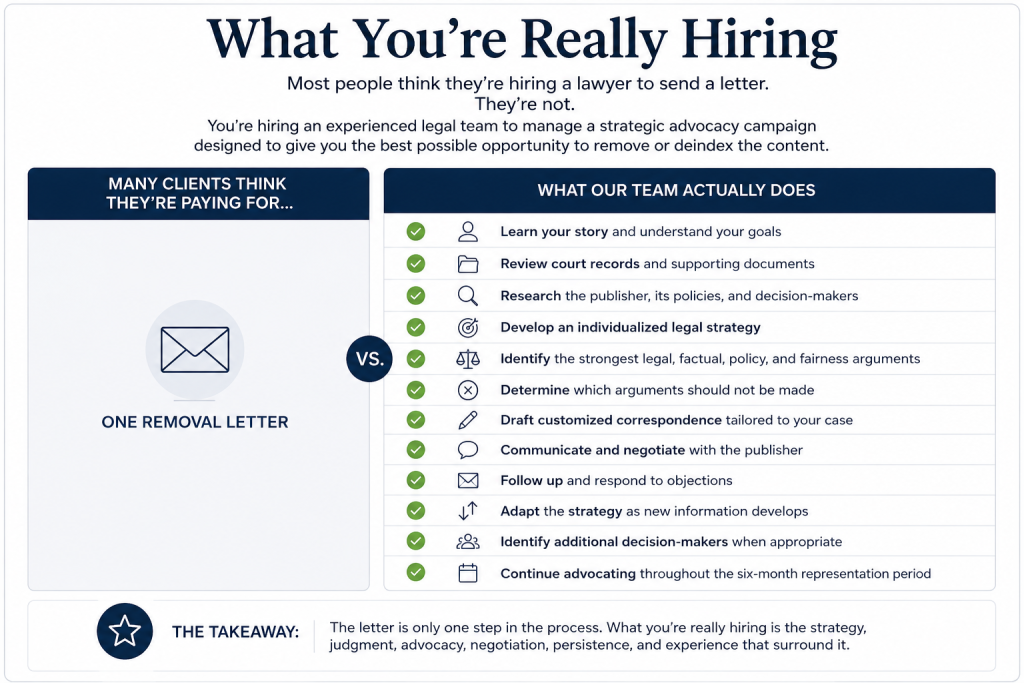
One of the biggest misconceptions about content removal is that clients think they’re hiring a lawyer to send a demand letter.

If that’s all we did, we’d agree—it would be expensive.

The reality is very different.

Every content removal matter is an evolving legal strategy that often unfolds over weeks or months. Every case is different, but this is generally what happens after a client hires our firm.


Step 1: We Learn Your Story

Before anyone contacts a publisher, we take the time to understand what happened.

We review your circumstances, gather supporting documentation, and identify the facts that may strengthen your request.

Just as importantly, we want to understand your goals.

How is the article affecting your life?

What opportunities has it taken away?

What are you hoping to accomplish?

No two clients have the same story, and understanding yours is where every successful strategy begins.


Step 2: We Investigate the Publisher

Next, we research the publisher.

Every publisher has different policies, different decision-makers, different procedures, and different philosophies regarding content removal.

Some are more receptive than others.

Some have formal editorial review processes.

Some have deindexing procedures that aren’t publicly disclosed.

Understanding how a particular publisher approaches removal requests often shapes the entire strategy.

That’s one of the reasons we avoid one-size-fits-all approaches.


Step 3: We Develop the Strategy

This is where the real legal work begins.

Our Content Removal Lawyers evaluate questions such as:

  • Which arguments should be made?
  • Which arguments should not be made?
  • Who should receive the request?
  • What supporting documentation should be included?
  • Does this case present a stronger opportunity for removal or deindexing?
  • How should your circumstances be presented in the most persuasive manner possible?

There isn’t a template.

Every publisher is different.

Every client is different.

Every strategy is different.

That’s why we spend significant time developing an individualized approach before anyone is ever contacted.


Step 4: We Prepare the Request

Only after the strategy has been developed do we begin preparing correspondence.

Our requests are individually drafted for each client.

They aren’t copied from a form or generated from a template.

Every communication is built around the strategy we’ve developed, the publisher involved, and the unique facts of your matter.


Step 5: We Begin Advocating

Many people assume the process ends after the first request.

In reality, that’s often where it begins.

Depending on the circumstances, our team may:

  • Communicate with editors.
  • Contact additional decision-makers.
  • Respond to questions.
  • Provide supplemental information.
  • Clarify misunderstandings.
  • Continue negotiations.
  • Explore alternative approaches.

Content removal is rarely a one-email process.

Our role is to continue advocating whenever legitimate opportunities remain.


Step 6: We Continue Developing the Strategy

Not every publisher immediately agrees.

Some ask questions.

Some request additional information.

Some initially decline.

Others propose alternatives, such as anonymization or deindexing.

Every response creates another strategic decision.

Depending on the circumstances, we may:

  • Present additional legal, factual, policy, or fairness arguments.
  • Pursue deindexing rather than complete removal.
  • Identify different contacts within the organization.
  • Revise our approach based on new information.

Content removal is rarely a straight line.

It’s an evolving strategy that continues throughout the representation.


Step 7: We Continue Looking for Opportunities

Our work doesn’t stop after a single communication.

Throughout the representation, we continue looking for every legitimate opportunity to achieve the strongest possible outcome.

Some matters resolve quickly.

Others require persistence over time.

That’s one of the reasons our standard representation extends for up to six months.

It gives us the opportunity to continue advocating, adapting our strategy when appropriate, and pursuing additional opportunities as they arise.


Why This Process Matters

If you’ve read through these steps, you’ve probably noticed something.

The legal work isn’t the letter.

The legal work is everything that happens before the letter is written—and everything that happens after it’s sent.

Every strategic decision influences the next one.

Every publisher responds differently.

Every case develops differently.

That’s why content removal isn’t simply about drafting correspondence.

It’s about developing, executing, and continually refining a strategy designed to persuade another person to voluntarily make an exception they generally have no legal obligation to make.

That’s what our Content Removal Lawyers do every day.


The 10 Biggest Mistakes People Make

Most unsuccessful outcomes don’t happen because the content couldn’t be removed.

They happen because someone made a preventable mistake before the right strategy was ever developed.

Here are the ten mistakes we see most often.


Mistake #1: Assuming Removal Isn’t Possible

One of the biggest mistakes people make is accepting the first opinion they hear.

Every publisher is different.

Every case is different.

Just because one company believes removal isn’t possible doesn’t necessarily mean that’s true.

Every matter deserves an individualized evaluation.


Mistake #2: Hiring a Suppression Company When Your Goal Is Removal

Suppression and removal solve two different problems.

If your goal is to permanently solve the problem, make sure the company you’re hiring is actually trying to remove or deindex the content—not simply bury it in search results.


Mistake #3: Thinking Every Lawyer Handles Content Removal

Content removal is highly specialized.

Many excellent attorneys have never negotiated with a publisher or developed a content removal strategy.

Don’t assume every lawyer offers the same level of experience in this area.


Mistake #4: Sending an Aggressive Demand Letter Too Soon

You only get one first impression.

An unnecessarily aggressive letter that threatens litigation without a realistic legal basis can immediately change the tone of the conversation and, in some cases, reduce the likelihood of a successful voluntary resolution.

Strategy matters.


Mistake #5: Hiring Based on Price Alone

The least expensive option isn’t always the least expensive outcome.

A lower fee doesn’t necessarily mean greater value.

Before comparing prices, make sure you’re comparing the services being provided—not simply the price. A lower fee isn’t necessarily a better value if the strategies, experience, or financial risk are significantly different.


Mistake #6: Assuming Deindexing Means Failure

Many clients initially believe that anything short of complete removal is a bad result.

That’s simply not true.

If an article no longer appears in Google or other search engines, it has effectively disappeared for the overwhelming majority of people searching your name.

Complete removal is always our first choice.

But deindexing is often an outstanding outcome.


Mistake #7: Believing an Expungement Automatically Removes News Articles

An expungement is incredibly valuable.

It just doesn’t automatically require newspapers or private websites to remove previously published articles.

Instead, it often becomes one of the strongest arguments available when asking a publisher to voluntarily remove or deindex the content.


Mistake #8: Thinking Every Case Can Be Solved with One Letter

Content removal is almost never that simple.

Every publisher is different.

Some matters resolve quickly.

Others require negotiation, follow-up, additional arguments, or alternative strategies.

The letter is usually just the beginning.


Mistake #9: Waiting Too Long to Address the Problem

Sometimes people wait years before seeking help.

There’s nothing inherently wrong with waiting.

But if the article is actively affecting your career, business, reputation, or peace of mind today, delaying the decision rarely improves the situation.

The sooner you evaluate your options, the sooner you can decide whether action is worthwhile.


Mistake #10: Hiring Before Understanding What You’re Actually Buying

This may be the biggest mistake of all.

Many people believe they’re paying someone to send a letter.

They’re not.

They’re hiring strategy.

Judgment.

Advocacy.

Negotiation.

Persistence.

The letter is simply one step in that process.

Understanding that difference changes how you evaluate every content removal lawyer and every reputation management company.


Common Misconceptions About Content Removal

One of the biggest reasons people become frustrated with content removal is that they’ve been given incomplete—or simply incorrect—information.

Below are some of the most common misconceptions we hear during consultations.


Does the Article Have to Be False?

No.

Many people assume the only articles that can be removed are those that contain false information.

That’s simply not true.

In fact, one of the biggest misconceptions about content removal is that only false articles can be removed. Many of the matters we handle involve articles that were factually accurate when they were originally published.

The question isn’t always whether the article is true.

The question is whether there is now a legitimate reason for the publisher to voluntarily reconsider continuing to identify the individual involved.

For example, circumstances may have changed.

The charges may have been dismissed.

The record may have been expunged.

The client may have rebuilt their life.

The article may no longer serve the same public interest that it once did.

Those are often the types of arguments that become important in a content removal request.

Bottom Line

An article does not have to be false to present a legitimate opportunity for removal or deindexing.


Does an Expungement Require a Publisher to Remove the Article?

No.

An expungement generally applies to government agencies and official records.

It does not automatically require newspapers or private publishers to remove previously published articles.

That doesn’t mean an expungement isn’t valuable.

Quite the opposite.

An expungement often becomes one of the strongest arguments we can make when asking a publisher to voluntarily remove or deindex content.

It demonstrates that the legal system has determined you deserve a fresh start—even if the law doesn’t require a publisher to remove the article.

Bottom Line

An expungement doesn’t require removal, but it often strengthens the request for voluntary removal.


Does Removal Depend Only on the Website?

No.

The publisher is one of the most important factors—but it’s only one factor.

Our Content Removal Practice Group evaluates many different considerations, including:

  • The publisher.
  • The age of the article.
  • The underlying facts.
  • The legal outcome.
  • Whether the article remains newsworthy.
  • The ongoing harm to the client.
  • The available legal, factual, policy, and fairness arguments.

That’s why two clients with articles published on the same website may have very different opportunities for success.

Bottom Line

The website matters—but it’s only one part of the overall evaluation.


If Another Company Told Me “No,” Is That the End?

Not necessarily.

We regularly speak with clients who have been told that removal isn’t possible.

Sometimes that’s based on the other company’s experience.

Sometimes it’s based on the services they offer.

And sometimes it’s because they didn’t evaluate the case the same way we would.

Content removal is a highly specialized area of practice.

Every publisher is different.

Every case is different.

That’s why we don’t make blanket statements.

We’ve accepted a number of matters after another company concluded removal wasn’t possible. Sometimes we ultimately agree with that assessment. Sometimes we don’t. That’s precisely why every case deserves its own independent evaluation.

Bottom Line

A previous “no” doesn’t necessarily mean your content can’t be removed. Every case deserves its own evaluation.


Do All Newspapers Refuse to Remove Articles?

No.

This is probably one of the biggest misconceptions we hear.

Some newspapers rarely remove content.

Some review requests on a case-by-case basis.

Some may be unwilling to remove an article but willing to anonymize it or deindex it.

Others have formal editorial policies explaining the circumstances under which they’ll consider changes.

Every publisher is different.

That’s why we never assume the answer based solely on the name of the publication.

Bottom Line

Never assume a newspaper won’t consider a removal request simply because it’s a newspaper. Every publisher has its own policies and practices.


How to Choose the Right Content Removal Lawyer or Reputation Management Company

If you’ve started researching content removal, you’ve probably noticed something.

Every company claims they can help.

Every website says they’re the best.

Some promise removal.

Others recommend suppression.

Some focus on search engine optimization.

Others focus on legal advocacy.

To someone researching this area for the first time, they can all sound very similar.

They’re not.

Choosing the wrong company can cost thousands of dollars, delay meaningful progress, and in some cases reduce the opportunity for a successful outcome.

That’s why we encourage prospective clients to evaluate how a company approaches content removal—not simply what it promises.

Below are several questions we believe every prospective client should ask before hiring anyone, including us.


1. Is Their Goal to Remove the Content or Simply Suppress It?

This is probably the most important question you can ask.

Some companies primarily create positive online content designed to push negative articles farther down in search results.

Others focus on pursuing removal or deindexing whenever a legitimate opportunity exists.

Neither approach is inherently right or wrong.

The important thing is understanding which service you’re actually buying.

Ask:

“Is your primary objective to permanently remove the content, or simply reduce its visibility?”


2. Who Bears the Financial Risk?

Every company is confident before you hire them.

A better question is:

“What happens if you’re unsuccessful?”

Some firms bill by the hour.

Some charge a nonrefundable flat fee.

Some reputation management companies charge ongoing monthly fees.

Others, like our firm, structure their business model differently.

Understanding who bears the financial risk is just as important as understanding the legal strategy.


3. Do They Develop an Individual Strategy?

Be cautious of anyone who suggests every matter begins with the same demand letter.

Every publisher is different.

Every client is different.

Every case is different.

A thoughtful content removal strategy should reflect those differences.

Ask:

“How do you determine the strategy for my particular case?”


4. What Happens If the First Approach Doesn’t Work?

Content removal is rarely a one-step process.

Publishers ask questions.

They decline requests.

They suggest alternatives.

The important question isn’t whether the first communication succeeds.

It’s what happens afterward.

Ask:

“If the publisher initially says no, what happens next?”

A good content removal team should be able to explain how they reevaluate the matter, adapt their strategy, and continue looking for legitimate opportunities.


5. How Much Experience Do They Actually Have?

Content removal is a highly specialized area of practice.

Ask:

  • Is this one of many practice areas?
  • Or is this something your team handles every day?
  • How frequently do you handle matters like mine?

Experience doesn’t guarantee success.

But it often improves judgment.


6. Are They Honest About What They Can’t Do?

One of the biggest red flags is someone who claims they can remove everything.

No one can.

Every reputable content removal lawyer should be willing to tell you when they believe removal is unlikely—or when they don’t believe they’re the right firm for your matter.

In our experience, honesty is often one of the best indicators of credibility.


7. Are They Explaining Their Strategy—Or Just Selling Their Service?

One of the things we’ve learned over the years is that clients often leave consultations understanding what a company wants to sell them, but not why that approach makes sense for their particular situation.

A good consultation should leave you understanding:

  • why a particular strategy is being recommended;
  • why other strategies may not be appropriate;
  • and how that recommendation aligns with your goals.

If you leave a consultation with more questions than answers, keep asking.


The Bottom Line

Choosing a content removal lawyer isn’t simply about comparing prices or promises.

It’s about understanding:

  • What strategy is being recommended;
  • Why that strategy makes sense for your situation;
  • What happens if it doesn’t work; and
  • Whether the firm’s interests are aligned with yours.

The more clearly a firm can answer those questions, the more confidence you should have in the advice you’re receiving


Understanding the Cost of Content Removal

One of the first questions almost everyone asks is:

“Why does content removal cost what it does?”

It’s a fair question.

The answer starts with understanding what you’re actually hiring.

One of the biggest misconceptions about content removal is that clients believe they’re paying an attorney to send a demand letter.

If that’s all we did, we’d agree—it would be expensive.

The reality is very different.

You’re hiring an experienced legal team to evaluate the facts, develop an individualized strategy, advocate on your behalf, negotiate with publishers, adapt that strategy as circumstances change, and continue looking for every legitimate opportunity to achieve removal or deindexing.

The letter is simply one step in that process.

What You’re Actually Hiring

When clients retain our Content Removal Practice Group, they’re hiring far more than a single request to a publisher.

A typical representation includes:

  • Understanding your circumstances and your goals.
  • Investigating the publisher, its policies, and its decision-makers.
  • Developing an individualized legal strategy.
  • Preparing customized legal correspondence.
  • Communicating and negotiating with the publisher.
  • Following up, adapting the strategy when appropriate, and continuing to advocate throughout the representation.

Every case is different.

Some matters resolve quickly.

Others require multiple rounds of communication, evolving strategies, and persistent advocacy.

That’s what our team is hired to manage.

Understanding the Financial Risk

When comparing content removal providers, don’t simply compare legal fees.

Compare who bears the financial risk.

Many law firms bill by the hour.

Others charge nonrefundable flat fees.

Reputation management companies often charge ongoing monthly fees because suppression requires continuous work.

In each of those situations, the client generally bears the financial risk.

We built our practice differently.

If we’re unsuccessful under the terms of our representation agreement, we refund our legal fee in full.

We believe clients should have the opportunity to pursue what we believe is the strongest opportunity for a permanent solution without permanently risking the money they invested in trying.

That philosophy shapes every aspect of our Content Removal Practice.

Our Pricing

Our standard fee is:

$3,000 per source

A “source” generally means a publisher or website—not necessarily each individual article.

For example, multiple articles published by the same publisher may often be treated as a single source because they’re handled through the same organization and decision-makers.

Your consultation attorney will explain exactly how many sources are involved before you decide whether to move forward.

What’s Included?

Our standard fee includes up to six months of representation for each source, including:

  • Strategy development.
  • Publisher research.
  • Customized legal correspondence.
  • Negotiations.
  • Follow-up communications.
  • Alternative strategies when appropriate.
  • Continued advocacy throughout the representation.

Payment Options

We understand that legal fees represent a significant investment.

For clients who prefer to spread payments over time, we offer financing through Affirm.

Depending upon eligibility, Affirm allows many clients to finance their legal fees over 3 to 24 months.

Our Fee Refund Guarantee

If we’re successful under the terms of our representation agreement, you’ve permanently solved the problem.

If we’re unsuccessful under the terms of our representation agreement, we refund your legal fee in full.

At that point, every other option remains available.

You may decide to pursue suppression.

You may seek another legal opinion.

Or you may simply decide you’ve explored every reasonable opportunity.

Either way, you’ll know you pursued what we believe was the strongest opportunity for a permanent solution first.

Is It Worth It?

Only you can answer that question.

For some people, the article isn’t affecting their lives in any meaningful way.

For others, it’s standing between them and the future they’re trying to build.

It may be preventing them from:

  • obtaining employment;
  • protecting a professional license;
  • maintaining a security clearance;
  • growing a business;
  • protecting their family;
  • restoring their reputation; or
  • simply moving forward after years of rebuilding their lives.

Ultimately, the value of content removal isn’t measured by the cost of legal services.

It’s measured by the opportunities it helps restore.

That’s why we encourage every prospective client to ask a different question.

Instead of asking:

“What does this cost?”

Ask:

“What is continuing to live with this article costing me?”

Sometimes the answer is very little.

Sometimes it’s a career.

A business.

A professional license.

A security clearance.

Or years of opportunities that may never come back.

Only you can decide whether pursuing content removal is worth the investment.


Why We Built Our Practice This Way

If you’ve read this far, you’ve probably noticed something.

Our approach to content removal is different.

That’s intentional.

Over the years, we’ve learned that content removal isn’t about sending a letter.

It’s about understanding the facts, developing the right strategy, presenting the strongest arguments, and persuading another person to voluntarily remove or deindex content they usually have no legal obligation to remove.

That philosophy has shaped every aspect of our practice—from the cases we accept, to the way we structure our fees, to the way we advocate for our clients.

Here’s why we’ve built our practice the way we have.


We Believe Permanent Solutions Are Better Than Temporary Ones

Whenever there’s a legitimate opportunity, our first objective is to permanently solve the problem—not simply manage it.

That’s why we focus on removal or deindexing whenever possible.

If we can permanently eliminate the problem instead of simply pushing it farther down in search results, we believe that’s almost always the better outcome.

Our clients usually aren’t looking for someone to help them manage this problem forever.

They’re looking for the opportunity to finally put it behind them.

That’s why our philosophy has always been simple:

Suppression manages the problem. Removal or deindexing attempts to solve it.


Our Interests Are Aligned With Yours

One of the things that makes our practice different is that our interests are directly aligned with those of our clients.

Many law firms bill by the hour.

Others charge nonrefundable flat fees.

In either situation, the firm is paid regardless of the outcome.

We built our practice differently.

If we’re unsuccessful under the terms of our representation agreement, we refund our legal fee in full.

That changes the relationship.

It means we have every incentive to carefully evaluate every case we accept, develop the strongest strategy possible, remain persistent, and continue looking for legitimate opportunities throughout the representation.

When our clients succeed, we succeed.

We believe that’s exactly how the relationship should work.


We Believe Strategy Matters More Than Templates

One of the biggest misconceptions about content removal is that success comes from sending the right letter.

We don’t believe that’s true.

Every publisher is different.

Every editor is different.

Every client is different.

Every case is different.

That means every strategy should be different.

Our Content Removal Lawyers don’t begin by asking:

“Which template should we use?”

We begin by asking:

  • Who are we trying to persuade?
  • What matters to this particular publisher?
  • Which arguments strengthen this request?
  • Which arguments weaken it?
  • What gives this client the best legitimate opportunity for success?

That’s also one of the reasons content removal is one of our firm’s dedicated practice areas.

Our attorneys aren’t balancing these matters with dozens of unrelated practice areas.

They focus on developing and executing individualized content removal strategies every day.

At the end of the day, content removal isn’t simply a search engine problem.

It’s an advocacy problem.

You’re asking another person—a publisher, editor, or decision-maker—to voluntarily make an exception they generally have no legal obligation to make.

That’s what attorneys are trained to do.

We Don’t Take Every Case

One of the hardest things for any law firm to do is tell someone:

“We’re probably not the right firm for your situation.”

We do it regularly.

Not because we don’t want to help.

Because we believe honesty is more important than accepting another client.

If we don’t believe your matter presents a legitimate opportunity worth pursuing, we’ll tell you.

We’d rather have an honest conversation today than accept a fee for a matter we don’t genuinely believe we can meaningfully help.

Being selective is also one of the reasons our Content Removal Practice Group has successfully removed or deindexed content in approximately 70% of the matters we’ve accepted.

That number isn’t a promise.

It’s the result of carefully evaluating which matters we believe present legitimate opportunities for success.

When we tell someone we believe we can help, that opinion carries more weight because we’re equally willing to tell people when we don’t.


Our Philosophy

There isn’t one solution that’s right for every client.

Sometimes removal is possible.

Sometimes deindexing is the strongest available outcome.

Sometimes suppression makes sense.

And sometimes the most honest advice we can give is that we don’t believe there’s a realistic opportunity worth pursuing.

Our philosophy has never been to promise the impossible.

It’s to honestly evaluate every matter, pursue the strongest legitimate opportunity available, and align our interests with thos

e of our clients throughout the process.

We don’t believe every article can be removed.

We do believe every client deserves an honest, individualized evaluation before anyone reaches that conclusion.

That’s the philosophy behind our Content Removal Practice.

And it’s the philosophy behind this guide.


Frequently Asked Questions (FAQs)

FAQ #1: What Is the Difference Between Removal and Suppression?

Clients often use the terms removal and suppression interchangeably, but they are two very different approaches.

Suppression

Suppression means the article stays online, but someone attempts to push it farther down in Google search results by creating or promoting positive online content.

The article isn’t removed.

Instead, the goal is to make it less likely that someone will find it because most people never look beyond the first page of Google. This is done by posting good content about you in an attempt to push down, or suppress, the negative content. 

Removal

Removal means the article is removed from the publisher’s website entirely so it no longer exists online.

For example:

  • The publisher deletes the article.
  • The publisher removes the article from its website.
  • The publisher removes your name or other identifying information from the article (anonymization), so the article no longer appears when someone searches your name.

Deindexing

Sometimes complete removal isn’t possible.

In those situations, we may pursue deindexing.

With deindexing, we convince the platform to insert what is called a “no index” tag on the webpage, which tells google and other search engines not to return that page in search results.

Deindexing means the article still exists on the publisher’s website, but it is removed from search engine results like Google, Bing, and Yahoo.

In other words, if someone searches your name on Google, the article will no longer appear.

Bottom Line

Suppression = The article stays online and is pushed farther down in search results.

Removal = The article is removed from the publisher’s website or your identifying information is removed so it no longer appears in searches for you.

Deindexing = The article stays on the publisher’s website but is removed from search engine results.

Whenever possible, our goal is to achieve removal. If removal isn’t possible, we will often pursue deindexing because it prevents the article from appearing in search results and is often the next best outcome.


FAQ #2: Why Does National Security Law Firm Focus on Removal Instead of Suppression?

Whenever there is a legitimate opportunity to do so, we believe it’s better to permanently solve the problem than simply manage it.

That’s why we always to pursue removal of the article or deindexing so it no longer appears in search engine results.

There are two main reasons for this.

First, search rankings are constantly changing.

An article that’s buried on page ten today could be back on page one tomorrow, and vice versa. If that happens, you may have to pay a reputation management company thousands of dollars again to push it back down.

Second, suppression doesn’t provide the same peace of mind.

Because the article is still online, many clients continue checking Google or worrying that it will move back up in search results. Suppression often requires ongoing monitoring and continued work to maintain those rankings. 

Removal or deindexing is different.

If we’re successful, the article is no longer showing up in search engine results, allowing most clients to stop worrying about it and move forward with their lives.

That’s why we believe clients should first pursue removal or deindexing before considering suppression.

Suppression manages the problem. Removal or deindexing attempts to solve it.


FAQ #3: Is There Ever a Time When Suppression Makes Sense?

Absolutely.

While we believe removal or deindexing should be pursued first whenever there’s a legitimate opportunity, there are situations where suppression becomes the best remaining option.

For example, if a publisher ultimately refuses to remove or deindex the content, suppression may be the only practical way to reduce its visibility in search results.

Although suppression has limitations, it’s often better than doing nothing.

One of the reasons we’ve structured our program the way we have is that it allows clients to pursue what we believe is the strongest possible outcome first.

If we’re successful, you’ve permanently solved the problem.

If we’re unsuccessful under the terms of our agreement, we refund your legal fee in full.

At that point, you can decide whether you’d like to use those funds toward suppression or another solution.

We think that’s a much smarter approach than immediately spending thousands of dollars suppressing articles that may have been removable in the first place.

It’s also worth remembering that if we’re successful in removing some of the content, suppression often becomes easier, less expensive, and more effective because there are fewer articles competing for search rankings.

National Security Law Firm does not provide suppression services. Our practice is focused exclusively on removal and deindexing.

However, if removal isn’t possible, suppression may be a very reasonable next step.

Bottom Line

Whenever there’s a legitimate opportunity, we believe clients should pursue removal or deindexing first. If those efforts aren’t successful, suppression often becomes the next best option—and our refund model allows clients to pursue that option without having permanently lost their legal fee.


FAQ #4: What Counts as a Successful Outcome?

Under our agreement, a successful outcome can be achieved in three different ways:

1. The Article Is Removed

This is always our first choice.

The publisher removes the article from its website entirely so it no longer exists online.

2. The Article Is Anonymized

Sometimes a publisher is unwilling to remove an article altogether but is willing to remove the client’s name or other identifying information.

When that happens, the article no longer appears when someone searches the client’s name, even though the article itself remains online.

For many clients, this accomplishes the same practical goal because the article is no longer associated with them.

This often occurs when an article involves multiple people. For example, a police blotter, arrest report, or news article may discuss several individuals or multiple unrelated incidents. The publisher may not want to remove the entire article because it remains relevant to the other people mentioned, but they may be willing to remove one individual’s name or identifying information.

Once the client’s name and identifying information have been removed, the article will no longer appear when someone searches the client’s name.

3. The Article Is Deindexed

If removal or anonymization isn’t possible, we may pursue deindexing.

The article remains on the publisher’s website, but it no longer appears in search engines like Google, Bing, or Yahoo when someone searches the client’s name.

For most clients, this is an excellent outcome because people typically find articles through search engines—not by visiting individual news websites.

Whenever possible, we always pursue complete removal first.

If complete removal isn’t possible, we’ll evaluate whether anonymization or deindexing provides the strongest available outcome.

Our goal is always to achieve the best result the particular publisher is willing to provide.

Bottom Line

A successful outcome under our agreement includes:

✔ Complete removal of the article

✔ Removal of your identifying information (anonymization)

✔ Deindexing so the article no longer appears in search engine results

All three outcomes prevent the article from appearing when someone searches your name online.


FAQ #5: What Is Deindexing?

Deindexing means the article still exists on the publisher’s website, but it no longer appears in search engine results like Google, Bing, or Yahoo.

In other words, if someone searches your name on Google, the article won’t appear.

Whenever possible, our first goal is always complete removal of the article from the publisher’s website. If complete removal isn’t possible, we will often pursue deindexing as an alternative.

For most clients, deindexing is an excellent outcome because it accomplishes the primary objective—preventing people from finding the article through a search engine.

There are generally only two ways someone could still access a deindexed article:

  1. They already have the direct link (URL) to the article and click on it.
  2. They go directly to the publisher’s website (for example, Cleveland.com or NJ.com), use that website’s internal search function, and search for your name.

Outside of those two situations, the article will no longer appear in search engine results.

For most people, that’s how articles are found in the first place.

From a practical standpoint, if an article no longer appears in Google or other search engines, it’s ‘as good as gone’ for most people because that’s how they would have found it in the first place.

It’s important to understand that publishers don’t always know what deindexing is or how to do it. In many cases, our Content Removal Team explains the process and works with the publisher to implement it correctly.

While complete removal is always our first choice, deindexing is often the next best outcome and can provide tremendous value when complete removal isn’t possible.

Bottom Line

Our goal is always complete removal first. If that isn’t possible, deindexing often accomplishes what most clients care about most—the article no longer appears when 


FAQ #6: A Reputation Management Company Told Me Removal Wasn’t Possible.

We hear that all the time.

In fact, many of our clients come to us after they’ve been told by a reputation management company that removal isn’t possible and that suppression is their only option.

Our experience has been very different.

Content removal is an entire practice area for our firm.

It’s what our Content Removal Practice Group does every day.

We’ve successfully removed or deindexed hundreds of content removal matters involving a wide variety of publishers, news organizations, and online platforms.

So why would another company tell you removal isn’t possible?

There are several possibilities.

They may genuinely believe that based on their own experience.

They may not have experience negotiating directly with publishers because their business focuses primarily on suppression rather than removal.

Or they may simply be recommending the service they provide (suppression).

The important thing is this:

We don’t make blanket statements.

Every publisher is different.

Every article is different.

Every case is different.

Before we tell a client that removal is—or isn’t—possible, our Content Removal Practice Group evaluates the publisher, the facts, and the available strategies to determine whether we believe there’s a legitimate opportunity worth pursuing.

Sometimes the answer is yes.

Sometimes it’s no.

If we don’t believe we can meaningfully help, we’ll tell you.

If we do believe there’s a legitimate opportunity, we’ll explain why.

We also don’t simply ask you to take our word for it.

If we accept your case and we’re unsuccessful under the terms of our agreement, we refund your legal fee in full.

That allows clients to pursue what we believe is the strongest opportunity for a permanent solution without permanently risking their legal fee.

Bottom Line

Just because someone else told you removal isn’t possible doesn’t necessarily make it true. Content removal is a highly specialized area of practice, and every case deserves an individualized evaluation before anyone reaches that conclusion.


FAQ #7: How Long Does the Process Take?

Our agreement gives us up to six months to work on your matter.

We begin working on your case immediately. Our Content Removal Team starts developing strategy, researching the publisher, and preparing the strongest approach as soon as the representation begins.

After we’ve made contact, however, the timeline is largely in the publisher’s hands.

Some publishers respond within days.

Some take weeks.

Some take months.

Some require multiple rounds of communication before making a decision.

Because every publisher and every case is different, there’s simply no honest way to predict how long your particular matter will take.

One thing we ask from our clients is patience.

Sometimes clients understandably want us to follow up every few days, but that isn’t always the best strategy.

Think of it like any important negotiation. Calling every day rarely changes someone’s mind—it often has the opposite effect. Sometimes giving the other side time is actually the best strategy.

Following up too frequently or becoming overly aggressive can sometimes make a publisher less willing to work with us.

Our Content Removal Practice Group will determine when additional follow-up is appropriate based on the publisher, the circumstances, and the progress being made.

If six months pass and we’re unsuccessful under the terms of our agreement, you’re entitled to a refund of your legal fee.

Occasionally, if we believe we’re making meaningful progress and simply need more time, we’ll ask whether you’d be willing to extend the representation.

That decision is entirely yours.

If you’d rather receive your refund, that’s absolutely your choice.

Bottom Line

We begin work immediately, but the publisher—not us—largely controls the timeline. Our job is to use the time strategically to maximize the opportunity for success, not simply to move as quickly as possible.


FAQ #8: I Had My Record Expunged. Why Is It Still on the Internet?

This is one of the most common questions we receive.

The short answer is that an expungement order doesn’t apply to everyone.

When a court grants an expungement, the order generally applies to government agencies, courts, law enforcement, prosecutors, and background check companies that are required by law to honor the order.

It doesn’t apply to newspapers, news websites, bloggers, or private individuals.

The reason is the First Amendment.

In the United States, news organizations generally have the right to publish truthful information about matters of public record, even if those records are later expunged.

Unfortunately, there is currently no legal mechanism that automatically requires the media to remove an article simply because the underlying record has been expunged.

That doesn’t mean the expungement isn’t valuable.

In fact, it often becomes one of our strongest advocacy tools.

An expungement allows us to explain that the court has determined you deserve a fresh start, yet the article continues to follow you years later.

Depending on the publisher and the circumstances, we may use the expungement to make arguments based on fairness, rehabilitation, privacy, public policy, or the continuing harm caused by keeping the article online.

While an expungement doesn’t legally require a publisher to remove an article, it can significantly strengthen the case we present on your behalf.

Bottom Line

An expungement doesn’t automatically require a publisher to remove an article, but it often gives us stronger arguments for why the publisher should voluntarily do so.


FAQ #9: Can Trying to Remove the Article Ever Make Things Worse?

This is a very fair question, and it’s important to answer it honestly.

The truthful answer is that there’s always some degree of risk anytime you’re asking another person to reconsider something they’ve already published.

We can’t predict human behavior, and no attorney can honestly guarantee how a publisher or website owner will respond.

With that said, we’ve handled hundreds of content removal matters, and we have had only one where the platform published a case outcome (i.e., that the matter was dismissed and expunged) where we did not want them to. 

Our Content Removal Practice Group approaches these matters thoughtfully and strategically. When communicating with news organizations, we generally do so professionally and, whenever appropriate, on an off-the-record basis. In our experience, reputable publishers typically respect that process.

Of course, every case is different, and there are situations—particularly with bloggers, private individuals, or smaller websites—where no one can predict exactly how someone will react.

That’s a risk every client should understand before moving forward.

Ultimately, it’s a personal decision.

For most of our clients, the potential benefit of permanently removing or deindexing the content outweighs the relatively small risk that asking for removal could lead to an unexpected response.

Bottom Line

No attorney can promise how another person will respond, but in our experience, the risk has been very low, and we have not seen our efforts make a client’s situation worse.


FAQ #10: What If the Publisher Offers to Update the Article Instead of Removing It?

Occasionally, a publisher may decline to remove an article but offer to update it instead.

For example, they may offer to add that the charges were dismissed, the record was expunged, or the client was found not guilty.

If that happens, we’ll discuss the offer with you before making any decision.

At first, an update may sound like an obvious “yes,” but it’s important to understand the tradeoffs.

One concern is that search engines like Google often treat recently updated content as more relevant. As a result, updating an article can sometimes improve its search rankings and make it more visible than it was before.

That’s one reason our first choice is almost always removal or deindexing whenever there’s a legitimate opportunity.

That said, every client’s situation is different.

For some clients, an update (if that is all the platform is offering) may be significantly better than leaving an outdated or misleading article online.

There isn’t a one-size-fits-all answer.

We’ll explain the advantages and disadvantages of any offer and help you decide which option best aligns with your goals.

Ultimately, the decision is yours.


FAQ #11: Why Does It Cost So Much?

One of the biggest misconceptions about content removal is that clients think they’re hiring us to send a letter.

That’s actually one of the smallest parts of what we do.

Before we ever contact a publisher, our Content Removal Team has already begun reviewing your matter, gathering records, researching the publisher, identifying decision-makers, developing strategy, evaluating the strongest legal and factual arguments, and determining which approach gives your case the best opportunity for success.

From there, we prepare customized correspondence, communicate with the publisher, negotiate when appropriate, follow up, respond to objections, explore alternative strategies, identify additional decision-makers if necessary, and continue advocating throughout the six-month representation period.

Some matters require multiple rounds of communication and many hours of attorney work before they’re resolved.

You’re not hiring us to send a letter.

You’re hiring an experienced legal team to develop and execute a strategy designed to give you the best possible opportunity to remove or deindex the content.

There’s also something else that’s unique about our practice.

Most law firms are paid whether they’re successful or not.

If we’re unsuccessful under the terms of our agreement, we refund the legal fee in full.

That means we’re investing significant attorney time and resources into your case before we ever know whether we’ll ultimately be paid.


FAQ #12: How Do You Actually Get Articles Removed?

That’s probably the question we hear more than any other.

The honest answer is that there isn’t one method.

If there were one letter or one strategy that worked every time, everyone would use it.

Every publisher is different.

Every article is different.

Every client is different.

That’s why our Content Removal Team starts by evaluating the publisher, its policies, the facts of your case, and the circumstances surrounding the publication.

From there, they determine which strategy is most likely to be effective.

Depending on the case, that may involve legal arguments, publisher policies, fairness, rehabilitation, privacy concerns, factual issues, negotiations, or a combination of many different approaches.

Sometimes the first strategy works.

Sometimes it doesn’t.

If it doesn’t, our team continues looking for other opportunities, other arguments, other decision-makers, or other solutions until they’ve exhausted the reasonable options available.

There isn’t a “magic letter.”

There isn’t a secret form.

Every matter requires judgment, strategy, and persistence.

That’s exactly what clients are hiring us for.

Bottom Line

There is no one-size-fits-all strategy. Every case begins with an individualized legal evaluation to determine the strongest approach for that particular publisher.


FAQ #13: Can Trying to Remove It Yourself—or Hiring the Wrong Attorney—Make Removal More Difficult?

The honest answer is yes, it can.

One of the biggest misconceptions about content removal is that every request should begin with a strongly worded demand letter threatening legal action.

In many cases, that’s actually the wrong approach.

Most publishers already understand their First Amendment rights and know they generally have no legal obligation to remove truthful reporting.

If the first communication is unnecessarily aggressive, threatens litigation that isn’t realistically available, or accuses the publisher of wrongdoing without a legal basis, it can immediately change the tone of the conversation.

Instead of considering whether they may be willing to voluntarily remove or deindex the content, the publisher may simply stop engaging or refer the matter to legal counsel.

Sometimes that closes doors that might otherwise have remained open.

That’s why strategy matters.

Our Content Removal Team spends considerable time deciding how to approach a publisher before anyone is contacted.

Sometimes the strongest approach is legal.

Sometimes it’s based on publisher policies.

Sometimes it’s fairness, rehabilitation, or the client’s personal circumstances.

There is no one-size-fits-all approach.

For that reason, if a client has already contacted the publisher—or another attorney has already taken an approach that we believe has significantly damaged the opportunity for a successful voluntary resolution—we reserve the right to decline representation.

Not because we don’t want to help.

Because we don’t believe it’s fair to accept a fee if we think the opportunity for success has already been substantially compromised.

One of the biggest reasons clients hire us before contacting a publisher is because you only get one opportunity to make a first impression. We want to make sure that first communication gives us the best possible chance of success—not the quickest chance to send a demand letter.

Bottom Line

You only get one first impression with a publisher. A thoughtful strategy can create opportunities. The wrong approach can sometimes close doors that are difficult to reopen.


FAQ #14: Can You Guarantee Removal?

No.

No attorney can ethically guarantee a particular outcome, and anyone who does should make you cautious.

Every publisher is different.

Every case is different.

Ultimately, the decision whether to remove or deindex content belongs to the publisher—not to us.

What we can guarantee is that we’ll give your matter every reasonable opportunity for success.

Our Content Removal Team will develop an individualized strategy, advocate on your behalf, continue looking for alternative approaches when appropriate, and pursue every legitimate avenue available throughout the representation.

We also put our money where our mouth is.

If we’re unsuccessful under the terms of our agreement, we refund your legal fee in full.

That’s the difference.

We can’t ethically guarantee the outcome, but we can guarantee that our interests are aligned with yours and that we’ll continue advocating for you throughout the representation.

Bottom Line

We can’t guarantee removal. We can guarantee that we’ll pursue every reasonable opportunity to achieve it and that, if we’re unsuccessful under our agreement, we’ll refund your legal fee.


FAQ #15: Why Don’t You Take Every Case?

Because our business model doesn’t allow us to.

Unlike a traditional law firm that bills by the hour regardless of the outcome, we put our legal fee at risk.

If we’re unsuccessful under the terms of our agreement, we refund the legal fee in full.

That means we have to be selective.

Before we accept a case, our Content Removal Team evaluates the publisher, the type of content, the available facts, and whether they believe there’s a legitimate strategy worth pursuing.

If they don’t, we’ll tell you.

There are certain publishers we generally won’t take cases against, certain types of content we decline, and situations where experience has taught us that removal is simply not realistic.

Rather than accepting a fee and billing by the hour on a matter unlikely to be removed and giving a client false hope, we’d rather be honest from the beginning.

We don’t take every case.

We take the cases we genuinely believe we have an opportunity to help.

Bottom Line

If we agree to take your case, it means our Content Removal Team believes there’s a legitimate strategy worth pursuing.


FAQ #16: What If I Have Multiple Articles?

The more articles involved, the more challenging the case becomes.

That’s simply because each article is its own matter.

Different publishers have different policies, different decision-makers, and different willingness to remove content.

Each additional article is another publisher, another decision-maker, and another independent removal request. Naturally, that makes achieving complete removal of every article more challenging.

That doesn’t mean we can’t be successful.

Our Content Removal Team will work just as hard on every article and pursue the strongest strategy available for each publisher.

The important question isn’t whether we’ll remove every article.

The important question is:

“What’s the best strategy to achieve the best overall outcome?”

We believe the answer is to pursue removal or deindexing first.

If we’re successful in removing several articles, you’ve permanently solved a significant part of the problem.

If we’re unsuccessful under the terms of our agreement, you’ll receive your legal fee back.

At that point, you can decide whether you want to use that refund toward suppression of the remaining articles or pursue another option.

In many cases, that’s actually a much better overall strategy.

Instead of paying thousands of dollars trying to suppress every article, you’ve first given yourself the opportunity to permanently eliminate as many articles as possible.

If only a few remain, suppression is often easier, less expensive, and more effective because there are fewer articles competing for search rankings.

That’s one of the reasons we believe our program gives clients the best opportunity for the best overall outcome.

Our goal is to permanently eliminate as much of the problem as possible first. If a few articles remain, you’ve put yourself in a much stronger position than if you’d started with suppression alone.

Bottom Line

Even when multiple articles exist, we believe the smartest strategy is to first pursue permanent removal whenever possible. If some articles remain, clients can still use their refunded legal fee to pursue suppression or another option, often at a lower cost because fewer articles remain.


FAQ #17: If One Article Probably Can’t Be Removed, What’s the Point of Trying to Remove the Others?

It’s a fair question, and we hear it from time to time.

The answer is that every article should be evaluated on its own.

Just because one publisher is unlikely to remove content doesn’t mean every other publisher will reach the same decision.

Every publisher has different policies, different decision-makers, and different willingness to consider removal or deindexing.

Our goal is to permanently eliminate as much of the problem as possible.

Even if one article remains online, removing or deindexing the others can still make a significant difference.

For example, imagine someone has five negative articles online.

If one article is published by a publisher that rarely removes content, but we’re able to remove the other four, we’ve still dramatically improved the client’s online reputation.

That’s a much better outcome than leaving all five online simply because one was unlikely to come down.

It also changes the client’s options going forward.

If only one difficult article remains, suppression becomes much easier, less expensive, and more effective than if all five articles were still competing in search results.

That’s one of the reasons we believe removal should almost always be pursued first.

We want to permanently solve as much of the problem as possible before considering alternatives for whatever remains.

Bottom Line

Our goal isn’t perfection—it’s achieving the best overall outcome. Even if one article can’t be removed, eliminating the others can still dramatically improve your search results, reduce the cost of future suppression, and move you much closer to your ultimate goal.


FAQ #18: Can We Sue the Publisher If They Refuse to Remove the Article?

Clients ask us this question fairly often.

The honest answer is:

Maybe—but that’s not what our firm does.

Whether someone has a viable legal claim against a publisher depends on many factors, including the facts of the case, the type of claim being considered, and the law of the state where the claim would be brought.

For example, claims such as defamation, invasion of privacy, or other related causes of action are governed by state law, and the applicable statutes of limitations and legal standards vary from state to state.

Because National Security Law Firm does not handle defamation or media litigation, we don’t evaluate whether a client has a viable lawsuit against a publisher.

Instead, our Content Removal Practice Group focuses exclusively on voluntary removal and deindexing.

Our goal is to develop the strongest legal, factual, policy, and fairness arguments available in an effort to persuade a publisher to voluntarily remove or deindex the content.

If a client is interested in pursuing litigation, explain that they should consult with an attorney in the appropriate state who practices in defamation or media law to evaluate whether a legal claim may exist and whether any filing deadlines apply.

If appropriate, we can also provide a referral to a litigation attorney.

Bottom Line

Our practice focuses exclusively on voluntary removal and deindexing. We do not evaluate or litigate defamation or other claims against publishers. Clients interested in litigation should consult with an attorney who practices in that area of law.


FAQ #19: What Happens If I Decide to Move Forward?

If you decide to hire National Security Law Firm, we’ll make the process as straightforward as possible.

Step 1: We’ll Send Your Retainer and Invoice

After the consultation, we’ll email you two things:

  • Your representation agreement (retainer).
  • Your invoice.

Once you’ve reviewed the agreement, you’ll sign it electronically and submit payment.

We do require payment in full before we begin work.

Step 2: Payment Options

We understand that legal fees are a significant investment.

For that reason, we offer payment plans through Affirm.

If you’re interested in financing, simply click the Pay Later with Affirm option on your invoice.

Depending on eligibility, Affirm allows many clients to spread payments over 3 to 24 months.

Step 3: Complete the Content Removal Questionnaire

Once we’ve received your signed agreement and payment, we’ll send you a detailed Content Removal Questionnaire.

This questionnaire helps our Content Removal Practice Group understand your case before work begins.

Among other things, we’ll ask about:

  • The content you’d like us to address.
  • Any inaccuracies or missing information.
  • Why the content is affecting you.
  • Why you’re seeking removal now.
  • Your goals for the representation.
  • Any supporting documents that may strengthen your request.

The more information you provide, the better equipped our team will be to develop the strongest possible strategy.

Step 4: We Begin Working on Your Matter

Once your questionnaire has been submitted, our Content Removal Practice Group will review the information, develop a strategy, and begin the content removal process.

From there, they’ll research the publisher, determine the strongest approach, and begin advocating on your behalf.

If additional information is needed during the representation, we’ll reach out to you.

Otherwise, our team will continue working on your matter and keep you informed of any significant developments.

Bottom Line

Getting started is simple. Sign the representation agreement, submit payment, complete the Content Removal Questionnaire, and our Content Removal Practice Group will begin developing your strategy and pursuing removal or deindexing.


Need Help Evaluating Your Situation?

Every content removal matter is different.

The publisher, the underlying facts, the age of the content, the legal history, and your personal goals all influence the available strategy.

That’s why we don’t make blanket statements about whether content can—or cannot—be removed.

Instead, every matter begins with an individualized evaluation.

If you’re ready to learn whether your content presents a legitimate opportunity for removal or deindexing, schedule a consultation with one of our Content Removal Lawyers.

During your consultation, we’ll:

  • Evaluate your situation.
  • Explain the strategies that may be available.
  • Discuss whether we believe your matter presents a legitimate opportunity worth pursuing.
  • Answer your questions.
  • Explain our fee refund guarantee and how our representation works.

Whether you ultimately decide to hire our firm or not, our goal is for you to leave the consultation with a clear understanding of your options.

👉 Schedule Your Free Consultation


Continue Exploring

Whether you’re just beginning your research or you’re ready to speak with one of our attorneys, here are the best places to continue.

Content Removal Lawyers

Learn about our attorneys, our fee refund guarantee, and how we help clients pursue the permanent removal, deindexing, and anonymization of harmful online content.

👉 Content Removal Lawyers

📖 Complete Guide to Content Removal

Everything you need to know before hiring a content removal lawyer or reputation management company.

👉 Complete Guide

📚 Content Removal Resource Center

Browse our complete library of articles covering publishers, platforms, legal strategies, expungements, Google, Reddit, and much more.

👉 Resource Center

❓ Frequently Asked Questions

Quick answers to the questions our Content Removal Lawyers hear most often.

👉 Frequently Asked Questions

📅 Schedule a Consultation

Ready to learn whether your matter presents a legitimate opportunity for removal or deindexing?

👉 Schedule a Free Consultation