
If you’re reading this, there’s a good chance something online is affecting your life.
Maybe you’re applying for a job.
Trying to obtain or keep a professional license.
Growing a business.
Maintaining a security clearance.
Protecting your family.
Or simply trying to move on from something that happened years ago.
If so, you’ve probably already discovered that there is no shortage of opinions about content removal.
One company tells you removal isn’t possible.
Another recommends suppression.
A lawyer offers to send a demand letter.
Everyone seems to have a different answer.
Unfortunately, very few resources explain how content removal actually works, what your realistic options are, or how to evaluate those options before investing thousands of dollars.
That’s why we created this guide.
Our goal isn’t simply to explain what our firm does.
It’s to help you understand:
- Whether your content or news article presents a realistic opportunity for removal.
- The difference between removal, deindexing, and suppression.
- When hiring a lawyer makes sense—and when it may not.
- The biggest mistakes people make before contacting a publisher.
- How to evaluate content removal lawyers and reputation management companies.
- The questions every prospective client should ask before making a decision.
Whether you ultimately hire National Security Law Firm, another attorney, a reputation management company, or decide to handle the matter yourself, our hope is that you’ll finish this guide with a much clearer understanding of your options and how to make an informed decision.
Before You Continue…
There is one idea we’d encourage you to keep in mind as you read.
Most people think they’re trying to remove an article.
In our experience, that’s almost never the real problem.
The article is simply the obstacle.
What people are really trying to recover is something much more important.
A career.
A business.
A professional license.
A security clearance.
A reputation.
A relationship.
Peace of mind.
Or simply the opportunity to move forward with their lives.
That’s why this guide isn’t just about removing online content.
It’s about understanding the strategies available to remove the obstacles standing between you and the future you’re trying to build.
Everything that follows is designed to help you make the best possible decision about how to accomplish that goal.
If, at any point, you’d like to learn more about our Content Removal Lawyers, our fee refund guarantee, or how we evaluate these matters, you can visit our Content Removal Lawyers page or schedule a free consultation.
Let’s begin.
Table of Contents
Understanding Your Options
If you’re researching content removal, you’ve probably come across three common terms:
- Removal
- Deindexing
- Suppression
Unfortunately, those terms are often used interchangeably—even though they describe three very different approaches.
Understanding the difference is important because each option carries different benefits, different limitations, and different long-term implications.
More importantly, understanding these differences will help you evaluate the recommendations you’re likely to receive from content removal lawyers, reputation management companies, and other service providers.
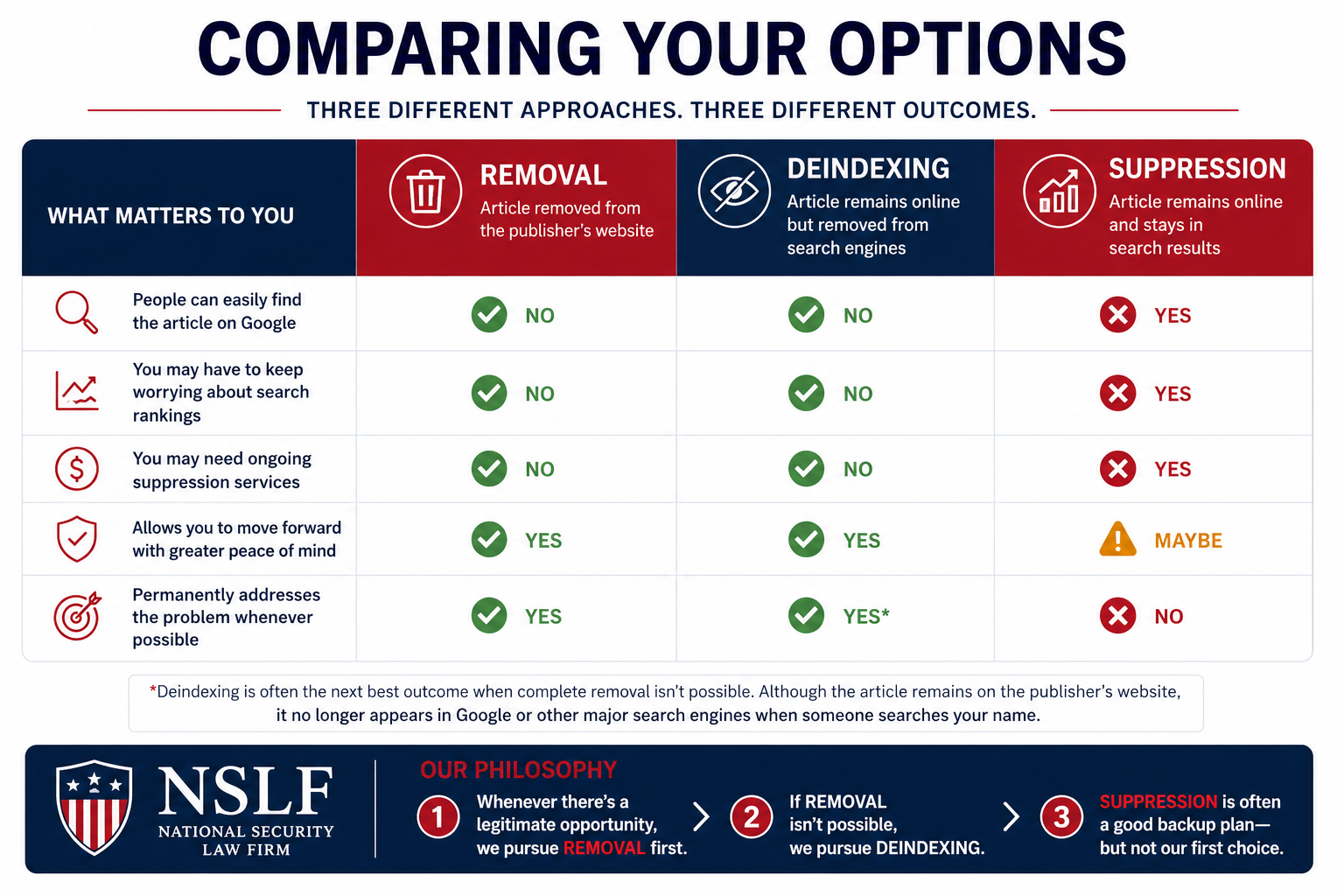
Option 1: Removal
Removal is exactly what it sounds like.
The publisher permanently removes the article or webpage from its website.
Once removed, the page generally no longer exists. If someone clicks on the original link, they’ll typically receive an error message or be redirected because the page has been deleted.
Search engines like Google will eventually recognize that the page no longer exists and remove it from their search results as well.
From our perspective, this is always the best possible outcome.
The content is gone.
There is nothing left to search.
Nothing left to suppress.
Nothing left to continue affecting your future.
Option 2: Deindexing
Deindexing is probably the least understood concept in content removal.
Many people hear the word and immediately assume it means the case wasn’t successful.
In many situations, that’s simply not true.
Unlike removal, the article remains on the publisher’s website.
What changes is its visibility.
Instead of removing the article itself, the publisher prevents search engines like Google, Bing, and Yahoo from displaying it in search results.
For most people, that’s an extremely significant distinction.
The overwhelming majority of people find online content by searching Google—not by visiting a newspaper’s website and manually searching years of archived articles.
As a result, if an article no longer appears when someone searches your name, the practical effect is often very similar to removal.
Generally speaking, there are only two realistic ways someone could still locate a properly deindexed article:
- They already know the exact web address (URL); or
- They go directly to the publisher’s website and search its archives.
For most people, neither of those situations ever occurs.
That’s why deindexing is often far more valuable than people initially realize.
It’s also worth knowing that many publishers don’t routinely handle deindexing requests or understand the technical process involved. In appropriate cases, our Content Removal Lawyers explain the process, identify the appropriate technical solution, and work directly with the publisher to implement it correctly.
Option 3: Suppression
Suppression takes a completely different approach.
Instead of removing the article—or removing it from search results—the goal is simply to make it less visible.
Reputation management companies typically accomplish this by creating or promoting positive online content, such as:
- Websites
- Blog posts
- Press releases
- Social media profiles
- Business profiles
- Other search-engine-optimized content
The objective is to push the negative article farther down in Google search results.
The theory is straightforward.
Most people never look beyond the first page of Google.
If the article moves from page one to page five, fewer people are likely to find it.
The important thing to understand, however, is this:
Nothing has actually been removed.
The article still exists.
Anyone who searches long enough—or whose search results change in the future—may still find it.
Because search rankings constantly change, suppression often requires ongoing monitoring, additional content creation, and continued expense to maintain those rankings.
Suppression manages the problem.
It does not permanently solve it.
Which Option Should You Choose?
Whenever there’s a legitimate opportunity, we believe clients should pursue removal or deindexing before considering suppression.
The reason is simple.
If you’re successful, you’ve permanently solved the problem.
If removal or deindexing ultimately isn’t possible, suppression remains available afterward.
The reverse isn’t true.
If you immediately invest thousands of dollars suppressing an article, you’ll never know whether it could have been permanently removed.
We believe your first opportunity to permanently solve the problem is often your best opportunity.
You only get one opportunity to make a first impression with a publisher. We believe that opportunity should be approached thoughtfully and strategically—not wasted pursuing a temporary solution before determining whether a permanent one may be available.
Why We Built Our Practice This Way
One of the biggest reasons people hesitate to pursue removal first is cost.
They don’t want to spend thousands of dollars pursuing what they believe is the strongest possible outcome only to wonder later whether it was worth the risk.
We understand that concern.
In fact, it helped shape the way we built our Content Removal Practice.
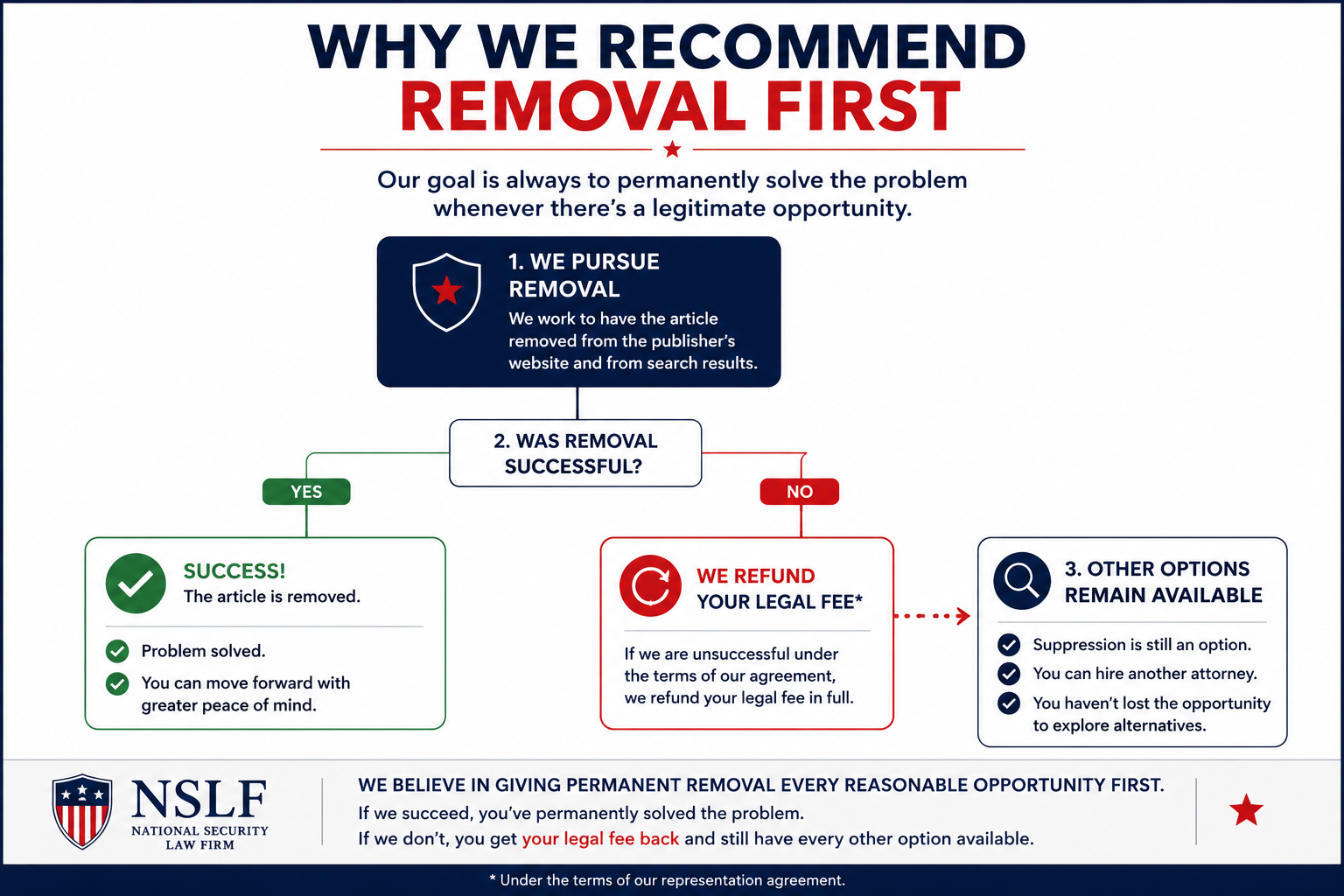
Rather than asking clients to permanently risk thousands of dollars pursuing what we believe is the strongest opportunity, we chose a different model.
If we’re unsuccessful under the terms of our representation agreement, we refund our legal fee in full.
We built our practice this way because we believe clients should have the opportunity to pursue permanent removal first without permanently risking the money they invested in trying.
If we’re successful, you’ve permanently solved the problem.
If we’re unsuccessful, you still have every other option available.
You can pursue suppression.
You can hire another attorney.
Or you can simply decide you’ve explored every reasonable opportunity.
You haven’t lost those options.
You’ve simply given permanent removal every reasonable opportunity first.
That’s the philosophy behind our practice.
And it’s the philosophy behind this guide.
Can My Content or News Articles Actually Be Removed?
This is probably the first question almost everyone asks.
The honest answer is:
It depends.
There isn’t one rule that determines whether online content can—or cannot—be removed.
Many people assume the answer depends entirely on the website.
For example:
- “It’s a newspaper.”
- “It’s Reddit.”
- “It’s a government website.”
- “It’s a mugshot site.”
In reality, that’s only one piece of the puzzle.
The better question isn’t:
“Can this website remove content?”
It’s:
“Does my particular case present a legitimate opportunity for removal or deindexing?”
Those are two very different questions.
When our Content Removal Lawyers evaluate a potential matter, we don’t simply look at the publisher.
We evaluate the entire picture.
No single fact determines whether removal is possible.
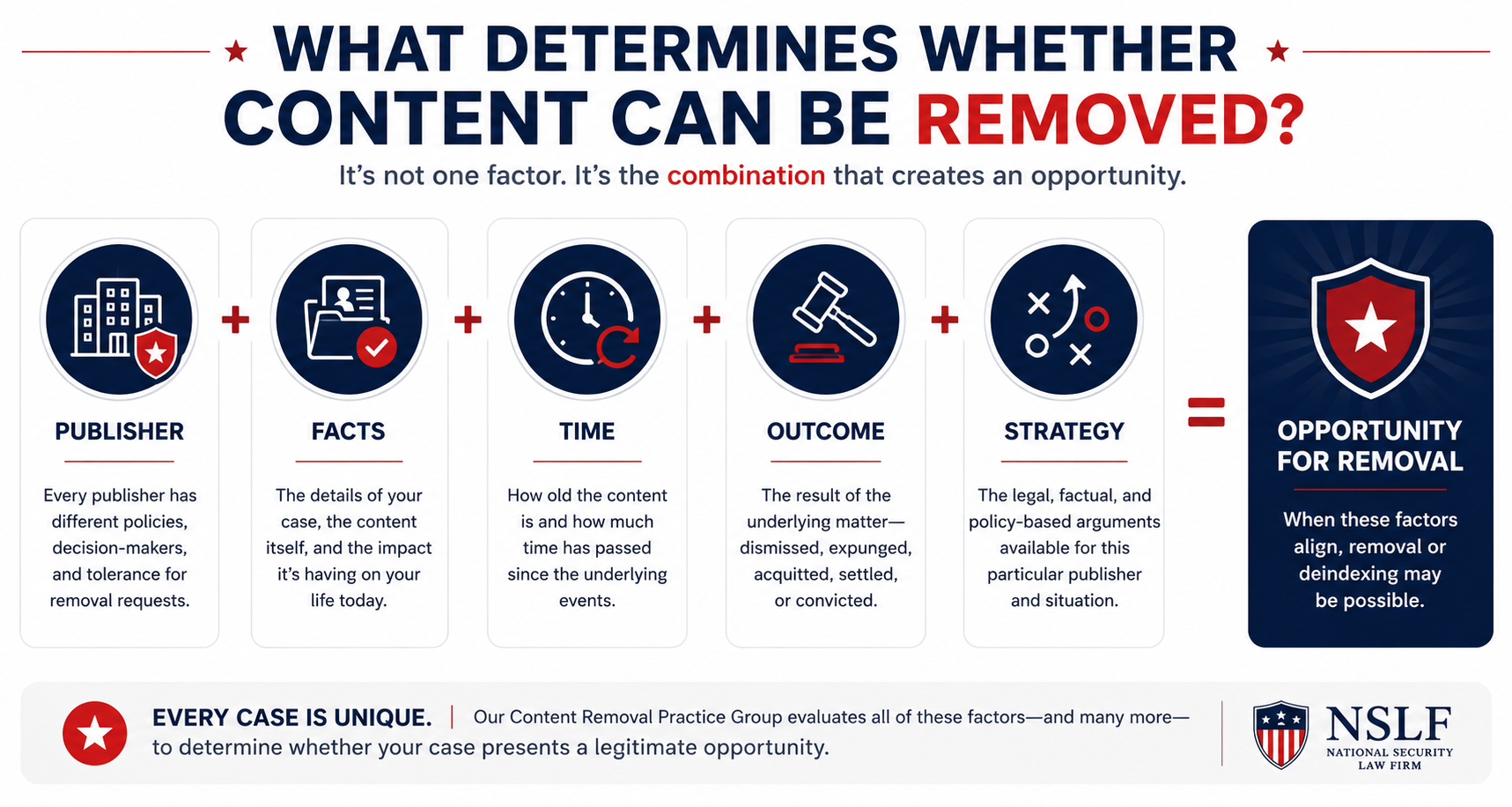
Instead, we look at how multiple factors work together to determine whether we believe there’s a legitimate strategy worth pursuing.
Below are some of the most important factors we evaluate.
1. The Publisher
This is often the single most important factor.
Every publisher has different policies.
Different decision-makers.
Different editorial philosophies.
Some regularly review removal requests.
Some almost never remove content.
Others may be willing to anonymize or deindex an article even if they won’t remove it entirely.
That’s why we never make blanket statements like:
“Newspapers never remove articles.”
or
“That publisher never removes content.”
The publisher matters.
But it’s only one part of the analysis.
2. The Type of Content
Different types of content present different opportunities and different challenges.
For example:
- News articles
- Mugshot websites
- Blogs
- Reddit posts
- Court record websites
- Government press releases
- Google Reviews
- Social media posts
Each requires a different strategy.
The approach we take with a traditional newspaper is often very different from the approach we take with a blogger, government agency, or online platform.
Understanding the type of content helps us determine where to begin.
It does not determine the outcome by itself.
3. The Underlying Facts
One of the first things we want to understand is what ultimately happened.
For example:
- Were the charges dismissed?
- Was the client found not guilty?
- Was the record expunged?
- Was there a conviction?
- Is the matter still pending?
These facts often shape the strongest arguments available.
An article describing an arrest that was later dismissed presents a very different opportunity than an article accurately reporting a recent conviction.
The more complete the factual picture, the better we can evaluate the available strategy.
4. The Passage of Time
Time changes cases.
Generally speaking, an article published ten years ago presents a very different opportunity than one published last week.
As time passes:
- the public interest often decreases;
- the client continues experiencing harm; and
- new facts often develop.
Clients rebuild their lives.
They complete treatment.
Advance their careers.
Serve in the military.
Raise families.
All of those developments may strengthen the arguments available.
5. Is the Article Still Newsworthy?
One question we frequently ask is:
Does this article still serve a meaningful public interest today?
That analysis often changes over time.
In many matters, our request isn’t based on the argument that the article should never have been published.
Instead, it’s based on the argument that circumstances have changed.
6. The Continuing Harm
Perhaps the most important question we ask every client is:
“How is this article affecting your life today?”
Examples include:
- employment;
- professional licensing;
- security clearances;
- business opportunities;
- relationships;
- family concerns;
- mental health; and
- reputation.
The article itself is only part of the story.
The ongoing impact often becomes just as important.
7. Everything That’s Happened Since Publication.
People change.
Lives change.
Circumstances change.
We evaluate everything that’s happened since the article was originally published.
Sometimes those later developments become some of the strongest arguments available.
8. Whether the Article Still Reflects the Complete Story.
Many articles accurately reported events on the day they were published.
The problem is that the story often continued.
For example:
- charges were dismissed;
- records were expunged;
- appeals were successful;
- lawsuits settled;
- important facts emerged later.
Sometimes an article remains technically accurate while still leaving readers with an incomplete understanding of what actually happened.
Those later developments can become an important part of the strategy we present.
The Bottom Line
No single factor determines whether content can be removed.
Likewise, no reputable Content Removal Lawyer can honestly tell you whether your case is removable based on a single fact, such as the publisher or the type of website.
Instead, successful evaluations come from understanding how all of these factors work together.
That’s why every matter accepted by our Content Removal Practice begins with an individualized evaluation rather than assumptions or blanket rules.
If you’ve read this far, you’ve probably noticed something.
Our approach to content removal is different.

That’s intentional.
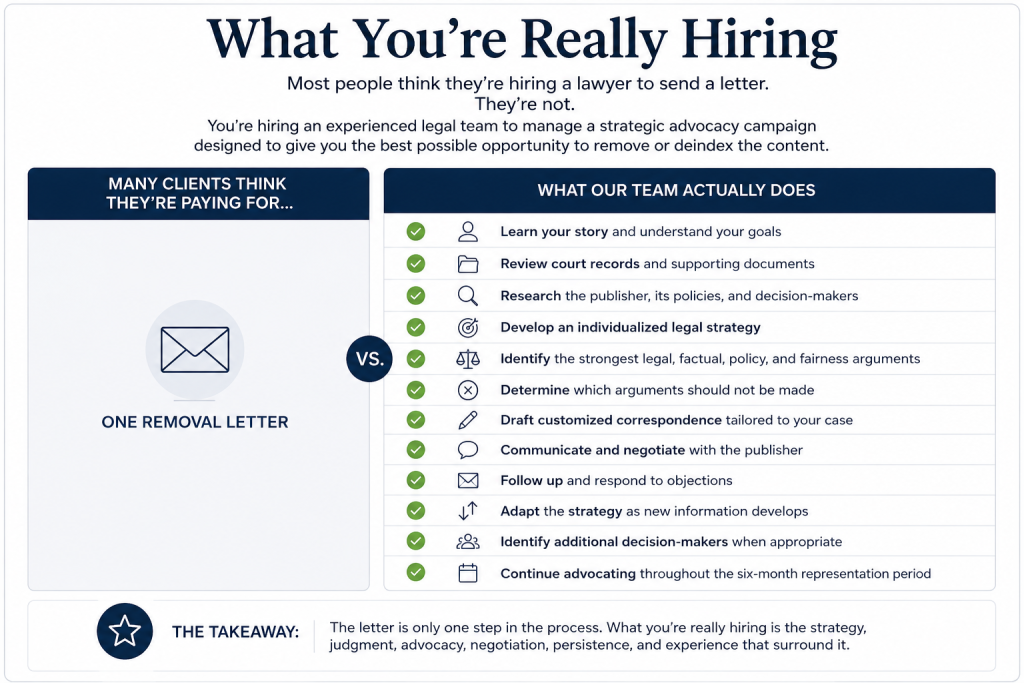
Over the years, we’ve learned that content removal isn’t about sending a letter.
It’s about understanding the facts, developing the right strategy, presenting the strongest arguments, and persuading another person to voluntarily remove or deindex content they usually have no legal obligation to remove.
That philosophy has shaped every aspect of our practice—from the cases we accept, to the way we structure our fees, to the way we advocate for our clients.
Here’s why we’ve built our practice the way we have.
We Believe Permanent Solutions Are Better Than Temporary Ones
Whenever there’s a legitimate opportunity, our first objective is to permanently solve the problem—not simply manage it.
That’s why we focus on removal or deindexing whenever possible.
If we can permanently eliminate the problem instead of simply pushing it farther down in search results, we believe that’s almost always the better outcome.
Our clients usually aren’t looking for someone to help them manage this problem forever.
They’re looking for the opportunity to finally put it behind them.
That’s why our philosophy has always been simple:
Suppression manages the problem. Removal or deindexing attempts to solve it.
Our Interests Are Aligned With Yours
One of the things that makes our practice different is that our interests are directly aligned with those of our clients.
Many law firms bill by the hour.
Others charge nonrefundable flat fees.
In either situation, the firm is paid regardless of the outcome.
We built our practice differently.
If we’re unsuccessful under the terms of our representation agreement, we refund our legal fee in full.
That changes the relationship.
It means we have every incentive to carefully evaluate every case we accept, develop the strongest strategy possible, remain persistent, and continue looking for legitimate opportunities throughout the representation.
When our clients succeed, we succeed.
We believe that’s exactly how the relationship should work.
We Believe Strategy Matters More Than Templates
One of the biggest misconceptions about content removal is that success comes from sending the right letter.
We don’t believe that’s true.
Every publisher is different.
Every editor is different.
Every client is different.
Every case is different.
That means every strategy should be different.
Our Content Removal Lawyers don’t begin by asking:
“Which template should we use?”
We begin by asking:
- Who are we trying to persuade?
- What matters to this particular publisher?
- Which arguments strengthen this request?
- Which arguments weaken it?
- What gives this client the best legitimate opportunity for success?
That’s also one of the reasons content removal is one of our firm’s dedicated practice areas.
Our attorneys aren’t balancing these matters with dozens of unrelated practice areas.
They focus on developing and executing individualized content removal strategies every day.
At the end of the day, content removal isn’t simply a search engine problem.
It’s an advocacy problem.
You’re asking another person—a publisher, editor, or decision-maker—to voluntarily make an exception they generally have no legal obligation to make.
That’s what attorneys are trained to do.
We Don’t Take Every Case
One of the hardest things for any law firm to do is tell someone:
“We’re probably not the right firm for your situation.”
We do it regularly.
Not because we don’t want to help.
Because we believe honesty is more important than accepting another client.
If we don’t believe your matter presents a legitimate opportunity worth pursuing, we’ll tell you.
We’d rather have an honest conversation today than accept a fee for a matter we don’t genuinely believe we can meaningfully help.
Being selective is also one of the reasons our Content Removal Practice Group has successfully removed or deindexed content in approximately 70% of the matters we’ve accepted.
That number isn’t a promise.
It’s the result of carefully evaluating which matters we believe present legitimate opportunities for success.
When we tell someone we believe we can help, that opinion carries more weight because we’re equally willing to tell people when we don’t.
Our Philosophy
There isn’t one solution that’s right for every client.
Sometimes removal is possible.
Sometimes deindexing is the strongest available outcome.
Sometimes suppression makes sense.
And sometimes the most honest advice we can give is that we don’t believe there’s a realistic opportunity worth pursuing.
Our philosophy has never been to promise the impossible.
It’s to honestly evaluate every matter, pursue the strongest legitimate opportunity available, and align our interests with thos
e of our clients throughout the process.
We don’t believe every article can be removed.
We do believe every client deserves an honest, individualized evaluation before anyone reaches that conclusion.
That’s the philosophy behind our Content Removal Practice.
And it’s the philosophy behind this guide.