
Published Flat Fees. Former Government Decision-Makers. A Legal Team Built to Evaluate Your Case the Way the Government Will.
National Security Law Firm’s standard security-clearance fees range from $950 for SF-86 review to $7,500 for hearing representation.
But price alone does not tell you what you are buying.
At NSLF, you are not hiring one lawyer to work through your case in isolation. You are hiring a security-clearance team that includes a former federal clearance judge, former government adjudicators, intelligence and counterintelligence counsel, and experienced hearing lawyers.
One attorney leads your case. When the matter qualifies, that attorney is supported by NSLF’s Attorney Review Board and the government-side perspectives relevant to your case.
NSLF Security-Clearance Fees
- SF-86 Review and Strategy: $950
- Letter of Interrogatory (LOI) Response: $3,500
- Statement of Reasons (SOR) Response: $5,000 (with a $3,000 credit if we handled your LOI)
- Defense Office of Hearings and Appeals Hearing: $7,500
- Security-Clearance Appeals: Individually scoped
- Stand-Alone Government Records Investigation: $1,995
Free · Confidential · No Obligation · Choose a Time Online · Speak Directly With an Attorney
★★★★★4.9 Stars From 300+ Google Reviews
Former Federal Clearance Judge · Former Government Adjudicators · Counterintelligence Experience · Nationwide Representation
★★★★★ “Tremendous Value for the Fee”
“Sean Rogers and his staff put together an excellent package which resulted in a favorable outcome for me. They also communicated promptly with me and my command throughout. Tremendous value for the fee. I can’t recommend this firm highly enough!”
— K.M., Google Review
Security Clearance Lawyer Fees at a Glance
| Your stage | NSLF flat fee | What the representation is designed to accomplish |
|---|---|---|
| SF-86 Review and Strategy | $950 | Identify disclosure problems, improve accuracy and consistency, and prepare for the subject interview |
| Letter of Interrogatory Response | $3,500 | Determine what the government is questioning and prepare a supported response before the concern escalates |
| Statement of Reasons Response | $5,000 | Answer formal allegations with rebuttal, mitigation and whole-person evidence |
| Defense Office of Hearings and Appeals Hearing | $7,500 | Prepare the evidence, witnesses and client testimony and represent the client at the covered hearing |
| Security-Clearance Appeal | Individually scoped | Identify reversible error and pursue the remedy permitted by the applicable agency process |
| Government Records Investigation | $1,995 stand-alone | Seek relevant government records that may support the defense, expose errors or prepare the client for what comes next |
The Government Records Investigation is included at no additional attorney fee for the covered initial requests in qualifying LOI, SOR, hearing and appeal matters. It is not included in the $950 SF-86 service.
The applicable engagement agreement identifies the precise scope, exclusions and client responsibilities.
Schedule a Free Consultation to Confirm Your Stage and Fee
Why Clients Choose National Security Law Firm
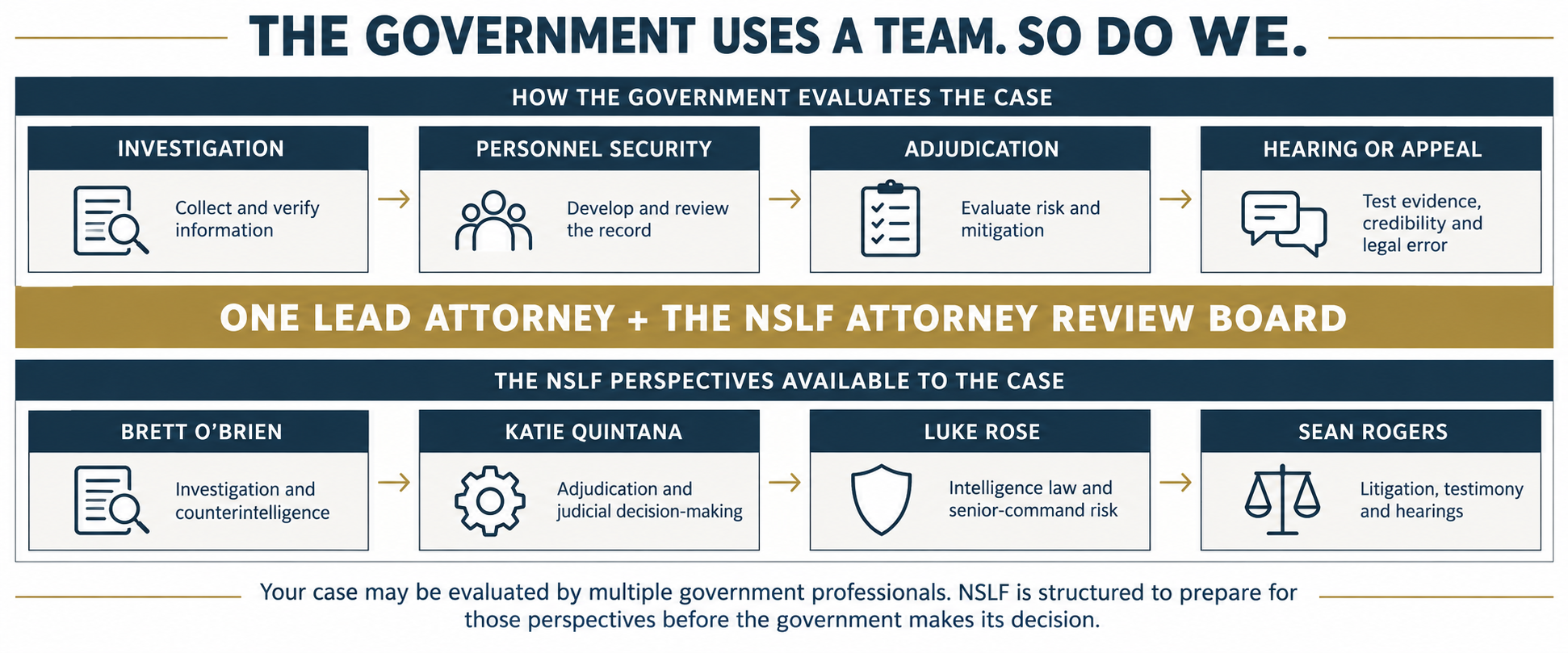
1. The Government Uses a Team to Evaluate Your Case. So Do We.
A security-clearance case is not evaluated through one person’s perspective.
Depending on the stage, the government may use:
- Investigators to collect and verify information;
- Personnel-security officials to develop the record;
- Adjudicators to evaluate risk and mitigation;
- Agency and intelligence counsel to advise government organizations;
- Government litigators to challenge the applicant’s evidence;
- Administrative judges to evaluate testimony and credibility; and
- Appellate officials to review the resulting decision.
Most law firms are not structured that way. One lawyer reviews the case, develops the strategy and decides when the work is ready to submit.
NSLF is different.
One attorney leads your representation, but that attorney does not have to rely exclusively on one professional perspective. In qualifying matters, the lead attorney can draw on NSLF’s security-clearance team and Attorney Review Board before important work is submitted.
One Lead Attorney. Multiple Perspectives. One Coordinated Strategy.
This structure helps us ask the questions that different government officials may eventually ask:
- What will an investigator try to verify?
- What facts will concern an adjudicator?
- What evidence establishes mitigation?
- Where will government counsel challenge the explanation?
- How will a judge evaluate the client’s credibility?
- Will the record still make sense if another official reviews it years later?
Why this matters: A response can sound persuasive from one perspective while creating a problem from another. Multiple viewpoints can expose an inconsistency, evidentiary gap or credibility problem before it becomes part of the government’s record.
2. Our Attorneys Have Held the Government Roles That Matter in Clearance Cases
“Security-clearance experience” can mean many things. At NSLF, it includes lawyers who have worked inside the government systems that investigate, adjudicate and litigate these cases.
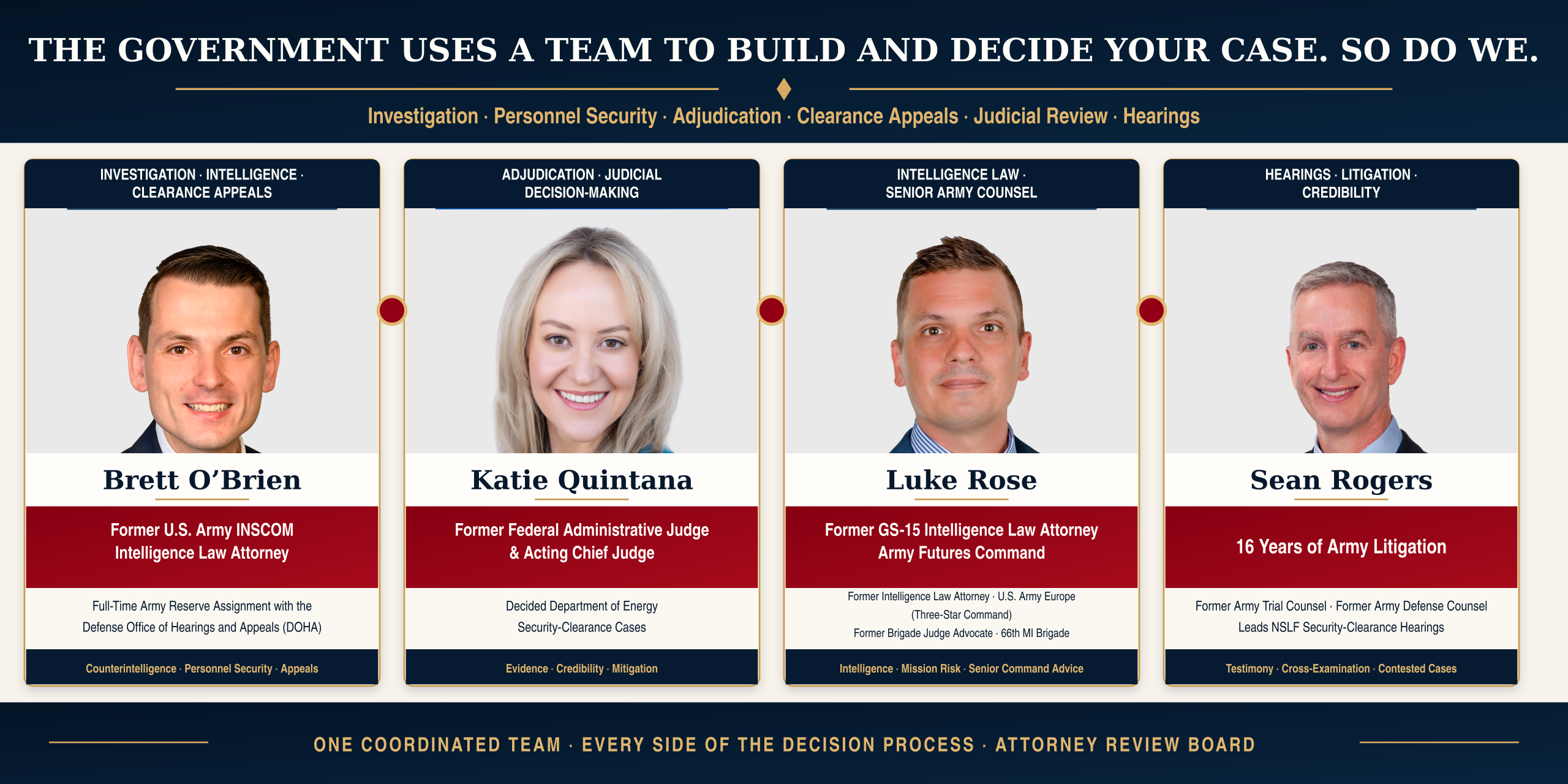
Katie Quintana: Former Federal Clearance Judge
Katie Quintana served as a federal Administrative Judge and Acting Chief Judge deciding Department of Energy security-clearance cases.
She evaluated:
- Government allegations;
- Documentary evidence;
- Applicant explanations;
- Witness testimony;
- Credibility;
- Rehabilitation and mitigation; and
- Whether the complete record supported clearance eligibility.
Why this matters: Katie has personally sat in the decision-maker’s position. She understands that a sincere explanation is not always enough. The evidence must give the decision-maker a defensible reason to resolve each material concern favorably.
Brett O’Brien: Investigation, Counterintelligence and Defense Department Experience
Brett O’Brien served as an Intelligence Law Attorney for U.S. Army Intelligence and Security Command and as the primary legal adviser for active Army counterintelligence investigations.
He also completed a full-time Army Reserve assignment inside the Defense Office of Hearings and Appeals (DOHA), the Department of Defense office that conducts significant industrial-security clearance hearings and appellate review.
Why this matters: Brett understands how investigators develop concerns, how separate facts may be connected and how information gathered during an investigation can later become an adjudicative or credibility issue.
Luke Rose: Intelligence Law and Senior-Command Risk
Luke Rose served as a GS-15 Intelligence Law Attorney for Army Futures Command. He also served as an Intelligence Law Attorney for U.S. Army Europe and as Brigade Judge Advocate for the 66th Military Intelligence Brigade.
Why this matters: Luke understands how intelligence organizations and senior commands may view foreign contacts, personal conduct, security incidents and other facts through the lens of mission risk, vulnerability and access to sensitive information.
Sean Rogers: Litigation, Testimony and Credibility
Sean Rogers brings 16 years of Army litigation experience as both trial counsel and defense counsel. He leads NSLF’s security-clearance hearing work.
Why this matters: Sean evaluates whether a written explanation, witness or client account will withstand government questioning. That perspective can identify credibility problems before they become the government’s strongest argument.
These backgrounds do not create special access, influence or a guaranteed outcome. They give NSLF the ability to evaluate a case through the same professional perspectives the client may encounter inside the government.
3. Your Case Is Led by One Attorney—But Important Decisions Do Not Have to Be Made Alone
Clients need one attorney who knows the file, communicates clearly and remains responsible for the strategy.
They should not have to coordinate several lawyers or receive conflicting advice.
That is why NSLF uses a lead-attorney model supported by collaborative review.
When the matter qualifies for Attorney Review Board review:
- The lead attorney develops the facts, evidence and proposed strategy.
- Other attorneys examine the significant issues through their relevant government, adjudicative or litigation backgrounds.
- The team identifies weaknesses, inconsistencies and unanswered questions.
- The lead attorney coordinates the final strategy and communicates with the client.
You receive one coordinated strategy with more than one professional perspective behind it.
Because NSLF uses defined flat fees for its standard services, covered internal collaboration does not generate a separate hourly bill every time another attorney contributes to the review.
★★★★★ “Their Teamwork and Complementary Skills Gave Me Complete Confidence”
“They assigned three different paralegals to ensure coverage, and I worked directly with two attorneys and indirectly with a third. Their teamwork and complementary skills gave me complete confidence.”
— C.L., Google Review
4. We Look Beyond the Notice the Government Gives You
A government notice may identify the allegations without showing every record behind them.
NSLF asks an additional question:
What does the government have that we have not yet seen?
In qualifying LOI, SOR, hearing and appeal matters, NSLF includes an attorney-led Government Records Investigation at no additional attorney fee for the covered initial requests.
The same service costs $1,995 when purchased separately.
We identify relevant government record holders and prepare targeted Freedom of Information Act and Privacy Act requests. The records may:
- Confirm that the client previously disclosed an issue;
- Document cooperation, favorable performance or other mitigation;
- Reveal an inaccurate date, incomplete summary or unsupported assumption;
- Show that different government records describe the same event differently;
- Prepare the client for questions at a hearing or later stage; or
- Reveal a separate path to seek disclosure, correction or other appropriate relief.
Learn About NSLF’s Government Records Investigation
A separate $1,995 service— included at no additional attorney fee in qualifying LOI, SOR, hearing and appeal matters.
5. We Consider More Than the Clearance Proceeding
The same facts can affect several government systems at once.
A clearance allegation may also create consequences involving:
- Federal employment;
- Suitability or fitness;
- Military discipline;
- Criminal exposure;
- Immigration;
- Professional or transportation credentials;
- Government records; or
- Future clearance adjudications.
A statement that appears helpful in one proceeding may create an admission or inconsistency in another.
NSLF’s broader federal and military practice allows the clearance team to recognize when another issue may need to be coordinated or separately addressed.
Why this matters: A law firm that sees only the clearance case may miss what the same statement, record or allegation could do somewhere else.
Separate representation may be required for another proceeding, but the risk is less likely to go unnoticed.
What You Receive at Each Stage
SF-86 Review and Strategy — $950
The SF-86 can influence the entire clearance process. The government may compare it with prior questionnaires, records, interviews, later written responses and future disclosures.
The $950 flat-fee service includes:
- Attorney review of every disclosure;
- Unlimited attorney Q&A during the covered engagement;
- Guidance for necessary written explanations;
- Review for omissions and inconsistencies;
- Multiple reviews; and
- Subject-interview preparation.
Learn More About the $950 SF-86 Review
★★★★★ “The Best Money I’ve Ever Spent”
“Because my encounter with these people has ensured that I’m able to keep my job and continue to provide for my family, I can easily say that this is the best money I’ve ever spent.”
— A.C., Google Review
Letter of Interrogatory Response — $3,500
An LOI usually means the government needs additional information before deciding whether a concern can be resolved or should advance.
The $3,500 flat-fee service includes:
- Review of the notice, instructions and deadline;
- Analysis of what the government appears to be testing;
- Reconstruction of the relevant facts and prior record;
- Identification of inconsistencies and evidentiary gaps;
- Development of rebuttal and mitigation evidence;
- Attorney drafting of the response and exhibits;
- Covered Government Records Investigation requests; and
- Attorney Review Board review when included.
Learn More About the $3,500 LOI Service
A $3,000 Credit if the Matter Becomes an SOR
If NSLF handles a qualifying LOI matter and the government later issues a related Statement of Reasons, a $3,000 credit may apply toward NSLF’s $5,000 SOR response fee.
The applicable engagement agreements control eligibility and scope.
Statement of Reasons Response — $5,000
An SOR formally identifies allegations that may support the denial or revocation of clearance eligibility.
The $5,000 flat-fee service includes:
- Review of the allegations, instructions and deadline;
- Analysis of the applicable adjudicative guidelines;
- Comparison with prior disclosures and investigative records;
- Allegation-by-allegation drafting;
- Rebuttal, mitigation and whole-person evidence development;
- Supporting exhibits;
- Covered Government Records Investigation requests; and
- Attorney Review Board review when included.
The SOR fee does not automatically include a later personal appearance, hearing or appeal.
Learn More About the $5,000 SOR Service
Defense Office of Hearings and Appeals Hearing — $7,500
At a covered industrial-security hearing, the applicant may face government counsel, questioning, evidentiary issues and an Administrative Judge evaluating credibility and mitigation.
The $7,500 flat-fee service includes:
- Review of the existing record and government exhibits;
- Hearing strategy;
- Evidence and exhibit preparation;
- Witness identification and preparation;
- Client testimony preparation;
- Preparation for cross-examination and judicial questions;
- Covered Government Records Investigation requests; and
- Representation at the covered hearing.
The hearing fee does not automatically include an earlier SOR response or a later appeal.
Learn More About the $7,500 Hearing Service
Security-Clearance Appeals — Individually Scoped
Clearance appeal procedures differ significantly by agency and stage.
An appeal may involve:
- A written administrative appeal;
- A personal appearance;
- A Personnel Security Appeals Board;
- An agency-specific review process; or
- Review by the Defense Office of Hearings and Appeals (DOHA) Appeal Board, which reviews industrial-security hearing decisions for error based on the existing record.
NSLF reviews the decision, record, deadline and permitted remedy before defining the scope and fee.
Learn More About Security-Clearance Appeals
How to Compare Security-Clearance Lawyer Fees
Two lawyers may quote different prices because they are offering very different services.
Before comparing fees, ask:
- Will an attorney develop and draft the submission, or only edit what I prepare?
- Will the lawyer help identify and obtain supporting evidence?
- Will anyone compare the submission with my SF-86, interview and prior statements?
- Will another attorney review the important strategy or final work?
- Does the representation include targeted government-records requests?
- Does the quoted fee cover only the current written response, or also a hearing or appeal?
- Which expert, travel, records or other expenses are separate?
- Who will communicate with me after I retain the firm?
The lowest fee may be appropriate for a limited task. A higher fee may include substantially more analysis, evidence development, attorney involvement and review.
Compare the price, people, process and scope together.
Why NSLF Uses Flat Fees
With hourly billing, the final legal fee depends on how much time is recorded.
With NSLF’s defined flat-fee services:
- You know the covered attorney fee before representation begins;
- Covered calls and drafting do not create a growing hourly bill;
- Covered internal collaboration does not generate a separate charge each time another attorney contributes; and
- You can focus on the work instead of watching the clock.
A flat fee does not cover every future proceeding or unrelated issue. The engagement agreement explains exactly what is included.
Representative Security-Clearance Results
NSA Reversed a TS/SCI Revocation
NSLF represented an intelligence professional in an agency appeal and personal appearance involving Guideline E and Guideline M allegations. The NSA Access Appeals Panel reversed the revocation.
Read the NSA TS/SCI Case Result
Clearance Granted Despite Extensive Drug-History Allegations
A case involved allegations concerning marijuana sales and cultivation, LSD, mushrooms and prescription-drug misuse. Clearance eligibility was granted after the evidence and mitigation were evaluated.
Read the Guideline H Case Result
Clearance Granted After More Than $90,000 in Debt and Delinquent Taxes
NSLF represented a client facing Guideline F financial allegations involving substantial debt and tax problems. Clearance eligibility was granted.
Read the Guideline F Case Result
Every case depends on its own facts, evidence, procedure and decision-maker. Prior results do not guarantee a similar outcome.
★★★★★ “Absolutely Worth the Investment”
“My clearance was reinstated within one month of submission, which, according to my leadership and administrative team, was one of the fastest reinstatements they had seen. Their expertise, professionalism, and attention to detail made a significant difference in my case, and they were absolutely worth the investment.”
— J.B., Google Review
Is Hiring a Security Clearance Lawyer Worth the Cost?
Not every applicant needs a lawyer.
A person with a straightforward history who understands the SF-86 may be able to complete the process without legal assistance.
Representation becomes more valuable when:
- You received an LOI or SOR;
- Your clearance has been denied, suspended or revoked;
- Your answers may conflict with earlier disclosures or records;
- Credibility or candor is in dispute;
- The allegations involve multiple adjudicative guidelines;
- You need to develop rebuttal or mitigation evidence;
- A hearing or appeal is available;
- The matter overlaps with employment, military or criminal exposure; or
- Your ability to continue in your profession depends on clearance eligibility.
The value of an attorney is not a guaranteed outcome. It is a more informed strategy, a stronger evidentiary record and fewer preventable mistakes in a process that may affect your career.
Payment and Financing Options
Eligible clients may apply for legal-fee financing through Pay Later by Affirm, available through LawPay.
Affirm and its lending partners—not NSLF—determine approval, interest rates, repayment terms and any required down payment.
Financing does not extend a government deadline or establish an attorney-client relationship.
Frequently Asked Questions About Security Clearance Lawyer Cost
How much does a security clearance lawyer cost?
NSLF’s published flat fees are:
- SF-86 Review and Strategy: $950
- Letter of Interrogatory response: $3,500
- Statement of Reasons response: $5,000
- Defense Office of Hearings and Appeals hearing representation: $7,500
- Government Records Investigation as a stand-alone service: $1,995
- Appeals: Individually scoped
Is the initial consultation free?
Yes. The consultation is free, confidential and does not obligate you to retain the firm. You speak directly with an attorney.
Are these flat fees?
Yes. They are NSLF’s published flat fees for the defined services. The applicable engagement agreement explains the precise scope.
What does the $950 SF-86 service include?
It includes attorney review of every disclosure, unlimited attorney Q&A during the covered engagement, guidance for written explanations, consistency analysis, multiple reviews and subject-interview preparation.
Does the $5,000 SOR fee include a hearing?
Not automatically. An SOR response and a hearing are separate stages unless the engagement agreement expressly provides otherwise.
Does the $7,500 hearing fee include the SOR response or appeal?
Not automatically. SOR preparation, hearing representation and appellate representation are separate services unless expressly combined in the engagement agreement.
Why are security-clearance appeals individually priced?
Different agencies use different appellate procedures. NSLF must review the decision, record, deadline, available evidence and permitted remedy before defining the service.
What expenses may be separate?
Depending on the matter, separate expenses may include experts, evaluations, testing, government charges, records fees, transcripts, witnesses, travel and representation in another proceeding.
Does NSLF represent clients nationwide?
Yes. NSLF evaluates security-clearance matters throughout the United States and, where permitted, for clients located overseas.
Can a security-clearance lawyer guarantee success?
No. The government retains authority over clearance eligibility. No ethical lawyer should guarantee a security-clearance result.
Can I finance the fee?
Eligible clients may apply for Pay Later financing through Affirm. Affirm or its lending partners determine eligibility and terms.
Find the Right Security Clearance Service for Your Stage
Attorney fees depend primarily on where you are in the clearance process and what must be prepared. Start with the service that matches your situation:
- Security Clearance Lawyers — Full Representation Overview
- SF-86 Review and Strategy
- Security Clearance Investigation Representation
- Letter of Interrogatory (LOI) Response
- Statement of Reasons (SOR) Response
- Security Clearance Hearing Representation
- Security Clearance Appeals
Not sure where your matter fits? Visit the Security Clearance Resource Center for plain-language guidance on each stage of the process.
Not Sure Which Service You Need?
Visit the Security Clearance Resource Center to learn more about:
- SF-86 preparation;
- Background investigations;
- Subject interviews;
- Adjudicative guidelines;
- Letters of Interrogatory;
- Statements of Reasons;
- Government records;
- Hearings; and
- Appeals.
Visit the Security Clearance Resource Center
One Lead Attorney. A Team Built for the Federal Clearance System.
NSLF combines:
- A former federal clearance judge;
- Former government security-clearance adjudicators;
- Intelligence and counterintelligence experience;
- Defense Department hearing and appellate experience;
- An Attorney Review Board for qualifying matters;
- Attorney-led Government Records Investigation in qualifying matters;
- Transparent flat fees; and
- Nationwide representation.
If your security clearance, position or career is at risk, schedule a free consultation and speak directly with an NSLF attorney.
Free · Confidential · No Obligation · Choose a Time Online
Attorney Drafter: Katherine O’Brien
Last Reviewed: September 8, 2026
This website is an attorney advertisement. The information on this page is general information and is not legal advice. Contacting NSLF does not create an attorney-client relationship. Do not transmit classified information. Representation begins only after the firm accepts the matter and the engagement requirements are completed. Results depend on the facts and circumstances of each matter.